
A retailer in São Paulo told us at the exhibition that she had ordered her first assessment system after watching a stranger’s video of a thin mat lighting up under someone’s feet — and that her first month with the real machine taught her the video had prepared her for none of the work. She had searched something like foot pressure pad, she said, and the phrase had conjured an object you unroll and forget. What arrived was a plate, a pair of cameras, a software licence and a set of decisions about where it all goes in the store. This article is the advice we now give before that delivery: what the search phrase promises versus what the equipment is, where a demo corner belongs in a shop’s floor plan, how a walk-up session is paced so it ends in a fitting conversation rather than a shrug, what the customer carries out of the corner, and how the demo keeps working after the novelty fades. Nothing here is about selling harder. It is about arranging the corner so the curiosity a shopper already has gets somewhere to land.
The phrase foot pressure pad is worth unpacking before the floor plan, because it shapes what a retailer expects and what shoppers expect of the retailer. Search terms in this category describe a wish more than an object, and the gap between the two is where demo corners quietly fail.
What the search phrase pictures, and what actually stands in the corner
Buyers who type foot pressure pad usually picture something flexible: a mat, a sheet, an object that rolls up and lives in a drawer between uses. The picture comes from the word itself and from consumer gadgets that measure weight or step counts. What a proper pressure assessment needs is different in kind. The F2 is a plantar pressure detection system: a rigid pressure-sensing plate you stand on and walk across, paired with a lower-limb camera and a posture camera, analysis software and AI-assisted report generation. It measures where load sits, how it moves through a step, and how the body is aligned above it.
None of that is a mat, and the distinction matters commercially. A mat suggests a passing curiosity — step, look, move on. A plate with a screen and a report suggests a service, and a service is what turns a shoe purchase into a fitting relationship. Retailers who buy the system expecting mat behaviour — set it out, ignore it, let it amuse — get mat results. Retailers who build a corner around it get the assessments that justify it.
We would rather say this plainly before an order than manage the disappointment after. If a store wants an unrollable novelty, this category is the wrong purchase and we will say so in the first email. What the F2 does, it does seriously: static, dynamic and balance records on one sensing plate, in a footprint a shop floor can host. The handbag it packs into makes storage simple, but nothing about the sensing area is soft, and that is not a compromise — rigidity is where repeatable measurement comes from.
Where the corner goes in the store
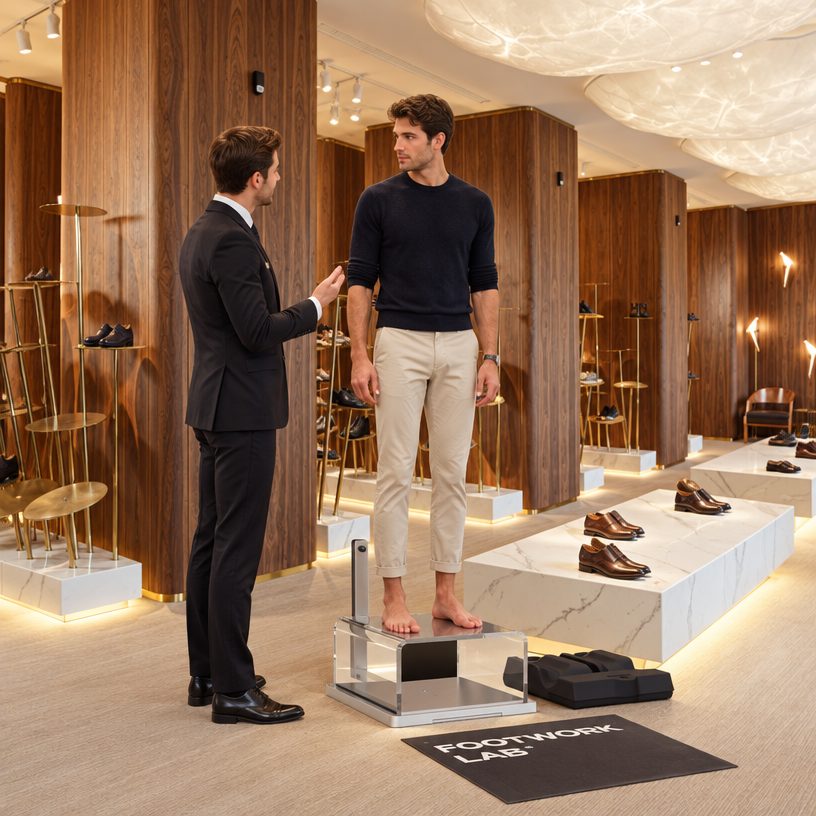
The demo corner succeeds or fails on sightlines before a single session is run. The plate should be visible from the entrance path but not in the main thoroughfare — shoppers will not walk across a live sensing area to reach the till, and traffic across the plate ruins passes. The walking line needs clear floor in front of and behind the plate, more than the machine itself occupies, because a natural pace is the whole difference between a real walking record and a careful shuffle. A retailer at the Canton Fair showed us photos of her first layout: the plate wedged beside a stockroom door, approach blocked by a display table. Every record was of somebody braking. She moved the corner four metres — to words, the distance a person needs to settle into a stride — and the records changed character overnight.
Proximity to the fitting bench matters more than proximity to the entrance. The session should end one step from where shoes are tried, so the report can be put down on the bench and the conversation can continue with stock in hand. A corner placed near the checkout produces interest that evaporates before it becomes anything; a corner placed beside the benching produces the handover naturally.
The screen is the window display of the corner. Passers-by cannot see a pressure number, but everyone can see a moving pressure map. Positioning the display so the map faces outward converts idle browsers into watchers, and watchers into walkers. Some of our retail customers run a loop of a staff member’s own recorded walk on the screen during quiet hours — a self-demonstration that requires nobody on the floor to start anything.
Floor marking is the small detail with the biggest yield. A taped line showing where to start, where to look and where to walk out removes the hesitation that makes first-time sessions awkward, and it keeps the approach identical between customers — which matters later if the store wants to compare a customer’s visits. The plate rewards the same discipline a clinic uses; the corner just delivers it with friendlier lighting.
How a walk-up session is paced
A retail session lives or dies by its length, and the workable version is short: a static standing pass, a walking pass or two, a moment at the screen together, and the report in the customer’s hand. Everything else — alignment views, a balance record, a second walk — is added only when the customer leans in for more. The demonstration exists to open a fitting conversation, not to complete an examination, and the pacing should show it.
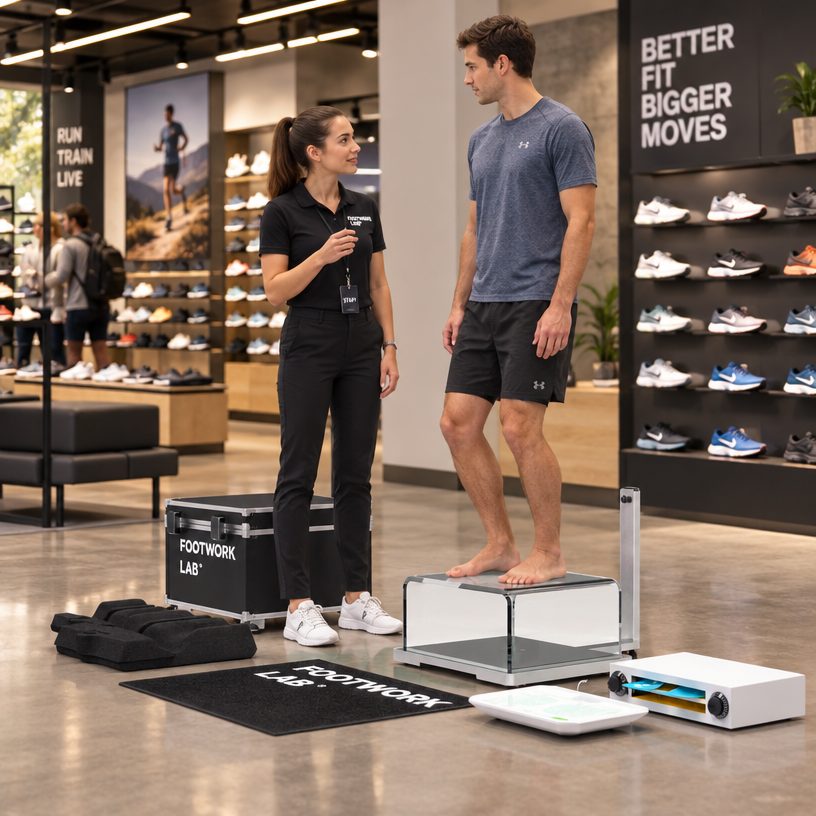
The invitation sentence does more work than any feature list. Staff we have seen succeed open with the screen, not the machine: “your walk draws this map in a few seconds — want to see yours?” It is an offer of a picture, not a test, and that framing matters. People decline tests; almost nobody declines a picture of their own walk. Once the customer is on the plate, the on-screen prompts carry the procedure — stand naturally, look at the camera, walk through without stopping — and the operator’s real job is making the room feel unhurried while the machine does the measuring.
The reading at the screen is where the retail value concentrates. The F2 report shows the foot axis angle, contact and flat phase proportions, footprint length and width, peak and mean pressure, contact area and the speed of the centre of pressure — but the operator’s script should pick two or three of those, not recite the list. “Your weight arrives here, and it stays here a long time on your right side” is a sentence a customer can respond to; seven parameters read aloud is a lecture. The map, the asymmetry and one connection to the shoes the customer came in for are enough.
One boundary belongs in the script and should stay there. Counter staff describe what the record shows; they do not interpret it as a health finding, and the report itself carries the line that the data is for reference. A customer who asks whether their feet are healthy, or whether something is wrong, gets the referral answer: that is a question for a professional, and the record can go with them. That refusal costs nothing at the counter and buys the store credibility nothing else can.
What the customer carries out of the corner
The report leaves the corner three ways: the customer scans a code, leaves an email address, or takes a printed sheet. For retail, the printed page underperforms its cost of a sheet of paper by a wide margin, because it survives the walk to the bench, the trying-on, the trip home and the second visit — and it carries the store’s conversation with it. Reports collected by email tend to be read once, on a small screen, away from the shoes.
What the report should do in a retail setting is feed the fitting, and that means the operator has to connect it forward. A record that shows load concentrating under the first metatarsal heads becomes, in the fitting conversation, a reason to look at shoes with a particular toe box shape and a build that spreads that load; a record that shows a long contact phase becomes a conversation about cushioning that does not bottom out. If the store stocks the FX insole range, this is where the session turns into a build choice — assessed with the BODYFIT AI assessment and senthmetic flexible-fabric sensing, and shaped on site where the customisation module is part of the room.
The record also earns its keep on the second visit. A customer who returns six months later can be walked across the same plate under the same routine, and the comparison is the most persuasive document the store owns — more honest than any claim about how feet change, because it is the customer’s own two maps side by side. Stores that archive records against customer files get this for free; stores that let reports walk out unrecorded start every relationship from zero.
Staffing the corner so it still works in month six
The demo corner’s failure mode is not technical; it is staffing drift. The system works identically in month six, but by then the operator who loved it has moved departments, the replacement was shown the machine in four minutes on a busy Saturday, and the corner slowly becomes furniture. The prevention is procedural: one named operator per shift, a one-page routine sheet — stance wording, walking line, two or three report sentences, the referral line — and a refresher whenever the sheet has not been followed for a week. In a support call earlier this year our engineers found a store whose reports had drifted not because the machine had changed but because three staff members had three different invitation lines and three different walking instructions. The sheet fixed in an afternoon what had eroded over a season.
Training investment is smaller than retailers expect. The on-screen prompts carry the procedure itself, so the trainable part is the conversation: the invitation, the two-sentence reading, the bridge to the bench, the boundary about health questions. Stores that role-play those four lines during setup get consistent sessions from the first week; stores that assume the machine will carry the conversation get sessions that vary with whoever is standing nearest.
We do not promise the corner generates sales by itself, and we would rather set that expectation honestly. What the corner reliably produces is conversations that start from the customer’s own body instead of from a shelf — and conversations of that kind convert differently, return differently and justify the floor space on their own terms. Retailers who track it as a cost with a curiosity dividend are usually satisfied; retailers who model it as a vending machine are usually not.
Ordering one, and what arrives with it
Equipment minimum order is a single unit, which suits a store testing the corner concept in one location before deciding about a second. Every unit runs a seven-day test at our plant before dispatch, warranty runs twelve months against non-human damage with free parts, and support runs through a dedicated group with our engineers directly in it — remote assistance for setup and everyday questions, over-the-air updates over a network connection when the software moves forward. Transit is express six to seven working days, air freight ten to twelve days or sea freight thirty to thirty-five, and the store should plan the corner’s floor work backwards from the arrival date.
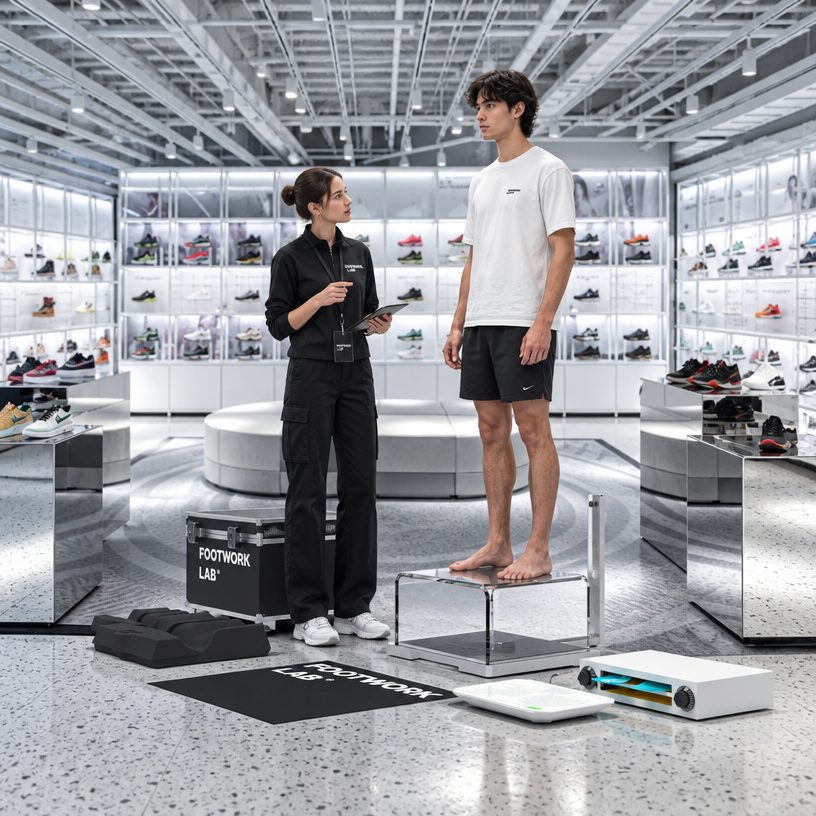
The delivery includes the main unit, the pressure-sensing plate, a USB data cable, the handbag for storage and transport, and the installation and user manuals with an installation toolkit. What it does not include is the two decisions that determine whether the corner works: where the walking line goes, and who owns the routine. Both are made before the crate is opened, and both are free.
A last word on where this equipment belongs among a store’s other tools. The F2 suits shops that want the assessment conversation as part of fitting; it sits in the same family of scenarios as sports training venues, podiatry clinics, foot therapy centres, gyms and children’s fitness venues, which is worth knowing for retailers who also wholesale. For stores whose whole model is the insole built on the spot, the combined capture-and-customise systems in our range close the loop in one room — and that is a different purchase conversation, best had with the shoe types and volume in front of us rather than in an article.
Frequently asked questions
Is a foot pressure pad the same thing as the F2?
The phrase describes a mat-like object shoppers imagine; the F2 is a rigid pressure-sensing plate with lower-limb and posture cameras, analysis software and AI-assisted reporting. It records static, dynamic and balance sessions on one sensing area. If a store wants an unrollable novelty item, this is the wrong category, and we say so before an order rather than after.
How much floor space does a demo corner need?
More than the machine’s own footprint, because the walking line is the measurement. The plate needs a clear approach so a customer settles into a natural stride, sightlines from the entrance path without sitting in the main thoroughfare, and a position one step from the fitting bench so the session ends where shoes are tried.
How long does one walk-up session take?
Short by design: a standing pass, a walk or two, a two-or-three-sentence reading at the screen and the report in hand. Alignment views or a balance record are added only if the customer asks for more. The session exists to open a fitting conversation, not to complete an examination.
Do customers need an appointment?
No. The corner works as a walk-up, and the invitation matters more than the booking: staff offer a picture of the customer’s own walk rather than a test. Almost nobody declines a picture of their own walk; many people decline anything framed as a test.
What does the customer leave with?
A report obtained by scanning a code, by email or as a printed sheet. For retail, print tends to earn the most, because the page survives the fitting bench, the journey home and the next visit. Every report carries the line that the data is for reference, with interpretation left to qualified professionals.
How much training does counter staff need?
Less than retailers expect. The on-screen prompts carry the procedure; the trainable part is the conversation — the invitation line, the short reading, the bridge to the fitting bench and the referral boundary. One named operator per shift and a one-page routine sheet keep the sessions consistent as staff rotate.
What does buying a unit for a store actually involve?
Minimum order is one unit, each tested for seven days at the plant before dispatch, with a twelve-month warranty against non-human damage and free parts. Support runs through a dedicated group with our engineers, including remote assistance and over-the-air updates. Delivery includes the main unit, sensing plate, cables, handbag, manuals and installation toolkit.
What we would do next
Send us a sketch of your floor: entrance, benching, stockroom door and the floor you can keep clear. We will suggest where the corner goes, where the walking line runs and which display orientation puts the pressure map in passers-by’s sight. The F2 product page lists the system’s functions in the manual’s own wording, and our business cases page shows how other retail rooms arranged theirs.
For the counter conversation in more depth, our articles on a footscan assessment at the counter and fitting a foot scanner into a shoe shop cover the retail flow, and how personalised foot analysis sells follows the report into the sale. Order and support terms sit on the FAQ page, and the contact page reaches the team directly.
This article is intended for professional and educational reference. It is not medical advice. Foot assessment equipment produces measurements and images; clinical interpretation and any decision about care remain the responsibility of a qualified professional. Certification scope is limited to the documentation we hold: European Union certification and ISO quality system certification.