
The room fits a plate, a chair and a folding screen, and the appointment is booked as a screen rather than an assessment. A customer steps on, takes a step or two, steps off, and ninety seconds later a page prints with a name, a date and a handful of named quantities. That is a gait plate session in its entirety, and in a pharmacy doorway or a shop corner it is exactly the right tool. The trouble starts when somebody reads more into the page than a step can carry. A plate captures a step; a walkway captures a walk, and the two records answer different questions despite printing on similarly authoritative paper. This article works through what a single-step record actually contains, what it quietly leaves out, how operators repeat and average steps so the record earns its keep, where the plate is the correct choice anyway, and the three misreadings we most often have to talk buyers out of at the demonstration stand.
A plate captures a step; a walkway captures a walk
The distinction is geometric before it is technical. A pressure plate is a fixed surface: the customer steps onto it, one foot lands, and the system records what happens between heel strike and toe-off on that one contact. A walkway is a longer instrument with the same sensors laid out over metres of floor, so it catches the foot repeatedly while the whole person walks past — approach, several consecutive contacts, and the exit. Same sensing principle, different scope of evidence, and the scope is what decides the questions each can honestly answer.
A single contact holds a great deal. It records how load enters the foot at the heel, how it travels forward through the sole, where it concentrates before leaving at the forefoot, and how long each phase of contact lasts. For questions about the foot itself — where this sole carries its load, how the arch presents under body weight, how the front of the foot is used at push-off — a clean step is genuine evidence. What one step cannot hold is walking: the rhythm of several strides, the left-and-right alternation, the settling that happens over distance, and the way load shifts as a person tires.
That sounds like a small gap until it is described operationally. Most of what a person does on their feet all day is not one step; it is a few thousand of them at a rhythm their body has settled into. A walkway record samples that rhythm; a plate record samples one beat of it. Both are worth having. Confusing which one you have is where the trouble begins, and the confusion is usually created by the label on the printout rather than by anything the customer did.
What one step contains
Break the contact down and the contents justify the page they print on. Entry: where the heel lands and how the load arrives, which the plate reads as the pressure pattern in the first phase of contact. Travel: the path of the centre of pressure from heel towards the forefoot, with the speed of that travel, which describes how the foot hands weight forward. Exit: the load under the forefoot in the final phase, where push-off concentrates the whole story of the step into a brief interval. Duration: the proportions of the contact spent arriving, spent flat and spent leaving.
Each of those items is a named quantity with a date and a customer name, and each can be compared with the same quantity from a later visit. That comparability is the plate’s real value. A screen at a shop door taken in October and repeated in April, under the same routine by the same operator, produces two sets of named quantities that can be set side by side without any argument about methodology. A casual observation made twice by eye cannot do that, and this — not the drama of the printout — is why even a short session beats a long chat.
The step also holds symmetry of a limited kind: what the landing foot does, in isolation. If the operator records the left foot and the right foot on separate contacts, the two records can sit beside each other on the same page — a side-by-side layout our own systems produce, and one that customers read more readily than any column of numbers. What that comparison cannot say is whether the two feet alternate the way they do at walking rhythm, because the two contacts were taken seconds apart from standing starts. It compares two steps; it does not compare a stride.
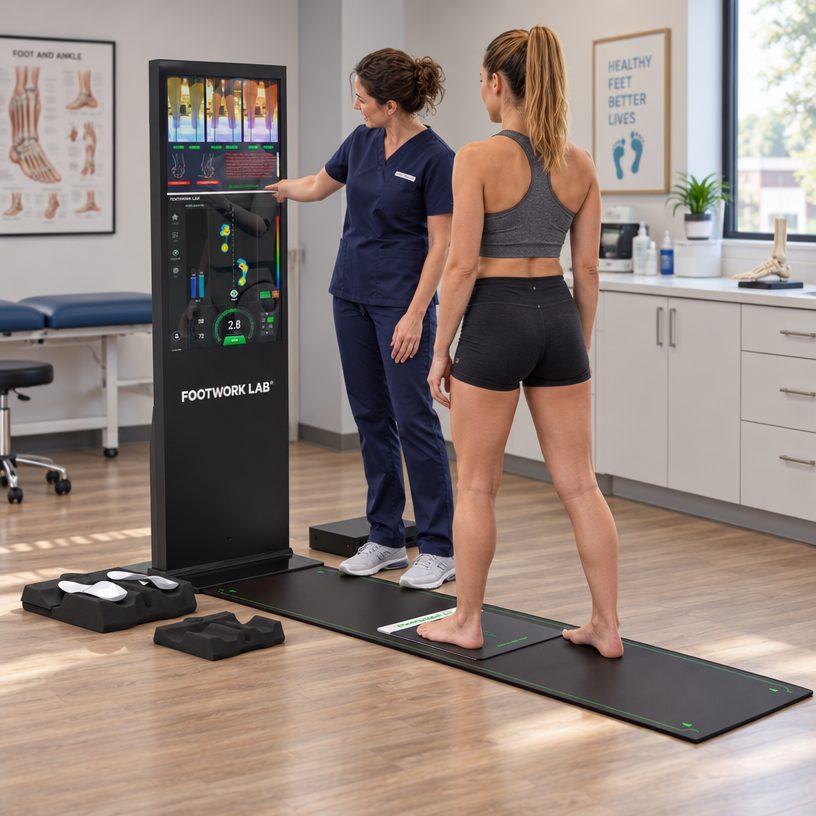
What one step leaves out
The omissions matter more than the contents, so they deserve the longer list. First, cadence and its neighbours: how quickly a person steps, how the steps string together, and how the rhythm holds up over distance. A person can take one exemplary step and walk badly for a mile, because walking is a repeated activity and its quality lives in the repetition. Nothing on a single-step record captures the repetition, and no amount of interpretation at the desk adds it back.
Second, the approach. On a walkway the foot that lands on the sensors has already been walking for several strides and arrives in its settled pattern. On a plate approached from a standing start, the first contact often belongs to a body that is accelerating from rest, and an accelerating body loads its foot differently from a cruising one. Operators who understand this take the second or third step onto the plate rather than the first, which helps — but it is a patch, not a substitute for the continuous record a walkway gives.
Third, fatigue and time. Load patterns drift as a day lengthens, and a record taken in the first minute of a session describes a fresh foot. That is fine for consistency — it is precisely why sessions are standardised — but it must be remembered when a customer reports symptoms that arrive in the afternoon. A fresh-foot step cannot contradict an afternoon report, because the two describe different hours. The honest desk sentence is that the record shows how the foot behaves fresh, and what the afternoon does is a conversation for the customer and, where relevant, a professional.
Fourth, everything above the foot. A step says nothing about the hip, the knee or the trunk, and a customer who wants to know why they walk the way they walk is usually asking about the whole person. The plate sees the sole; the rest is inference, and inference at a counter is where misreadings are born. Naming these four omissions out loud takes half a minute and is the best habit a screen operator can build.
Repeating the step, and what averaging is for
Because a single step is a small sample, the operator’s discipline is repetition. The routine we teach: take several contacts per foot, discard at the desk the ones marred by hesitation or a misplaced landing, and work with the remainder. The discards matter as much as the keeps — a customer whose first landing half-misses the plate has not revealed anything about their foot, only about the geometry of the attempt, and filing that contact poisons the average.
Averaging does one specific job. It smooths the contact-to-contact variation that belongs to being a person — a slightly different landing each time, a wobble on one attempt, attention drifting between attempts — so the values filed describe the foot’s steady behaviour rather than one lucky or unlucky step. It does not manufacture walking. An average of eight standing-start steps is still eight standing-start steps; it is a more stable description of the same narrow thing, and the report should be read as that and no more.
Practically, the repeat routine costs minutes, not seconds, and the session budget should carry them. Each contact needs the customer stepped back, repositioned and re-instructed — the same instruction, in the same words, every time, which is why operators keep a card. Three to five clean contacts per foot is the working figure for a screen; fewer and the average wobbles with the customer, more and the queue at the door starts writing the protocol for you. The operator marks on the session sheet which contacts were kept, because a later visit that keeps a different set is not quite comparing like with like.
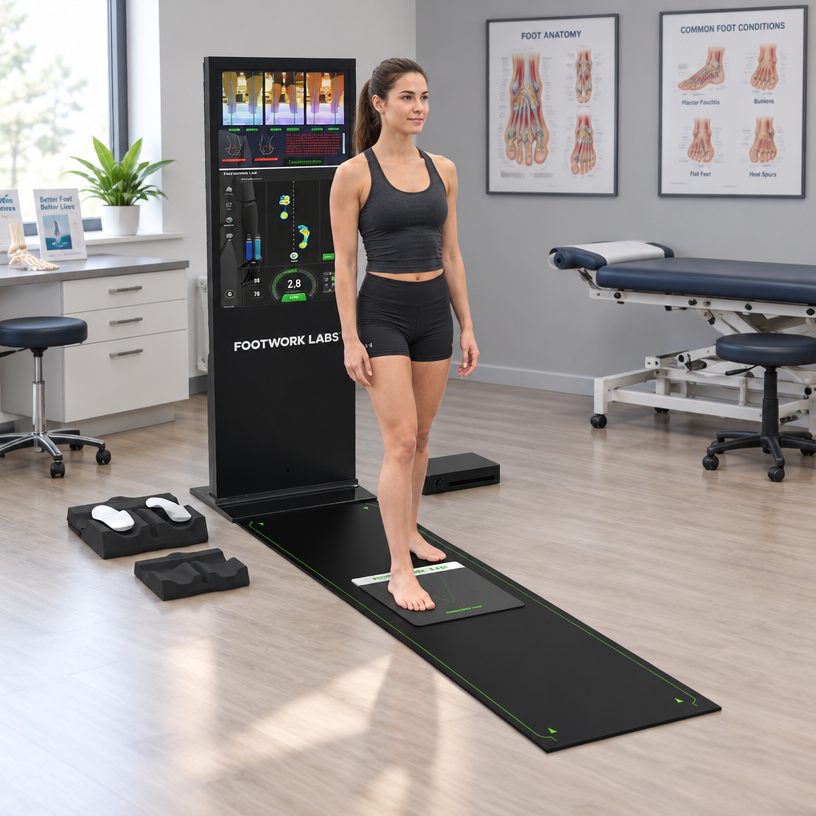
Where the plate is the right tool anyway
Having subtracted so much, it would be odd if the plate had no job. It has several, and they are the jobs most small rooms actually need. Screening at a doorway or counter: a few contacts per foot, a side-by-side page, a conversation about which shoes or builds suit this load pattern, and a referral sentence where one is due. Fitting retail: where a shop wants the shelf narrowed by evidence rather than by eye, the standing and stepping record narrows it honestly. Follow-up: a repeat of the same routine months later, held to the same conditions, gives a comparable set of named quantities without needing the floor space a walkway demands.
The space argument is the decisive one in many real rooms. A walkway wants clear floor before and after the sensors, and small premises do not have it; what floor area an X3 walkway setup actually needs walks through the arithmetic. A plate wants a square of floor and a chair. Where the room decides, the plate is not a compromise purchased reluctantly — it is the correct instrument for the questions the room can host, provided the desk keeps the scope honest.
The throughput argument matters too. A plate session is minutes; a walkway session is the better part of twenty. Pharmacies, wellness days and shop corners measure their service in minutes per customer, and a screen that fits that budget gets used, while a grander instrument that does not fit it sits turned off in the back room. The best equipment is the equipment the room will actually run every day, and we would rather sell the smaller unit and have it used than the larger one and have it photographed. That trade — scope for viability — is exactly what the buyer should be choosing deliberately.
Three ways a single step gets misread
The first misreading is the verdict step: one contact, one confident sentence about the person. The customer steps on once, the operator glances at the pattern, and a pronouncement follows — usually about the arch, usually delivered as a finding. Whatever the pattern shows, one contact is one sample taken from a standing start under the eyes of a stranger. The disciplined version is several kept contacts, an average, and a sentence about load pattern rather than about the customer’s body.
The second misreading is the comparison that compares different things. A plate record from a standing start is set beside an old walkway report from another premises, and the numbers differ, so one of the two machines is blamed. Neither machine is wrong; the sessions differ in scope, in approach and in fatigue, and no conclusion lives in that comparison. Records compare cleanly when the routine, the instrument class and the conditions match, which is why the session sheet should record which kind of session it was, every time.
The third misreading is the diagnosis by printout: the belief that because the page carries named quantities and a date, reading it is a clinical act. It is not. The page is a set of measurements; what they mean for this person’s health belongs to a qualified professional, and the screen operator’s rehearsed sentence — this is something a professional should look at — ends the conversation before it drifts. Three sentences cover the risks, and all three cost nothing but the discipline to say them.
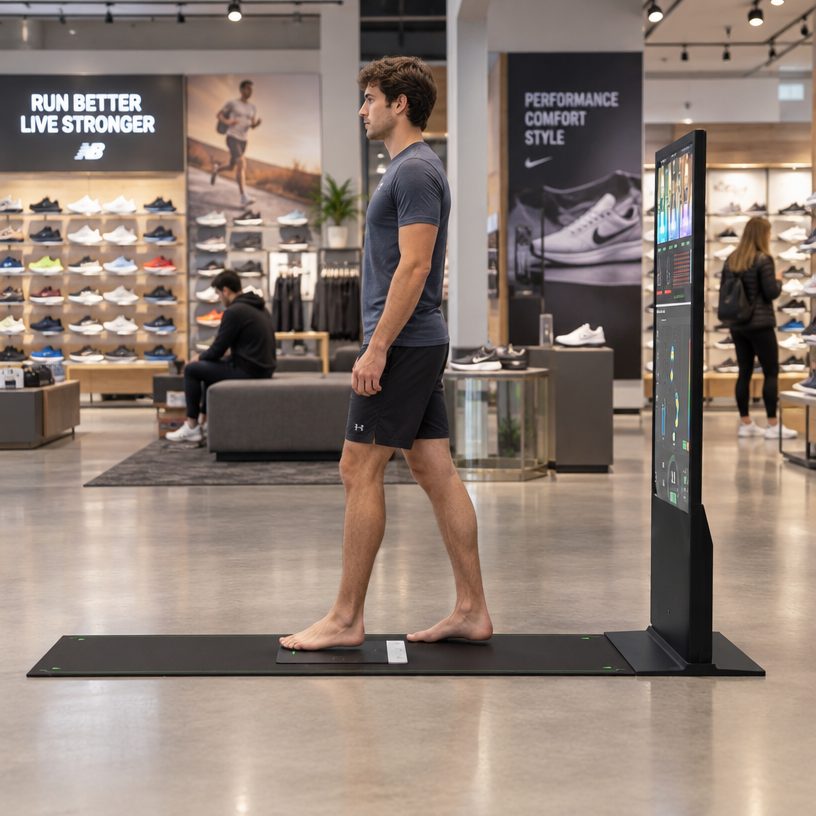
Writing the session down so it can be repeated
The last discipline is archival, and it is the one that turns a screen into an instrument rather than an event. The session sheet carries: which contacts were kept, the instruction wording used, whether the customer held any support, what footwear was worn in, and anything unusual about the day. A page of printout plus those five lines is a record; the printout alone is a souvenir. Rooms that keep this discipline produce second visits that compare cleanly, and second visits are where the equipment pays for itself.
The filing habit is small: one folder per customer, sheet behind printout, date on top. When a customer returns, the operator reads the previous sheet aloud before starting — which contacts were kept, what was noted — and repeats the same routine on purpose. Ten seconds of reading buys comparability that no software can reconstruct from two orphaned printouts. Shops that skip the reading usually also skip the sheet, and their folders fill with pages that cannot be compared with anything, including each other.
What the session sheet cannot do is widen the step’s scope. Everything recorded stays a record of contacts, taken fresh, from standing starts, on the day the sheet says. That is the honest boundary of a plate-based screen, stated on the page and repeated at the desk, and rooms that state it sell more follow-up visits, not fewer, because customers trust a measurement that knows its own size.
Frequently asked questions
What can a single-step record actually tell you?
It records one contact: how load enters at the heel, travels forward and concentrates at the forefoot, the proportions of the contact phases, and the pressure pattern across the sole. That is genuine evidence about the foot under body weight, and a clean repeated set of contacts is comparable across visits.
What does a step record miss that a walkway catches?
Rhythm and repetition. Cadence, stride-to-stride alternation, the settling that happens over distance and the effect of fatigue all belong to walking, not to one contact. A plate describes one beat; a walkway describes the music. The questions you ask should match the instrument you have.
How many steps should the operator take?
Three to five clean contacts per foot is the working figure for a screen. The operator discards hesitant or misplaced landings at the desk, keeps the rest, and notes on the session sheet which contacts were kept so a later visit repeats the same routine.
Why does the first step onto the plate get discarded?
Because the body is accelerating from a standing start, and an accelerating body loads its foot differently from a cruising one. Later contacts approach the settled pattern a walkway catches naturally, which is why operators instruct, repeat and keep the settled attempts.
Is a plate record comparable with an old walkway report?
No, and neither machine is at fault. The two sessions differ in scope, approach and fatigue, so the numbers differ without meaning anything. Records compare cleanly only when the routine, the instrument class and the conditions match, which the session sheet should record every time.
Where is a plate the better choice than a walkway?
Small rooms, doorway screens, wellness days and high-throughput counters. A plate needs a square of floor and a chair; a walkway needs clear run-up and a longer appointment. For narrowing a shelf and taking repeatable screens, the plate is the correct instrument, not a compromise.
Can the printout be used as a diagnosis?
No. It is a set of named measurements with a date; clinical interpretation belongs to a qualified professional. The operator’s rehearsed sentence — that anything the record raises beyond the fitting conversation is something a professional should look at — is part of the session, not an apology for it.
What we would do next
If the room is small, measure it before the buyer’s visit and decide deliberately which questions the room will host: shelf narrowing, doorway screening, repeat screens on returning customers. Then write the session routine on one card — instruction wording, contacts kept, discard rule — and put the session sheet behind every printout. The X3 system page shows the plate and walkway configurations in the equipment’s own terms, and what the word plate actually covers untangles the vocabulary buyers meet first. For the shorter sibling of this session type, the quick screen at the door covers the three-minute version.
This article is intended for professional and educational reference. It is not medical advice. Foot assessment equipment produces measurements and images; clinical interpretation and any decision about care remain the responsibility of a qualified professional. Certification scope is limited to the documentation we hold: European Union certification and ISO quality system certification.