
The visitor folded the printout in half, slid it into her coat pocket and carried it out of the hall; the same record on the laptop had been closed before she reached the door. That pocket is the argument of this article. A printed footprint on glass podoscope panels has survived every generation of software for one unfashionable reason: the sheet leaves the room. Our Q1P foot and leg quick-screening system works the way these panels always have. The customer steps onto the glass, the contact outline appears under their weight, and the session ends with a sheet carrying a name, a date, two footprints and a handful of quantities that have names rather than bare digits. The screen holds more detail and gets consulted less. The paper holds less and never quite disappears, because it lives in a handbag, a shoebox, a drawer at the till. This article works through why the printout still earns its place beside the software, what the wet and dry conditions each do to the outline, what a footprint can honestly be read for, what it cannot, how a shop and a clinic each put the sheet to work, and how to run a training exercise with nothing but a stack of old prints and a table.
The sheet that leaves, the screen that stays
Every session on a glass footprint panel ends twice. It ends on the screen, where the software lays out the images and the quantities, and it ends at the printer, where a warm sheet slides out with the customer’s name at the top and two footprints below it. The screen version holds more and is reopened less. The paper version holds less and is almost impossible to lose track of, because it attaches itself to physical life: folded into the shoebox the customer bought that afternoon, taped inside a cupboard door, posted to a daughter who wanted to see it. We have watched hundreds of these sessions at trade fairs and in customer rooms, and the sheet is taken home nearly every time.
The reasons are mundane and worth stating plainly. Paper does not need a login, a password reset or a working internet connection. It can be read by the customer, by a family member, by a second professional in another town, without anyone installing anything. When a customer returns a year later and opens the conversation with the words “last year’s paper says the arch side was narrower”, the sheet starts the appointment before the software has finished loading. That opening line is worth more to a busy counter than any dashboard, because it arrives already carrying the customer’s own memory of the visit.
None of this makes paper the better format in general. Paper is lost, coffee-stained and photocopied badly; files are backed up and searchable, and we recommend our customers keep electronic records for exactly that reason. The two formats simply do different jobs. The file is the archive, and the archive belongs to the room. The sheet is the object the customer owns, and ownership changes how a record is treated. A person will bring back a piece of paper they were given far more readily than they will remember the login to a portal they were signed up for.
Dry foot or wet foot: the condition behind the print
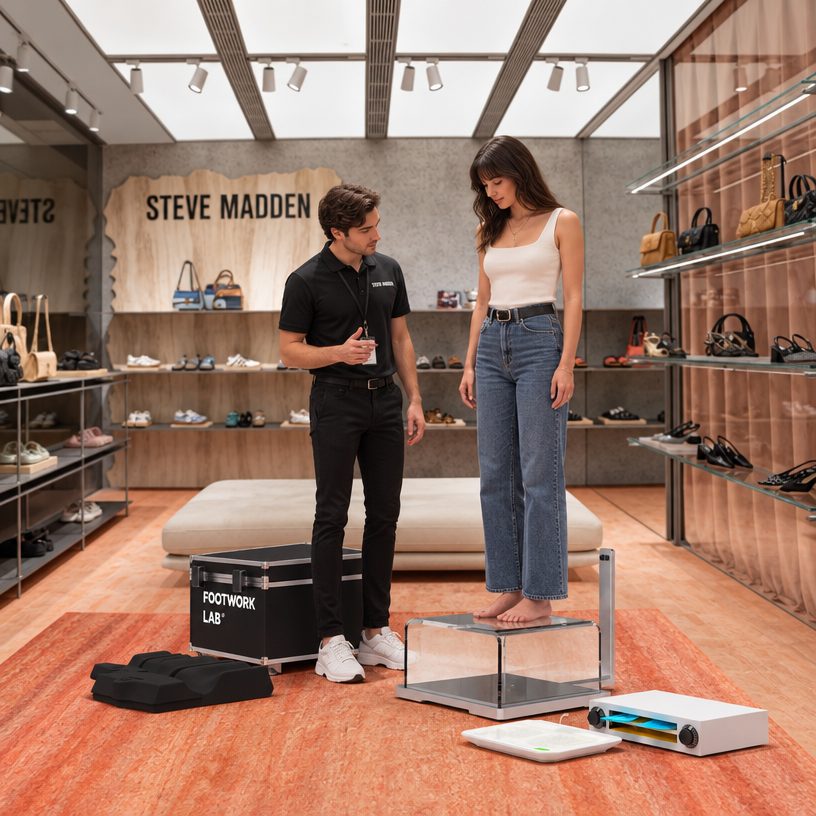
A glass footprint panel can be read under two conditions, and the choice changes the picture more than most newcomers expect. In the wet condition, the sole is dampened before the step, and the print shows the whole sole: skin that carries load and skin that merely hovers near the surface. The outline comes out generous and the edges come out sharp, which is why this is the traditional method and the one most people picture when they picture a footprint. In the dry condition, the customer steps onto the glass with clean, dry feet, and only skin that actually touches and carries shows at all. The arch region reads wider, the edges read softer, and the print is a more honest but less flattering account of standing still.
Neither condition is the correct one in the abstract. The wet print answers the question “what is the shape of this sole”, and it answers it cleanly. The dry print answers the question “what touches and carries when this person stands still”, which is closer to what a fitting conversation usually needs but further from what a customer expects to see. The mistake worth avoiding is not choosing the wrong one; it is mixing them. A wet print in spring and a dry print in autumn are two different measurements of the same foot, and a year-on-year comparison built on top of them will find differences that belong to the water, not to the foot.
The wet condition also carries a small piece of housekeeping that separates tidy rooms from sloppy ones. Damp feet leave a film on the glass, and the next customer steps onto a surface that is slightly slick before anyone notices. The towel that lives in the drawer under the panel, the wipe-down between customers, the sheet that records which condition was used: these three habits cost perhaps a minute across a morning and decide whether the panel is a pleasure to step on or a small liability. We mention the towel because in demonstrations it is the detail visitors ask about most, after they have watched an operator wipe the glass without being asked.
What the outline can be read for
The first thing a footprint offers is the contact outline itself: the proportions of heel, midfoot and forefoot, and how the arch presents between them. On a printed sheet these read at a glance, without software, which is exactly why the format has outlived its critics. A wide forefoot against a narrow heel, an arch line that sits close to the inner edge, a midfoot that barely prints at all: each of these is visible to an untrained eye once someone has pointed at it once. For a counter conversation, that visibility is the whole point. The customer sees their own foot, not a rendering of it, and the conversation starts from something they can verify with their own eyes.
The second thing worth reading is the heel. On a print taken standing still, the heel patch sits either roughly square to the long axis of the sheet, or rolled visibly towards one side, and that position describes how the customer was standing at the moment of the print. This is a description of stance, not a finding about the foot, and the wording on the sheet should keep the two apart. The heel patch is also the region where left and right differ most often on the same sheet, and those small differences between sides are ordinary. A print where both heels sit identically is rarer than one where they do not.
The third reading is the comparison across the sheet: left foot beside right foot, taken seconds apart under the same condition. Whatever asymmetry exists is already framed by the paper, side by side, at the same scale, which is a comparison the screen recreates but the paper does natively. Staff who are new to foot assessment learn the normal range of variation fastest from these paired prints, precisely because there is nothing else on the page to distract them: no force colours, no time axis, just outline and position. The simplicity that makes a print look old-fashioned is the same simplicity that makes it teachable.
What the outline cannot tell you
A print is one merged moment. It cannot say how load arrived, how it moved, or how it left, because a footprint has no time axis and no force scale. A foot that rolls quickly through contact and a foot that settles slowly can leave outlines so similar that only the person who took both would know the difference. This is the boundary between a footprint and a pressure measurement, and it should be stated to customers before they draw conclusions from the sheet rather than after. The print shows where the foot was. It does not show what the foot did to get there.
Neither can a diagnosis be read off the paper, and any staff member who implies otherwise has overstepped. The same outline appears under different conditions, on different days, from different people, and the equipment itself produces measurements and images rather than conclusions. What the sheet legitimately supports is description: this is the contact pattern under this condition on this date. Anything beyond that belongs to a qualified professional, and the rooms that use our panels well are the ones whose staff say so early and without apology. Customers respect the boundary once it is drawn; they distrust the room that quietly ignores it.
The sheet is not a build specification either. Nothing printed on it tells a workshop what to make, because a build draws on measurements, on the shoes it will live in and on professional judgement about load and comfort. When a customer asks whether the print shows what kind of insole they need, the honest answer is that it shows one useful view of the foot and that the build decision is made from more than one view. The print earns its place in the folder; it does not run the folder.
Two rooms, two uses of the same sheet
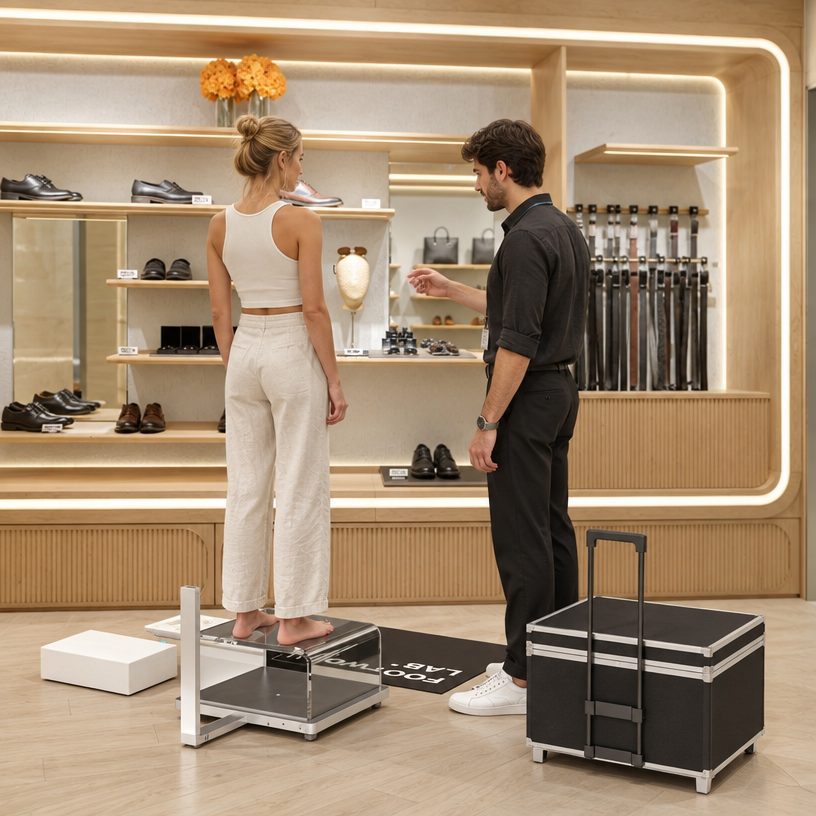
In a shoe shop, the printout is a fitting tool. The customer’s footprint sits on the counter next to the shoes under discussion, and the conversation about width, volume and fit acquires a picture that the customer can consult as readily as the fitter. A print whose forefoot runs wide makes the conversation about a generous toe box shorter and less argumentative, because the evidence is lying on the counter where both parties can see it. The shop also hands the sheet over, and the customer leaves with a personal reference for the next time they buy shoes anywhere, which is a small service that costs the shop a sheet of paper.
In a clinic or screening room, the same sheet works as an opening record: the first view taken in the first minutes of an appointment, before any instrumented measurement. It gives the professional a starting description and gives the patient something concrete while they wait. Where the room also runs camera capture of posture and alignment, the print pairs with the images naturally, because both are still records of position rather than movement, and reading them together is easier than reading either beside a dynamic measurement. The sheet, in this setting, is a triage document in the plainest sense: it shows the professional where to look first.
What both rooms share is the handover. The print is given, not withheld, and the customer keeps it. This is worth insisting on because the reflex in some rooms is to treat any output as internal material. A footprint sheet carries nothing sensitive: it is an outline the customer already owns, attached to their own foot. Handing it over converts a measurement into a keepsake, and keepsakes come back. Every returning customer who arrives holding last year’s paper is a small advertisement for the habit.
Teaching with a stack of old prints
The cheapest training exercise we know for new staff needs no software at all. Collect a stack of prints taken under one known condition, spread ten of them on a table, and ask the newcomer to sort them by how the arch presents, then by how the heels sit. The exercise takes twenty minutes, produces arguments worth having, and leaves the newcomer with a mental library that transfers directly to the counter. Software-trained staff often read the numbers first and the foot second; staff trained on paper read the shape first and check the numbers afterwards, and on a busy floor that order is faster.
The same stack teaches customers, with the prints made anonymous. During wellness days and school visits we have watched a footprint do more explanatory work in one minute than a leaflet does in ten: a child steps, the outline appears, and the idea that feet differ from one another lands without a lecture. Rooms that run such visits should keep a set of example prints for exactly this purpose, each labelled with its condition and nothing else. The demonstration works because it is the visitor’s own foot on the glass, and the printed examples exist only to give the operator something to point at afterwards.
A labelled drawer of prints, kept by condition, also becomes the room’s reference for wording. When a member of staff needs to describe an arch line or a heel position in a report and wants consistent language, they check how the same feature was phrased on earlier sheets. This is documentation work at its most ordinary, and it prevents the slow drift where one operator writes “low arch” and another writes the same feature as “reduced midfoot contact” and a reader assumes two different findings. Consistent wording on paper is where consistent records start.
Dating the sheet and keeping prints comparable
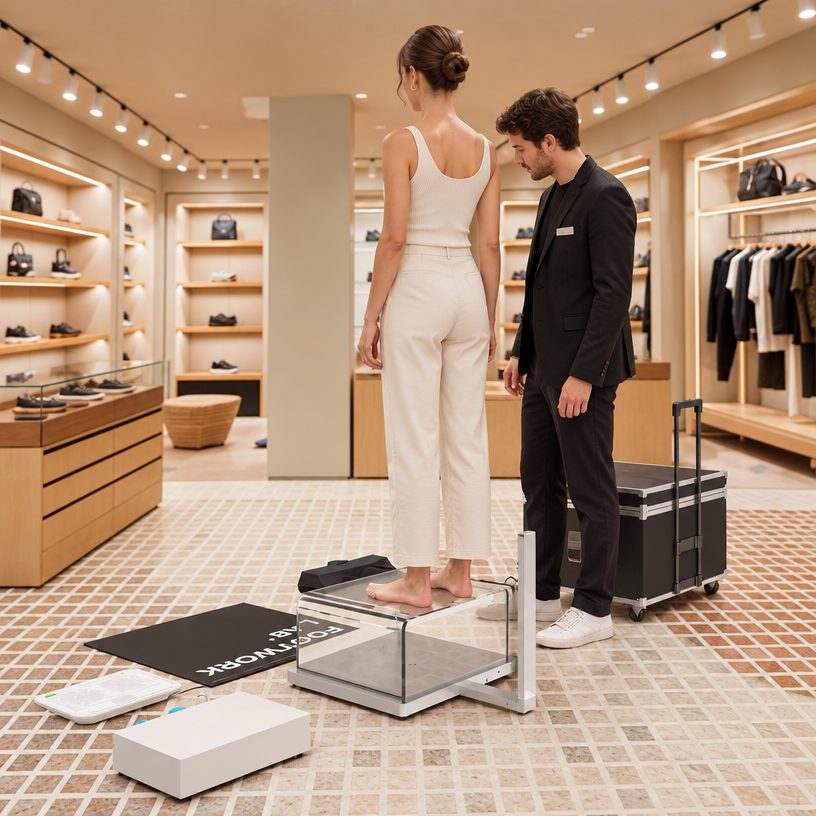
The printed sheet is only worth comparing across visits if the conditions were written on it, which is why the condition line belongs on the printout itself and not only on the internal record. Wet or dry, standing or after a short walk, footwear removed or not: one line under the date. A customer who brings back a sheet from another shop, another town or another decade is holding a record whose conditions nobody in your room knows, and the first move is to read that line if it exists, not to lay the two prints side by side and start describing differences.
When the conditions do match, the comparison is genuinely useful and strikingly simple. Last year’s sheet on the glass panel, this year’s customer standing beside it, the two prints read against each other in real time while the customer watches. Feet do change across a year, and some of that change is real; what the matched comparison does is separate the changes worth discussing from the ones that belong to the condition. An operator who has kept the condition line honest can have that conversation in a minute. An operator who cannot say how last year’s print was taken should say so rather than guess.
The honest framing for customers is the same one we give buyers of the equipment. A footprint supports comparison of the same person, measured the same way, across time. It does not rank one customer against another, it does not predict anything, and it does not replace the measurements that a build or a treatment plan would rest on. The sheet’s virtues are older and humbler than that: it travels, it survives, it gets read, and it brings the customer back through the door holding their half of the record.
Frequently asked questions
Does the foot have to be wet for a glass footprint panel?
No. The wet condition gives the traditional, generous outline that includes skin which barely carries load; the dry condition shows only skin that actually touches and carries while standing. Both are legitimate; they answer different questions. Whichever a room uses, it should stay with it between visits and note the condition on the sheet, because a wet print and a dry print of the same foot are not comparable.
What can be read from a printed footprint?
The proportions of the contact outline, how the arch presents, how the heel patch sits relative to the long axis, and the differences between left and right on the same sheet. These are descriptions of contact and stance under the stated condition. The print is a single merged moment, so it shows where the foot was, not how load moved through the step.
Can a footprint be used to diagnose anything?
No. The equipment produces measurements and images; clinical interpretation belongs to a qualified professional. A footprint supports description: the contact pattern under a stated condition on a stated date. Staff who keep to that wording keep the room credible. Anything a customer hears beyond description should come from the professional, not from the sheet.
Why keep the printed sheet when the software stores the record?
Because the two formats do different jobs. The file is the archive: searchable, backed up, kept by the room. The sheet is the object the customer owns: it travels in a shoebox, gets read by a family member, and comes back through the door a year later starting the conversation before the software loads. Rooms do best keeping both.
Can a wet print be compared with a dry print of the same foot?
Not directly. The wet condition shows the whole sole and reads a wider contact area; the dry condition shows only what carries and reads a wider arch region. The differences belong to the water, not to the foot. Only prints taken under the same condition, on the same kind of sheet, form a baseline a later visit can be read against.
What appears on the printed sheet?
The customer’s name, the date, the condition line, two footprints side by side and a few named quantities that describe the outline. No conclusions and no recommendations are printed. If the room uses camera capture alongside the panel, those images stay in the electronic record; the sheet carries what the customer can verify with their own eyes.
Is the printed footprint useful for staff training?
Very much so. Ten prints under one known condition, spread on a table and sorted by arch presentation or heel position, teach a newcomer the normal range of variation faster than a software tour. The same stack, made anonymous, works for customer education during wellness days. A labelled drawer of prints by condition also keeps report wording consistent across staff.
What we would do next
Decide which condition your room standardises on, print the condition line on every sheet, and put a towel in the drawer under the panel. Then pull the last ten printouts and check the dating; where the condition is missing, say so honestly rather than compare across it. What changes when you measure in socks, bare feet or shoes covers the same discipline for pressure records, what a pressure measurement can report, and what it cannot draws the boundary between a print and a dynamic record, and what the camera adds beside the pressure mat explains how still images and captured posture work together. The Q1P system page describes the quick-screening panel in its own terms, and the FAQ page carries the operational answers we send most often by message.
This article is intended for professional and educational reference. It is not medical advice. Foot assessment equipment produces measurements and images; clinical interpretation and any decision about care remain the responsibility of a qualified professional. Certification scope is limited to the documentation we hold: European Union certification and ISO quality system certification.