
How a Flexible Fabric Sensor Plate Collects Plantar Pressure
柔性织物传感压力板如何采集足底压力
Core Summary
- A flexible fabric sensor plate works as a resistive matrix: every point where a row electrode crosses a column electrode becomes a tiny variable resistor whose resistance falls as local plantar load rises.
- Electronics scan that matrix row by row at 60–100 Hz, converting resistance into calibrated pressure values so each frame becomes a full plantar pressure map with a timestamp.
- The same hardware supports three different protocols — static, dynamic and balance — and each answers a different clinical or performance question.
- Data quality depends less on marketing claims than on calibration, barefoot protocol, sampling rate and interpretation; the plate measures, the clinician decides.
- Reference hardware in this category includes the Sinmec F2 / F2-Pro systems: sensing area 41 × 115.2 cm, 64 × 64 × 3 pressure points, 5 V supply, Windows/Mac software.
1. Introduction
Plantar pressure measurement has traditionally meant rigid force platforms or thick capacitive mats. They are accurate, but they are also heavy, expensive, limited in surface area, and often confined to a gait laboratory. That creates a practical gap: podiatry clinics, rehabilitation departments, sports training centres and footwear retailers increasingly want repeatable pressure data in an ordinary room, on an ordinary floor, without a technician-engineer standing by.
Flexible fabric sensing changed that trade-off. By replacing rigid plates with a thin, walkable textile matrix, a pressure plate can be rolled out, stepped on barefoot, and used for standing, walking and balance testing within the same session. In a clinical workflow this matters because static, dynamic and balance data on the same patient, captured on the same device, are far easier to compare than measurements spread across three different machines.
But "fabric sensor" is not a self-explanatory term. Buyers reasonably ask: how does a piece of cloth actually measure force? How many sensors are there, how often are they read, and what happens between the raw signal and the report a clinician hands to a patient? This article answers those questions step by step — sensing principle, signal acquisition, calibration, and interpretation — and closes with the boundary conditions that determine whether the numbers can be trusted.
2. The Sensing Layer: Turning Foot Load into Resistance
Core conclusion: a fabric pressure plate is a two-dimensional grid of resistive cells. Pressure does not generate a charge; it changes contact resistance, and that change is what the electronics read.
Most fabric-based plantar systems, including the Sinmec Fabric sensing approach used in the F2 series, are built as a layered textile sandwich. The structure is conceptually simple:
- A top conductive fabric carries parallel row electrodes.
- A piezoresistive or pressure-sensitive layer sits in the middle, often as a coated fabric whose conductivity improves as it is compressed.
- A bottom conductive fabric carries parallel column electrodes running perpendicular to the rows.
At every row–column intersection, current must pass through the middle layer. With no load, contact between the fibres is loose and resistance is high. When the foot presses down, fibres and coating are compressed into closer contact, more conductive pathways open, and the local resistance drops. Each intersection therefore behaves as a force-dependent resistor: more load, lower resistance, with a roughly monotonic relationship across the working range.
The geometry is what makes this clinically useful. A specification such as 64 × 64 × 3 pressure points means 64 row and 64 column lines form roughly 4,096 sensing intersections per panel, with three sensing panels covering the plate. Spread across a 41 × 115.2 cm sensing area, that gives a cell pitch on the order of a centimetre — fine enough to separate the heel, the five metatarsal heads and the hallux, coarse enough to keep data volume manageable. Because the textile is only a few millimetres thick, it does not create a step that distorts natural walking, and it is walkable barefoot without the patient adapting their gait to a rigid edge.
Practical advice: the resistive principle is inherently sensitive to how evenly the middle layer is loaded, so foot placement, sock thickness and skin moisture all influence absolute values. That is not a defect — it is why comparable protocols matter more than raw numbers when you compare two sessions.
3. From Sensor Signal to Pressure Map: Scanning, Sampling and Calibration
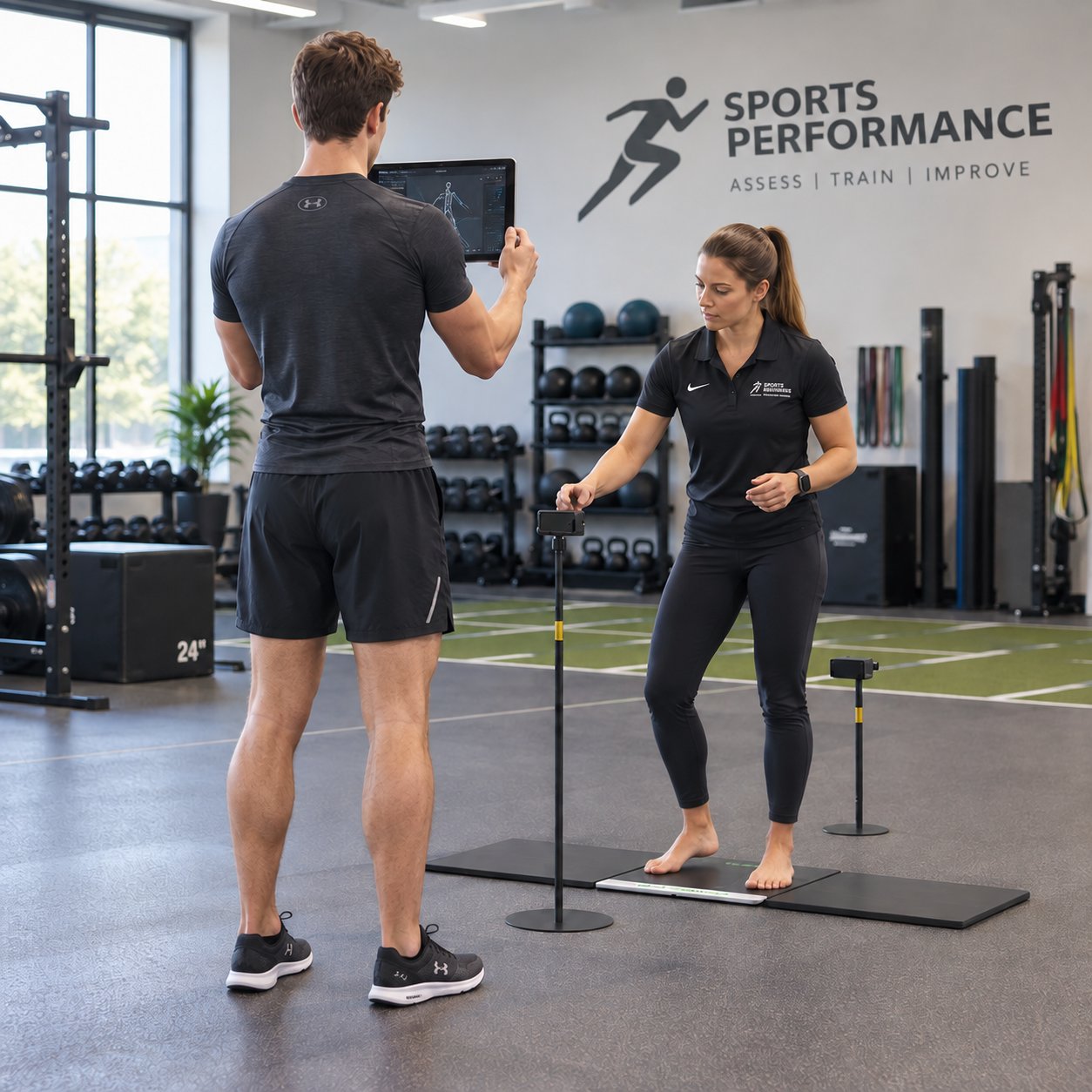
Core conclusion: the plate does not read 4,000 sensors simultaneously. It switches through rows and columns rapidly, digitises each intersection, and then reconstructs a full pressure image — typically 60 to 100 times per second.
The acquisition chain has four stages.
1. Multiplexed scanning. Control electronics activate one row at a time and measure the voltage drop across each column, forming one frame of raw resistance values. Well-designed systems manage crosstalk between adjacent cells, because current can otherwise sneak through neighbouring paths and inflate readings.
2. Sampling rate. The F2-Pro specification lists a 60–100 Hz acquisition frequency, which is meaningful in context: a normal adult stance phase during walking lasts roughly 0.6–0.8 seconds, so at 60 Hz you capture about 40–50 frames per step. That is enough to plot the centre-of-pressure trajectory and the timing of peak loading. For running, where heel-strike transients last tens of milliseconds, higher rates or dedicated gait systems are preferable — a boundary worth confirming before purchase.
3. Calibration and zeroing. Raw resistance becomes pressure in newtons per square centimetre only after calibration. In practice this means zeroing the plate before each trial (no load, no drift), applying known loads at defined points, and accepting that textile sensors show some hysteresis and creep under sustained standing. Systems that support online OTA updates can carry improved calibration curves and processing algorithms to installed devices without replacing hardware.
4. Reconstruction and reporting. Software assembles the frames into colour-coded pressure maps, then derives the metrics clinicians actually use: peak plantar pressure, contact area, force–time integral, centre-of-pressure path and bilateral load distribution. In the F2-Pro configuration, reports can be printed on site or online, and the system runs on standard Windows or Mac computers over USB, drawing only 5 V — which is why it can be deployed in a treatment room rather than a dedicated lab.
Practical advice: treat sampling rate and spatial resolution as a matched pair. A dense grid at low sampling rate is excellent for standing analysis and weak for sprint work; a fast but coarse plate captures timing well but blurs the metatarsal detail needed for orthosis design.
4. From Pressure Map to Clinical Decision: Three Protocols, One Plate
Core conclusion: static, dynamic and balance analyses are not marketing variations — they are three different loading conditions, and each reveals information the others miss.
Static analysis captures the patient standing still. It answers where load sits at rest: left–right asymmetry, excessive heel or forefoot loading, reduced contact area under a specific metatarsal, or a pressure hotspot consistent with a structural deformity. Because posture is stable, the frames can be averaged for a low-noise baseline. This is the appropriate starting point before custom foot orthoses are designed, since it gives a quantified load reference.
Dynamic analysis captures walking. It reveals the sequence of loading — heel contact, midfoot transfer, forefoot roll-off — together with centre-of-pressure progression and the timing of peak pressure in each region. Systems such as the F5-LAB extend this with treadmill walking and running plus camera-based posture capture, so pressure and body alignment can be reviewed in the same session. Dynamic data is what supports decisions about functional insoles, rehabilitation progress and return-to-sport load tolerance.
Balance analysis captures postural sway. By tracking centre-of-pressure excursion over time, it complements pressure distribution work in neurological rehabilitation, fall-risk screening and sports return-to-play testing, where stability rather than peak load is the question.
Across all three, interpretation stays with the clinician. Fabric plate output supports screening for foot deformity, monitoring of rehabilitation progress, assessment of movement capacity and quantification for orthosis planning — it does not diagnose on its own. What modern software does add is efficiency: AI-assisted reporting tools and machine-vision posture recognition shorten the path from raw frames to a structured, comparable report, which matters in a clinic seeing dozens of patients a day.
Practical advice: fix your protocol before you buy — barefoot versus shod, walking speed, number of passes, eyes open or closed — and record it alongside the data. A consistent protocol on a mid-range plate gives more decision value than an inconsistent protocol on an expensive one.
5. Key Comparison and Boundary Conditions
What each analysis mode answers
| Protocol | Loading condition | Typical metrics | Best suited to |
|---|---|---|---|
| Static | Standing still | Bilateral load %, peak pressure by region, contact area | Baseline before orthosis, deformity screening, load asymmetry |
| Dynamic | Walking or running | Centre-of-pressure path, regional peak timing, force–time integral | Gait assessment, rehabilitation progress, sports capacity |
| Balance | Standing with controlled conditions | Sway path, centre-of-pressure excursion | Stability screening, neuro rehabilitation, return-to-play |
Reference specifications (F2-Pro class plate)
| Parameter | Value |
|---|---|
| Sensing area | 41 × 115.2 cm |
| Main unit size | 120 × 47.5 × 1.9 cm |
| الوزن | 10.5 kg |
| Sensor type | Resistive pressure-sensitive fabric |
| نقاط الضغط | 64 × 64 × 3 |
| Acquisition frequency | 60–100 Hz |
| Supply voltage | 5 V |
| Operating system | Windows / Mac |
Conditions that affect data quality
- Calibration state — uncalibrated or drifted plates produce plausible-looking maps with unreliable absolute values.
- Barefoot protocol — socks and footwear redistribute load; mixing conditions breaks comparability.
- Sampling adequacy — 60–100 Hz suits walking and standing; fast running transients need more.
- Textile behaviour — hysteresis and creep under long static standing; allow warm-up and re-zero between trials.
- Environmental factors — temperature and humidity shift fabric conductivity; clinics in humid climates should schedule periodic recalibration.
- Operator training — placement, walking speed and step count influence results as much as hardware does.
On the supply side, these systems come from specialised manufacturers rather than general electronics brands. Sinmec, the company behind the Fabric sensing platform, reports more than 110 authorised patents as of April 2026, distribution to 65 countries, over 200,000 users, and a 10,000 m² manufacturing base — context that helps buyers judge support depth, spare-part availability and software update continuity, which matter as much as the sensor count.
6. FAQ
Q1. Does the patient walk on the plate barefoot?
Yes, in most clinical protocols. Barefoot measurement removes the confounding effect of shoe geometry and midsole cushioning, and it is the standard condition for deformity screening and orthosis baselining. If you need shod data — for footwear design or sport-specific assessment — keep it as a separate, clearly labelled protocol, because in-shoe and barefoot pressure distributions are not directly comparable.
Q2. Is a fabric plate as accurate as a rigid force platform?
They measure different things with different trade-offs. A rigid platform is typically optimised for total ground reaction force with very high sampling rates; a fabric plate is optimised for spatial distribution across a large walkable area at moderate sampling rates. For regional plantar loading, contact area and centre-of-pressure trajectories, a calibrated fabric matrix provides usable clinical data. For force-plate-grade kinetic analysis of impact transients, a laboratory platform remains the reference.
Q3. How often does the plate need calibration?
It depends on usage intensity and environment. A practical schedule is zeroing before every session and full calibration at intervals set by the manufacturer, with earlier recalibration after relocation, noticeable humidity changes, or any session where results look inconsistent with the clinical picture. Because textile sensors are subject to creep, long static standing tests should be repeated rather than extended.
Q4. What determines whether the data is good enough for orthosis decisions?
Three things: spatial resolution fine enough to separate metatarsal heads, a stable barefoot protocol, and a clinician who reads the map alongside physical examination. The plate quantifies load; it does not explain why the load is there. Combining static baseline with dynamic walking data gives the most defensible basis for a custom insole design.
7. Conclusion
A flexible fabric sensor plate collects plantar pressure through a straightforward physical chain: textile compression changes local resistance, row-and-column scanning reads thousands of those changes per frame, calibration converts resistance into pressure, and software turns frames into maps and metrics. What separates a useful clinical tool from an interesting demo is everything around that chain — sampling rate matched to the task, disciplined barefoot protocols, honest calibration, and interpretation by a trained clinician.
For buyers, the practical sequence is to define the questions first — deformity screening, rehabilitation monitoring, sports assessment or orthosis design — then check whether the plate’s sensing area, pressure-point density and acquisition frequency fit those questions, and finally confirm calibration support, software updates and service depth. A fabric plate is a measurement instrument, not an answer machine; used with a fixed protocol, it turns subjective impressions about how someone stands and walks into numbers you can compare over time.