
A scanner for a foot clinic is not one purchase decision but three,
and the clinics that buy well separate them deliberately. The first decision is what
the machine will record. The second is where it sits in the consultation flow. The third is who
stands behind it after the invoice. Buyers who collapse the three into a single browsing session
tend to buy the most persuasive listing; buyers who take them in order tend to buy the right
instrument. This article walks the sequence as we would with any clinic, from the first
question — what does your service actually need to know about a foot? — to the day the
warranty conversation matters.
FOOTWORK LAB has supplied assessment equipment since 2014 and runs its own plant in Ruichang,
Jiangxi Province since 2018, so this is written from the factory side of many clinic
installations — podiatry-style assessment rooms, rehabilitation units, and retail clinics that
added professional measurement to their service list.
Those three installation types share one lesson worth opening with: the successful ones look
unremarkable from the waiting room. No theatre, no ceremony — a person walks a few steps,
stands on a plate, and leaves with a report their practitioner can read. The equipment
disappears into the routine, and that disappearance is the achievement. Buyers evaluating
machines should keep that image in mind: the question is never whether the unit photographs
well, but whether it will vanish this completely into your working day.
Start with the consultation, not the catalogue
The most reliable way to specify clinic equipment is to sketch the consultation first. Write
out the patient or customer journey you intend to run: what happens in the first two minutes,
what the person is asked to do, what the practitioner looks at, what gets printed or sent. Then
ask, for every step, what data the step consumes. That list of data requirements — not a
product page — is your true specification.
Most clinic services need three data streams. Plantar pressure in stance: how load
distributes when the person simply stands. Plantar pressure in movement: how that distribution
shifts step by step, which stance alone cannot show. And posture and alignment: how the knees
track, how the pelvis carries, how the rearfoot lines up under the lower leg. Some services
need only one stream; many need the first two together; assessment rooms that want the full
picture combine all three.
When a clinic skips this step, the purchase drifts toward whichever machine had the best
demo video, and the consultation ends up shaped around the machine’s habits instead of the
other way round. Sketching the flow first costs an afternoon and prevents that inversion.
What the machine should record in a clinical setting
With the consultation sketched, the recording requirements become concrete. A pressure plate
records load distribution through the sensing surface; read it in static stance and it shows
how the person bears weight when still. Walk them across it and the recording extends into
movement, which is where most assessment questions actually live — the foot behaves differently
in motion than at rest, and a clinic that measures only stance is reading half the story.
The camera module answers what the plate cannot: alignment and posture. Force data says
where load concentrates; the camera shows how the limb positions itself over the foot while it
happens. Read together — pressure map on one screen, posture frames beside it — the two streams
give a practitioner a defensible basis for what they observe. Either stream alone invites
over-reading, which is why we build them into one workflow rather than selling them as
separate gadgets.
One boundary belongs in this section because it protects the clinic: the equipment produces
measurements and images. Interpretation — what the data means for this person — stays with the
qualified professional. Suppliers who blur that line are creating risk for their customers, and
clinics should keep it sharp in their own marketing too.
On positioning within the service: the recording is also your most honest communication
asset. A customer who watches their own pressure map form, and hears a professional read it
inside its limits, understands the service in a way no brochure achieves. Clinics that build
the report walkthrough into the consultation — two minutes, on screen, in plain language —
report better follow-up attendance and fewer mismatched expectations. The screen in the
assessment room is not furniture; it is where the professional value becomes visible to the
person paying for it.
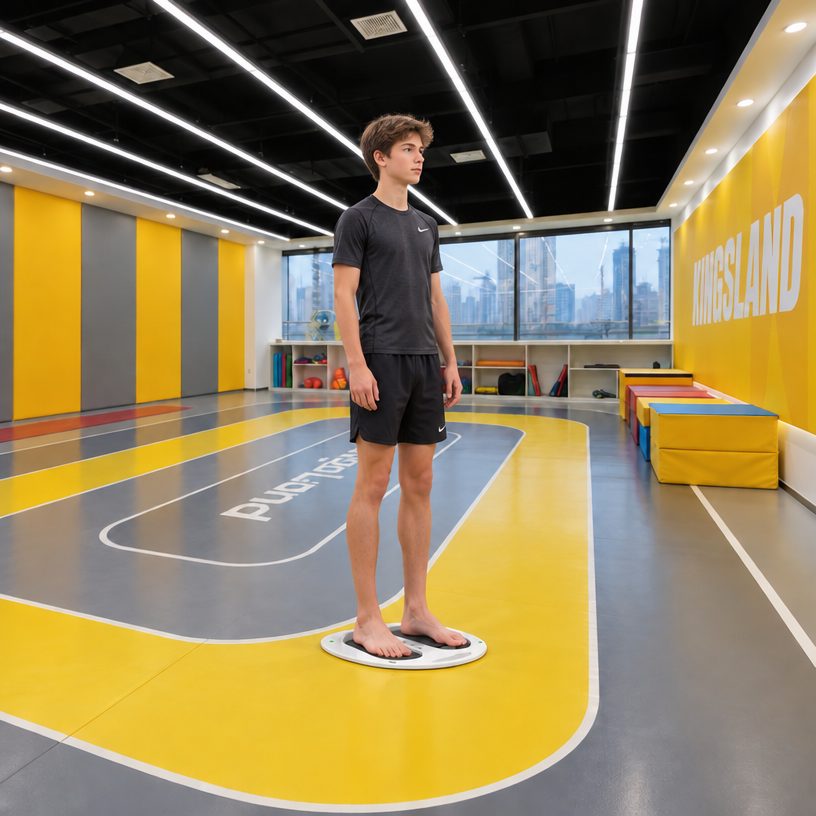
Fitting the machine into a real room and a real day
Specifications read better in brochures than in floor plans. Before ordering, measure the
actual space: the approach path a person walks, the plate’s position relative to the desk and
screen, whether the camera’s field of view stays clean when the room is busy. A walk-in
assessment needs a few clear steps of runway; a space that forces tight turns will degrade
every dynamic recording, and no software setting recovers it.
Then time the flow. A well-run session — greeting, static capture, dynamic passes, posture
capture, report walkthrough — fits comfortably into a standard consultation slot. If your
draft flow exceeds the slot, the remedy is usually in the sequence, not in faster hardware. Clinics
that design the session to a set number of minutes keep their day predictable and their
customers unhurried.
Staffing completes the picture: one trained operator can run the full capture, but the
first week should be practice on colleagues and volunteers, not billable sessions. The
equipment is simple to operate; the skill worth rehearsing is keeping the capture consistent —
same positioning, same instructions, same passes — so that recordings compare cleanly across
customers and across time.
Consistency has a second, less obvious beneficiary: the business’s own records. Assessments
that follow the same capture recipe can be compared month over month, which turns the equipment
from a service tool into a practice-management tool — session volumes, follow-up patterns and
re-measurement rates all become readable. None of that analytics is possible on recordings whose
conditions vary with whoever operated the machine that day. The discipline costs nothing and it
is the difference between a data archive and a data asset.
Software and reports: the part practitioners actually live in
Hardware captures once; software is touched all day. When comparing machines, spend the
disproportionate share of attention here. Who writes the analysis software — the manufacturer
or a licensed third party? Can report layouts adapt to your documentation style? How does data
export, and into which formats? What does the interface show during capture, when the operator
needs to confirm quality before the person steps off the plate?
We write our own analysis software, which is why these questions have concrete answers for
us: report sections can be adjusted to a clinic’s workflow, and the interface is designed
around the capture sequence rather than bolted onto it. A clinic evaluating any supplier
should ask the same questions and expect the same concreteness. Vague answers about software
predict friction for the life of the machine, because software is the surface the team
touches most.
A practical software test to run during evaluation, beyond the questions: ask the supplier
to record a complete session on video, screen included, without cuts. Watch for the moments
that matter — how the operator confirms a good stance capture, how walking passes are checked
for consistency, what happens when a pass is poor. Demos show successes; uncut videos show
processes. A supplier who provides one readily is describing a workflow they are proud of, and
a workflow you can evaluate before the machine arrives.
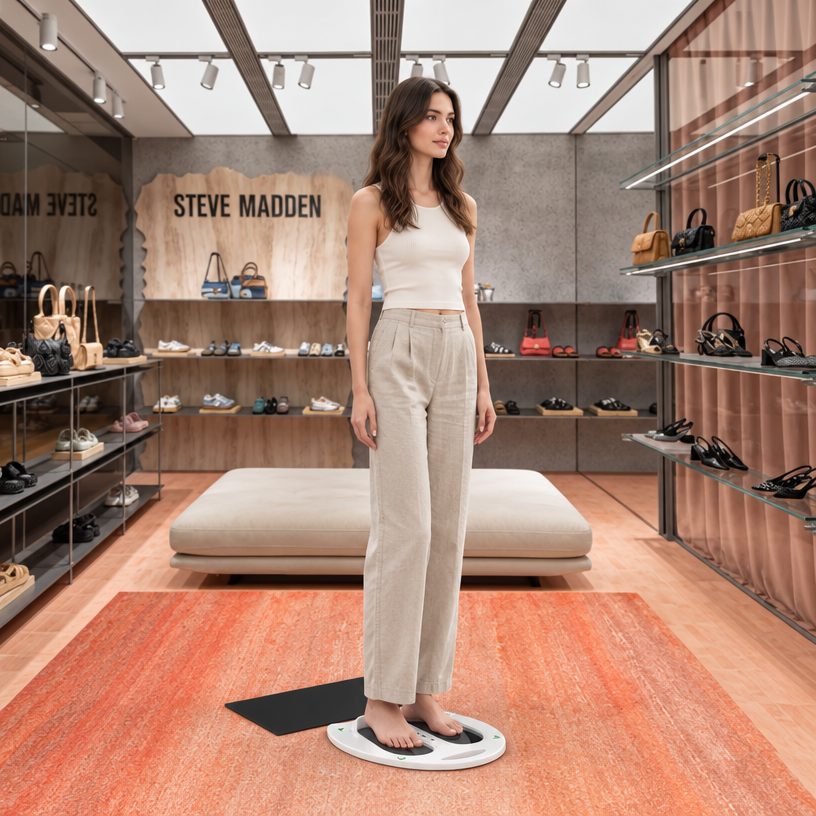
Ordering: quantities, testing and what arrives before the machine does
Clinics rarely need to over-order. Our minimum for machines is a single unit — we would
rather a clinic validate the workflow on one machine than fill a room on the strength of a
demonstration. Scaling afterwards is a re-order, not a redesign, and the data a first unit
generates makes the second purchase smarter.
Before any unit ships, it is tested in-house for seven days. Production runs at roughly
three to five machines per day — deliberately modest, because a testing regime that keeps pace
with output is the point. Ask any prospective supplier what happens between “finished
assembly” and “dispatch”; the answer reveals how the factory thinks about quality, and a
factory with nothing to show for that interval is telling you something.
Delivery planning is straightforward: six to seven working days by express, ten to twelve
by air, thirty to thirty-five by sea. What arrives with the machine matters as much as the
machine: setup guidance, report templates, and a support channel that already exists before
you need it.
Clinics sometimes ask whether they should standardise on one supplier’s ecosystem or mix
vendors across assessment, insole production and reporting. Our observation is that mixing
costs more than it saves: each interface between vendors is a place where data formats,
workflows and support responsibilities can drop, and the clinic absorbs those drops. A
single-source assessment-and-production chain — which is how our own range is built — removes
the seams. Whatever you choose, make the data format question explicit: what leaves the
machine, in what file, and who can read it.
After the invoice: warranty, support and the long relationship
Assessment equipment is a years-long relationship, and the fourth section of every clinic
purchase should be written for month fourteen, not day one. Our structure: a twelve-month
machine warranty covering non-human damage with free spare parts within scope; a dedicated
WhatsApp group per client with direct engineer access — not a ticket queue; remote assistance
where the setting allows; and over-the-air software updates for connected units, so
improvements reach the machine without a service visit.
Clinics comparing suppliers should translate these into their own terms: if the plate fails
on a Tuesday, who responds, in how many hours, and can the session run tomorrow? A supplier
that answers from direct operational experience — named engineers, a real response rhythm, a
remote path — is describing how it works. A supplier that answers with adjectives is
describing a brochure.
Worth adding: the service relationship is testable before purchase, and testing it is free.
Send a technical question by the ordinary contact route and measure the reply — not the
marketing reply, the engineering one. Ask something a real user would eventually ask, about
capture conditions or report exports. The speed, the specificity and the tone of that first
answer are a fair sample of the next several years. Buyers who run this test report being
surprised in both directions, which is precisely why it is worth running before the invoice
rather than after.
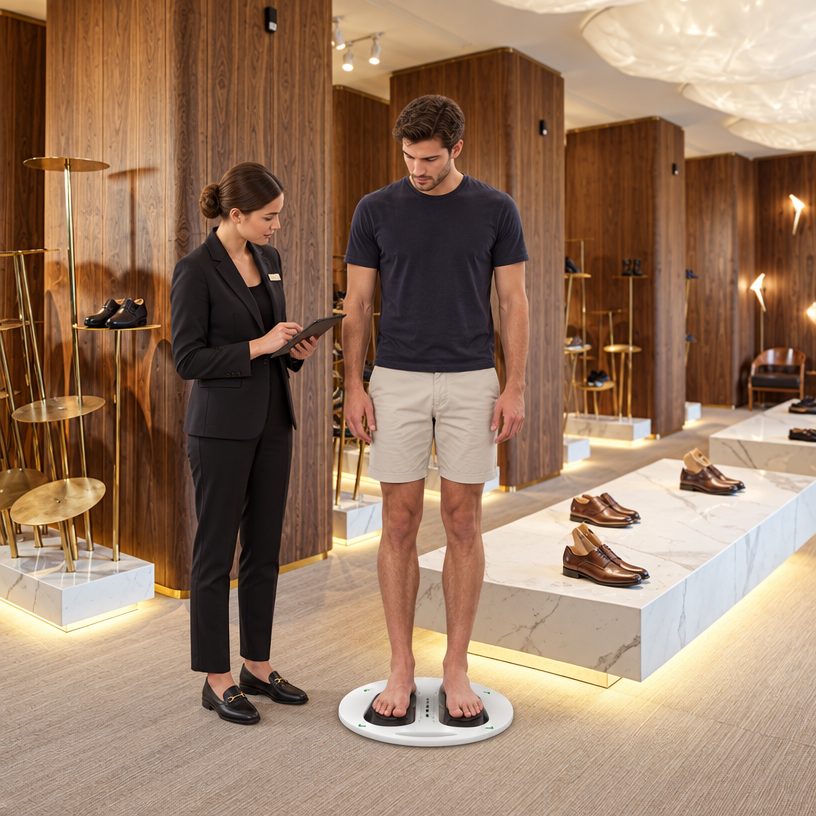
The three decisions, restated as a checklist
Decision one, the recording: pressure in stance, pressure in movement, posture and
alignment — named against your consultation, not against a listing. Decision two, the fit:
room, flow, minutes, staffing — checked with a tape measure and a stopwatch before ordering.
Decision three, the relationship: software ownership, testing regime, warranty scope, support
channel — written down and comparable across suppliers.
Run in that order, the process turns an ocean of listings into a short, checkable
comparison. It is the same order we use internally when advising a clinic, and it works with
every brand, including ours.
One last calibration for the checklist mindset: perfection is not the standard, closure is.
A supplier who answers every question with a named person, a process and a scope — even where
the scope is honestly limited — is a supplier you can work with for years. A supplier whose
answers are uniformly magnificent and universally vague is a supplier you will be
re-qualifying in month six. Clinics do not need their equipment partner to be flawless; they
need it to be findable, specific and stable. Write the checklist accordingly.
Frequently asked questions
Can a clinic start with a single machine?
Yes. Our minimum order quantity for machines is one unit. Most clinics validate the workflow
on one machine and re-order once their session volume justifies it.
Does the equipment assess both standing and walking?
Yes. The pressure plate records load distribution in static stance and across dynamic
passes, and the camera module captures posture and lower-limb alignment alongside the plantar
data.
Who writes the analysis software, and can reports be adapted?
We write our own software in-house, which is why report layouts and workflow steps can be
adjusted to a clinic’s documentation style rather than locked at a generic template.
How much space does an assessment setup need?
Enough for a stable plate position, a screen within the operator’s sightline, and a few
clear walking steps for dynamic capture. Sketching the actual room before ordering avoids most
layout surprises.
What testing happens before dispatch?
Every unit is tested in-house for seven days before shipping. Production runs at roughly
three to five machines per day, keeping the testing regime honest.
What does the warranty cover and what follows it?
Twelve months covering non-human damage, with free spare parts in scope. After delivery,
each client has a dedicated WhatsApp group with direct engineer access, remote assistance where
possible, and over-the-air updates for connected units.
Which certifications should a clinic verify?
Ours are European Union certification and ISO quality system certification, and we keep our
claims to exactly that scope. Ask every supplier to state theirs as precisely.
What we would do next
Sketch your consultation, then bring us the sketch: the F2
and FMP platform is the combined pressure-and-posture workflow most assessment rooms
settle on, and the technology overview shows how the modules
fit together. The clinic setup guide covers space and flow in
detail, the buyer’s guide and price guide
answer the questions that follow, and the contact page starts the
conversation with the factory that builds and supports the machines. For standing answers on
warranty and logistics, see the FAQ page.
This article is intended for professional and educational reference.
It is not medical advice. Foot assessment equipment produces measurements and images; clinical
interpretation and any decision about care remain the responsibility of a qualified professional.
Certification scope is limited to the documentation we hold: European Union certification and ISO
quality system certification.