
A gait analysis 3D scanner for foot assessment rarely fails in a clinic
because of the technology. It fails because of the room. Buyers spend months comparing
capture rates and report templates, then discover that the walking path they chose does not fit the
space they have, that a second pair of hands is needed for every appointment, or that nobody agreed
in advance who reads the report and where it is kept. The equipment arrives and works exactly as
specified; the service around it was never designed.
This article is about the part that comes after the specification: getting gait analysis running
as a routine service rather than an occasional demonstration. FOOTWORK LAB has built foot assessment
equipment since 2014, with our own plant in Ruichang, Jiangxi Province since 2018, and we install and
support these platforms for clinics, rehabilitation centres and workshops. What follows is the setup
list we work through with buyers — the decisions that are cheap to make at the planning stage and
expensive to discover afterwards.
Decide the question the platform has to answer
Before floor plans and before budgets, write down what the platform is expected to show. Gait
analysis equipment captures movement data: the plantar pressure pattern through the gait cycle, the
timing of the stance and swing phases, the trajectory of the centre of pressure, and how load
distribution shifts from one step to the next. Depending on the configuration, the same platform may
also record a static standing assessment and a lower-limb alignment view. These are measurements.
What they mean for a particular person, and what should happen next, is a professional judgement the
platform does not make.
That question decides the class of hardware you need. A clinic wanting a standing assessment plus
a slow-walking capture for structural and pressure work can often manage with a compact plate or a
short walkway. A setting that wants to observe running needs a runway or a platform with a treadmill,
which brings a different set of space and safety requirements. A rehabilitation service following
walking over time may value repeated, comparable passes more than a single detailed run — reliability
across sessions matters more than depth in any one of them. A workshop preparing for in-house
production needs the geometry to connect to whatever comes next.
It also decides who has to be in the room. If the platform is going to be read by a clinician who
was not present at the capture, the workflow has to be designed for that from the start, including
how records are labelled and handed over. If the same person captures and reviews, the room can be
simpler. Both are workable; they are not the same design.
Be clear about the boundary here, because it shapes expectations across the whole project. We build
a measurement platform. We do not provide clinical interpretation, and we do not suggest that the
equipment changes how anyone walks. Any supplier implying that the device makes the clinical call is
overstating what measurement hardware can do, and a clinic that buys on that basis will be
disappointed by equipment that is working perfectly.
Floor space, and the surface underneath it
Space is usually the binding constraint, not the machine. The platform itself may fit a modest
room, but gait analysis needs a run-up, a capture zone and a run-out, and those three together set
the minimum room length. Walking assessment needs a clear, level approach; running assessment needs
more of it, and needs it to be unobstructed. Ask any supplier for the working footprint including the
approach, not the footprint of the plate alone — the difference between those two numbers is where
most planning mistakes are made.
Floor and structure
Level, solid, non-slip flooring matters more than it sounds. A plate or walkway set on an uneven or
springy floor picks up movement that has nothing to do with the person walking, which shows up as
noise in the data. Some walkway designs sink a plate into the floor; others sit on the surface with
ramps at each end. The first gives a cleaner walking line but needs a floor that can be modified. The
second is easier to install and remove, but it adds transitions the person has to walk across, and
transitions change how people step.
Light, power and network
Camera-based channels need controlled light. A room with a window throwing hard afternoon sun
across the walking line will produce inconsistent captures at different times of day, and the
clinician will not always be able to tell why. Plan for blinds or for a windowless room. Confirm where
the power sockets are, whether the platform talks to the workstation over a cable or a wireless link,
and where that cable will run so that nobody trips over it during an appointment. Ceiling height
matters if the design uses overhead camera positions, and the ceiling is easy to forget until
installation day.
Sharing the room
Ask honestly whether the platform can coexist with other equipment. Many clinics cannot dedicate a
room as its own, and a platform that must be set up and packed away for every appointment will be
used far less than one that stays ready to run. If the room is shared, plan the storage for the ramps,
markers and accessories now, not after the first week.
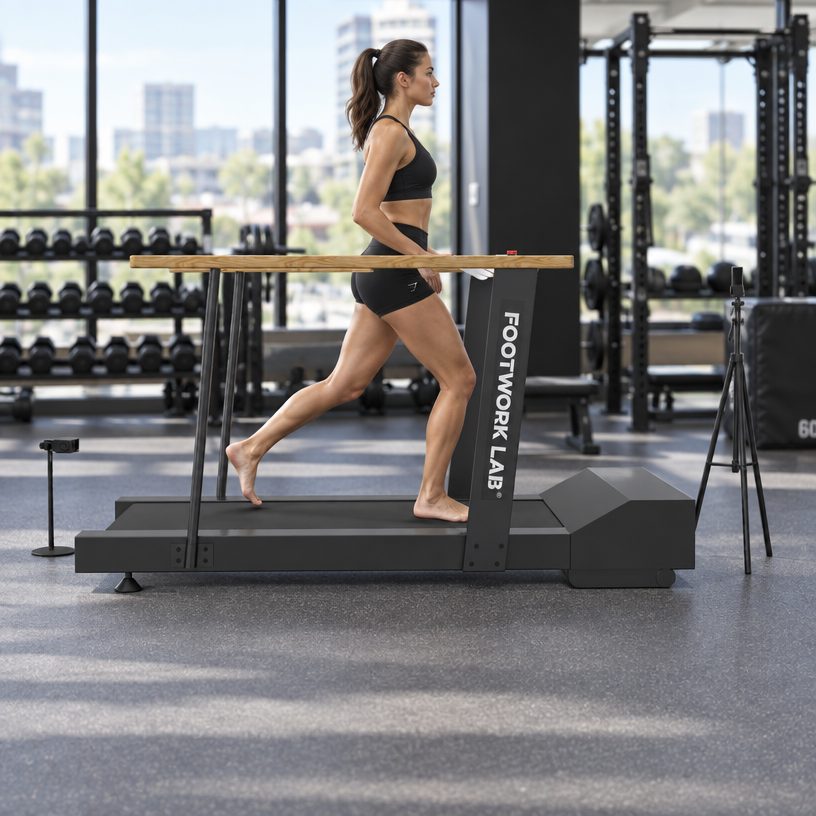
Patient flow: the route through the room
Once the equipment fits, design the appointment as a journey through the space. Where does the
person enter, and where do they sit to remove outer footwear? Is there somewhere they can warm up and
walk a few steps before the recorded passes, because the first steps anyone takes are rarely
representative? Where does the recorded walking line run, and can the person reach the end of it
without turning into a wall, a desk or another person?
The clinician’s position
The person running the assessment needs a clear view of both the walking line and the screen, and
should not have to walk through the capture zone to reach either. That usually means positioning the
workstation beside the line rather than at the far end. If the design involves markers or sensors
being attached, there needs to be a stable place to do that without the person balancing on one foot
for longer than is comfortable.
The review corner
Where does the report get discussed? In many clinics this is an afterthought, and the result is a
clinician turning a screen away from a seated person and describing an image they cannot see. A
review position — a chair or two facing a second screen or a wall display — turns the data into a
conversation and makes the appointment feel finished. It costs almost nothing at the planning stage
and is awkward to add later.
Privacy deserves the same thought. If the room has a window to a corridor or a door that opens
without warning, the flow needs a screen or a curtain in the right place. Nobody performs at their
best while being watched, and a person who is self-conscious about how they walk will not produce a
representative capture. The room design quietly influences the quality of the measurement.
How long an appointment really takes
The single most common planning error is budgeting for the capture and forgetting everything
around it. A realistic gait assessment appointment contains several distinct blocks, and only one of
them is the part the datasheet describes.
The blocks to plan for
- Check-in and preparation. Removing outer footwear, explaining what will happen,
answering questions, and setting up any markers or sensors. - Warm-up passes. Unrecorded walking so the person settles into a natural pattern
before anything is captured. - Recorded passes. Several repetitions, because a single pass is rarely enough and
the operator will usually discard some. - Data handling. Labelling, saving and, where the report is not generated
automatically, assembling the output. - Discussion. Reviewing the result with the person, which is where the value of the
appointment actually lands.
Ask for a demonstration that runs through the whole sequence rather than the capture alone, and
time it. Then add a margin for the passes that get spoiled and the questions that take longer than
expected. Two people make the appointment faster but not twice as fast, and if the second person is a
clinician whose time is expensive, the arithmetic may favour a one-operator workflow. Decide that
deliberately rather than defaulting to it.
Expect the first weeks to run slower than the steady state. Staff are learning the software, the
room layout is still being adjusted, and everyone is being careful. A clinic that plans for the
settled pace and then meets the learning curve can feel that the equipment has underperformed; the
equipment has not changed, the routine just has not formed yet.
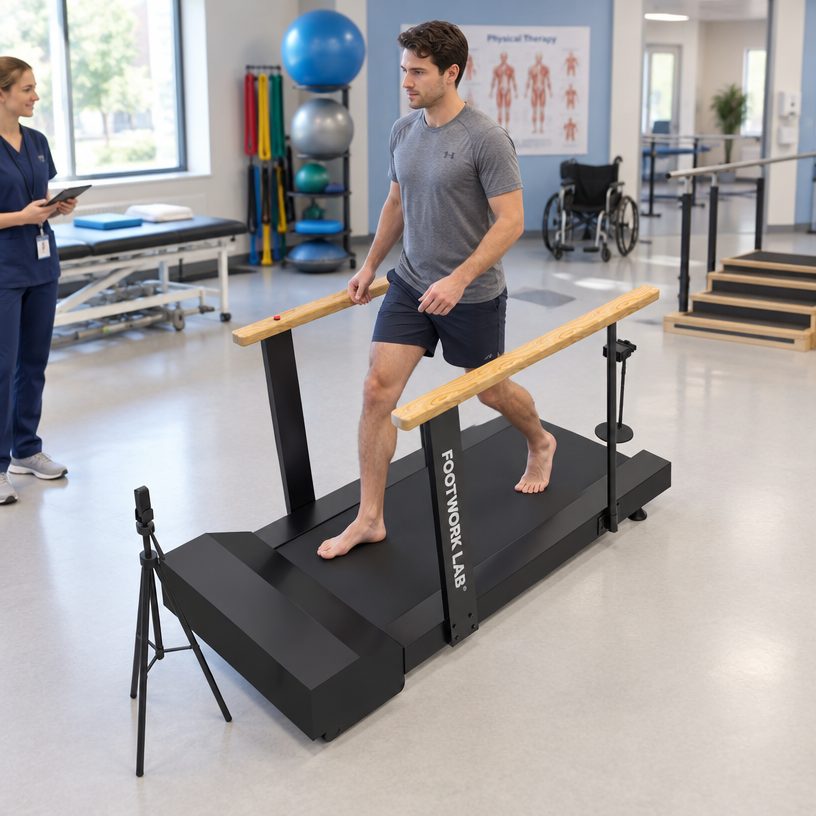
Where the data goes, and who reads it
Gait data accumulates quietly and then becomes a problem. Settle the storage question before the
first appointment, not after the first hundred.
Local, networked or cloud
Is captured data stored on the platform itself, on a local workstation, or in a cloud account? Each
has consequences for backup, access and continuity. A machine holding the only copy of two years of
assessments is a single point of failure. A cloud account raises its own questions about who holds
the account and what happens to the data if the subscription ends. Ask how records are backed up, how
they are searched, and what the plan is if the workstation is replaced.
Who writes and who reads the report
If several staff members capture and one clinician reviews, the software needs to support those
roles without everyone sharing a single login, because shared credentials make the record ambiguous.
Decide in advance who owns the final report, whether it carries your clinic’s branding, and whether
copies are given to the person or to a referring professional. This is a policy decision as much as a
software feature, and it is easier to agree before the first report is produced than after.
Getting the data back out
Confirm the export formats. If the platform is part of an in-house production path, or if the data
must move into a records system, the ability to export raw measurements — not only a formatted report
image — is a functional requirement, not a nicety. Ask to see an actual export file during the
demonstration. A report that can only be viewed inside the manufacturer’s tool is a limitation you
discover at the worst possible moment.
Software also ages. Ask how updates reach the machine, whether over the air while it is online or
by installer file, and what happens when the operating system the software depends on reaches end of
life. Our own machines accept over-the-air updates when connected, which keeps an installed base
current without arranging a technician visit.
The practical difficulties that get underestimated
Three things recur whenever we help a clinic go live, and they are almost never on the buyer’s
planning list.
Installation, calibration and the daily check
A platform needs to be installed level and checked against a reference, and it needs a short
routine check before use. Ask what that check involves and who performs it, because a device that is
never checked drifts without announcing it. Confirm that a calibration procedure and a software
reference are part of the documentation delivered with the machine, not an extra to be requested
later. Our units go through a seven-day test cycle before dispatch, and the documentation that comes
with the machine is the same one we use in that test.
Staff turnover and room booking
The person who was trained on the platform leaves, and the replacement has never seen it run. Plan
for retraining as a recurring cost, not a one-off. In the same way, a shared room needs a booking
convention from day one; without it the platform quietly loses its slot to whatever is more urgent
that week, and the service fades.
The gap between the demonstration and the routine
A demonstration is run by a specialist on a good day with a cooperative volunteer. The routine is
run by a busy staff member at the end of a long list, with a person who would rather be somewhere
else. The way to close that gap is to design the routine for the worst day, not the best one:
everything in its place, a predictable sequence, and a hardware design that lets a single module be
replaced without shipping the whole platform. Our machines are built on a modular structure for
exactly this reason, and each customer has an after-sales group with our engineer in it, so a fault
can often be assessed from photographs and video, or through remote assistance with the buyer’s
consent, rather than a site visit.
None of this is dramatic. It is the difference between a platform that is used weekly for years and
one that is impressive at the open day and idle by the following quarter.
Frequently asked questions
Are you a manufacturer or a trading company?
We are a manufacturer. FOOTWORK LAB has been developing and producing foot assessment equipment
since 2014, and has operated its own production plant in Ruichang, Jiangxi Province since 2018.
Development and production are done in-house.
Can a single clinic buy one platform, or is there a minimum order?
For machines, the minimum order is one unit. We would rather a clinic start with a platform it can
use routinely and expand later than commit to a fleet it cannot deploy yet.
Does the platform produce a diagnosis?
No. The platform produces measurements and images — pressure patterns, gait timing, centre of
pressure and related data. Interpreting those measurements and deciding what to do next remain the
responsibility of a qualified professional. The equipment does not make that call and should not be
presented as if it does.
How much room does a gait analysis platform need?
It depends on the configuration and on what you want to observe. Walking and running assessment
need different amounts of clear run-up, capture zone and run-out, so the useful figure is the working
footprint including the approach, not the size of the plate alone. Send us a plan or a photograph of
the room and we will tell you what will work in the space you have.
How long does installation and training take?
Installation is typically quick once the room is prepared; the longer part is staff training and
the first few weeks of routine. We plan for a settling-in period rather than assuming the first
appointment runs at full pace, and we would encourage any buyer to plan the same way.
What happens if a part fails after delivery?
The machine carries a twelve-month warranty covering non-human-caused failures, with free parts
during that period. Our machines use a modular design and the software includes remote-control
functionality, so in many cases we can identify and resolve an issue from video and photographs, or
through remote access given your consent. Each customer also has an after-sales group including our
engineer for direct support.
Can the data be exported, and can the software be updated?
Yes. Measurements can be exported for use in your own systems or downstream production, and where
the machine is connected to the internet, software updates can be pushed when a new version is
released. Because we develop the software ourselves, custom report fields and additional languages
are possible and are quoted separately.
What we would do next
Start with a single sheet of paper. On it, write the question the platform must answer, the number
of people who will run it, where the walking line will go, where the data will be stored and who reads
it. If the walking line does not fit the room on that sheet, no specification will rescue the project.
If it does, the rest becomes a sequence of ordinary decisions.
If it would help, send us the room dimensions and a description of your routine and we will tell
you which configuration fits — and which parts of it you can leave out. The
F5 LAB gait and running platform page describes the
platform this article is based on, and the
guide to reading plantar pressure and gait data covers what the output
actually contains. For the boundaries of what this kind of measurement can and cannot tell you, see
gait analysis: what it can and cannot tell you. To talk through a specific
room or layout, the contact page reaches the team directly.
This article is intended for professional and educational reference. It is
not medical advice. Foot assessment equipment produces measurements and images; clinical
interpretation and any decision about care remain the responsibility of a qualified professional.
Certification scope is limited to the documentation we hold: European Union certification and ISO
quality system certification.