
A runner steps onto the treadmill, the belt starts, and two screens fill up at once: one showing pressure moving under both feet, the other showing how the body holds itself over each stride. That is the moment buyers of a gait analysis system usually realise the product they are comparing is not one instrument but a set of instruments that have to agree with each other. Search the term and you will find everything from a single sensor mat to a full laboratory, which leaves clinics, gyms and sports venues asking a fair question: what does a complete system actually consist of, and which part does the work I need? This guide walks through the F5-LAB piece by piece — the treadmill-form main unit, the two cameras, the software — and describes whom each part serves, for buyers deciding whether the whole set belongs in their room.
The manual names the product a Dynamic Gait Detection System, and its opening description is precise about the job: it measures and analyses pressure distribution and body posture during walking and running, automatically identifies the gait pattern, and provides clinical gait parameters. The fields it lists are medical rehabilitation, sports scientific research and footwear. Every component in the box exists to serve one of those three sentences, so the clearest way to judge the purchase is to follow the components rather than the marketing sheet.
Unpacked, the F5-LAB is a main unit built in the form of a treadmill, two cameras with their mounting brackets, a hub, USB data cabling, an installation manual, a user manual and an installation toolkit. Three of those items do the measuring — the belt surface, the camera pair, and the software that binds their signals together — while the rest exist to make the first three installable and maintainable in a normal room.
The division of labour is worth stating plainly, because most pre-sales confusion we hear starts here. The main unit answers what happens under the feet. The cameras answer what happens above them. The software merges the two into one timed record, so that a pressure event and a posture position can be read against the same stride instead of against two separate timestamps. A buyer who understands that split can walk into a negotiation knowing which capability they are actually paying for — and, just as usefully, which one they are not.
We keep a longer checklist for people comparing suppliers — what to verify about the factory, the warranty and the service years — in a separate article on buying a gait analysis machine. This one stays on the composition question: what the parts are, and who each one works for.
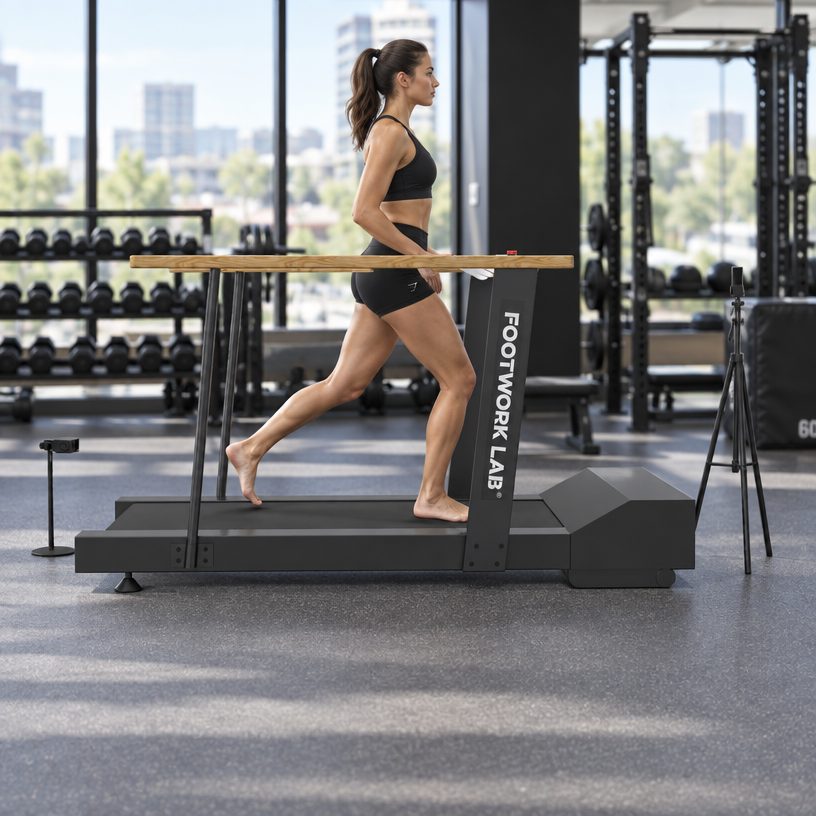
The treadmill main unit: the walking and running record under the feet
The main unit is the part most people picture first, and it carries the pressure layer of the record. The walking surface runs on Sinmec flexible-fabric sensing, which registers how load distributes under each foot while the person moves. Because the surface accepts both slow walking and sustained running, the capture covers the two states the manual names: gait cycle detection and evaluation, and dynamic pressure assessment analysis.
In practice those two functions serve different rooms. A rehabilitation hospital is usually interested in the walking state — how load transfers from heel contact through midstance to push-off, stride after stride, on a surface long enough to hold several full cycles without the patient turning around. A sports venue or a performance programme is more often interested in the running state, where both feet leave the ground and the load pattern compresses into a shorter, harder contact window. The same surface serves both, but the protocol, the speed range and the questions differ, which is why we ask buyers which state they will run most before we recommend a configuration.
One of the software’s signature outputs depends entirely on this surface: the dynamic bipedal butterfly line, a presentation that traces the pressure path of both feet across successive strides so the two traces sit mirrored on the screen. Read side by side, the two wings make asymmetries hard to miss. At a Canton Fair booth we watched a sports-science lecturer stop mid-sentence the first time the butterfly line drew itself live on the demonstration unit — she had been showing students photographs of footprints for years, and the continuous trace showed in one screen what a shelf of prints could only suggest. That display does nothing without the sensing surface beneath it, which is the main unit’s claim to its share of the budget.
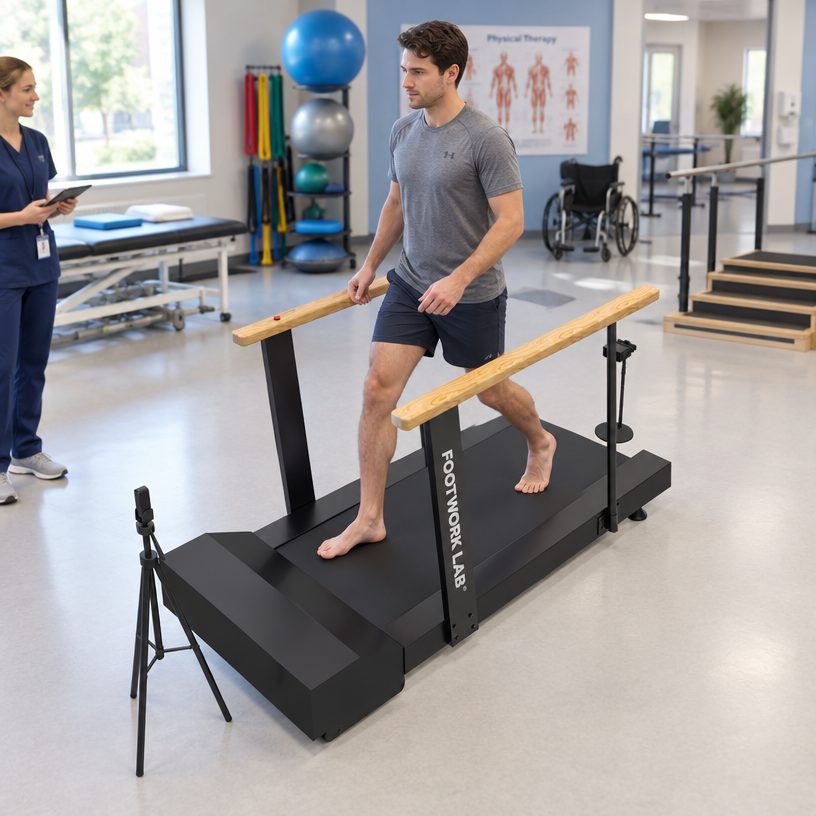
The two cameras: posture recorded beside pressure
The camera pair is the part buyers most often misunderstand, and it is worth a paragraph of precision. The two cameras, mounted on their brackets at the positions the installation manual specifies, feed the BodyftAi machine-vision layer that performs motion posture assessment — where the body holds itself over the stride, captured at the same time the belt records the load underneath. The hub and cabling synchronise the streams, which is what allows the software to present a posture frame and a pressure frame from the same moment of the gait cycle.
What the cameras do not do is capture foot shape. Some of the market vocabulary — buyers searching for three-dimensional shape capture, for instance — refers to a different product category entirely, one that records the geometry of the foot rather than its behaviour under load. On the F5-LAB the cameras record alignment and movement: how the trunk, pelvis and legs position themselves while the feet do the work. A rehabilitation department uses that pairing to see, in the same session, both how load lands and how the body compensates around it. A gym uses the posture layer to open a training conversation that a pressure map alone would not justify.
In our pre-sales calls this is the question that keeps returning: whether a single pressure surface would be enough. Our answer depends on whether the buyer’s service ever needs to explain the body above the foot. If every question they face ends at the sole, the cameras are spare capacity. If the report ever needs to show a physical therapist why the load landed where it did, the synchronized posture record is the part that makes that conversation possible.
The software: who the finished report serves
The software layer is where the system stops being hardware and starts being a service. It merges the belt and camera streams, runs the analysis the manual describes — automatically identifying the gait pattern and generating the parameter set — and produces the report through AI-assisted report generation. Clinical gait parameters, phase breakdowns, pressure visualisations and the butterfly line all arrive in one document that a non-specialist can follow and a specialist can interrogate.
Three different readers take three different things from that document. The podiatry clinic reads the clinical parameters against its own assessment routine and keeps the record for follow-up comparison. The sports venue reads the running-state data as a baseline and re-tests across a training block. The footwear field — the third application the manual names — reads the pressure and posture record as an input to shoe and last decisions, which is why the report travels well beyond the room where it was captured.
The software also carries the service commitments that outlast delivery. Where a buyer needs a particular report layout or workflow, the software can be customised, and that work is quoted separately from the equipment. Connected units receive over-the-air updates, and support runs through a dedicated WhatsApp group with our engineers, with remote assistance wherever a screen can be shared. On one support call we walked a rehabilitation hospital through re-synchronising their camera brackets after the units had been moved during a room rearrangement — nothing was broken, but the posture frames had drifted out of step with the pressure record, and the merged report quietly lost the alignment it was built for. Ten minutes on a shared screen restored it. That is the less visible half of the software layer’s job: keeping the three parts of the system agreeing with each other over years, not just on installation day.
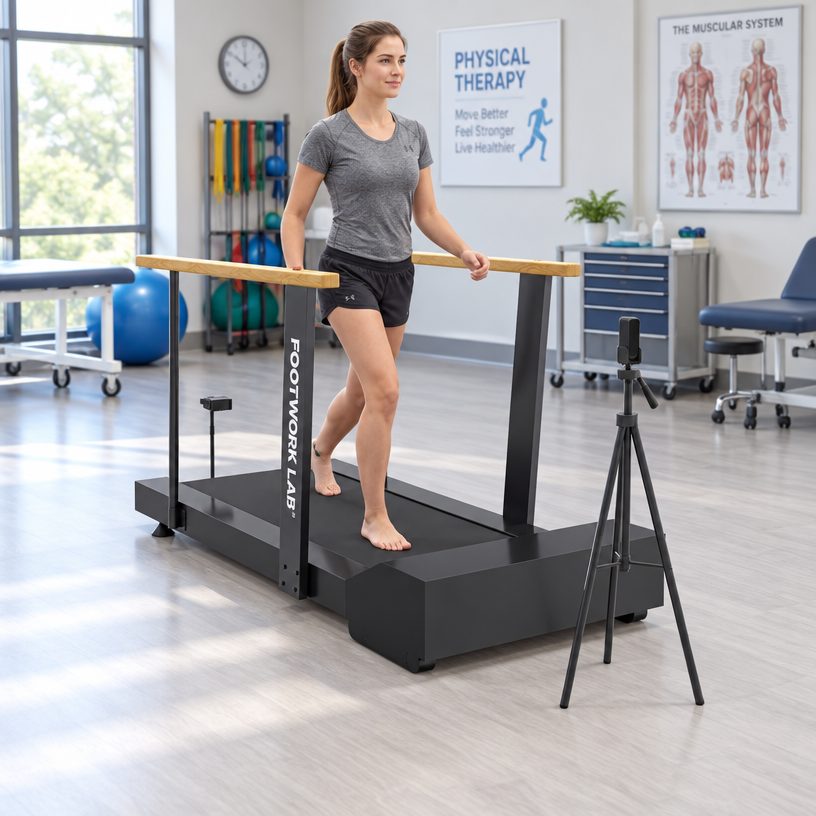
Matching each part of the gait analysis system to a room
The manual lists four application scenarios — rehabilitation hospitals, sports venues, podiatry clinics and gyms — and the mapping between rooms and parts holds up well in practice. A rehabilitation hospital leans on all three layers: the walking-state record for patient sessions, the posture cameras for the compensation picture, the software for the follow-up comparison that progress reviews need. A sports venue is the most treadmill-forward buyer: running protocols, repeated baselines, and the butterfly line as a coaching display. A podiatry clinic uses the clinical parameters most heavily and treats the treadmill capture as the dynamic complement to its existing static tools — a role the F2 pressure plate fills from the other direction, which is why we sometimes see the two devices in one practice rather than either alone. A gym typically wants the shortest useful session: capture, report, conversation, booking.
The composition question, asked honestly, usually answers itself once the buyer writes down which of those four rooms they are. A venue that never sits with patients does not need the deepest report customisation; a clinic that never runs does not need the fastest belt. The system is modular in its use long before it is modular in its price, and the buyer who knows which parts they will actually exercise is the one who orders once and keeps the unit busy.
Frequently asked questions
What exactly arrives with an F5-LAB system?
The product package list covers the F5-LAB main unit in treadmill form, two cameras with two mounting brackets, a hub, USB data cabling, an installation manual, a user manual and an installation toolkit. Everything needed to install the three measuring layers — belt, cameras, software — ships in the same set.
Can the F5-LAB record running as well as walking?
Yes. The manual defines the system as measuring and analysing pressure distribution and body posture during both walking and running, with the gait pattern identified automatically and clinical gait parameters provided. Walking and running are different capture states with different protocols, and the belt surface supports both.
What is the butterfly line in the report?
Dynamic bipedal butterfly line analysis is one of the system’s four core functions. It presents the pressure path of both feet across successive strides as two mirrored traces, which makes left-right asymmetries visible at a glance. It is a presentation of the pressure record, not a separate measurement.
Do the two cameras scan the shape of the foot?
No. The cameras feed a machine-vision layer that performs motion posture assessment — how the body holds itself over the stride, synchronised with the pressure record. Foot-shape capture is a different product category; the F5-LAB records pressure and posture behaviour under load, which answers different questions.
How is the system supported after delivery?
Support runs through a dedicated WhatsApp group with our engineers, with remote assistance where a screen can be shared, and connected units receive over-the-air updates. Software customisation for a particular report layout or workflow is available and quoted separately from the equipment.
Which facilities is the F5-LAB designed for?
The manual lists rehabilitation hospitals, sports venues, podiatry clinics and gyms as application scenarios, with the system applied in medical rehabilitation, sports scientific research and the footwear field. The parts divide the work: belt for pressure, cameras for posture, software for the merged report each room reads differently.
What we would do next
Write down the two or three sessions your room will actually run — walking protocols, running protocols, posture capture — and who operates each one. Send that list with your floor dimensions through our contact page, and we will tell you which parts of the F5-LAB your plan exercises fully, which it barely touches, and whether a lighter configuration would serve the same sessions. The F5-LAB dynamic gait running platform page carries the product overview, and our FAQ page lists the order, warranty and delivery terms in full.
If you already run a static pressure plate and are weighing the jump to a dynamic platform, read the comparison between a pressure plate and a gait treadmill first, and the overview of the F2 and FMP foot assessment systems for the static side. The two purchases solve different problems, and the clearest signal is whether your unanswered questions sit under the foot or above it.
This article is intended for professional and educational reference. It is not medical advice. Gait analysis equipment produces measurements and images; clinical interpretation and any decision about care remain the responsibility of a qualified professional. Certification scope is limited to the documentation we hold: European Union certification and ISO quality system certification.