
A sports insole is not a firmer version of an everyday insole, and
treating it that way is why so many of them end up unworn. Walking, training and
competition place different demands on both the foot and the footwear, and the design decisions that
answer one demand often work against another. Added structure that helps during controlled training
can feel intrusive at speed. Additional cushioning that suits long sessions can blur the feedback a
competitor relies on. Weight that goes unnoticed during a walk becomes a factor over a longer
session. The product that works is the one specified for a particular activity, not the one that
scores well on every count.
FOOTWORK LAB produces custom orthotic insoles at roughly five hundred to one thousand pairs per
day from our plant in Ruichang, Jiangxi Province, where we have manufactured since 2018. Our sports
family sits alongside everyday and rehabilitation-oriented designs, and we accept both ODM and OEM
across the range. What follows is how we approach a sports specification with a retailer,
distributor or clinic, including the questions that usually decide the outcome.
The same foot, three different demands
Start by separating the activities, because they are genuinely different problems.
Walking
Walking is a repeated, relatively low-intensity loading cycle sustained for long periods. The
priorities are comfort over hours, predictable behaviour, and a design that does not demand
adaptation from the wearer. Durability matters more here than peak performance, because the pair may
be used daily for months.
Training
Training introduces variation: direction changes, repeated loading, and sessions that may last
considerably longer than the activity being prepared for. Designs here often need to balance
supportive structure with enough cushioning to survive volume, and the shoe itself usually offers
more internal room than a competition shoe.
Competition
Competition is the shortest and most demanding phase. Feedback from the ground, weight, and
consistency of behaviour under high loading all matter more than long-duration comfort. A design
optimised for training volume is rarely the design a competitor wants on the day.
Because these demands differ, a single pair rarely serves all three well. Where a client supplies
all three contexts, the practical approach is to define a family with variants rather than one
compromise product — and to be honest with the wearer about which variant is intended for which
use.
What changes as activity intensity rises
Three properties shift as intensity increases, and understanding the shifts makes the
specification conversation much shorter.
- Loading rate. Higher intensity means load arrives faster and repeats more
often. Materials that respond well to slow loading are not necessarily suited to rapid loading, and
the difference is felt by the wearer rather than visible on a data sheet. - Tolerance for added thickness. A thicker design is often comfortable at
walking pace and intrusive at speed, partly because of the internal volume of competition footwear
and partly because of how the foot expects to sit. - Value of ground feedback. As intensity rises, wearers increasingly want to feel
the surface. Excess cushioning reduces that feedback, which is a genuine trade rather than a
quality failure.
There is a fourth shift that buyers often miss: the shoe changes as well as the activity. Sports
footwear spans a wide range of internal volumes, from roomy training models to tightly built
competition shoes. The same foot data applied to two different shoes produces two different
specifications, and the shoe should be decided before the design is drawn.
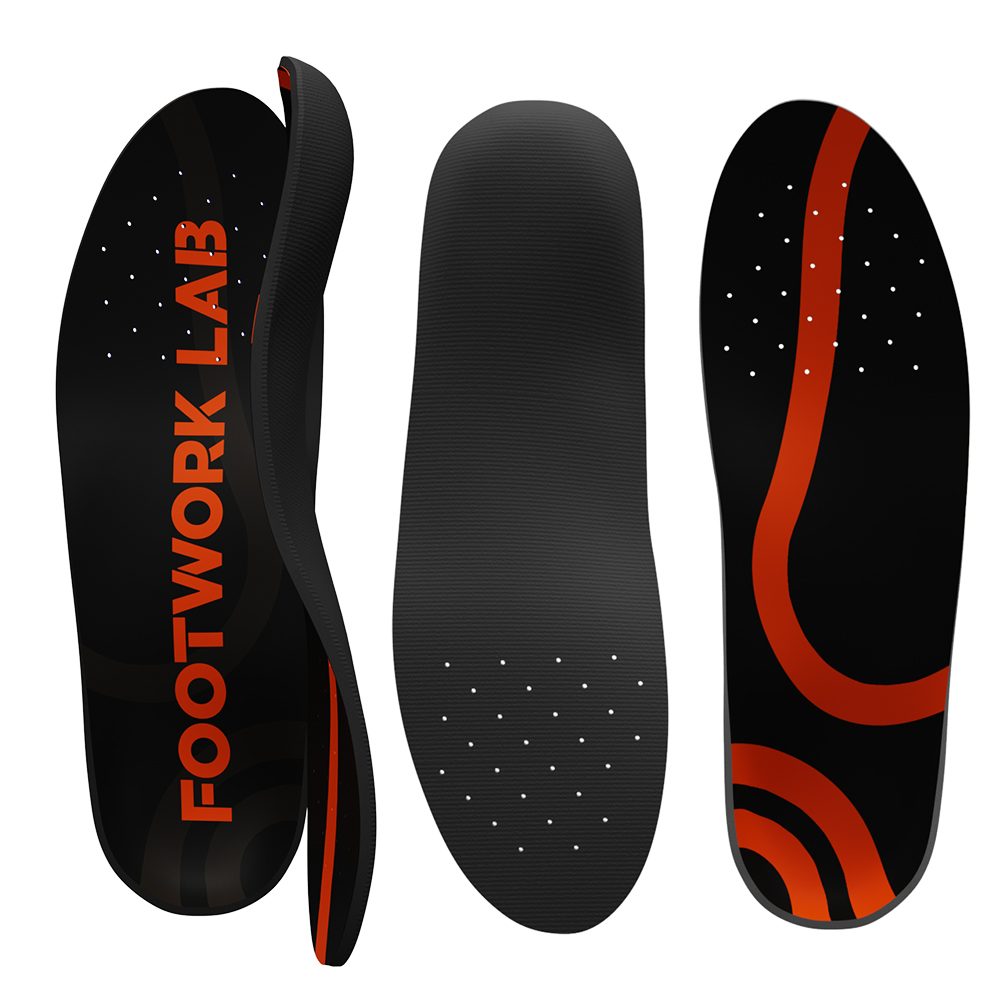
Cushioning, structure and weight: the three-way trade
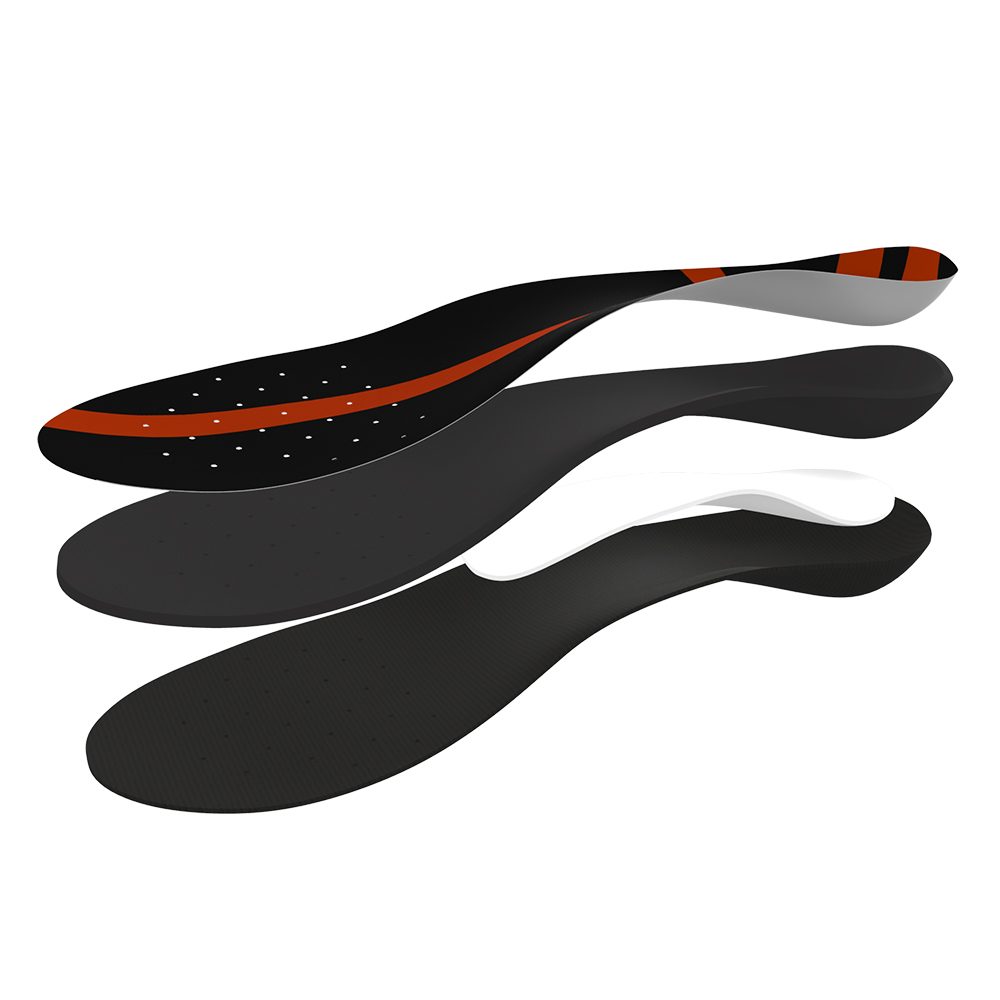
Every sports insole sits somewhere on a three-way trade between cushioning, structural support
and weight. Improving one usually costs something on another, and a supplier who claims otherwise
is either simplifying or overselling.
Cushioning absorbs and distributes load, which contributes to comfort over time.
It also adds thickness and mass, and it reduces the closeness of the contact between foot and
ground.
Structural support maintains the position and shape of the arch region under
loading. It contributes a sense of control, and it adds firmness that some wearers find intrusive at
high intensity.
Peso is the property most easily measured and least often discussed. Lower
mass is generally preferred, but achieving it usually means removing material from somewhere, and
that somewhere is usually cushioning volume or structural depth.
The right position on the trade depends entirely on the intended use, which is why specifying by
activity is more useful than specifying by preference. A pair intended for long training sessions
and a pair intended for a short competition effort should not be expected to look the same on
paper, and clients who understand the trade tend to be far happier with the outcome.
Two of those properties are frequently confused, so it is worth separating them. Intensity describes how hard the activity is at a moment in time; volume describes how much of it accumulates. A long training session at moderate intensity and a short competition effort at high intensity place quite different demands on a design, and they are not interchangeable. Clients who describe both, rather than describing only one, tend to receive specifications that match what they actually need.
Volume inside sports footwear: a constraint that varies by sport
The internal volume of the shoe governs how much design can physically fit, and sports footwear
varies more in this respect than almost any other category. Training shoes often have a removable
footbed, generous depth and a flexible upper. Competition shoes may be built tightly with little
spare room. Court shoes, field shoes and cycling shoes each bring their own geometry.
The practical consequence is that a sports insole specification should always name the footwear.
Not the sport — the shoe. Two training shoes from different manufacturers can differ enough in depth
and last shape that a single design behaves differently in each, and a client who supplies both
should decide whether to accept a compromise or to specify separately.
There is a second consequence worth flagging to wearers. Ask whether the existing footbed can be
removed. Where it can, the insole takes its place and the net change in volume is modest. Where it
cannot, the insole is added on top, and the wearer may need to allow for a slightly different feel
during the first sessions. Neither outcome is a defect; both are foreseeable, and either is
preferable to a pair that does not fit.
It is also worth deciding early who will explain the design to the wearer. In a clinic or a specialist retail setting, that conversation is usually straightforward. In a distribution business, the explanation has to be carried by packaging, labelling or a leaflet, and the wording needs to be agreed before the order is placed rather than after. This is one of the practical advantages of working directly with a factory: material intended for the end user can be produced alongside the product.
How a sports pair is specified in practice
In our experience a productive sports specification follows a set order, and the order matters
because each step constrains the next.
- Name the activity and the footwear. One line each. Everything downstream depends
on this. - Establish the available volume. Whether the footbed is removable and what
remains underneath it. - Decide the position on the cushioning, structure and weight trade. Explicitly,
not by implication. - Choose the material layering that delivers it. Material follows function rather
than leading it. - Confirm how the pair will be formed and how consistently. Batch consistency is
what makes a reorder the same product. - Agree the minimum quantity and the sample. Our insole minimum is two hundred
pairs with models and sizes mixable, and samples ship within three days.
Two of those steps deserve a note. Step three is where client expectations are set, and it is
worth writing down what was agreed, because it becomes the reference for judging the result. Step
five is where many buyers stop asking questions, and it is the step that determines whether the
second order matches the first.
Where a client also measures the foot, the data feeds step three directly. We manufacture the
equipment as well as the insoles, so a clinic can capture data and specify a design within one
supplier relationship; the technology overview describes how the
measurement and forming stages connect.
Durability, replacement and what to expect over a season
Sports insoles are consumables in a way that everyday pairs are not. Loading is higher, sessions
are more frequent, and the design is often closer to its performance limit. Buyers who plan for
replacement are not admitting weakness; they are being realistic about a product used under load.
Three questions help a client plan. How does the design behave after extended use rather than on
the first day? What signals indicate the pair has reached the end of its useful service? And how
consistent are reorders with the original specification? A supplier who can answer all three in
plain language is giving a buyer something more valuable than a durability promise.
On claims, we stay deliberately narrow. Our documentation covers European Union certification and
ISO quality system certification, and we describe exactly that scope. We do not extend certification
language, and we do not quote figures for a general specification, because the honest number depends
on materials, layering, quantity, packaging and destination. Clients who need a number get one
against their actual requirement.
Inspection and consistency
Inspection in insole production runs from incoming materials through forming to a check of the
finished pair against the agreed design. Where a batch does not conform, it is addressed at the
point of detection rather than shipped with a note. This is mundane to describe and significant in
practice, because consistency between reorders is what a sports client is really buying after the
first order.
Producing at volume
Capacity sits at roughly five hundred to one thousand pairs per day. Clients whose demand clusters
around seasons should discuss scheduling early, since capacity is finite everywhere and a
well-planned year is easier to serve than a short-notice peak.
It is worth closing the commercial loop on planning. Clients who order seasonally benefit from agreeing a rough annual pattern at the start of the relationship, even if individual orders are placed later. Knowing that demand clusters around particular months allows a supplier to reserve capacity, and it allows the client to avoid the situation where a specification is agreed in plenty of time but the schedule is not. Our insole line runs at roughly five hundred to one thousand pairs per day, and that figure is easier to allocate with notice than without it.
What sports insoles are not
Restraint is part of accuracy, so the boundaries are worth stating.
A sports insole is a support and alignment product. It is not a device that changes the structure
of a foot, it is not a performance enhancer and it carries no promise of an outcome, and it is not a substitute for
professional judgement about a person’s care. Decisions about what a particular athlete needs belong
to a qualified professional who has examined them, and the insole is one part of that decision.
This shapes how we work with clients. When a requirement moves into clinical judgement, the right
response is to refer the question back rather than to adjust a product specification and imply an
outcome. We also avoid comparing our products against named competitors, and we avoid describing our
range as the best available. A buyer should compare specifications and decide; our contribution is
to make that comparison accurate.
Frequently asked questions
Can one pair of insoles cover walking, training and competition?
Often not well. The three activities place different demands on cushioning, structure, weight and
footwear volume, so where a client serves all three contexts we would usually define a family with
variants rather than a single compromise design.
How do I know which footwear volume a design will fit?
Name the actual shoe rather than the sport. Ask whether the footbed is removable and what remains
underneath it. Sports footwear varies widely in internal volume, and two training shoes from
different manufacturers can behave differently with the same design.
What are your minimum quantities for sports insoles?
Two hundred pairs, with models and sizes mixable within a single order. That lets a retailer or
clinic trial a range across real footwear before committing a full order to one specification.
How quickly do samples ship, and do you support custom design?
Samples ship within three days. We accept both ODM and OEM on insoles, so a design can either be
adapted from our existing families or built to your own specification.
How long should a sports pair last?
It depends on loading, frequency and the intended activity, which is why we describe expected
behaviour over time rather than promising a set service life. Ask what signals indicate the pair
has reached the end of its useful service in your particular context.
Does the measurement equipment matter for a sports specification?
It helps, because loading data informs the position chosen on the cushioning, structure and
weight trade. We manufacture the equipment as well as the insoles, and the machine minimum order
quantity is a single unit.
What certification applies, and what is your production capacity?
Our documentation covers European Union certification and ISO quality system certification.
Insole capacity is roughly five hundred to one thousand pairs per day.
What we would do next
Write the activity and the shoe down first, then decide the position on the cushioning, structure
and weight trade, and only then choose the material layering. If you want to see how a
measurement-led specification works in practice, read
how arch support is specified from foot data and
what goes into an arch support insole. The
insole categories page shows how our families are grouped, and the
FAQ page covers quantities, samples and scheduling. For a specification
discussion against your own footwear list, contact the team.
This article is intended for professional and educational reference.
It is not medical advice. Foot assessment equipment produces measurements and images; clinical
interpretation and any decision about care remain the responsibility of a qualified professional.
Certification scope is limited to the documentation we hold: European Union certification and ISO
quality system certification.