
A customer sits down in a shoe shop, takes off a trainer, and says the sentence every fitter knows: it hurts when I first stand up in the morning, then it eases, then it comes back after I have been on my feet all day. The fitter has a bench, a heat box, a drawer of blanks and about twenty minutes. What can honestly be offered in that time is a change in how load sits under the heel — a wider spread, a slower arrival, a heel that stays where it is put instead of drifting. What cannot be offered is a reason for the pain, and the two should never be sold as the same thing. This article is about that line: what a build can alter under a heel, how cushion and structure divide the work, how the four grades of the rehab range are chosen, what the shoe takes away before the insole is tried, and where a fitter should stop. If you are looking for a promise that the pain will go, this is not that article, and no insole catalogue should be.
The phrase customers type is heel pain relief, and it is worth noticing what kind of phrase that is. It names an outcome the person wants, not a property a factory can print on a box. Between the outcome and the product sits a series of decisions — how much cushioning, how much structure, how deep the heel sits, which shoe the build has to live inside — and each of those decisions is made by a person looking at a foot and a pair of shoes. The FX Rehab range exists to give that person a set of builds to choose from. It does not exist to make the choice for them.
What load distribution can and cannot change under a heel
The heel is the first part of the foot to meet the ground and, in walking, the part that takes the sharpest arrival. A record of that contact shows two different things at once: how high the pressure rises, and how long a region stays loaded. They are not the same measurement and they do not move together. A soft material can lower the peak and do nothing about duration; a firmer structure can spread the area and leave the peak where it was. Reading only one of the two is how fitters end up with a build that measures well and feels wrong.
What a build can change is real but bounded. It can enlarge the area over which the heel meets the surface, which lowers the pressure at any single point. It can slow the rate at which load arrives, by putting something compliant between the heel and the ground. It can move the location of the peak, slightly forward or slightly outward. And it can hold the heel in a consistent position inside the shoe, so the same part of the foot meets the same part of the insole on every step rather than a different part each time.
What it cannot change is the tissue, the person’s weight, the hours they stand, the surface they work on, or the reason the heel became sensitive in the first place. Those belong to a different conversation, usually a clinical one. A fitter who understands the boundary can still do excellent work, because the boundary leaves plenty of room: most of what a customer feels under a heel during a working day is load, and load is exactly what a build is good at rearranging.
The honest framing is that a build redistributes load and the person’s experience may follow. That is a weaker sentence than the ones in some marketing, and it is the one that survives a customer returning three weeks later with an accurate account of what changed.
The cushioning layer and the shaped board do different jobs
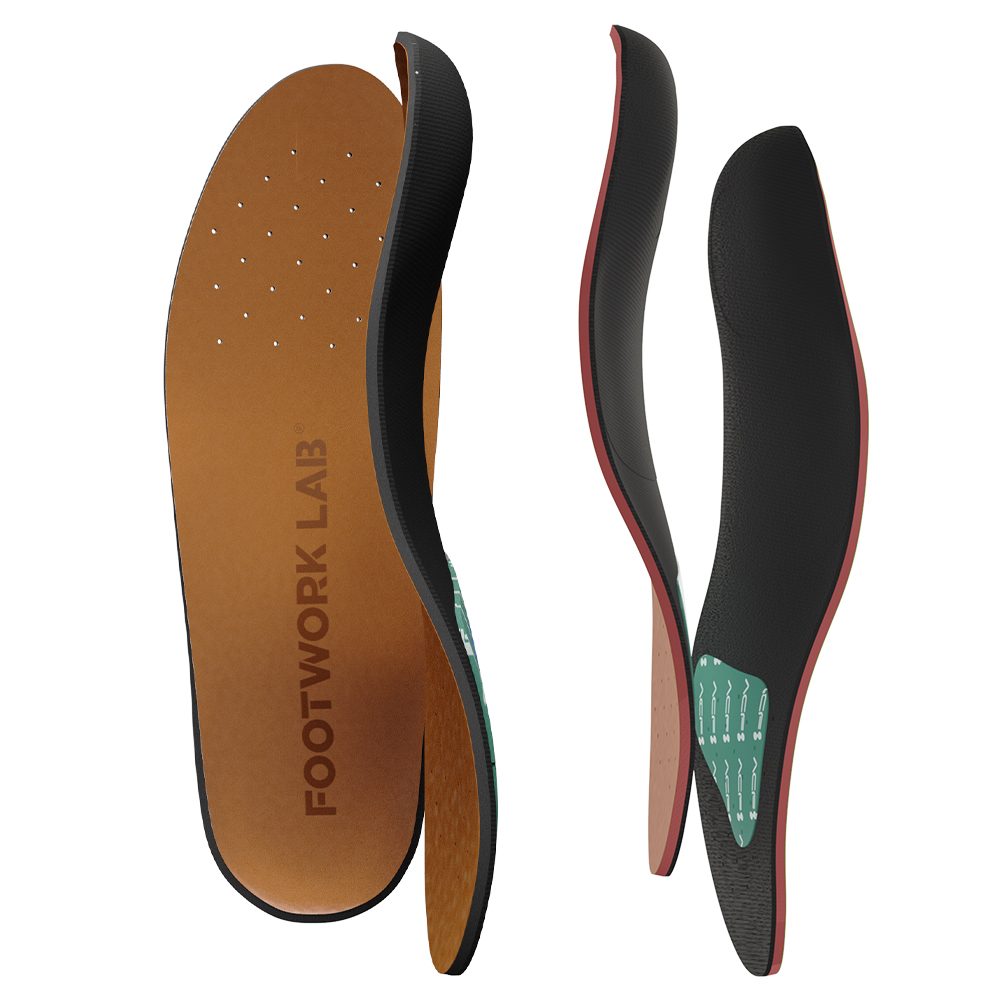
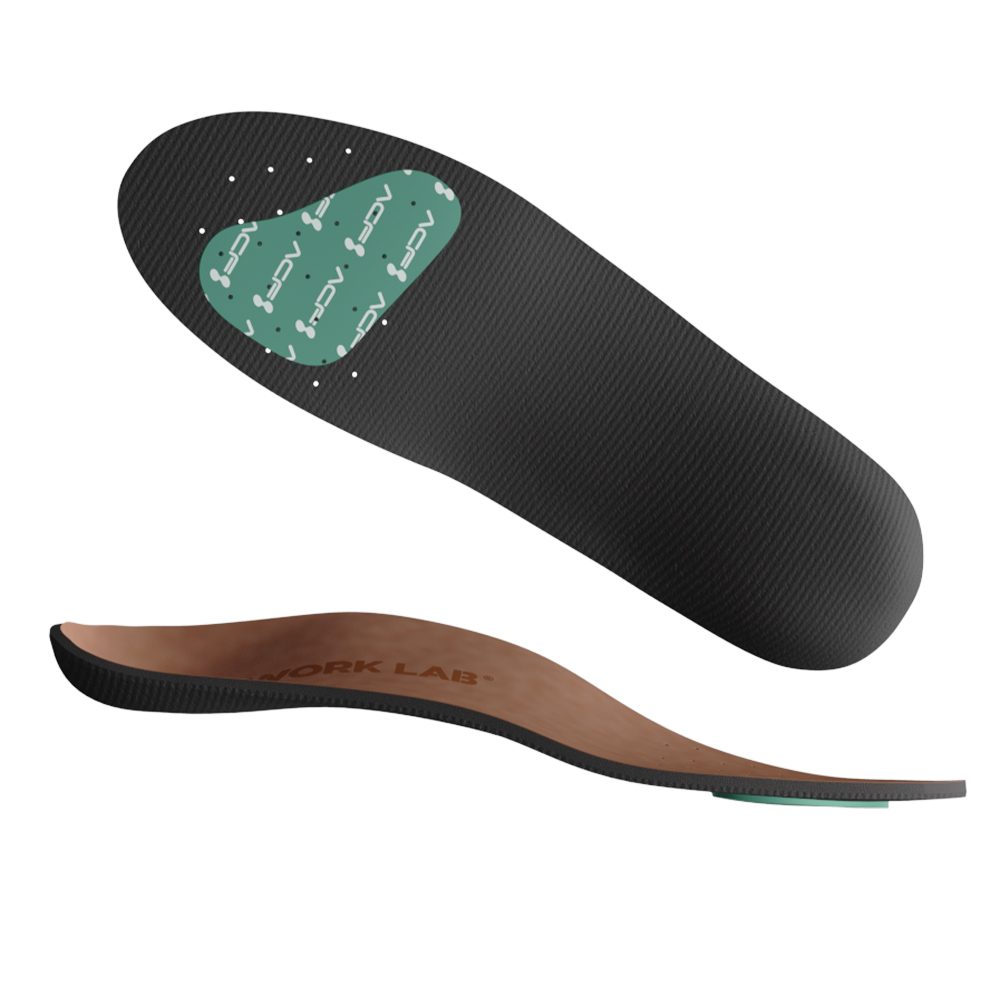
Almost every build in the range is a stack of layers, and the stack is easier to understand as three jobs rather than three materials. The top layer is the interface: it manages friction and moisture against the foot and holds the surface the foot sits on. The middle is the cushion: it deforms under load, spreads contact over a wider area and takes the edge off the arrival. The bottom is the structure: a shaped board that holds the contour the fitter chose, resists bending and torsion, and gives the build a memory so it returns to shape instead of flattening by lunchtime.
Those jobs fail in different ways when they are overdone. A build that is all cushion bottoms out under a heavy, long-standing day: the material compresses, the contour disappears, and the foot ends up sitting on the shoe’s own flat bed with a thin sheet of foam over it. A build that is all structure does the opposite — it transmits load rather than spreading it, and a stiff board directly under a sensitive heel feels like standing on a plank. The right balance is not a formula. It depends on the shoe’s volume, the person’s weight and hours, and what the record shows about where the load sits.
For a concrete example of the logic, the daily comfort build in the FX range pairs a mesh cloth top, an Ortholite layer and an AQ polymer shaping board. Read as a materials list it is three nouns; read as a division of labour it is interface, cushion, structure, in that order, each doing the job the one above it cannot. The rehab builds follow the same logic with the balance shifted towards spreading load and holding the heel, which is what the range is for.
The record describes the foot. The shoe describes the space. The stack is what fits between them, which is why two people with similar records can leave with different builds.
The heel cup is containment, not pressure relief
The heel cup is the part of a build customers notice first and describe worst. It is a raised rim that wraps the back and sides of the heel, and its job is containment: it gives the heel a seat, keeps the fat pad gathered under the heel bone rather than spread sideways, and limits how far the heel can drift inside the shoe during a stride. A person who complains that their heel “slides” or that the shoe “eats” their heel at the back is describing a containment problem, and a cup is the right answer to it.
What a cup does not do is remove load. It changes where the heel sits and how it meets the surface, and that change can matter a great deal, but it is not the same as cushioning. A deep, hard cup under a sensitive heel can feel worse than a shallow soft one, because the rim becomes the pressure line instead of the heel. The common mistake in fitting is to reach for depth when the complaint is about impact, and to reach for softness when the complaint is about the heel moving.
Depth also has to be paid for somewhere. A cup that is deeper than the shoe’s collar allows will lift the heel out of the shoe’s own heel seat, push the foot forward, and shorten the space in front of the toes. In a low-cut leather shoe that shows up as a heel that rides up with every step; in a trainer it shows up as a tight toe box that was fine before. A cup that is too narrow makes its own problem, a pressure line down each side of the heel that the customer reports as “the insole is biting me”.
The check takes seconds. Seat the heel in the cup with the person standing, run a thumb down each side for a rim digging in, ask them to rise onto the toes and back down, then watch from behind while they walk. A heel that lifts out of the cup on toe-off means the cup is too shallow for the shoe, or the shoe is too loose to hold it.
Reading the four grades without turning them into a ladder
Every FX build is described on four grades: support, torsion, cushioning and launch. The names are not a quality scale and the numbers behind them are not a score. Each grade answers a different question. Support describes how much contour the build holds under the arch and how firmly it holds it. Torsion describes how much the build resists twisting along its length, which decides whether it behaves as one piece or two halves. Cushioning describes how much the stack gives under load. Launch describes how much the build returns as the foot pushes off.
Because they are separate dials, a high setting on one says nothing about the others. A build can be soft and torsionally stiff at the same time, which is exactly what some work boots need. It can be firm under the arch and compliant under the heel. The mistake buyers make when they first see the table is to read across it as a ladder — assuming the highest column is the most advanced — and to order everything at the top. That produces a range that is stiff, heavy and unsuitable for the customers who most need help.
Choosing starts with the shoe and the day, then moves to the record. A person standing for long shifts on a hard floor needs cushioning that will not bottom out before the shift ends, which usually means more structure underneath the cushion rather than more cushion on top. A person who walks a lot on uneven ground needs torsion control so the build does not fold under the midfoot. A person whose complaint is about the heel moving needs the cup and the support grade more than the cushion grade. Only after those questions does the pressure record refine the choice.
The rehab range is positioned for flat foot and for spreading load, which describes what the builds are shaped to do rather than what a customer will feel. A flat foot under load presents a wide contact area and a particular line through the midfoot; a build for it holds contour where the foot does not, and keeps the heel contained while doing so.
The shoe decides as much as the record
A trainer is the easiest shoe to build for and the easiest to get wrong. The removable sockliner usually leaves usable depth, the heel counter is often soft, and the shoe flexes where the foot flexes. That space invites a fuller build, and a fuller build can quietly stiffen a shoe that was bought for its flexibility. The rule we suggest to fitters is that the insole should not change the shoe’s character: if the customer loved the shoe for being light and springy, the build should not turn it into a boot.
A leather shoe is the opposite problem. Depth is scarce, the sole is stiff, the collar is low and the lace line decides how much room the instep will tolerate. A build for a leather shoe is thin under the forefoot, low at the cup, and slim through the board, and the fitter has to accept that some of the cushioning available in a trainer simply cannot be delivered here. Customers who split their week between a trainer and a leather shoe usually need two builds, and the second is not a copy of the first with the edges trimmed.
A work boot adds its own constraints. There is height at the collar, so a deeper cup is possible, and mass, so a firmer structure does not feel out of place. Against that, the boot’s own footbed is often thick and may have to come out, which changes the volume the build has to fill, and a safety toe limits anything added at the front.
The record says where load sits; the shoe says what can be done about it. That is why the shoe check comes before the build is finalised, and why we ask distributors to keep three or four common shoe types at the bench rather than one.
Where the fitter stops and the clinician starts
The fitter’s scope is concrete: take a record, read the shoe, choose the stack, shape it, fit it, check it, explain what changed, and set a review. That is a full session and a real service. It does not include naming a cause or predicting an outcome. The sentence that holds the line is short: we can change how load sits under your heel, and we cannot tell you why it hurts.
Some presentations should end the fitting conversation and start a referral. Pain that wakes a person at night, swelling or redness around the heel, numbness or tingling into the sole, a recent fall or twist, a heel that cannot take weight at all, pain that has worsened steadily across several weeks rather than settling, and heel pain in a child are all reasons to send someone on rather than build for them. None of those is a reason to sell a thicker insole and hope.
The review is where the boundary gets tested. A customer who returns after two weeks saying nothing has changed is giving useful information: check the fit, the shoe and the routine before changing the build. A customer who returns after a second build with the same sentence is not asking for a third. That is a referral, with the record in hand.
We do not diagnose, and we do not present a build as a treatment for a named condition. What we make is an object that redistributes load and holds a heel in place, and what a fitter does with it is a professional service delivered in a room with a person in it. Everything in this range sits upstream of the clinical judgement, and it works best when everyone involved agrees about where that line is.
Frequently asked questions
Can an insole stop heel pain?
No build can promise that, and we do not sell one on those terms. What an insole can do is change how load is distributed under the heel, how quickly it arrives, and how consistently the heel sits inside the shoe. Whether that changes what a person feels is a clinical question, and the answer belongs to the professional who knows the case.
What does the cushioning layer do that the shaped board does not?
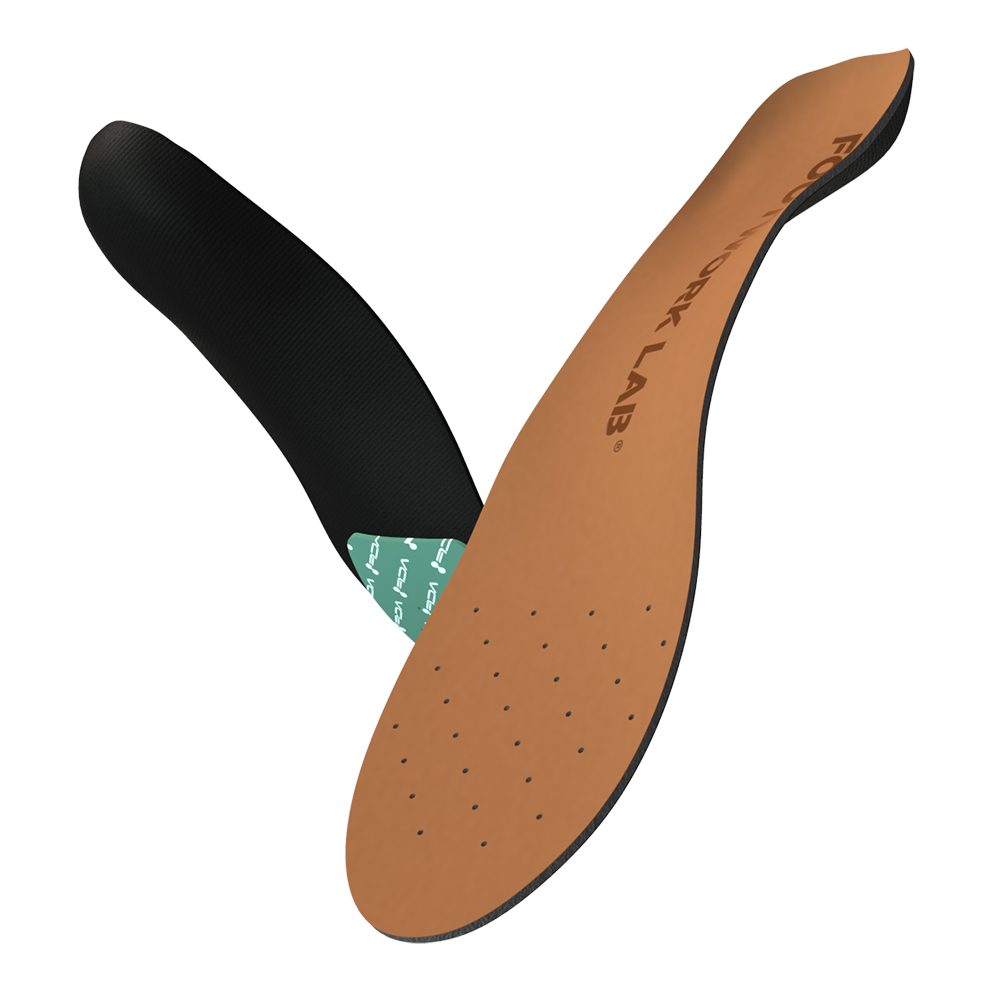
The cushion deforms under load, widens the contact area and softens the arrival. The board holds the contour the fitter chose and resists bending and twisting so the build keeps its shape through a working day. Cushion without structure bottoms out; structure without cushion transmits load. The balance is the fitter’s decision.
Which of the four grades should a first pair use?
Start from the shoe and the working day, then refine with the record. A stiff leather shoe will not accept the cushioning a trainer can carry, and a flexible trainer should not be turned rigid by a high torsion grade. Most fitters begin with the build the shoe can actually hold and adjust at the review rather than ordering everything at the top of the table.
Can one pair work in both trainers and leather shoes?
Rarely well. The two shoes differ in depth, collar height and how much the sole flexes, so the same build is either cramped in one or loose in the other. Customers who split their week between them usually need two builds, made from the same record but not from the same stack.
Does a rehab build need a pressure record first?
It helps, and it is not the only route. The range is assessed with the BODYFIT AI assessment and senthmetic fabric sensing, and it works alongside the X5 detection system where a fuller postural record is wanted. A fitter working from a measured mould and a shoe check can still produce a sound build; the record mainly makes the choice more repeatable.
When should a fitter refer instead of building?
Pain that wakes the person at night, swelling or redness, numbness or tingling, a recent injury, a heel that cannot take weight, pain worsening across weeks, and heel pain in a child all belong to a clinician. A second build that leaves the complaint unchanged is also a referral, not a reason to try a third.
What are the insole order terms?
Minimum order is two hundred pairs, and styles and sizes can be mixed within it. Samples ship within three days, production capacity runs at roughly five hundred to a thousand pairs a day, and the range is available for ODM and OEM programmes. Machines are quoted separately from insoles.
What we would do next
If you fit in a shop or a clinic, send us the three shoes your customers actually wear and the complaint you hear most often at the counter. We will map those onto the four grades and tell you which builds you would use weekly and which would sit in the drawer — a shorter range used well beats a long one used rarely. The insole category page sets out the three series and the grade table in the factory’s own wording.
If you are building a programme rather than a single bench, our article on orthotic inserts for heel and arch complaints covers how the same record is turned into a repeatable order, and insole design for a sensitive heel goes further into the structural side. Sample and production terms sit on the FAQ page, and the contact page reaches the team directly.
This article is intended for professional and educational reference. It is not medical advice. Foot assessment equipment produces measurements and images; clinical interpretation and any decision about care remain the responsibility of a qualified professional. Certification scope is limited to the documentation we hold: European Union certification and ISO quality system certification.