
A woman walks into a shop because her lower back aches by the end of a working day, and the first thing the owner sees is not her back — it is her feet. That is the whole reason searches joining the spine to the foot exist, and the whole reason they arrive carrying more expectation than any foot record can honestly hold. The foot is where the column meets the ground; a base that loads unevenly is a reasonable thing for a back-conscious customer to wonder about. What an assessment system can do is document that base — how it loads, how the legs and pelvis sit above it, how the whole column presents in a photograph. What it cannot do is explain the back, and this article is about that boundary: what our X5 records, why a posture item is a recording and not a correction, and where every interpretation still belongs to a professional.
What the searcher arrives expecting
The phrase joins two subjects that different professions own, and the searcher rarely knows where one ends. Someone typing about spinal alignment and the foot in the same breath is usually a shop owner whose customers mention their backs, a trainer whose clients do, or a clinic receptionist booking someone who used the word spine on the phone. Their hope is concrete: a machine that will show the customer something about the connection, in a way that is visible, repeatable and worth coming back for. That hope is answerable — but only within what a record can actually document.
The expectations arrive in layers. The bottom layer is fair: show me how this person’s feet load, and how the legs and hips sit above them. The middle layer is still answerable but needs care: show me whether anything above the foot is visibly asymmetric. The top layer is not answerable by equipment at all: tell me this is causing the back pain, and that fixing the base will fix the top. A supplier who lets the top layer stand unchallenged in a demonstration is not making a sale; they are scheduling a disappointment, and attaching the shop’s name to it.
Our own practice in these conversations is to answer the bottom two layers and hand the third back explicitly. The equipment documents. The professional interprets and, where a case needs it, refers. That hand-back is not a hedge; it is the reason the record is trusted by the professionals who read it, and it is the sentence we would want any buyer to repeat to their own customers before the first session rather than after the first complaint.
What the posture record actually lists
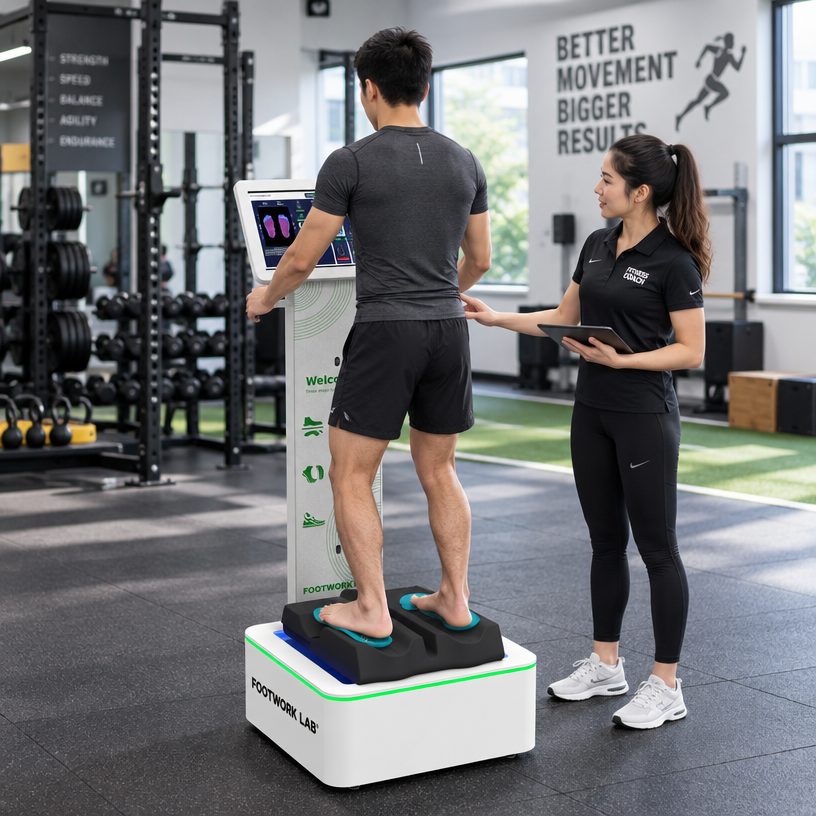
The X5 is built for exactly the lower two layers. In one session it captures the foot data from the sensing area, the alignment of the lower limbs from its cameras, and the whole-body posture from the posture camera, all assembled into one report beside a touchscreen the operator reads from. The posture items are named and specific: neck tilt, shoulder droop, pelvic tilt including anterior and posterior presentation, knee hyperextension, and the X-shaped or O-shaped presentation of the legs. Each is recorded as an observation of the standing body, alongside the foot and ankle data rather than in a separate document nobody reconciles.
What makes the list useful to a shop or clinic is that the customer can see it. Shoulder height is something a person half-knows from mirrors; seeing it recorded as a measured observation beside the way their foot loads turns a vague complaint into a document. That visibility is why posture records belong in assessment conversations — not because they explain anything, but because they give the conversation a starting page both people can read at once.
What the list deliberately does not contain is a verdict about the spine. Neck tilt, pelvic presentation and the rest are recordings of how the body stood in that session, under those instructions, in that room. They say nothing about cause, nothing about structure, and nothing about what should be done. A report that implied any of those three would be overclaiming, and the professionals who use these records would be the first to hand it back across the counter.
A recording, not a correction
The word correction is doing heavy lifting in the searches behind this article, and it deserves to be taken apart. Correction is something a qualified professional may pursue, case by case, with clinical reasoning we do not possess and do not pretend to. What the equipment produces is the evidence that reasoning starts from: angles, offsets, pressure distributions, images. A recording documents the present. Whether the present should change, how, and by whose hands — those are professional questions, and the equipment has no opinion about them, which is the correct amount of opinion.
This is why every report our systems produce carries a line stating the data is for reference and interpretation belongs to a qualified professional. The line is not decoration. It is the load-bearing sentence that lets a shop show a document to a customer without practising anything, and lets a clinician place the record in a file without the record claiming expertise it does not have. Buyers should read that line in every supplier’s sample report and notice which suppliers print it prominently and which bury it.
The boundary also has a commercial shape. A shop that promises correction will eventually meet a customer whose back needs a clinic, and the promise becomes the complaint. A shop that promises a record — taken now, repeated next season, compared side by side — keeps that customer either way, because the record was honest about what it was. Retests are also the quieter business: the second session costs the shop nothing new and gives the customer the one thing a single photograph never can, which is a direction of travel, documented.
Buyers sometimes ask why the equipment does not simply flag the asymmetric items automatically. Part of the answer is technical honesty: an angle photographed in a session is one observation under one set of instructions, and whether it matters for this person depends on history, symptoms and context the machine does not hold. The other part is deliberate. A system that highlighted findings would push the operator toward reading them out as problems, and the shop would drift, session by session, into practising without noticing. Keeping the record flat and the interpretation with the professional is a design decision about behaviour, not a missing feature, and it is worth asking every supplier which way their software leans.
Where the foot genuinely meets the spine
None of this makes the connection between the two subjects unreal. The foot is the base the column stands on, and how it loads is a legitimate input in a professional’s wider reading of a person — alongside everything else that professional knows. The pressure record shows how load distributes across the sole, how the centre of pressure travels through a step, how the arch presents, and how the legs align under load. Read together with posture items, those are reasonable observations to place in front of a professional who is thinking about the whole person.
The honest phrasing matters, and it is narrower than most marketing. Not: the feet are causing the back problem. Rather: here is how the base loads and how the column presents above it, recorded this season, comparable next season, available to whoever is managing the case. That phrasing survives being read aloud by a customer to their physiotherapist, which is a test most claims in this category would fail. A shop owner who adopts the narrower phrasing will find the local clinicians become referrers rather than critics, because the document they are handed does not try to do their job.
Where the boundary sits in practice is easy to state. The equipment records the base and the column. The professional decides whether the two are connected in this person, and what, if anything, to do about it. When a supplier’s demonstration quietly skips the professional — the machine shows the pelvis, the machine suggests the insole, the machine promises the back will notice — the buyer is watching someone else’s liability being dressed up as a feature, and should leave with their questions intact.
How clinics and training rooms use the record
In a rehabilitation setting the record is a baseline. A patient enters with a story; the session captures foot, ankle, lower limb and posture in one document; and the retest next season is set beside it, item by item, by the professional managing the case. The equipment’s contribution is that the second document can be compared with the first — same items, same order, same report structure. Comparison is the entire value of recording, and it is a property of disciplined sessions as much as of devices.
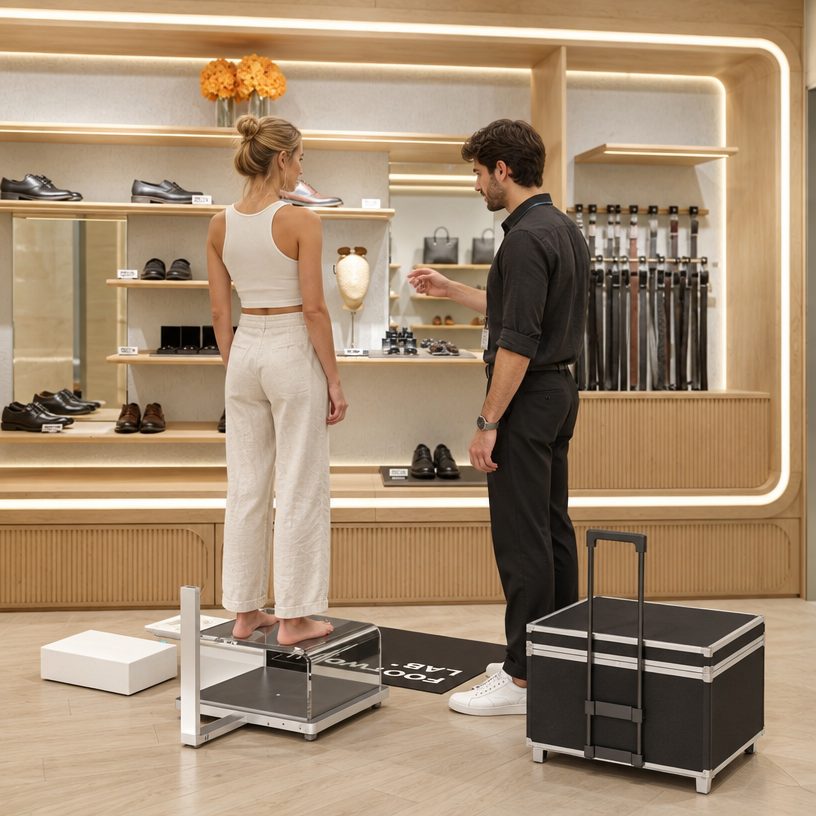
In sports training the same document serves a different conversation. A trainer uses the posture items and the pressure findings to talk with an athlete about how they stand and how they load — not as a diagnosis, but as a shared starting page for programming. In shoe shops the record earns its place at the counter: the customer who came in asking about their back leaves with a document about their base, and a reason to return next season to see what changed. Three rooms, one record, and in none of them does the record issue instructions.
The common thread across the rooms is that the professional stays between the data and the decision. Where that thread holds, the same assessment supports retests, referrals and honest conversations for years. Where it is dropped — the shop that reads angles aloud like verdicts, the trainer who promises the pelvis will level — the record becomes a prop, and customers sense it before professionals do. Buyers choosing a system should watch a demonstration for exactly this: not what the machine shows, but who the supplier’s story puts in charge of the meaning.
Staffing makes the difference between the rooms, more than the equipment does. The document is the same; what varies is who stands beside the customer while it is read. In a rehabilitation setting the reader is qualified and the referral path is short. In a training room the trainer borrows the language carefully and keeps the programming on their own ground. In a shop the owner’s best move is often the humblest: show the page, answer what the page itself answers, and keep a card for the clinician they trust. Buyers planning a purchase should plan that staffing as part of the purchase, because a system operated without a plan for who interprets is a system that will eventually improvise badly.
What we will not say to this searcher
We will not say the equipment corrects anything, or that a record of the base explains the column. We will not attach our reports to promises about backs, and we will not let a demonstration imply that the software reaches conclusions, because it does not and should not. We also will not describe our equipment with the flashier word from the search bar: what the X5 captures is pressure and alignment through fabric pressure sensing and cameras — it is not a shape scanner of any kind, and we would rather lose a click than be corrected by a buyer in the second conversation.
We will not promise outcomes, publish prices, or offer exclusivity by region. A quotation depends on configuration, destination and the service around the system, which is why it comes after a conversation rather than instead of one. On the terms we can state simply: one unit is the minimum order, machines accept ODM, every machine runs seven days of testing at the plant before dispatch, the warranty runs twelve months against non-human damage with free parts, and support runs through a dedicated WhatsApp group with engineers reachable directly, remote assistance when a session goes wrong, and over-the-air updates where the unit is connected.
What we can offer this searcher is the narrower promise, kept: a document that records how the base loads and how the column presents, consistent enough to compare across seasons, honest enough to hand to a clinician, and clear on its own page about who reads it. That is what the phrase spinal alignment foot correction is actually reaching for when the buyer behind it is serious — not a machine that settles the spine, but a record that gives the professionals who might a fair place to start. We build the record. The rest of the sentence belongs to someone else, and we are comfortable with the split.
Frequently asked questions
Can the equipment explain my customer’s back pain?
No. The equipment documents how the feet load and how the body presents above them. Whether any of it relates to a particular person’s back is a clinical question that belongs to a qualified professional, and every report we produce states that the data is for reference.
What posture items does the X5 record?
Neck tilt, shoulder droop, pelvic tilt including anterior and posterior presentation, knee hyperextension, and the X-shaped or O-shaped presentation of the legs — recorded alongside the foot and ankle data in one session, one document.
Is a posture recording the same as a correction?
No. A recording documents how the body stood in that session. Correction is a clinical pursuit that belongs to a professional, built on their reasoning, of which the record is only the starting evidence.
Why show customers a posture record at all?
Because it makes an invisible complaint visible and specific: measured observations beside the load data, on one page both people can read. It starts a conversation; it does not settle one.
Can records be compared across visits?
Yes, provided the session is run the same way each time — same instructions, same position, same routine. Comparison is the main value of recording, and the report structure is built so a retest sits beside the baseline item by item.
Is the X5 a scanner of the foot’s shape?
No. It captures pressure and alignment through fabric pressure sensing and cameras. It does not capture the outer contour of the foot, and the scanning word in search phrases is a market term rather than a description of the equipment.
What are the order and support terms?
One unit is the minimum order, machines accept ODM, each runs seven days of plant testing before dispatch, and the warranty covers twelve months against non-human damage with free parts. Support runs through a dedicated WhatsApp group with direct engineer access and remote assistance.
What we would do next
If your customers arrive asking about their backs, decide before buying what your room will promise: a record, taken and repeated, and a referral when one is warranted. Put that in a sentence and send it with your questions through the contact page, and we will answer in the same terms. The X5 system page lists the posture items, the cameras and the foot capture area in the equipment’s own words.
Three articles walk the same boundary further. Spinal orthopedics and the 3D scanner search term takes the search phrase apart from the equipment side, postural analysis with the X5 describes the posture items one by one, and foot type is a record, not a verdict makes the measurement-versus-judgement case in full.
This article is intended for professional and educational reference. It is not medical advice. Foot assessment equipment produces measurements and images; clinical interpretation and any decision about care remain the responsibility of a qualified professional. Certification scope is limited to the documentation we hold: European Union certification and ISO quality system certification.