
A sports venue installs a dynamic gait platform, every coach gathers around the screen for the first week, and three months later nobody can say whether the athletes they started with actually move any differently — because nobody wrote down what the first session recorded, under which instructions, at what point in the training week. That is the situation buyers who search for “gait training” are usually trying to avoid. The word covers two jobs at once: the training itself, and the record-keeping that decides whether the training can be judged at all. This article is about the second job. It is written for rehabilitation hospitals, sports venues, podiatry clinics and gyms that are about to put a gait platform into a room and need to decide the protocol before the first athlete steps on.
The question behind the keyword is narrower than it looks. Gait training, as a search term, mostly attracts two buyer groups: clinical teams building a documentation pathway around walking and running assessments, and performance staff who want a baseline they can return to across a season. Both groups need the same three decisions made early — what the walking mode records, what the running mode records, and which conditions get frozen so a retest is comparable to a baseline. The F5-LAB sits underneath those decisions as a Dynamic Gait Detection System: it measures and analyses pressure distribution and body posture during walking and running, automatically identifies the gait pattern, and provides clinical gait parameters. How a team turns that capability into a repeatable protocol is what the rest of this article walks through.
What gait training asks of the record before it starts
In our pre-sales calls, the sentence we hear most often from venues and clinics is some version of “we will work out the protocol once the system is installed”. We understand the instinct — the room is not finished, the staff are not hired, the athletes are mid-season. But the protocol is not an operating detail; it is the thing that makes the second month of data worth anything. A gait cycle record captured on a fatigued athlete after a hard session cannot be read against a baseline captured on a rested one, no matter how good the equipment is. The measurement did not fail; the comparison did, because the two sessions answered different questions.
The F5-LAB manual lists four core functions, and they map neatly onto the four things a protocol has to pin down: gait cycle detection and evaluation, assessment of motion posture, dynamic pressure assessment analysis, and dynamic bipedal butterfly line analysis and evaluation. Two cameras on brackets capture posture and movement alongside the pressure record, and the system runs on BodyftAi machine vision recognition together with senthmetic flexible-fabric sensing, turning the session into a report through AI-assisted report generation. None of that decides the protocol by itself. The hardware will faithfully record whatever conditions exist in the room; the protocol is the team’s agreement about what those conditions will be, every single time.
What the walking mode records, and what a walking baseline needs to hold still
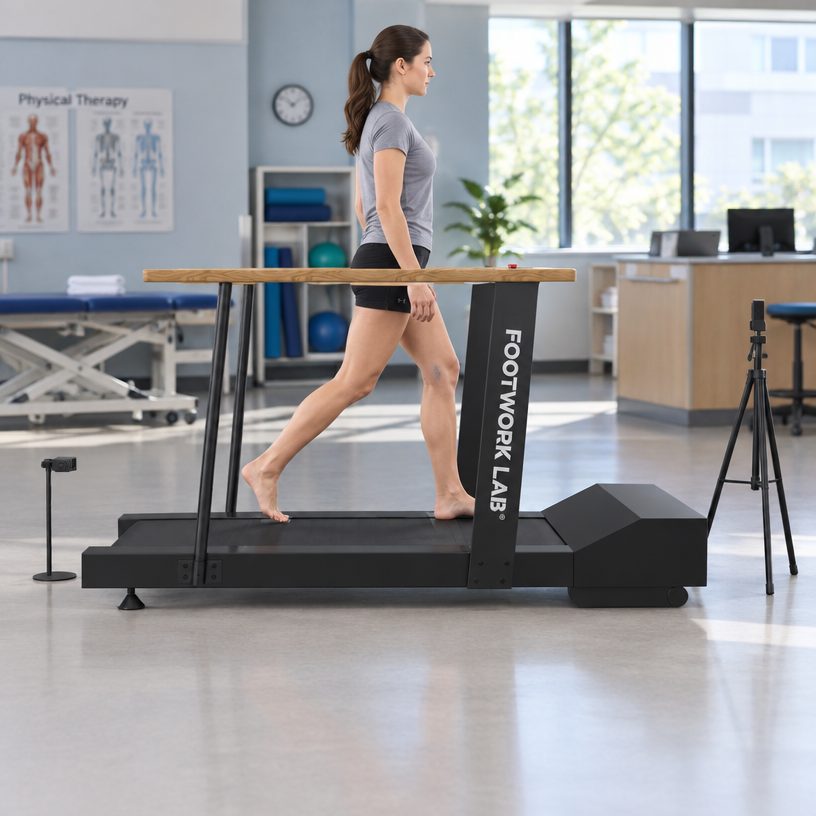
The walking pass is the protocol’s backbone. Gait cycle detection and evaluation breaks the repeated sequence of a stride into its phases and measures how the person moves through them; dynamic pressure assessment analysis records how load travels across the sole from first contact to push-off; the bipedal butterfly line draws the pressure trajectories of the two feet together on one picture, which is why it carries that name — the two curves spread and cross like wings. Motion posture assessment runs in parallel through the cameras, so the report places what the legs and trunk were doing at the same moments the pressure record shows where load landed.
For the baseline to be reusable, four conditions need fixing in writing before the first session. Footwear state: barefoot or shod, and if shod, the same category of shoe. Warm-up state: fresh, or after a defined amount of activity. Speed control: the treadmill form factor of the F5-LAB means speed is a setting, so the protocol states the walking speed band rather than leaving it to whoever runs the session that day. Instruction script: the same operator, or at least the same wording, tells every person how to stand, start and stop. None of these is a technical requirement from the manual; they are the conditions that make two records from two months readable against each other.
Who runs the walking pass also shapes what the protocol looks like. A rehabilitation hospital typically archives the walking record as part of a patient’s documentation, so the protocol there is written for clinical consistency: the same room, the same appointment slot in the pathway, the same professional reviewing the report afterwards. A gym or sports venue archives it as part of an athlete’s training file, so the protocol is written around the training calendar: capture at the same point in each training block, not the day after a competition, and not on the one afternoon the coach is free. A podiatry clinic may use the walking pass to open a fitting conversation, which puts the emphasis on capturing the customer’s habitual state rather than a controlled condition. The device serves all three rooms — the manual lists rehabilitation hospitals, sports venues, podiatry clinics and gyms as its scenarios — but each room writes the protocol that fits its own reason for recording, and the sooner that reason is named, the fewer sessions get captured for no reader at all.
What the running mode adds, and why it gets its own baseline
Running is a different capture, not a faster version of walking. Contact with the ground is shorter, load rates are higher, and the posture demands change — which is why the manual treats walking and running as the two modes of the same system rather than one continuous measurement. A running pass still produces the gait cycle record, the dynamic pressure analysis, the motion posture assessment and the butterfly line, but every one of those numbers describes a different movement problem than the walking record does. A butterfly line that spreads wider at running speed may be unremarkable; the same shape at walking speed may be worth a conversation. The record does not rank these; it presents them for a professional to read.
Because the conditions differ, the running baseline is a separate document from the walking baseline. Teams that keep the two apart get clean comparisons; teams that mix them spend their follow-up sessions explaining differences that were built into the capture. At a Canton Fair booth last season, a sports-venue manager asked exactly this: whether a running record captured on Monday could be read against a walking record from the same athlete captured on Wednesday. Our answer was that the two records can sit in the same report and inform each other, but the retest comparison — the one that says whether anything changed — should always run against the same mode under the same conditions. He wrote that distinction into his staff handbook before leaving the booth, which struck us as the right instinct.
The butterfly line deserves a word of its own, because it is the part of the report that non-specialist staff read first. It presents the two feet’s pressure trajectories drawn on one picture, and at a glance it shows how symmetrically load travelled — whether the two wings hold a similar shape, or whether one side spread wider, crossed differently, or stayed compressed. That readability is an asset in a training room, where a coach can point at a picture and an athlete can see the change without reading a parameter table. It is also a risk if the protocol does not state what the picture is: a shape, drawn from pressure trajectories, whose meaning a professional interprets. We suggest the protocol include one sentence — who reads the butterfly line, and against which baseline — so the picture circulates with its reader attached rather than on its own.
Baseline first, retest second: writing the protocol the whole team reuses
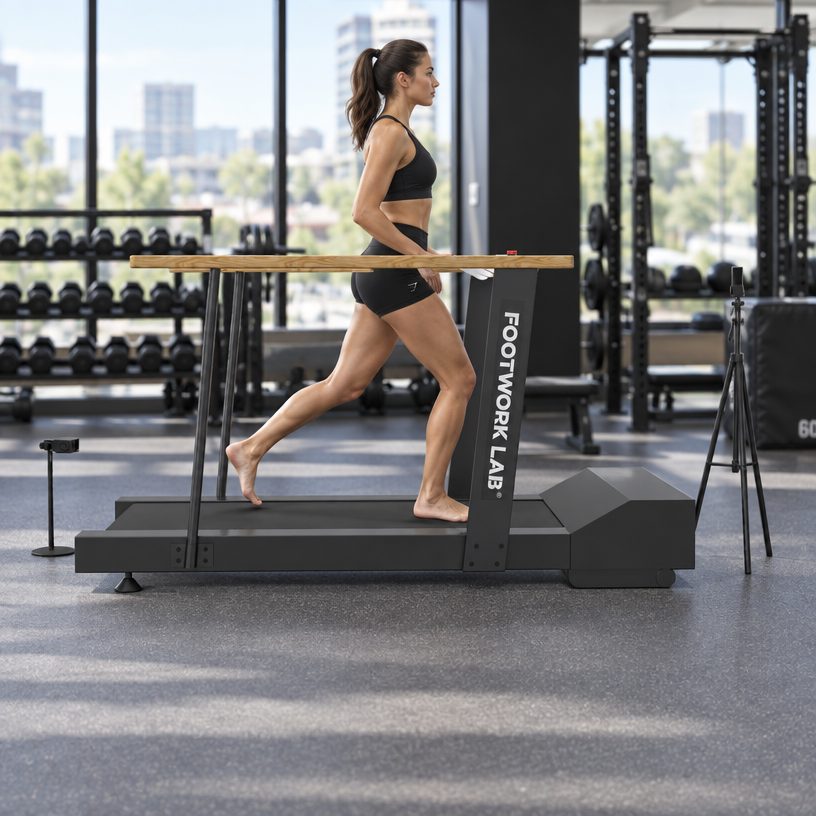
A baseline session is not special equipment or a longer appointment. It is the first session run under the finished protocol, archived against the person’s name, and treated from that moment as the reference point. The F5-LAB report gives the session a stable layout — gait cycle parameters, pressure distribution, posture images and the butterfly line in the same arrangement every time — so a retest lands beside the baseline without anyone rebuilding a spreadsheet. That layout consistency is why the protocol matters more than the hardware: the system will hold its end of the comparison if the team holds theirs.
Our engineers see what happens when the protocol drifts. On one support call through the WhatsApp group, a gym was comparing retests against baselines and finding changes everywhere — the butterfly lines looked nothing alike, the gait cycle numbers moved in every direction. Walking through their records, the engineers found the cause was simple: the baselines had been captured barefoot and rested, the retests after full training sessions, by two different coaches using different instructions. Nothing was wrong with the data. The gym wrote a one-page protocol — footwear, warm-up state, speed band, instruction script — and the next month of comparisons finally read cleanly. The platform had not changed; the discipline around it had.
Two practical notes close the loop. Where a team needs a particular report layout or data export for their own documentation system, the software can be customised, and that work is quoted separately from the equipment. And the platform itself ships with the support structure behind it: pre-sales consulting before the order, a dedicated technical product team after installation, aftersales marketing and service guidance, and over-the-air updates for connected units — so a protocol decided in month one does not get frozen out when the software improves in month twelve.
Frequently asked questions
What does a gait training protocol on the F5-LAB actually record?
Per the manual’s four core functions: gait cycle detection and evaluation, assessment of motion posture, dynamic pressure assessment analysis, and dynamic bipedal butterfly line analysis and evaluation. The walking and running modes run these records under their own capture conditions, with two cameras recording posture alongside the pressure data and the report produced through AI-assisted report generation.
Do walking and running need separate baselines?
Yes. Running changes contact time, load rate and posture demand, so the same four functions describe a different movement problem in each mode. A retest comparison should always run against a baseline captured in the same mode, under the same written conditions — footwear state, warm-up state, speed band and instruction script.
How often should we schedule retests?
We do not set a clinical interval; that is a professional decision tied to each programme. What we advise operationally is to align retests with the milestones your own programme already has — a training block, a review appointment — and to keep the capture conditions identical each time. Frequency without a fixed protocol produces records that cannot be compared, which defeats the purpose.
Is the butterfly line a diagnosis of how someone runs?
No. The bipedal butterfly line is a presentation of the two feet’s dynamic pressure trajectories drawn together — a record, not a verdict. The manual’s own framing is measurement and analysis: the system provides clinical gait parameters, and a qualified professional reads them and decides what they mean for the person in front of the platform.
Can the report be adapted to our own documentation system?
The software system is customisable, and that customisation is quoted separately from the equipment itself. Teams that need a specific report layout, export format or data field for their records should raise it during pre-sales consulting so the requirement is scoped before delivery rather than after.
Who is the F5-LAB built for, and what support comes with it?
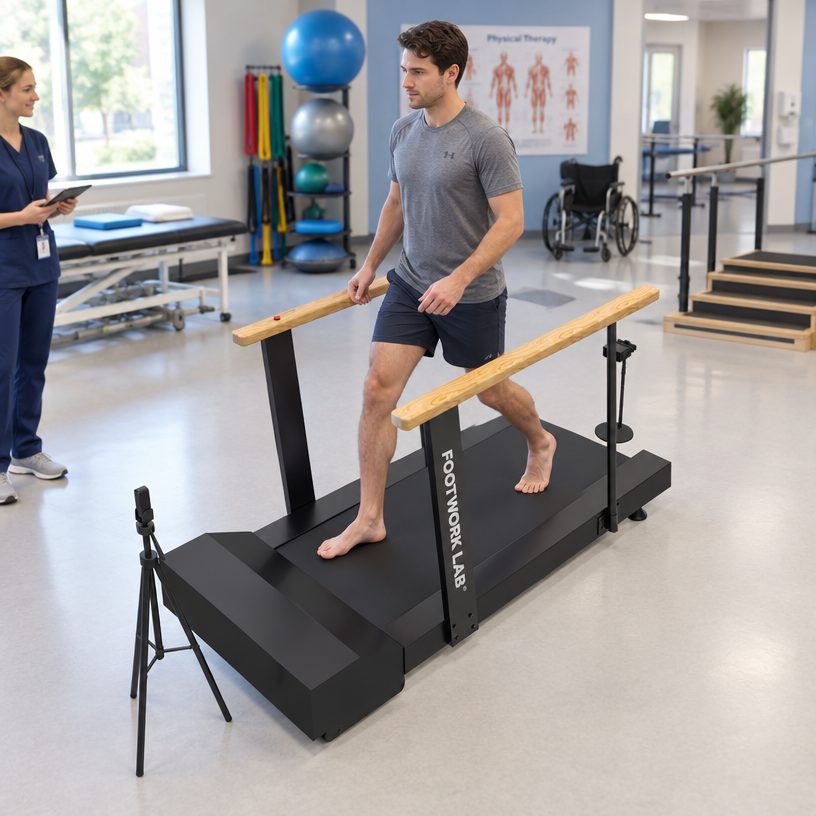
The manual lists its application scenarios as rehabilitation hospitals, sports venues, podiatry clinics and gyms. The minimum order is one unit, every unit is tested before dispatch, and support runs through a dedicated WhatsApp group with our engineers, remote assistance, aftersales marketing and service guidance, and over-the-air updates for connected units.
What we would do next
If you are planning a gait training protocol around a dynamic platform, write down the four conditions you intend to freeze — footwear, warm-up state, speed band, instruction script — separately for walking and running. Send us that draft with your room layout and the role of the person who will run sessions, and we will tell you what the F5-LAB covers in your space and where teams usually leave a gap. Our FAQ page carries the order, warranty and support terms in full.
If you already run a platform and your retests are not comparing cleanly, the fix is usually a one-page written protocol rather than new hardware. Send us the instructions your operators currently use and we will point out where two sessions would quietly diverge. For the full specification of the system described here, see the F5-LAB dynamic gait platform page.
This article is intended for professional and educational reference. It is not medical advice. Gait assessment equipment produces measurements and images; clinical interpretation, training decisions and any decision about care remain the responsibility of a qualified professional. Certification scope is limited to the documentation we hold: European Union certification and ISO quality system certification.