
A gym owner at our Dubai booth put the problem in one line: members pay for training, not for a report, so anything measured at intake has to prove itself twice — once on the day it is captured, and again when the member comes back for a retest. That is a harder test than most listings for fitness analysis suggest, because it rules out any measurement that produces a page nobody opens a second time. The X5 was designed around the opposite assumption: capture foot data, lower-limb alignment and body posture in one session, keep the record tied to the person, and make the second session comparable to the first. This article is for gym owners, sports-training managers and studio operators deciding whether that kind of record belongs in their intake routine — and, just as importantly, where the record has to stop.
The X5 manual names the system a Foot & Posture Detection Insoles Customization System, and lists five core functions: plantar data detection, lower-limb biomechanical alignment detection, ankle data detection, body posture detection, and on-site customization of biomechanical insoles. Five lines rather than one is not padding. Each answers a different question, and a facility that will only ever run two of them should know that before it orders the other three.
What a fitness analysis is expected to do in a training business
Three kinds of buyer arrive at the same phrase. A commercial gym wants a reason for a member to book a review after eight weeks. A sports training institution working with young athletes wants a starting record before a season, so that a change in training load has something to be measured against. A studio that sits next door to a physiotherapy practice wants a handover document it can pass across the corridor without overstating what it says. What they share is a need for a baseline and a comparison. What they do not share is who reads the output, and that single difference decides how the room should be set up.
The manual’s wording is deliberately narrow on this point. The X5 detects and evaluates; it does not name a condition. That distinction is easy to lose in a sales conversation, and it is the first thing we explain when a gym asks whether the machine can tell a member which muscle is weak. It cannot. It records angles at the neck, shoulder, pelvis and knee, the alignment of the leg, and the load under the foot. Strength is tested with load and with movement, not with a camera and a pressure area. Saying so early has cost us a few orders and saved several installations, because a buyer who expects a strength test will read the first report as a failure.
Where the system does earn its place is in the sequence. Intake happens before a programme is written, the record is filed against the member, and the retest happens on a date booked at intake rather than on the day someone remembers. That calendar entry is the difference between a measurement service and a device sitting in a corner. Gyms that run it well treat the retest as part of the membership conversation, not as an upsell bolted on at the end.
One recording that holds posture angles and foot data together
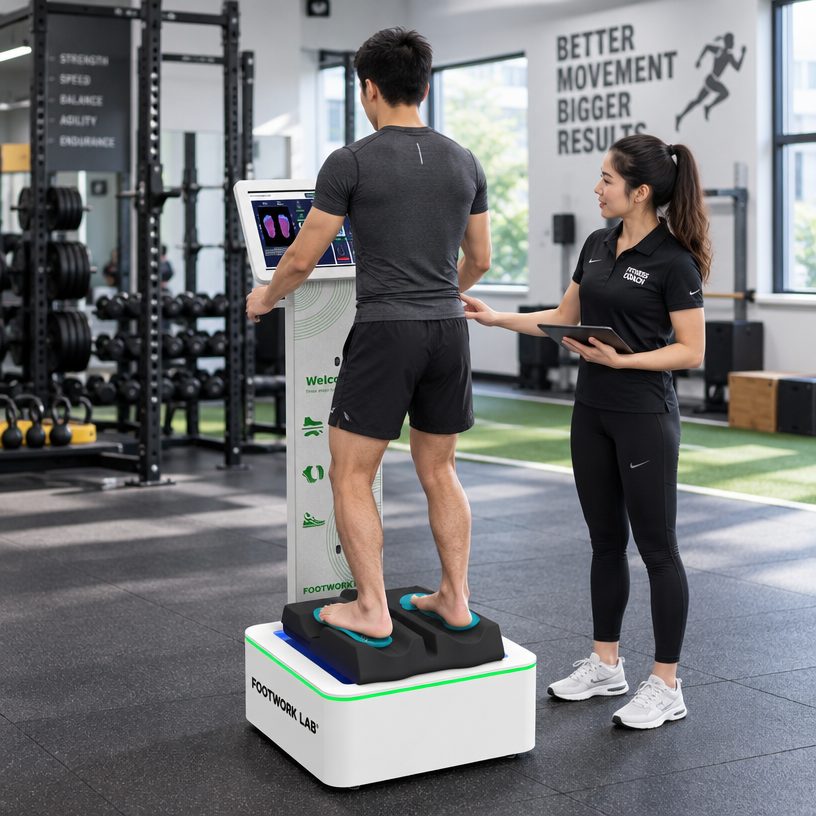
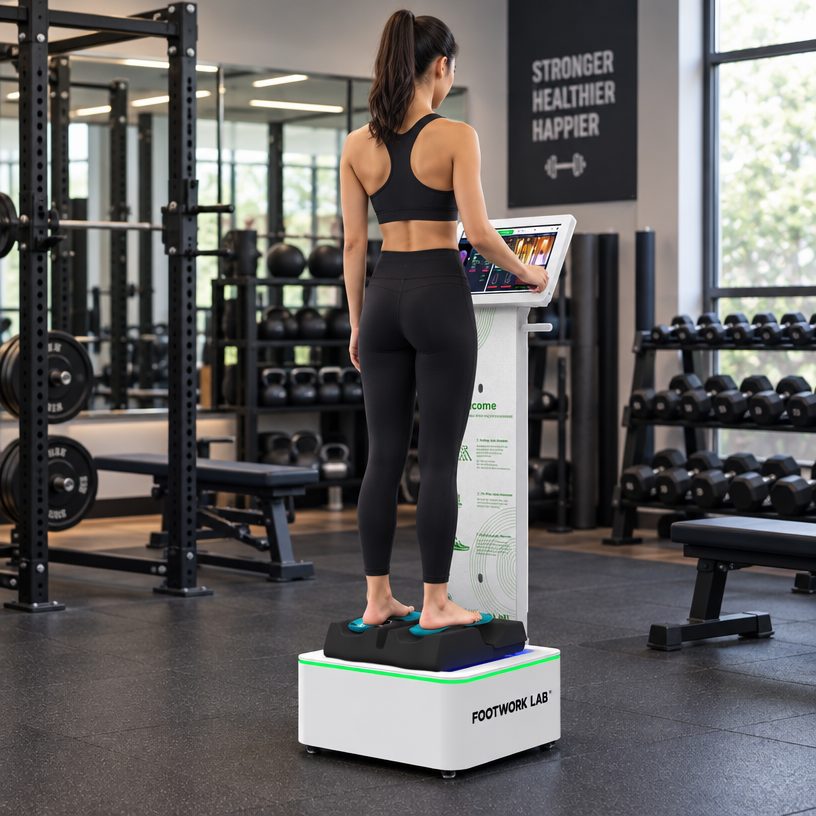
Capture is guided by the touch screen, and it runs in a fixed order: posture first, then the lower limb, then the foot. A posture camera records the member standing, viewed from the front and from the side. A lower-limb camera picks up the alignment of the leg above the foot. The foot collection area records the plantar data and the ankle position. Because the three views are captured in one standing sequence, the report can place them on the same page without asking the member to undress, walk a corridor, or come back on another day.
The posture items the manual lists are neck tilt, shoulder droop, pelvic tilt in both directions, knee hyperextension, and X- or O-shaped leg alignment. Each is recorded as an angle. On the foot side the record covers plantar data, ankle data and lower-limb alignment, which is what lets a trainer see a knee position and a foot position in the same frame instead of guessing at one from the other. Stance width, foot rotation and where the member puts their weight all change what the cameras see, which is why the capture instructions are scripted rather than left to whoever is operating that morning.
At one Canton Fair a personal trainer spent close to half an hour on the posture screen and almost none on the pressure view. His clients came in with shoulder complaints, he said, and he had assumed the foot was irrelevant to that conversation. What held him was the side view: the same standing position, read at the neck and at the ankle, in one frame. He did not need the machine to tell him what to do about it. He needed a starting picture he could show a client who did not believe there was anything to look at.
What the report says, and where it stops
The report gathers the angles with a left-and-right comparison, the alignment view, the plantar load picture and the ankle position, assembled through AI-assisted report generation. The layout is built for a conversation at a desk: a member can see two sides of their own body on one screen, and the operator can point at a line rather than describe a number. Reports can be issued from the system and kept against the member record, which is what makes the retest possible months later.
The boundary sits in how those angles are described. An angle that falls outside the reference band printed beside it is a measurement, not a verdict. The band describes a population, and the same reading can be unremarkable for one member and worth a conversation for another. Nothing in the report names a condition, recommends a course of care, or predicts an outcome. Where the record touches structure, the language stays at support, alignment and load distribution — because those are the things a measurement can actually describe, and a training business is not the place to go further.
We are equally direct about referral. If a member arrives with a known medical history, or describes something that has been getting worse, the record does not replace a clinician’s assessment and should not be presented as one. The practical version of that rule is a sentence the operator learns to say: here is what we measured, here is what changed since last time, and here is the point at which you should have someone qualified look at it. A gym that says that consistently is trusted more, not less, because members can tell the difference between a measurement and a promise.
The insole side runs from the same capture. The on-site customization module forms a biomechanical insole against the recorded foot position, using the shaping pillow set and heating box that ship with the machine, and the FX series pairs with the X5 for that work. Four build grades — support, anti-torsion, cushioning and starting ability — give the trainer and the fitter a shared vocabulary instead of a vague request for something softer. The insole is an object built to a record, not a correction of the record, and we describe it that way in every demo.
Setting a baseline a retest can be compared against
A retest is only worth the discipline behind the first capture. Barefoot or shod, feet together or apart, captured before a session or after one, operated by the manager on Monday and a part-timer on Saturday — each of those moves the angles enough to swamp the change you were hoping to see. The gyms that get value out of the X5 write a short protocol on a card and stick it beside the machine: footwear off, same stance instruction read aloud, same mat position, same camera height, same operator where possible, and a note of what the member did in the previous hours.
Our support team sees the other version of this regularly. On a WhatsApp group, a gym sent two records side by side and asked why a member’s posture had apparently changed so much in six weeks. The engineers walked through the setup and found the second capture had been taken straight after a heavy leg session, with the member standing in a wider stance because the first capture had been done on a different mat position. The training had not changed the picture. The capture had. Once the routine was fixed, the next two comparisons were readable, and the gym stopped treating every wobble as progress.
Before the first member is measured, four decisions are worth making in writing. Who operates the machine, and who covers when that person is off shift. Where the record lives, and how it is found again in three months. What triggers the referral sentence described above. And how the retest gets booked, because a baseline with no booked retest is just an expensive photograph. None of those decisions needs new hardware, and all of them decide whether the equipment is used in month six.
The commercial terms are the plain ones. Equipment minimum order is one unit, every unit is tested for seven days before dispatch, and the warranty runs twelve months against non-human damage with free parts. Support continues through a dedicated WhatsApp group with our engineers, remote assistance where a screen can be shared, and over-the-air updates for connected units. Report layouts can be customized in the software, and that work is quoted separately from the machine.
Frequently asked questions
What does the X5 capture in a single session?
Four detection functions plus the customization module: plantar data, lower-limb biomechanical alignment, ankle data and body posture, with on-site biomechanical insole customization. The posture part records neck tilt, shoulder droop, pelvic tilt, knee hyperextension and X- or O-shaped leg alignment as angles, captured by a posture camera and a lower-limb camera alongside the foot collection area.
Are the posture angles graded as pass or fail?
No. Each angle is recorded against a reference band, and a reading outside that band is a measurement rather than a grade. The band describes a population, not the person standing in front of the camera, so the same number can mean different things for two members. The report does not name a condition or recommend care.
Can two visits be compared directly in the system?
Yes, provided the capture conditions match. Records are kept against the member, so an intake and a retest can be placed side by side in the same layout. Comparisons only hold when footwear, stance instruction, mat position, camera height and operator are kept constant, which is why we recommend a written capture protocol from the first session.
Is the insole part of the device or a separate order?
The X5 includes an on-site customization module, with a shaping pillow set and heating box, so a biomechanical insole can be formed in the same visit as the capture. The FX insole series pairs with the X5 for that work. Insole production orders carry a separate minimum of 200 pairs, mixed models and sizes accepted, while equipment minimum order is one unit.
Who should operate it in a gym without a clinician on staff?
A trained operator can run the capture and hand over the report; the reading stays with a qualified professional where a clinical question exists. In practice gyms appoint one lead operator, keep a short written protocol beside the machine, and route anything beyond a measurement conversation to a clinician or physiotherapist they work with.
What are the order and support terms?
Equipment minimum order is one unit, each unit is tested for seven days before dispatch, and the warranty covers twelve months against non-human damage with free parts. Support runs through a dedicated WhatsApp group with our engineers, remote assistance, and over-the-air updates for connected units. Software customization is quoted separately. Full terms sit on our FAQ page.
What we would do next
If you are fitting out a gym or a training studio, write down the two sessions you intend to run — intake and retest — and the person who will operate each. Send that with a photograph of the room and the floor space you can give the capture area, and we will tell you which of the five functions you will actually use and which you would be paying for without running. Full product detail sits on the X5 foot and posture detection system page.
If the machine is already installed and the retest records are not being compared, the fix is almost always the protocol rather than the hardware. Send us two reports from the same member and we will point out where the capture conditions diverged. For a broader look at how measurement fits into a training programme, the article on building a training baseline covers the season-level view.
This article is intended for professional and educational reference. It is not medical advice. Foot and posture assessment equipment produces measurements and images; clinical interpretation and any decision about care remain the responsibility of a qualified professional. Certification scope is limited to the documentation we hold: European Union certification and ISO quality system certification.