
A training centre outside São Paulo booked a Saturday, taped a sign to the door that read children’s posture screening day, and spent the week before telling parents to bring both shoes and both questions. One mother arrived holding her phone with a search already typed in — foot biometrics scanner — and a picture in her head of a machine that would look at her son and announce what was wrong with him. What actually stood in the room was quieter than that: a touch screen, a camera for the whole body, a camera for the legs, and a floor area where the child stands while the system writes down angles. The gap between what she expected and what the machine does is the subject of this article. It covers how a screening day is organised so the records taken at nine in the morning match the ones taken at three in the afternoon, exactly which items the X5 records as angles, how the conversation with parents stays descriptive instead of frightening, what belongs in a child’s file, and why the second record, six months later, is the reason the first one was worth taking.
A screening day is not a clinic visit and should not be dressed up as one. Nothing in the room names a condition, and nobody hands a parent a sentence that begins with a diagnosis. What the day produces is a dated, repeatable set of measurements — the shape of the sole under load, the line of the leg above it, the tilt of the shoulders and the pelvis — plus a report that says on its own face that the data is for reference. That is a smaller promise than the search term suggests, and it is the one the equipment can keep.
How the day is organised so the records stay comparable
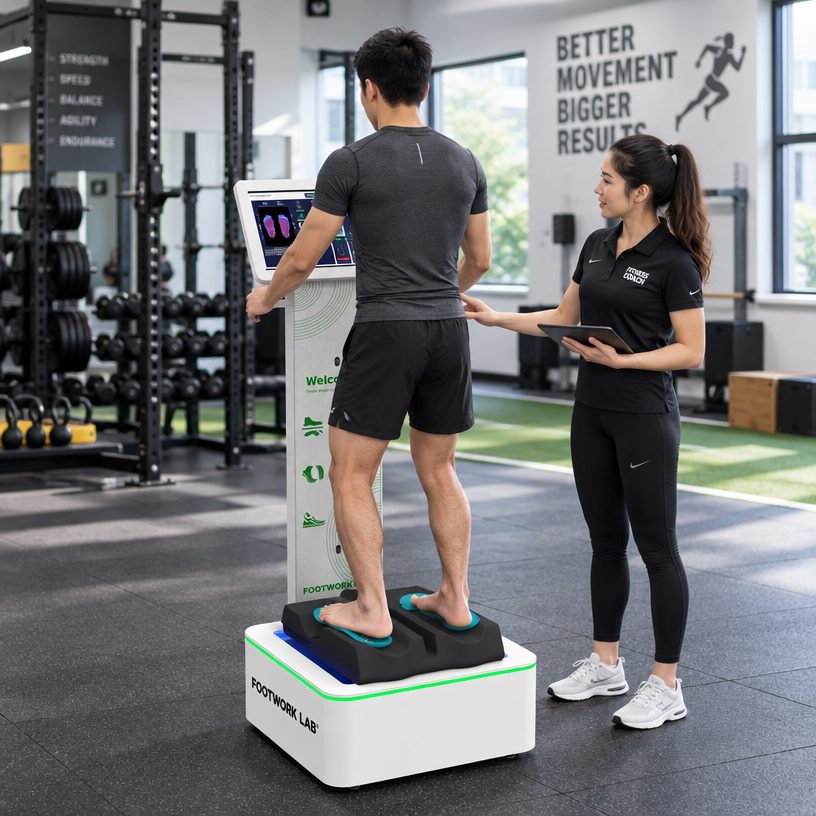
A screening day lives or dies on routine, and the routine has to be written down before the first child walks in. The centre splits the room into stations: sign-in and shoe removal, the foot capture area, the standing posture capture in front of the cameras, and a table where the report is read through with a parent. Children move through in one direction. Nobody skips a station, and nobody adds one mid-day, because a record taken with an extra step in the middle is not comparable to one taken without it.
The standing instructions are the same for every child, in the same words, from the same operator where the staffing allows it. Feet at a natural width, arms relaxed, eyes ahead, stand still for the capture. Children fidget, and the prompts on the touch screen exist partly for them: the screen walks the child through the pose so the operator does not have to keep repeating it. A child who has just run in from the car park stands differently from one who has been sitting and waiting, so the centre builds in a short settle time at sign-in and keeps it constant across the day.
Operator rotation is the quiet risk in any event like this. At one session we heard about through pre-sales support, the morning records and the afternoon records looked like two different populations; the morning operator had children hold a pose against a wall mark and the afternoon operator had let them stand free. Nothing was wrong with the equipment. The instruction sheet simply had not covered that detail, so the two operators invented different ones. Since then we suggest every screening day starts with a written protocol that names the stance, the number of passes and who signs off each file.
Throughput matters less than honesty about throughput. A session per child of a few minutes, plus the conversation at the report table, means a morning holds a limited number of children. Centres that overbook end up shortening the conversation, and the conversation is where the record becomes useful to the parent. A queue that moves slower is the better problem to have.
What the X5 writes down as angles
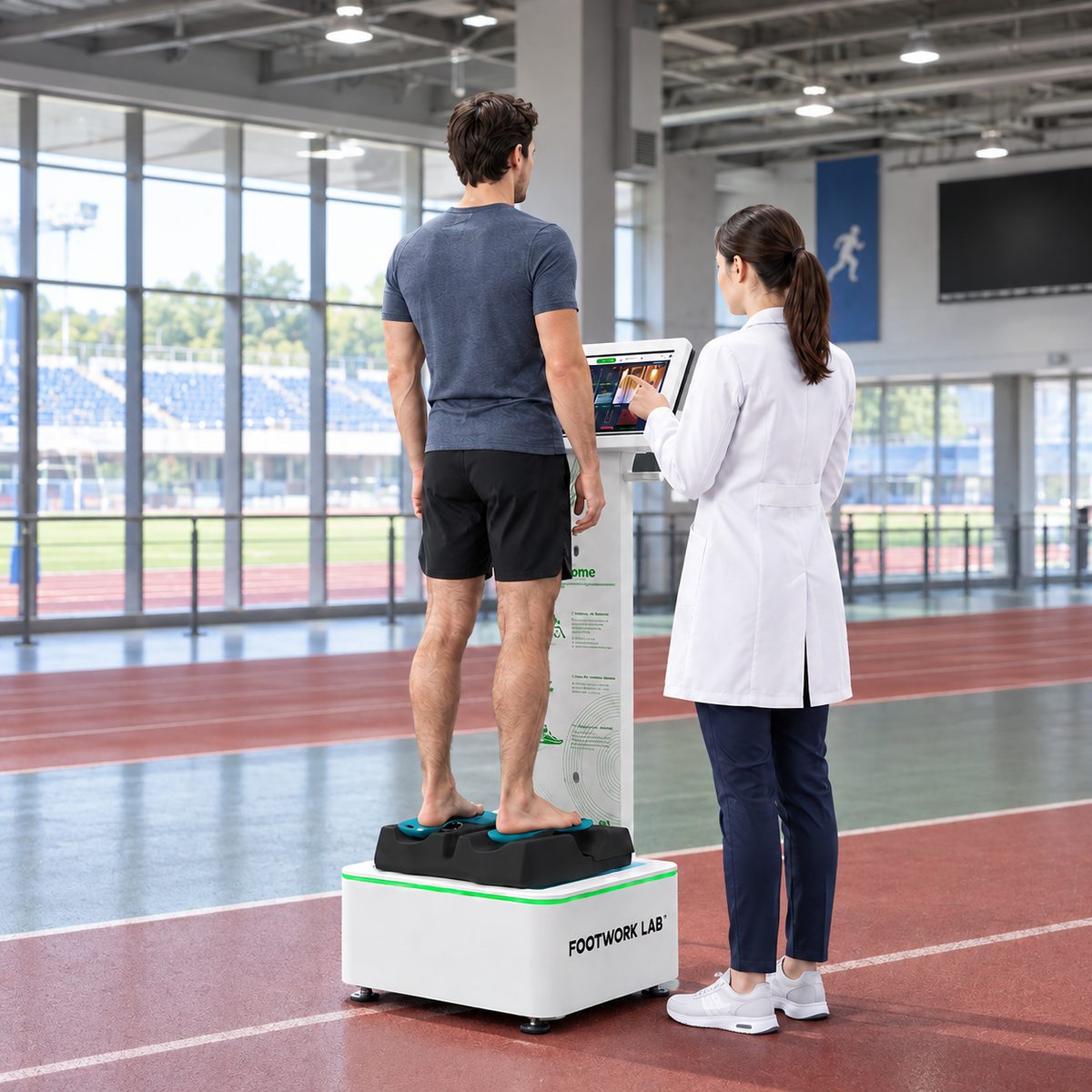
The search phrase foot biometrics scanner suggests a machine that reads the child and passes judgement. What the X5 actually holds is a set of records taken in one session: plantar data from the foot capture area, ankle data, lower-limb biomechanical alignment from the leg camera, and full-body posture from the body camera. The touch screen assembles them into one report with AI-assisted report generation, and every item in it is a measurement — a distribution, a proportion, an angle — rather than a conclusion.
The posture items are the ones parents ask about, because they are the ones with everyday names. The system records neck tilt, shoulder droop, pelvic tilt including forward and backward pelvic tilt, knee hyperextension, and X-shaped and O-shaped leg alignment. Each appears on the report as an angle against a reference, captured from the posture camera while the child stands in the standard pose. The screen shows the child’s own image beside the numbers, which matters more than it sounds: a parent looking at their own child’s shoulders reads the record faster than one staring at a table of figures.
The foot side of the record is equally concrete. The plantar capture holds how load sits across the sole in standing, the foot data covers arch behaviour and foot dimensions under load, and the ankle data records what the ankle does while the child bears weight. The lower-limb alignment image places the line through ankle and knee against the reference drawn on screen. Taken together the session puts the foot, the leg and the whole-body posture into a single file — which is the X5’s actual purpose, holding the chain in one record instead of three separate ones.
Every one of those numbers is a record quantity. An angle on a report is not a verdict about the child’s structure, and the report itself carries a line saying the data is for reference and that medical questions belong with a professional institution. We keep that line on every report we configure, including when a buyer asks whether it can come off. It cannot.
Keeping the parent conversation descriptive
The report table is where a screening day succeeds or turns into something it should not be. The person reading the report with the parent needs a vocabulary that stays descriptive: here is where the load sits under the foot, here is the line the leg makes above it, here is the angle the shoulders record against the vertical. What that means for this particular child is not a sentence the machine can finish, and it is not a sentence the person at the table should finish either unless they are clinically qualified to finish it.
Words do the work here. Descriptive language — wider, narrower, more on one side than the other, an angle that sits inside or outside the drawn reference — gives the parent something true and checkable. Diagnostic language, even casual diagnostic language, gives them something to worry about in the car home. We have watched operators at exhibition demos fall into the second vocabulary within minutes, because parents push for an interpretation and the path of least resistance is to give one. The operators who hold the line do it with a prepared sentence: the record describes what was seen today, and what it means is a question for a professional who knows your child.
Showing the child’s own image does more to settle a parent any reassurance sentence could, and it does it honestly. When the parent sees the shoulders in the photograph and the angle recorded beside it, the number stops being abstract. The same image is also the fastest way to show what the record does not contain: it does not name a condition, it does not predict anything, and it does not rank the child against a chart of normal and abnormal children.
One more habit separates good screening days from sloppy ones: the operator narrates the limits out loud at the table, not in a footnote the parent reads later. Screening is a first look. A single record taken on one afternoon cannot account for how the child slept, whether they were nervous, or what they had been doing before they arrived. Saying that at the table takes half a minute and prevents the record being quoted back later as something it never claimed to be.
What goes into the child’s file — and what stays out
A screening day that does not file its records properly has bought the equipment the wrong way round, because the value of a first record only appears when a second one exists beside it. The file is keyed to the child: the date, the conditions under which the capture was taken, the operator, and the full report. The centre should also keep a plain-language note of anything the parent said at the table — a complaint about shoes, a mention of discomfort after sport — because that context is what makes the next comparison meaningful.
What stays out of the file matters as much as what goes in. No interpretations, no conditions, no predictions, and no freehand notes that read like clinical opinions from someone not qualified to hold them. If the operator is not clinically trained, their observations stay observational: the child favoured one leg getting onto the platform, the parent mentioned the school nurse had raised a question. Those are facts about the day. Writing down what they mean is a different act, and it belongs to different people.
Consent and data handling belong in the protocol, not in an afterthought. Parents should know the record is kept, how long it is kept, who can see it, and what happens if they ask for it to be deleted. A centre that can answer those questions in one calm sentence earns more trust at the report table than any feature on the screen. We advise buyers to settle the data policy before the first event, and we supply the software support to make the policy enforceable.
The report leaves the room the way our reports always do: scanned to a phone, sent to an email address, or printed on the spot. Whichever route the centre chooses, the copy the parent takes home should be identical in content to the copy in the file. Two versions of one record is how discrepancies are born.
Why the file matters at follow-up
A single set of angles on a single afternoon is a snapshot of a child who was standing still for a few minutes on one particular day. Children change constantly, and a record taken during a growth spurt reads differently from one taken three months later. This is the strongest argument for the screening-day format: the same routine, repeated on a schedule, produces a series rather than a snapshot, and a series is the only thing that can honestly show direction.
The comparison is only valid if the routine held. Same stance, same prompts, same operator where possible, same settle time. When a centre brings a child back and the new report differs from the old one, the first question is not what changed in the child but what changed in the room. We take support calls of exactly this shape — the second record looks nothing like the first — and more often than not the difference traces back to a detail of procedure, not to the feet.
Follow-up is also where the parent relationship either matures or spoils. A centre that calls a family back for a scheduled re-record, and walks them through what moved and what did not, is providing a service worth paying for. A centre that calls back to sell is doing something else, and parents can tell the difference immediately. The file, kept honestly, gives the centre something true to say: here is the record from last season, here is today’s, here is what the professional reading them would want to look at.
And when nothing has moved, saying so is the service. Parents are braced for bad news at follow-up appointments; telling them the angles held steady, with the two reports side by side on the screen, closes the loop the first record opened. The equipment’s real product is that moment of settled comparison, not the first sheet.
Where a screening day ends and a referral begins
Some children should not end the day with a report and a rebooking date, and the protocol needs to say so in advance. A child in pain, a child limping, a child who guards one leg or refuses to bear weight, a child with a recent injury, a child whose presentation visibly alarms the parent — these are referral cases, and the operator’s job is to say plainly that this belongs in a clinical setting, hand over the record, and stop. Screening equipment is a first look; it is not the look.
We do not diagnose, and we tell every buyer of an X5 that the system they are purchasing produces records, not conclusions. The posture angles, the foot data and the alignment images are inputs to a professional’s judgement, and the judgement stays with the professional. A training centre that understands this runs better events, because the operators stop being asked questions the room cannot answer and start referring with confidence.
The referral step is easier when the centre knows the local professionals. The centres that run these days well keep a short list of clinics they trust, and the handover is a printed report with the file number on it rather than a verbal summary. The receiving clinician gets a dated, condition-controlled record — which is precisely what makes their own first appointment shorter and better informed.
Between the first record and the referral, there is a wide, honest middle: the child whose record is unremarkable, the family that wanted a baseline before a sports season, the follow-up that shows steady angles. Most of a screening day is that middle, and most of its value is there too. The equipment’s job is to keep the middle honest, and the protocol’s job is to catch the edges.
Frequently asked questions
What does the X5 actually record about a child’s posture?
In one session it records plantar data from the foot capture area, ankle data, lower-limb biomechanical alignment from the leg camera, and full-body posture from the posture camera. The posture items are neck tilt, shoulder droop, pelvic tilt including forward and backward tilt, knee hyperextension, and X-shaped or O-shaped leg alignment, each shown as an angle against a reference on the child’s own image.
Does a posture screening day diagnose anything?
No. Screening produces a dated record of angles and distributions. Reading what those mean for a particular child is the responsibility of a qualified professional, and every report carries a line stating that the data is for reference and that medical questions belong with a professional institution.
How long does one child’s session take?
The capture itself takes a few minutes; the conversation at the report table takes longer, and it should not be rushed. Centres that overbook end up cutting the conversation, which is the part that makes the record useful to the family.
Can records from two screening days be compared?
Yes, and comparison is the point — but only if the routine held: same stance, same prompts, same settle time, ideally the same operator. When a second record differs sharply from the first, the first thing to check is the procedure, not the child.
What does the family take home afterwards?
A report assembled with AI-assisted report generation, delivered by scanning a code, by email, or printed on site. The copy the parent takes home matches the copy in the centre’s file, and both carry the reference note about professional interpretation.
Does the session have to end with an insole?
No. The X5 carries an on-site customization module for biomechanical insoles, so a session can end with one where the professional judges it appropriate, but nothing in the workflow requires it. Many screening days end with nothing but a record and a rebooking date, which is a complete outcome.
What are the terms for ordering an X5?
Equipment minimum order is one unit, and each unit runs a seven-day test before it leaves the plant. The warranty covers twelve months against non-human damage with free parts. Support runs through a dedicated group with our engineers, remote assistance, and over-the-air updates when the unit is connected.
What we would do next
If you run a training centre, a rehab hospital or a podiatry clinic and a screening day is on your calendar, tell us the room, the staffing and the number of children you expect. We will help you draft the written protocol — stance, prompts, passes, operator sign-off — before the equipment ships, because the protocol is what makes the records comparable. The X5 system page lists the detection functions in the manual’s own wording.
For how the posture record is read in a clinical setting, see our article on postural analysis with the X5, and for the boundary between a record and a verdict, foot type as a record covers the same line from the fitting side. Order, warranty and support terms sit on the FAQ page, and the contact page reaches the team directly.
This article is intended for professional and educational reference. It is not medical advice. Foot assessment equipment produces measurements and images; clinical interpretation and any decision about care remain the responsibility of a qualified professional. Certification scope is limited to the documentation we hold: European Union certification and ISO quality system certification.