
The customer lifts the shoe off her foot and slides out the original footbed before anyone has asked her to, and the footbed tells the room more than her description does. The heel edge on the outer side has worn through to the base layer. The forefoot carries a smooth, compressed patch where the ball of the foot has ridden the same spot for a year. The foam in the midfoot has flattened into a shape that no longer springs back when pressed. None of this arrived as a complaint; the customer came in for insoles for worn out shoes, or more precisely came in believing that a new pair dropped into this shoe would sort out the ache she described on the walk over. The footbed already in the shoe is a record, though, and the record has to be read before anything is built. This article covers what wear through the outer heel says, what the forefoot imprint adds, how much collapse inside a shoe is too much, how a shop says plainly that the shoe rather than the footbed is the problem, what happens when a fresh build goes into footwear that is already finished, and the cases where the only honest answer is a new shoe first.
The footbed already in the shoe is a record
Every shoe arrives with some kind of footbed inside, whether it is a shaped pair or a flat sheet of card, and the customer has been writing on it with every step since the day the shoes were new. Load leaves marks. Where the heel struck hardest, the covering wears smooth and the foam beneath it thins first. Where the forefoot pressed longest, the surface compresses into a polished patch. Where the arch barely touched, the original texture survives almost untouched. A trained eye reads this in under a minute, with the shoe off the foot, on the counter, under ordinary shop lighting.
The reason this matters before any measurement is that the footbed sits closer to the shoe’s condition than to the foot’s. A pair of shoes worn for a season imprints the loads that shoe has carried, on the days it carried them, through the socks and the ground of that period. It is not a substitute for a pressure record taken on a platform, which is a controlled capture under stated conditions. But it is free, it is present, and it comes from the exact shoes the customer actually wears, which no studio capture can claim.
So the first move at the counter is to ask for the shoe, not to sell the build. Take the original footbed out, lay both of them on the counter side by side, left beside right, and look at where the covering has gone. The customer is usually curious rather than offended; most people have never examined their own footbeds. Asking permission, and explaining in one sentence why, keeps the moment comfortable and buys the room the credibility it needs for the harder conversation that sometimes follows.
What the worn heel edge is telling you
Wear through the outer edge of the heel is the most common pattern a shop sees, and it carries a fairly plain message: the customer lands on that edge, repeatedly, with enough force and enough repetition to wear the covering away. Some edge wear is ordinary; every footbed wears at the heel eventually. What deserves attention is wear that has gone through the covering to the layer beneath, or wear that has eaten a visible slope into the foam, higher on one side than the other. That is not decoration wearing off. That is a load path that has been running the same way for a long time.
The slope matters as much as the location. Once the heel area of a footbed wears into a wedge shape, the shoe is no longer holding the foot level; it is holding the foot tilted, in the direction the wear chose. Every step since then has been taken on a foundation that slightly encourages the same landing that created the wear. A shoe with a worn-in tilt keeps feeding the pattern that wore it. This is the quiet reason a customer can feel worse in a favourite old pair than in an unfamiliar new one, and the reason the tilt cannot be left in place under a new build.
There is a limit to what the heel wear can tell you, and it is worth stating honestly to staff. It shows where load has arrived in this shoe. It does not show why, and it does not show what the foot does in other footwear, on other ground, or without the shoe’s own counter and sole influencing it. Some customers heel-strike heavily by habit, some shoes have a soft outer heel that exaggerates wear, and some pairs are simply old. The wear pattern is the start of a conversation, not a conclusion, and staff who present it as a diagnosis have gone further than the evidence.
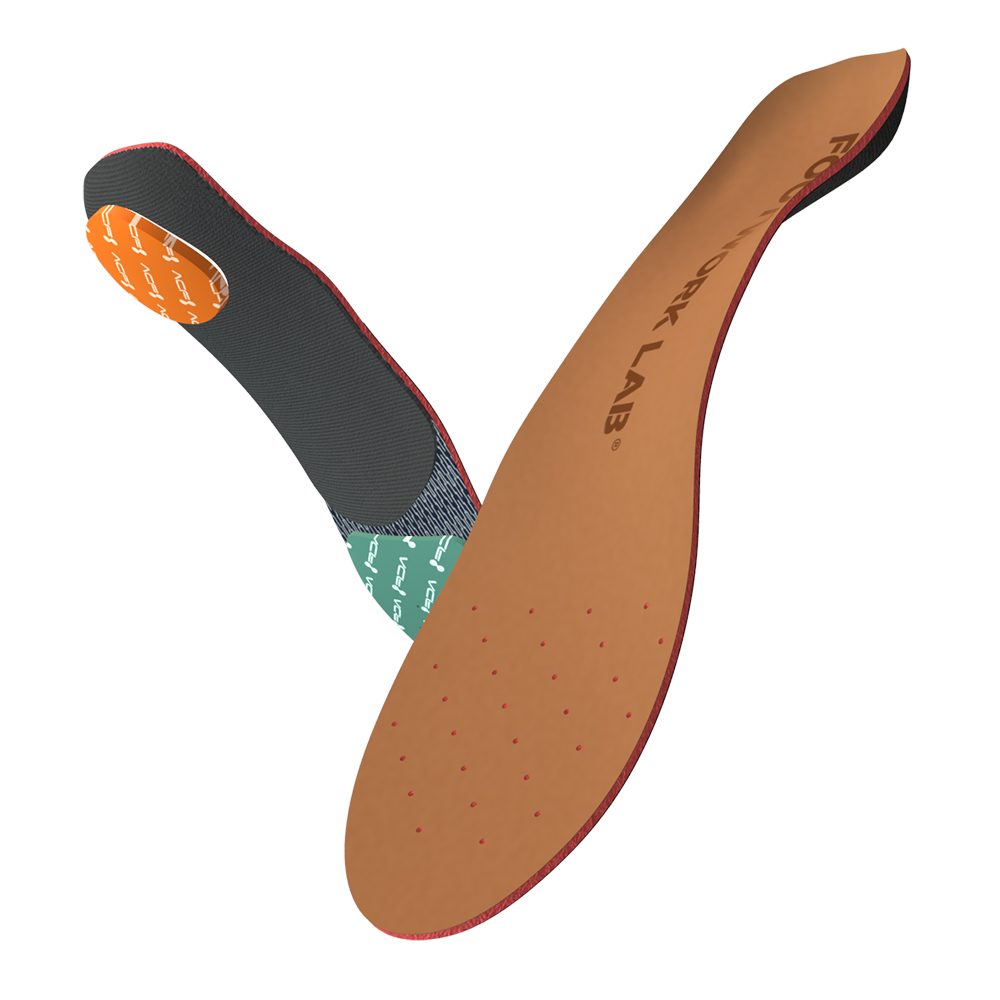
What the forefoot imprint adds
Turn the footbed over and the forefoot usually has its own story. A smooth patch under the ball of the foot, roughly where the toes meet the rest of the foot, shows where pressure concentrated at push-off. A patch that sits noticeably more towards the inner edge or the outer edge says the load has been leaning one way through every step in these shoes. Wear under the big toe joint alone, spread across a narrow band, reads differently from wear spread broadly across the whole ball. None of these marks names a condition; each of them narrows where the conversation should go.
Comparing the two footbeds, left against right, often says more than either one alone. Feet are not symmetrical, and some difference between sides is entirely ordinary. But a pair whose forefoot imprints sit in clearly different places, or whose heel slopes run in visibly different directions, is telling the room that the two feet are being used differently inside these shoes. That observation, written down, becomes useful when a pressure record is taken later, because the two kinds of evidence either agree or they disagree, and both outcomes shape the advice.
The forefoot imprint also answers a question the customer often asks directly: why do my shoes always wear out here? The honest answer combines the foot’s own loading with the shoe’s construction, and nobody in the room can separate the two contributions by looking at the footbed alone. What the imprint supports is a demonstration, not a verdict. Showing a customer the polished patch under their own ball of the foot, next to the unworn arch area, explains in five seconds what a page of explanation cannot, which is why shops that build footbeds keep a few retired footbeds behind the counter as teaching material.
When the shoe, not the footbed, is finished
Footbeds are one layer, and they sit on top of the shoe’s own cushioning and structure. When the shoe’s midsole has collapsed, the base under any new build is dead, and no footbed placed above it can restore what the midsole has lost. The signs are visible without instruments: the shoe leans visibly inward or outward on a flat counter, the heel counter has softened enough to fold sideways with finger pressure, the creasing across the forefoot has gone deep and set, or the original footbed has worn through so completely that the shoe’s own base layer is showing. Each of these says the shoe has spent its structure.
The temptation in a retail setting is to avoid this conversation. A new build in an old shoe is a sale today, and telling a customer their shoes are finished feels like refusing their money. But the arithmetic fails quickly. A footbed built for a foot, dropped into a shoe whose base has already taken a set, sits on a tilted, flattened foundation. It cannot do its intended work, because the surface it rests on has its own opinions. Within weeks the new pair starts to take on the shape of the shoe beneath it, and the customer has paid for a build that a dead shoe is busy undoing.
How much collapse is too much is a judgement the room can write down, the same way a speed protocol gets written down. The counter tests are simple and repeatable: does the shoe lean on a flat surface, does the heel counter fold under pressure, has the forefoot creased through to a visible ridge, is the original footbed worn through to the base? A shoe that fails two or more of those checks is a shoe the room should not build into, however friendly the customer and however new the shoes look on the shelf.
How to say it at the counter
The conversation goes better when the footbed does the talking. Instead of opening with a judgement about the shoes, lay the original footbeds on the counter, show the wear, and describe what it means in plain terms: this edge is worn through, which says your load has been arriving here every step; the base under it has taken a set; anything new placed on top of this will follow the same shape within a short while. The customer is looking at her own evidence, not hearing an opinion. This framing keeps the discussion factual and gives the customer a reason to reach the conclusion herself.
Then say the sentence the shop owes the customer, plainly and without apology: in this pair, a new build would not be doing its job, because the shoe beneath it has finished its working life. Shops that hesitate here usually frame it as losing the sale, but the better frame is protecting the outcome. A customer who buys a build into a dead shoe, feels nothing change, and blames the footbed is a lost customer for every future pair. A customer told honestly today, with the wear shown and explained, usually returns once the shoes are replaced, and remembers who told her the truth when it cost the shop something.
What helps the conversation land is offering a path rather than a refusal. The refusal is only half the answer; the other half is what to do next. If the customer is close to needing new shoes anyway, the advice is to replace first and build second, into shoes worth building into. If the customer wants to bridge the gap, some shops fit a simple ready-made pair as a stopgap rather than a custom build, so nothing expensive is committed to a shoe that cannot support it. The exact path varies with the shop, but the direction does not: nothing valuable goes into a shoe that cannot hold it.
What a new build inside a dead shoe actually does
The consequences of building into a worn shoe are predictable enough to list from experience. First, the build deforms early. A footbed is shaped to sit on a reasonably level base; on a collapsed one, it takes the base’s shape, and the shaping the workshop put into it stops being the shaping the foot meets. Customers describe this in their own words: the pair felt right for a fortnight, then it went flat, then it started to feel like the old shoe again. It did not go flat. It was pressed into the shape of the shoe beneath it.
Second, the blame lands in the wrong place. The customer experiences a new pair that stopped working, and the natural conclusion is that the footbed, the shop, or the whole idea of a build does not work for them. Nobody in that moment blames the shoe, because the shoe is invisible in the story; the footbed is the thing they can see and touch. This is the most expensive outcome in the whole transaction, because it poisons not just one sale but the customer’s willingness to try again, and it usually travels by word of mouth exactly as wrongly as it was formed.
Third, the shoe keeps wearing the build unevenly, which shows up as a pair that wears through its covering on one edge long before the other side shows anything. We see returned pairs like this from time to time, and the wear pattern on the returned build frequently matches the wear pattern on the customer’s original footbed almost exactly, because the shoe taught the new pair the same lesson it taught the old one. That match is worth showing a customer who doubts the explanation, because it makes the shoe’s influence visible in a way words are not.
The cases where the shoe has to go first
Some situations remove the choice entirely. A shoe whose midsole has visibly collapsed cannot host a build, whatever the customer prefers, because the foundation has no structure left to sit on. A shoe whose heel counter has broken down cannot hold the rear of the foot steady, so anything placed inside moves with the counter instead of guiding it. A shoe worn through at the inner lining, where the footbed should rest, gives the build nothing clean to lie against. In these cases the shop is not choosing between sale and refusal; it is choosing between an honest refusal now and an unhappy customer later, and only one of those keeps the relationship.
Other cases sit on the boundary, and these are where judgement earns its keep. A shoe that is worn but structurally sound, with a solid counter and an intact base, can often take a build even if the original footbed shows real wear, provided the worn footbed is removed and not stacked underneath. A customer who is two months from replacing the shoes anyway may be best served by waiting, and a shop that says so, rather than selling into the last stretch of a dying pair, is playing a longer game that customers eventually recognise. The boundary cases are worth a house rule as much as the clear ones, because rules are what keep the advice consistent between staff members.
What ties the whole article together is a simple order of operations that a shop can adopt: read the footbed the customer walks in with, check the shoe’s structure against the counter tests, and only then talk about what to build. The footbed came in as a record. The shoe’s condition decides whether the record can be acted on in this footwear at all. Shops that keep this order build into shoes that can carry a build, and the pairs they sell behave the way the workshop intended when they made them.
Frequently asked questions
Can a custom pair be fitted into any shoe the customer brings?
No. The shoe needs a sound base, an intact heel counter and enough volume to accept the build without crushing it. A shoe with a collapsed midsole or a softened counter deforms the build quickly and undoes the shaping the workshop put into it. Checking the shoe comes before quoting the build, and the check takes only a minute on the counter.
What does wear through the outer heel of the original footbed mean?
It shows that load has been arriving repeatedly on that edge, in these shoes, long enough to wear through the covering. If the foam beneath has worn into a slope, the shoe now holds the foot tilted in that direction and feeds the same landing. It describes the shoe’s history honestly, but it is not, on its own, a conclusion about the foot.
How worn is too worn for fitting a new build?
Use counter tests and apply them the same way every time: does the shoe lean on a flat surface, does the heel counter fold under finger pressure, has the forefoot creased into a firm ridge, is the original footbed worn through to its base? A shoe failing two or more of these is finished, and a build placed inside it will not last or perform.
Should we tell a customer to replace the shoe instead of buying a build?
Yes, when the evidence supports it, and show the evidence rather than state an opinion. Lay the worn footbeds on the counter, point out the wear-through and the tilt, and explain that a new build follows the shape of what sits beneath it. Customers told plainly, with their own shoes as proof, generally return to build once the shoes are replaced.
Will a new pair wear out faster inside an old shoe?
It will, and unevenly. A collapsed base presses the build into the shoe’s own worn shape, so the new pair takes on the same tilt and the same edge loading that wore out the original. Returned builds often show wear patterns matching the customer’s old footbed almost exactly, which demonstrates the shoe’s influence better than any explanation.
Does a worn original footbed mean the customer’s foot has changed?
Not by itself. The footbed records what these shoes carried, through the socks, ground and habits of the period, and wear accumulates with time regardless. Any question about whether the foot itself has changed belongs to a fresh pressure record taken under stated conditions, compared against an earlier one taken the same way, not to the footbed alone.
What should a shop write down when it declines to build into a shoe?
The counter tests that failed, the wear observed on the original footbed, the date, and the advice given. One dated line protects the shop and the customer alike: it shows the refusal was based on the shoe’s condition, keeps the next visit consistent, and lets whoever serves the customer next pick up the same honest position.
What we would do next
Put the counter tests on one card, the way a room puts its measurement conventions on one card, and train the decline conversation until every member of staff says it the same way. Then start asking to see the original footbed at every fitting, because the habit costs nothing and catches the dead shoes before any quote is given. Reading wear instead of the calendar covers how finished footwear is judged, and shoes with and without a removable footbed explains the two very different builds each construction allows. The insole categories page sets out the ranges in their own terms, and the FAQ page carries the answers we give most often by message.
This article is intended for professional and educational reference. It is not medical advice. Foot assessment equipment produces measurements and images; clinical interpretation and any decision about care remain the responsibility of a qualified professional. Certification scope is limited to the documentation we hold: European Union certification and ISO quality system certification.