
Buyers ask which foam is best, and the honest answer is that the question is malformed. Cushioning materials are a set of trade-offs, not a ranking. The foam that feels best in the hand is rarely the one that survives a season of daily wear, and the foam that lasts longest is rarely the one a customer describes as comfortable in the first week.
What a buyer can do is match the material to the use case and the expected life, then specify it precisely enough that the next batch behaves like the first. That is a smaller ambition than finding the best foam, and it produces better products.
FOOTWORK LAB produces custom orthotic insoles in our own plant in Ruichang, Jiangxi Province, and we buy cushioning materials in volume. This article sets out the families we work with, the properties that actually differ, and the way to write a foam into a specification so that a factory can hold it.
Why foam choice is a trade-off, not a ranking
Every cushioning material balances three properties: how much it deforms under load, how quickly it returns, and how much of that behaviour it retains over time. Improving one usually costs another. A softer foam feels better and compresses faster; a firmer foam lasts longer and feels less forgiving.
That is why product ranges exist. A single foam cannot serve a customer who wants a soft everyday insole and a customer who wants a durable work insole, because those two customers are asking for opposite ends of the same trade-off.
The practical consequence for a buyer is that the brief has to state the intended use and the expected life. Without those two facts, a foam recommendation is a guess dressed as expertise.
The families, and what each is good at
EVA is the workhorse. It is light, cheap, easy to bond and available in a wide range of densities. It is also the material most often used as a base layer, with softer materials placed on top where the foot actually sits.
Polyurethane foams offer a different balance: more resilience, a broader range of firmness and better recovery in some formulations. They are common in midsoles and in cushioning layers where repeated loading matters.
Memory foam deforms slowly and conforms to shape, which customers find comfortable and which makes it a poor choice for a structural layer. It is a comfort material, and it belongs on top of something that holds shape.
Poron and similar microcellular urethanes are dense, resilient and dimensionally stable, which makes them useful where a thin layer has to do real work without adding height. Latex and blends of the above fill specific niches, usually where a particular feel or a particular durability target is required.
Density and hardness are not the same thing
Density describes how much material is in a given volume. Hardness describes how the material resists indentation. A dense foam can be soft, and a light foam can be firm, because the two properties are controlled by different aspects of the formulation.
Buyers conflate them constantly, usually by asking for a “dense soft foam”, which is a legitimate request and one that requires both numbers rather than one word. A specification that names density alone leaves hardness to the supplier.
The test is simple. Ask for both figures and ask how they are measured. A supplier who can answer is working from a material datasheet; one who answers with a word is working from memory.
What resilience actually predicts
Resilience describes how much energy a material returns after deformation. A highly resilient foam feels springy and returns quickly; a low-resilience foam absorbs more and returns slowly.
For an insole, resilience predicts how the material behaves under repeated loading. A low-resilience foam damps impact and feels dead after a while; a high-resilience foam feels lively and can feel unstable under a heavy load. Neither is universally better.
Where the brief calls for damping, low resilience is a feature. Where it calls for a consistent platform for the foot, higher resilience is usually better. The word “comfortable” hides both, which is why the specification should use the technical terms.
Compression set and durability
Compression set describes how much deformation remains after a load is removed. It is the single most useful predictor of whether a cushioning layer will still be doing its job after a year.
A foam with poor compression set becomes thinner at the point of highest load, which is exactly where the cushioning was needed. The customer experiences that as the product wearing out, and no amount of top cover quality compensates.
Ask for the compression set figure and the test conditions. A number without conditions is not comparable, and a supplier who offers one without the other is either careless or hoping you will not ask.
Thickness, stack height and shoe volume
Cushioning occupies space, and the space inside a shoe is finite. Every layer added to an insole reduces the room available for the foot, and the reduction is felt at the heel and at the toe box first.
This is why the footwear record belongs in the brief. A build that works in a roomy trainer may be unwearable in a dress shoe, and the difference is not the foam but the stack height.
The skill is in achieving the cushioning target within the volume available. That sometimes means a thinner, denser material rather than a thicker soft one, which is counter-intuitive for buyers who equate thickness with comfort.
Moisture, temperature and aging
Foam ages faster in the presence of heat and moisture, both of which are normal in a shoe. A material that performs well in a laboratory at room temperature may behave differently after a summer in a car boot.
Open-cell foams absorb moisture and can retain it, which affects both comfort and durability. Closed-cell foams resist absorption and are often preferred where the insole will see sweat or rain.
Ask how the material behaves after accelerated aging, and whether the supplier has data or only an opinion. For products sold into hot climates, that question is not academic.
Specifying a foam in a production order
A production specification names the material family, the density, the hardness, the thickness with a tolerance, and the position in the stack. Five items, written down, produce a repeatable layer. Words like soft and premium produce a conversation.
The tolerance is the item buyers forget. A thickness range with an upper and lower bound allows a factory to reject a sheet rather than use it, and it gives the buyer a basis for complaint when a batch arrives outside the range.
Position matters as much as material. The same foam placed under the heel and under the forefoot produces different behaviour, because the loads are different. The specification should say where the layer sits, not just what it is.
How the layers work together
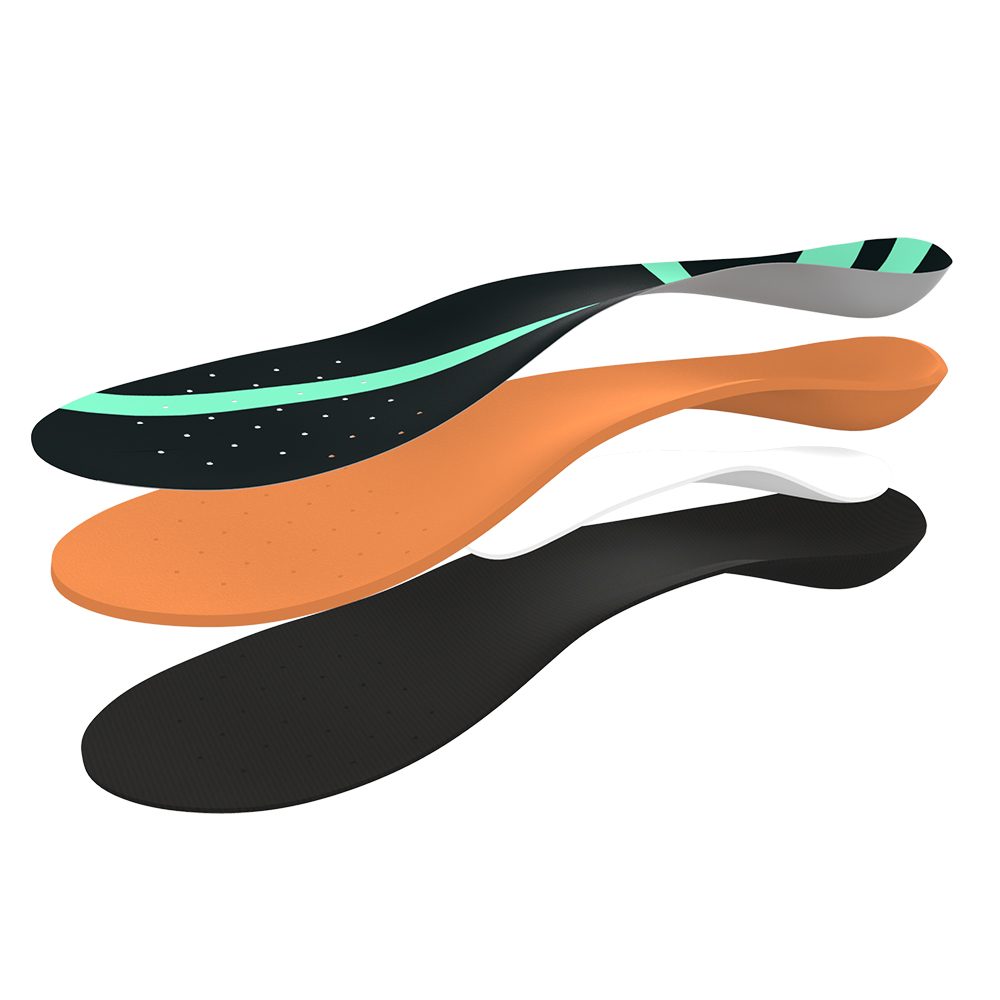
An insole is a stack, and the stack behaves differently from the sum of its layers. A soft foam over a stiff shell produces a different result from the same foam over a flexible one, because the foam can only deform as far as the layer beneath allows.
That interaction is why specifying a material without specifying its position is incomplete. A foam that feels ideal on a bench becomes a pressure point when it is bonded over a sharp transition in the shell, and the material is blamed for a geometry problem.
The practical rule is to specify the stack from the bottom up: shell, then structural layer, then cushioning, then top cover. Each layer has one job, and the specification should say which job each one is doing. When two layers are doing the same job, one of them is costing money without adding anything.
It also helps to keep the number of layers low. Every additional layer adds a bond line, and every bond line is a potential failure. The best builds we produce are usually the simplest ones that meet the brief.
What a top cover contributes, and what it cannot
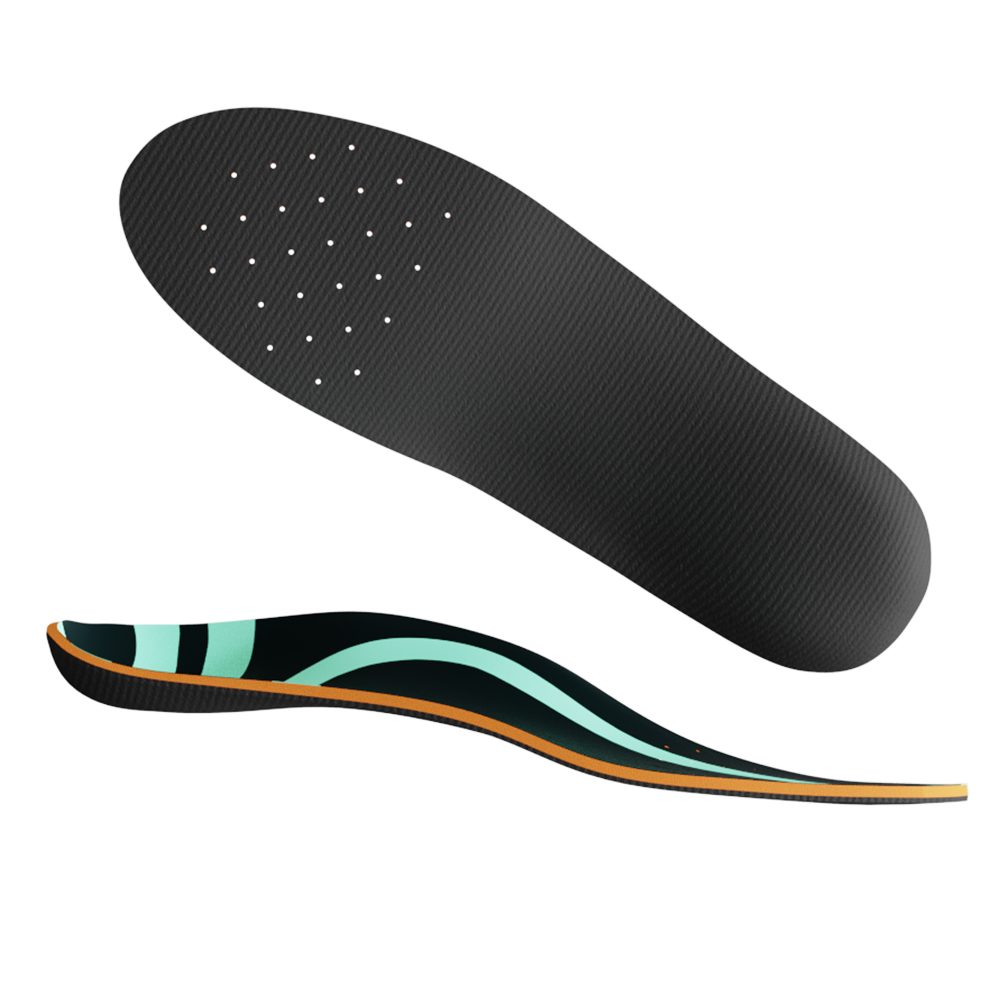
The top cover is the layer the foot actually touches, and it does more work than buyers expect. It manages friction, it wicks or absorbs moisture, and it protects the cushioning layer from abrasion. A poor cover makes a good build feel cheap within a week.
It cannot compensate for a cushioning layer that has compressed or a shell that creates a hard edge. Those are structural problems, and covering them changes the sensation without changing the cause.
Cover selection should follow the use case: a fabric cover for everyday wear, a smoother cover where the foot moves inside the shoe, a more durable cover where the insole will be moved between shoes. None of these decisions is expensive, and all of them are visible to the customer immediately.
The buying conversation, in order
Start with the use case and the expected life. Then ask which material families suit that combination. Then ask for the numbers: density, hardness, resilience, compression set, thickness tolerance. Then ask what the supplier does when a batch falls outside those numbers.
That sequence keeps the conversation anchored to the product rather than to the catalogue. A supplier who answers the first two questions with a material name is selling stock; one who asks about the use case before recommending anything is specifying.
Finally, ask for a sample in the exact build. Not a demonstration pair, not a similar model: the build, with the layers and the cover you intend to order. Ten minutes in the hand and a week on a foot will tell you more than a datasheet.
None of this requires technical expertise. It requires the discipline to ask for numbers instead of adjectives, and to write down what was agreed so that the next order produces the same product.
Where the money goes in a cushioning decision
Material cost per pair is the visible number and rarely the decisive one. The decisive numbers are usually the defect rate, the re-make rate and the complaint rate, all of which rise when a material is specified loosely.
A cheaper foam that compresses early generates returns that cost more than the saving. A more expensive material that holds its properties for the life of the product reduces the cost of service, even though the invoice looks larger.
The way to see that clearly is to calculate cost per pair worn for a year rather than cost per pair shipped. That number changes the ranking of materials, and it is the number a clinic or a distributor should be optimising.
Sourcing and batch consistency
At volume, foam is a batch material. Colour can vary, density can vary within a tolerance, and the feel can differ between shipments even when the datasheet matches. A factory that checks incoming material catches the variation; one that trusts the certificate does not.
Ask how incoming material is checked and what happens when a batch falls outside the specification. A supplier with a documented answer is a supplier that has dealt with the problem before.
Our own terms are simple: two hundred pairs minimum for insoles, mixed across models and sizes; samples within three days of specification approval; ODM and OEM both available. We name the materials in the specification so that a reorder is a reorder rather than a new product.
One last point on specification language: a material name alone is not a specification, because several suppliers can sell under the same generic name with different numbers behind it. The name, the numbers and the position in the stack together are what a factory can build to, season after season.
Frequently asked questions
Which foam is the most durable?
Dense microcellular urethanes generally hold their properties well, and some polyurethane formulations are close. Durability also depends on thickness, load and the environment, so the material alone does not answer the question.
Is memory foam suitable for an insole?
As a comfort layer on top of a structural layer, yes. As the only layer, it deforms under load and does not hold the shape the insole needs.
How do I compare two foams?
Ask for density, hardness, resilience, compression set and thickness tolerance, with test conditions. Then compare like with like rather than comparing a sample in the hand.
Does a thicker insole cushion more?
Up to the limit of the shoe. Beyond that, thickness reduces the space for the foot and creates fit problems that feel worse than the cushioning helps.
What is the minimum order for a foam build?
Two hundred pairs, mixed across models and sizes, with samples dispatched within three days of specification approval.
Do you supply foam material separately?
We supply finished insoles built to a specification. Our commercial scope is the finished product and the assessment equipment that supports it.
How long does delivery take?
Six to seven working days by express, ten to twelve by air freight and thirty to thirty-five days by sea, depending on destination and clearance.
What we would do next
Write the material into the specification by family, density, hardness and thickness, and keep a reference pair from each approved build. Our article on Poron goes deeper into the microcellular urethanes, and the piece on arch support construction shows how the layers sit together.
For samples, minimum order and OEM arrangements, see the FAQ page. To have a build reviewed, contact our team or visit the factory page.
This article is intended for professional and educational reference. It is not medical advice. Foot assessment equipment produces measurements and images; clinical interpretation and any decision about care remain the responsibility of a qualified professional. Certification scope is limited to the documentation we hold: European Union certification and ISO quality system certification.