
A distributor with a brand, a clinic group with twelve sites and a footwear label with an insole line all end up asking the same question: can this device carry our name instead of the factory’s? The answer is usually yes, and the useful conversation is about what an own-brand programme actually covers, because the word ODM hides a range of arrangements from a printed logo on an existing model to a design built from the buyer’s own specification.
We have produced insoles under other people’s brands since long before it became a common request, and the pattern of a good programme is consistent. The buyer owns the design intent and the market; the factory owns the production discipline, the material choices and the paperwork. Where that division is written down, programmes run for years. Where it is assumed, the first shipment arrives with a label mismatch or a carton that fails a warehouse scan.
What follows sets out the layers of an own-brand programme: design, materials, branding, packaging, compliance wording and the commercial terms that hold them together. It is written for buyers who already know they want their own name on a device and need to know what to specify.
Design: whose specification is it
There are three ways a design can arrive. The buyer brings a complete specification and the factory executes it. The buyer brings a concept and the factory proposes a specification for approval. Or the buyer selects an existing model from the factory’s range and asks for it under their own name. All three are legitimate, and they carry different amounts of risk and different lead times.
A complete specification is the fastest route because nothing has to be invented, but it assumes the buyer has the knowledge to write one: shell family, thickness at named regions, arch family, cover and shoe context. A concept is slower, because the factory has to translate intent into those fields, and translation is where a sample cycle appears. An existing model is fastest of all and offers the least differentiation.
Most programmes settle in the middle: the buyer names the market, the price position and the customer, and the factory proposes two or three specifications to sample. That arrangement uses each side’s knowledge properly, and it produces a decision within one sample cycle rather than three.
Whichever route is chosen, the approved specification should be a controlled document with a version and a date. Buyers who have been through a rebrand know why: a specification that exists in four email threads cannot be audited, and the first quality question will require reconstructing it from memory.
Materials and construction choices
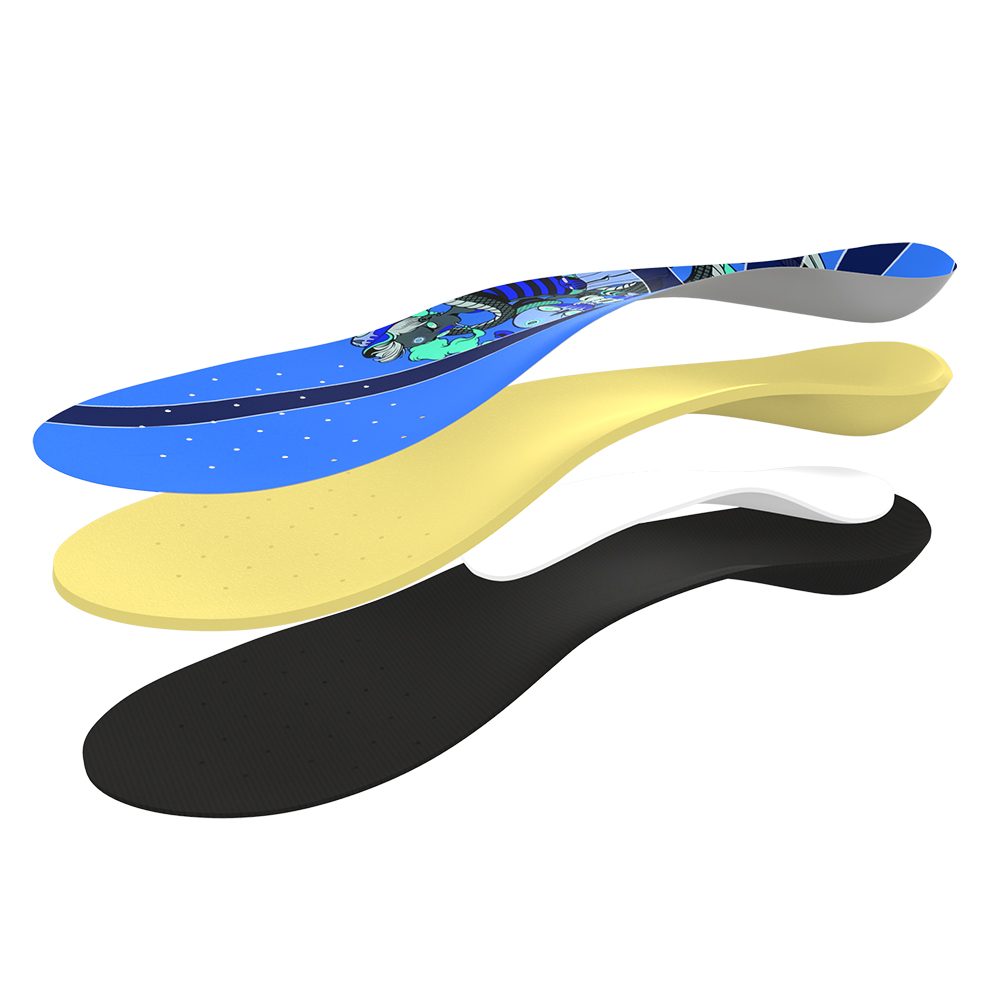
A functional device is defined by how it holds load, and that is decided by the shell. Stiffness family sets how much the shell resists; thickness at named regions sets where it supports and where it gives; the arch family sets the shape a foot rests against. A buyer choosing an own-brand device is choosing, in effect, which of those the market will accept.
Cover material is the second decision and the most visible one. Leather, velour and synthetic covers differ in feel, durability and price position, and a cover that suits a premium clinic range may be wrong for a volume retail line. The cover is also where branding is most often placed, which means the material decision and the printing decision have to be made together.
Construction method follows from the volume. A cut-and-formed shell suits a programme with a defined size run; a moulded shell suits either a programme or a single case, depending on the mould. Buyers should ask which method their order will use, because the answer determines the lead time and the tolerance the pair will be checked against.
None of these choices can be priced in isolation, which is why quotations that state a single number per pair without naming the shell, the cover and the construction are not comparable. Ours list the three, and we would encourage any buyer to ask every supplier for the same three lines.
There is one more material question that separates a careful programme from a rushed one: what happens to the offcuts. A cut-and-formed shell produces waste, and a buyer ordering a large run may want to know whether that waste is costed into the pair price or absorbed elsewhere. Suppliers who can answer plainly are usually the ones whose quotations do not move after the first sample.
Branding: what actually goes on the product
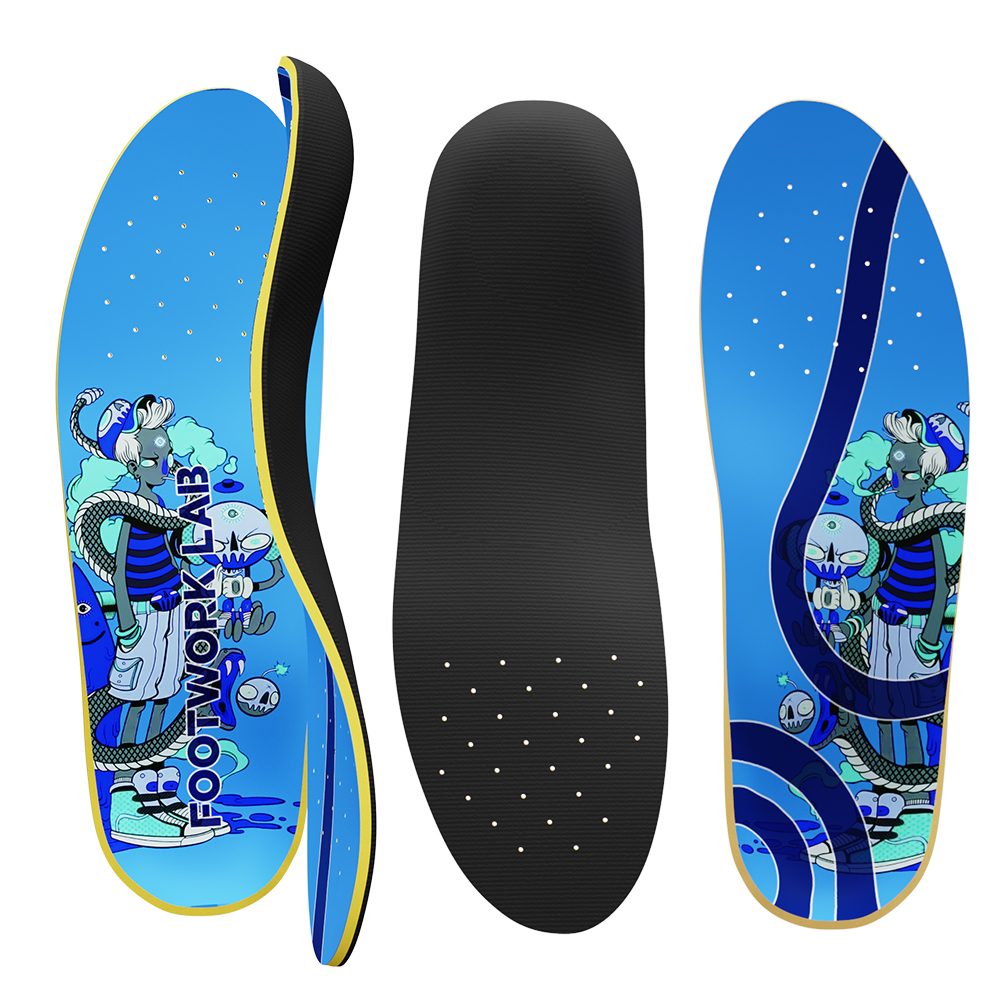
Branding on an insole is a small surface with a few options. An embossed or printed mark on the shell, a printed mark on the cover, a label under the heel, or a combination. Each has a cost, a durability question and a legibility limit. An emboss that reads clearly on a photograph may disappear in the shoe; a print that survives a hundred kilometres may not survive a solvent.
The practical approach is to sample the mark before approving a run. A single pair with the mark applied, photographed in the shoe and after a period of wear, answers more than a design file. Buyers who skip that step sometimes approve a mark that nobody sees, and pay for a plate that produces it.
Branding also raises the question of where the factory’s own mark appears. Most programmes keep a small factory identifier on the product or the packaging for traceability, and buyers should agree the form of it rather than discovering it at delivery. Traceability is not a marketing decision; it is how a batch question gets answered later.
There is also a question of who approves the mark. In a clinic group the clinical lead usually wants to see it; in a footwear brand the marketing team does. Having one named approver per programme, with the sign-off recorded next to the artwork version, prevents the situation where two departments both believe the other has agreed the final file.
Packaging, labelling and carton logic
Packaging is where an own-brand programme succeeds or fails operationally. A pair bagged with a handwritten size is fine for a clinic and unusable for a chain with a receiving warehouse. Cartons mapped to the size run, labels in the market’s language, and insert cards that carry the buyer’s brand are all agreed once and then executed without interpretation.
Labelling language is a compliance decision as much as a marketing one. A market that requires certain wording will not accept a carton that carries different wording, and a reprint mid-run costs days nobody planned for. Buyers should name the markets they ship to at the specification stage, not after the artwork has gone to print.
Carton logic is the part warehouse managers judge. Which panel carries the size, whether the outer carton is scannable, how many pairs fit a case, and whether the case can be opened and resealed. Each is trivial to agree in advance and expensive to change, and the buyer’s own receiving team is the best source of the requirements.
We treat packaging as a design task with its own sign-off because that is what it is. Buyers who bring their warehouse and their marketing team into the same conversation as the factory get a carton that works in both directions; buyers who treat packaging as an afterthought get a shipment that has to be repacked in a stockroom.
Insert cards deserve a mention of their own because they carry the words a customer reads last. A card that explains what the device is, which shoe it suits and how to care for it adds value at almost no cost. A card that repeats a marketing slogan on both sides is a wasted surface, and it is usually the version nobody reviewed.
Compliance wording and what may be claimed
Own-brand products raise a specific question: whose compliance is it? Our answer is that we supply the documentation we hold, and we describe its scope exactly. Our plant operates under ISO quality system certification, and insoles for European Union destinations carry our European Union certification. We do not extend those statements into claims they do not support, and we do not put words on a buyer’s packaging that we cannot document.
Buyers with their own regulatory obligations should bring them to the specification meeting. Where a market requires a particular declaration, our team will confirm whether the plant can support it before artwork is approved. That sequence protects both sides: the buyer gets a carton that clears import, and the factory does not print a claim it cannot stand behind.
The same discipline applies to performance language. A device supports, aligns and distributes load; it does not promise an outcome. Buyers writing their own packaging sometimes reach for stronger language, and the honest advice is to keep the wording descriptive. A claim that cannot be supported is a liability on a shelf, and the shelf is where it will be read.
Buyers with an existing brand should also check consistency across the range. A label that uses one spelling on the carton and another on the insert card looks careless to a distributor, even when the product is identical. One glossary of product terms, agreed before artwork, keeps a range coherent as it grows across markets and languages.
Commercial terms that hold a programme together
A programme rests on four terms: minimum quantity, lead time, price structure and the ownership of tooling. Our insole minimum is two hundred pairs, mixed across models and sizes, which suits a brand launching a range rather than a single design. Lead time depends on the design mix and the freight mode: six to seven working days by express, ten to twelve by air, thirty to thirty-five by sea.
Tooling ownership is the term buyers most often forget to discuss. Where a programme uses a mould or a printing plate built for the buyer, the question of who owns it and what happens if the relationship ends should be settled in writing at the start. It is an unromantic clause and a useful one, because it decides how easily a brand can move later.
Price structure should be quoted per component with the shell, cover and construction named, and with any packaging cost shown separately. A single blended number makes comparison impossible and hides the line that will change when a buyer asks for a different cover. Ours are broken down for exactly that reason.
Finally, agree the review rhythm. A programme with a quarterly review catches a drifting material lot, a size mix that has stopped matching demand, and a packaging change before it becomes a reprint. Programmes without a review tend to discover those things in a complaint.
A word on currency and payment terms, since it comes up in every programme conversation: we quote in a single currency and state the payment structure with the quotation, so a buyer can compare the whole arrangement rather than a unit figure. Terms that change after an order is placed are a sign to ask harder questions at the start.
What an ODM programme does not include
An own-brand programme does not include a market. The buyer brings the customers, the channel and the price position; we bring the product, the production discipline and the paperwork. Buyers who expect a factory to generate demand are buying a different service, and the misalignment usually appears in the second quarter when the first order has not sold through.
It does not include clinical claims support either. We can describe what a device is and how it is built. We cannot tell a buyer’s customers what their feet need, and any programme that implies otherwise is putting a factory in a clinical role it cannot hold.
And it does not include exclusivity by default. Where a buyer wants a design held for their market only, that is a commercial conversation with its own terms, and it should be raised before the first run rather than after the brand has launched.
Frequently asked questions
Can you produce insoles under our own brand?
Yes. Insoles are available as ODM and OEM, covering design to specification as well as branding, packaging artwork, labelling language and carton marking. Everything is agreed in writing before a run is scheduled.
What is the minimum order for an own-brand range?
Two hundred pairs, mixed across models and sizes. The minimum applies to the order rather than to a single design, which lets a new range cover several models and a full size run in one production slot.
Who owns the tooling if we commission a design?
That is settled in writing at the start of a programme. Where a mould or printing plate is built specifically for a buyer, the ownership and the position if the relationship ends should be agreed before the first run rather than after it.
Can you support our own packaging and labelling?
Yes. Packaging artwork, labelling language, insert cards and carton marking are part of an ODM or OEM agreement. Buyers should name the markets they ship to at specification stage so the wording can be confirmed before print.
What certification can you supply?
Our plant operates under ISO quality system certification, and insoles for European Union destinations carry our European Union certification. We supply the documentation we hold and describe its scope exactly as defined.
How long does a first programme take?
Samples ship within three days of specification agreement. Production follows depending on the design mix and the size run, and freight adds six to seven working days by express, ten to twelve by air, or thirty to thirty-five by sea.
What we would do next
If you are planning a range under your own name, send the market, the price position and the customer profile through our contact page. We will return two or three specifications to sample, with the shell, cover and construction named line by line.
The insole categories page shows the families we build, our certificate page sets out the documentation we hold, and the FAQ page covers minimums, sampling and transit.
This article is intended for professional and educational reference. It is not medical advice. Foot assessment equipment produces measurements and images; clinical interpretation and any decision about care remain the responsibility of a qualified professional. Certification scope is limited to the documentation we hold: European Union certification and ISO quality system certification.