
Three questions reached our booth within one morning at a recent trade show. A distributor covering a basketball-heavy market asked why the gel pads he stocked kept coming back — not damaged, just returned by coaches who wanted more hold under the arch. A sports-store buyer asked the same thing from the other side: her customers tried gel, loved the first fitting, and reported mid-season that the feel had gone quiet. And a strength coach asked plainly which of his athletes should stay on gel and which should not. The three questions share one answer. Gel Sport Orthotic Insoles and a structural build are not two price points on the same product — they are two different jobs. Gel answers local point pressure and impact. A structural board answers support and anti-torsion. This guide is for dealers, sport retailers and coaches who need to see where the first job ends before writing the order for the second.
The framing matters because most return conversations start in the wrong place. A buyer who chose gel for cushioning and returned it for instability was never sold the wrong material — the material was asked to do a second job it was not built for. The sections below take the questions above one at a time: what a gel pad is actually being asked to do, where a sport outgrows that answer, why soft does not stay comfortable for a whole season, and how the four build grades turn the gel-versus-structure decision into something you can write on a purchase order.
What Gel Sport Orthotic Insoles Are Asked to Do
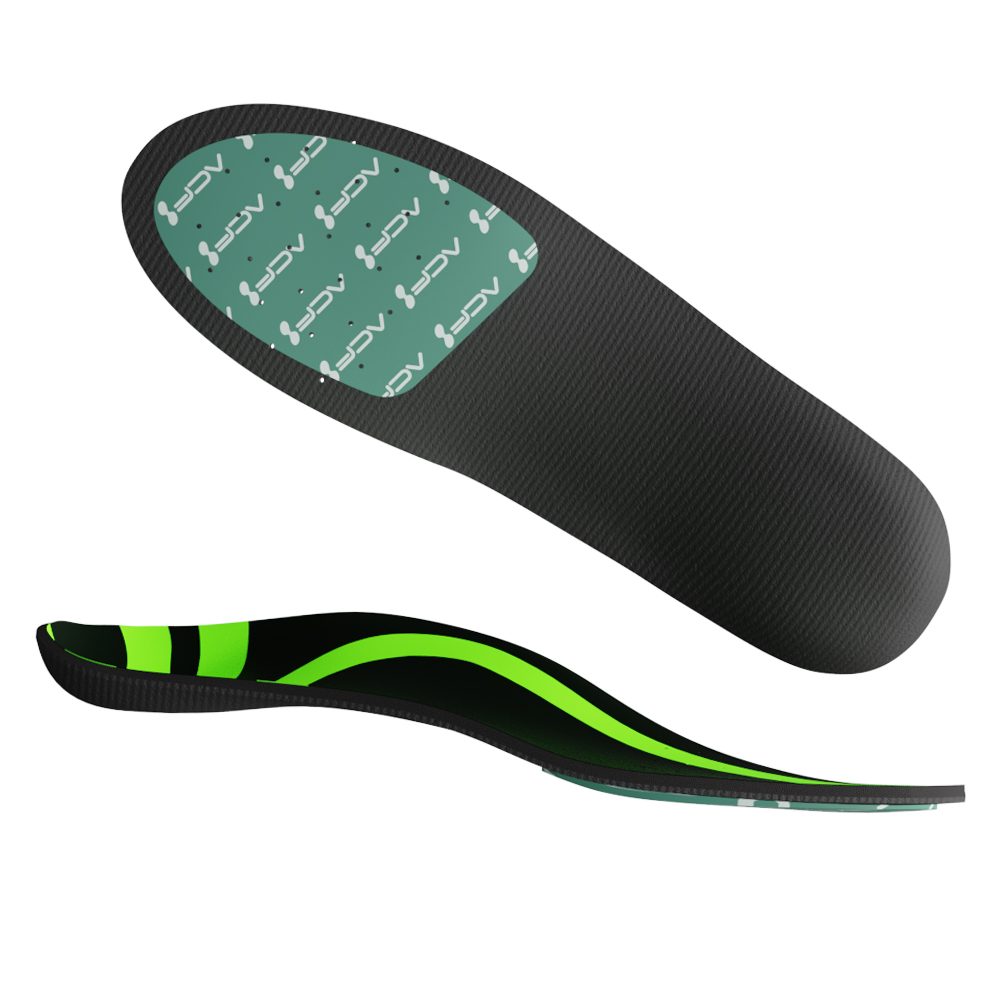
A gel pad is a compliant, resilient mass, and its strength is accepting a concentrated spot. At heel strike, under the first metatarsal head, or at the point where a hard gym floor presses back into a stationary foot, gel deforms around the pressure point and spreads it across a wider area. That is the whole promise: less sting at the spot, a softer first contact, and a more forgiving session on unforgiving surfaces. The cushioning stack in our builds — an Osolite comfort layer under a sport mesh fabric face, with XRD and ACF artificial-cartilage materials placed where the load map says — exists to do that job and to keep doing it after repeated compressions.
The same property that makes gel good at this also draws its boundary. A material soft enough to deform around a pressure point cannot also stop a foot from rolling across it. Yielding is the feature. A dealer at one trade show squeezed a gel sample between thumb and forefinger, then asked why the same sample would not “stand up” under a cutting athlete — and that question contains the answer: the very softness he was praising is what a support board has to overcome. If the dominant load in a sport is vertical and repeated in one plane, cushioning carries the session. If the load crosses the foot sideways, something with shape has to meet it.
This is why the question “is gel good?” has no general answer and a very good specific one. Gel is the right tool for exactly the job it is sold for, and the wrong tool the moment the brief includes lateral hold. Neither the gel build nor the structural build is the better product; they are answers to different questions, and the order should name the question first.
Where the Job Turns From Cushioning to Control
Watch what the foot does, not what the sport is called. Basketball asks a foot to land, then to slide and cut before the next step — the load arrives vertically and leaves laterally. Paddle sports push off a planted foot into a direction change. Skiing locks the foot into a stiff boot and asks the edge of the foot to hold against sustained torsion. Skateboarding lands impacts on a surface the foot must also feel. The golf swing drives rotational torque against a planted front foot. Loaded hiking on uneven ground keeps the foot correcting sideways for hours. In all of these, the load that matters crosses the insole rather than pressing straight down on it — and the part that resists that crossing is a shaping board, not a softer layer. This is where the FX Sport builds place an AQ polymer shaping board under the cushioning layers: the board gives the insole its geometry, holds the arch shape through a cut, and resists the twist that a compliant material would simply follow.
Equally, some sessions never leave the first job. Fitness floor work is largely vertical loading under control — a lifter wants the pressure point under heel and forefoot handled and little else asked of the foot. Cycling loads the forefoot repetitively with almost no torsion. Long standing sessions want the point pressure spread and the impact taken. In these settings a structural board adds weight and stiffness without answering a question the session asks, and a cushioning-led build is the honest specification.
Golf is worth naming because it sits on both sides. Walking eighteen holes is cushioning’s job: repetitive, sagittal, hour after hour on firm ground. The swing is not: the front foot is planted while the body rotates over it, which is precisely the crossing load a gel pad lets through. Our golf build therefore carries both — cushioning for the walk, a shaping board and forefoot rebound for the swing — and a buyer who orders it “for walking” or “for the swing” alone is buying half of what the build was shaped to do.
In our pre-sales calls, one report comes back so often that we now ask for it first: the pads “went flat” by mid-season. The product manual says this directly — high-intensity sport shortens the working life and reduces both the cushioning and the support the build started with. A pad that feels dead in month three under daily court sessions is not a customer being fussy; it is the material reporting what it was asked to absorb. That report should trigger a conversation about build and rotation, not a discount on the reorder.

Why Soft Stops Feeling Comfortable Before the Season Does
Comfort at the first fitting and comfort in the second hour of a session are two different measurements. The first is surface feel: softness against the sole, the pleasant sink of a compliant material. The second is load distribution — whether the pressures that build fatigue have somewhere to go. A soft build lets the foot find its own alignment and then asks the wearer’s muscles to hold it there; the stabilising work is transferred from the insole to the athlete. That is why an all-soft build can feel wonderful for twenty minutes and tiring for two hours, and why “soft” and “comfortable for long” are not synonyms. The structural build works in the opposite direction: it holds the arch shape so the same muscles do less, and the comfort shows up later in the session rather than sooner.
We watched the difference being made during a production visit to our Ruichang plant. The shaping boards come off the forming step with the arch geometry already set — a contour decided by the assessment record, not by how hard the material springs back. The cushioning layers are then placed where the load map calls for them, at heel and forefoot, over a sport mesh face chosen for breathability through long sessions. The point of the sequence is that support and cushioning are decided separately: the board does the holding, the softer layers do the absorbing, and neither is expected to do the other’s work.
One wearing note belongs here because buyers ask about it at the counter. A build with a shaping board can feel unfamiliar on the first wear — the foot is being given a shape it did not choose for itself. The manual’s guidance is to build up wearing time gradually rather than judging the build from a single full session. A retail counter that explains this at the point of sale avoids the return that would otherwise arrive labelled “uncomfortable”, when what actually happened was an adjustment period measured in days.
Reading the Four Build Grades Into the Order
The FX line writes every build against four grades: Support, Anti-torsion, Cushioning and Starting ability. The grades are what make the gel-versus-structure decision concrete, because each build scores differently on them. A cushioning-led build scores on Cushioning and contributes little to Support or Anti-torsion — by design, since yielding is its working principle. A structural build raises Support and Anti-torsion while keeping Cushioning through the XRD and ACF layers placed at heel and forefoot. Starting ability — the forefoot rebound that returns energy at push-off — sits with the shaped builds, which is why our golf build pairs the board with forefoot rebound construction under the ArchQuick quick-custom technology.
Where do the grades come from? From a record, not from a vibe. The FX builds are specified through BODYFIT AI assessment and senthmetic flexible-fabric sensing technology, paired with the X5 detection system — the same measurement workflow that produced the load map in the first place sets the grades on the finished insole. For a dealer, that sequence is the difference between stocking a catalogue and stocking a product that can be defended: when a coach asks why this build is graded the way it is, the answer points to a capture session rather than to a preference.
It also gives the return conversation a diagnostic shape. Ask what changed before the return: if the complaint is a returning pressure point — a hot spot under the heel or first metatarsal that a fresh pad used to spread — the cushioning layer has done its work and the replacement question is about wear and rotation. If the complaint is rolling, sliding or instability through a cut, cushioning was never going to answer it, and the reorder belongs to the structural build. Two different complaints, two different reorders, and neither one means the original product was bad — it means the question the foot asked changed.
Frequently asked questions
What does a gel pad do that a structural build does not?
A gel pad deforms around a concentrated pressure point and spreads it — that is its working principle and its strength at heel strike, under the forefoot, or during long standing on hard surfaces. A structural build does the opposite of deforming: it holds a shape. The two are complements in our sport line, where the shaping board holds the arch and the XRD and ACF layers handle impact.
Can a basketball player stay on gel if I add a thicker cushioning layer?
Adding softness answers a pressure-point question, not a control question. A cutting athlete’s failing load crosses the foot laterally, and a softer layer follows that crossing rather than resisting it. What the player is missing is the Support and Anti-torsion a shaping board provides — which is why our basketball build is structured, not just thicker.
Which sessions are genuinely fine on a cushioning-led build?
Sessions with mostly vertical, repetitive loading and little torsion: fitness floor work, cycling, long standing, and the walking portions of a round of golf. If the foot never has to hold against a sideways load, a structural board adds stiffness the session does not need. Golf is the divided case — the walk wants cushioning, the swing wants the board.
Why did the pads feel flat halfway through the season?
The product manual notes that high-intensity sport shortens working life and reduces both cushioning and support. A pad that loses its feel under daily training is reporting use, not defect. The answer is a rotation and replacement rhythm matched to session intensity — and, for athletes whose complaint is instability rather than flatness, a move to the structured build.
Are both builds specified from a foot assessment?
Yes. The FX line is built through BODYFIT AI assessment with senthmetic flexible-fabric sensing technology, used together with the X5 detection system. The four build grades on the finished insole — Support, Anti-torsion, Cushioning, Starting ability — are set against that measurement record, which is what makes a grade discussable with a coach or a shop’s fitter.
What are the ordering terms for the sport line?
Insole orders start from a small mixed minimum — two hundred pairs, mixed across models and sizes — and we accept ODM and OEM work. Sample pairs are dispatched within three days. Sport builds ship in the same size range as the rest of the line, and our insole categories page lists the series and the sessions each one is shaped for.
What we would do next
If you are a dealer or a sport retailer, write down the two complaints you hear most often at the counter and match each to its job: a returning pressure point belongs to the cushioning question, a rolling or unstable foot belongs to the structural one. Send us that split together with the sports your customers actually play, and we will tell you where a cushioning-led build is the honest specification and where the AQ shaping board should be in the order. Our FAQ page carries the order minimums, sample terms and support arrangements in full.
If your market serves golfers specifically, look at the golf build before the general sport one — it is the clearest example of a session that asks for both jobs in one product. And if you want the grades anchored to a record rather than a catalogue, ask about the X5 pairing: see the X5 foot and posture detection system for the assessment workflow the sport builds are specified against.
This article is intended for professional and educational reference. It is not medical advice. Assessment equipment and insole records produce measurements and design inputs; clinical interpretation and any decision about care remain the responsibility of a qualified professional. Certification scope is limited to the documentation we hold: European Union certification and ISO quality system certification.