
A visitor walks up to the plate, watches one of our colleagues cross it, and opens with the sentence we hear at every show: “I am looking for a plantar pressure scanner.” The next question is the one that decides the order — what do you want to have in your hand when the session ends? The replies divide into three groups that are not variations of each other. One buyer wants to see how load moves under a standing and a walking foot. Another wants the customer to leave the room carrying something that was shaped on the spot. A third needs the whole set-up to travel, because the machine will work in a shop on weekdays and at an event on Saturday. The FMP was designed around the overlap between the first two, and its portability is what makes the third workable. Below is what the search term actually contains, how the measurement and the build sit in one visit, and which rooms the system normally ends up in.
The FMP manual gives the system a long name — Foot Pressure & Posture Detection Insoles Customization System — and the length is informative. It lists five core functions: static pressure detection and evaluation, dynamic pressure detection and evaluation, balance pressure detection and evaluation, full-body biomechanical alignment detection, and an on-site module for biomechanical insole customisation. Read as a feature list, that is a specification. Read as a sequence, it is the answer to the search: a measurement, a reading of that measurement, and an object that comes out of the same appointment.
What a plantar pressure scanner search is asking for
The word scanner is doing two jobs in this market. In most listings it describes shape capture — a device that turns the surface of a foot into a file, which is why the same buyer often has a tab open for a 3D foot scanner while reading about pressure plates. A pressure scanner borrows the noun and changes the object: what gets recorded is load, not contour. Settling that difference first saves a long conversation later.
On the FMP, the recorded set is pressure in three states plus the alignment of the body above the foot. There is no surface model of the sole at the end of a session and no geometry file to send to a milling bench. A buyer whose production depends on a shell shape is looking at another category and is better told so in the first email. A buyer whose work depends on knowing where load lands, how long a region stays loaded, and whether the leg above the foot sits where it should is the buyer this system was built for.
The requests behind the phrase fall into three groups. The first is diagnostic curiosity: what is this foot doing that a conversation cannot reveal. The second is demonstration: how do I show a customer, in a way that survives being looked at from across a counter. The third is production: can the same visit end in a pair of insoles. Buyers rarely name the group they are in; they type the keyword instead. One question sorts it out — what happens after the report prints. If the honest answer is that it goes into a folder, a plate is enough. If it is that the customer waits while something is shaped, the on-site module becomes the deciding line on the quotation. If the machine has to be in three buildings a week, weight and packing move to the top of the list.
Standing, walking, and the line above the foot
The three pressure states are separate records, not three settings of one measurement. Static holds the standing distribution — where load sits under each foot at rest, the shape of the contact area, how the two sides compare. Dynamic holds the walking sequence: the order in which regions take load, how long the contact and flat phases last, and the path the centre of pressure travels as the person crosses the plate. Balance holds the small corrections a person makes to stay upright, which is a stability question rather than a peak-load one.
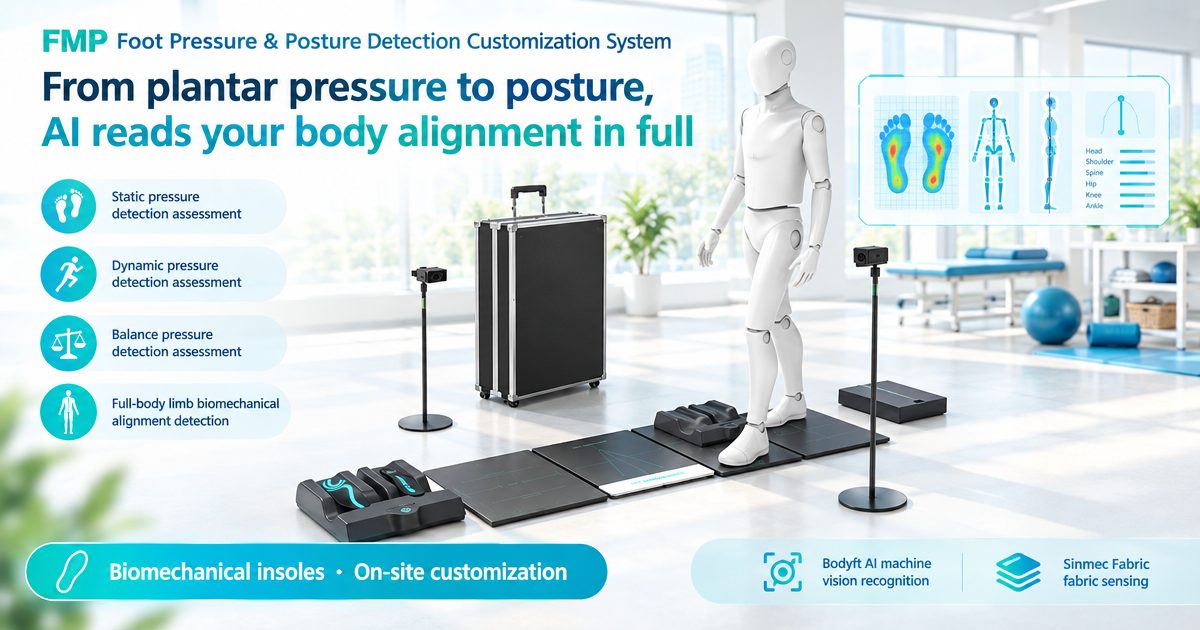
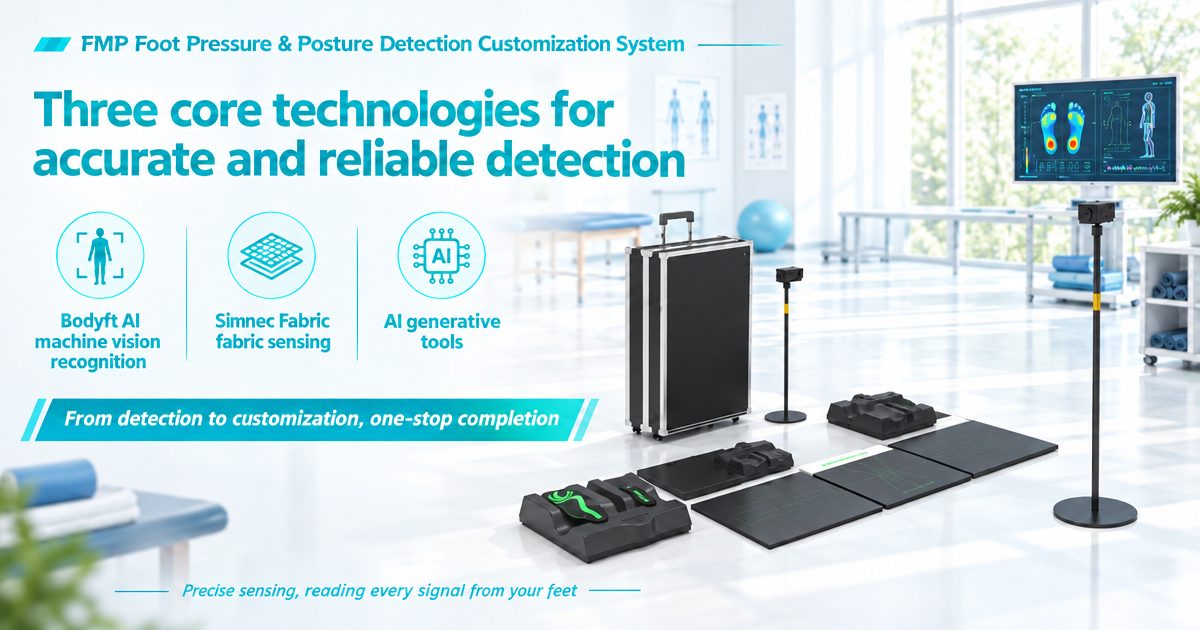
Underneath, the system uses Sinmec Fabric fabric sensing for the pressure layer and BodyftAi machine vision for the capture layer, with AI-assisted report generation assembling the output. Two high-precision cameras sit on brackets and record the alignment of the body while the plate records the foot. That is why a report can put a pressure picture next to a biomechanical alignment view instead of showing load alone — the foot is read in the context of the knee, the pelvis and the shoulder line above it.
What comes back on screen is a set of quantities: the centre-of-pressure path and its displacement, foot axis angle, the share of the contact and flat phases, peak and average pressure, contact area, and the region carrying the heaviest load. Each is a record with a reference band printed beside it. A band describes a population, not the person standing on the plate, so a value outside it starts a conversation rather than closing one. Keeping that distinction visible on the report is a deliberate choice on our side.
At a Canton Fair booth a visitor spent several minutes watching the cameras and then asked whether they scan the foot’s shape. They do not. The cameras read the alignment of the leg and the posture above it; the plate reads load. His follow-up was more useful than the first question: he said his actual problem was not measurement at all, it was that customers left the shop with a recommendation and nothing to hold. That sentence moved the conversation from the plate to the customization module, which is where his order eventually landed.
The visit that ends with a pair of insoles on the counter
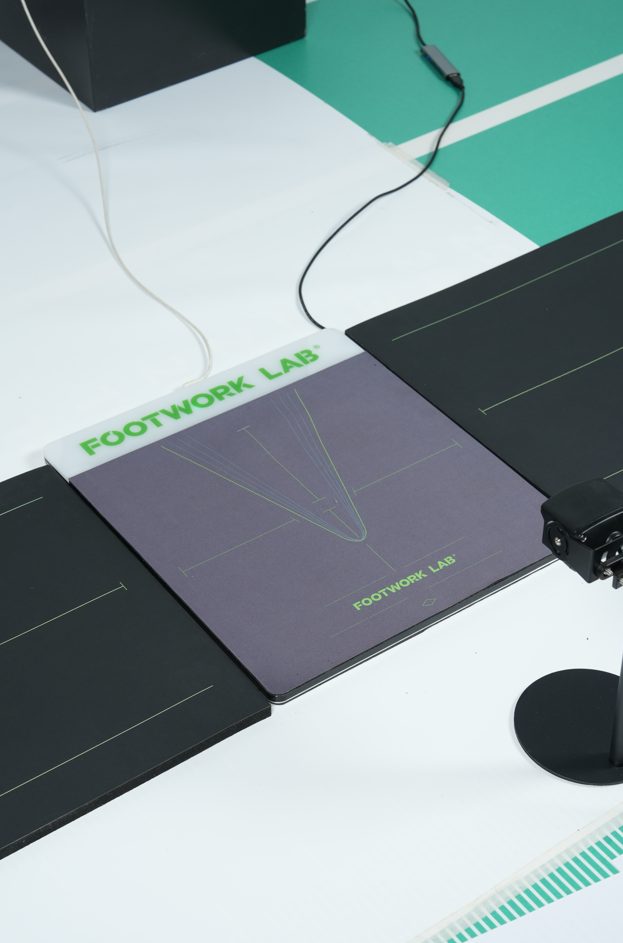
The on-site module is listed as a core function, not an accessory. What ships with it is a heating box and a set of shaping pillows — one for adults, one for children, plus auxiliary pieces — along with the pressure plate, the two cameras, a hub and a floor mat. The sequence in a room runs from capture to a finished pair without a second appointment: standing and walking passes first, the record read with the customer in front of them, the build chosen from the load pattern and the shoe, the shell heated, shaped on the pillow, trimmed, fitted, and checked inside the shoe the person actually wears.
Where the record and the shoe disagree, the shoe wins. A build that cannot sit inside the last is a build that will be left in the box, and the fitter’s job is to notice that before the shell goes into the heating box rather than after. This is also why we ask buyers to bring three pairs of the shoes their customers wear most, not one. The differences between a trainer, a casual shoe and a leather shoe show up in where the insole can be thick and where it has to stay thin, and the same pressure record can lead to two different builds for that reason.
A shoe-store owner in our pre-sales calls had budget for the module but a counter with no depth behind it, and the camera brackets needed a clear run of a few steps. We moved the capture point to the side of the shop floor and kept the shaping bench at the counter, which split one station into two and made the flow work in a room that was never designed for it. Layout questions like that one come up in most retail enquiries, and they are cheaper to solve on a floor plan than after delivery.
The software side separates from the hardware. Report layout can be customised to a clinic’s format and is quoted separately; updates reach connected units over the air; the after-sales technical team stays with the account through a dedicated group rather than a ticket queue.
The boundary stays where it belongs. The FMP records pressure and alignment; it does not diagnose, and it does not decide what a person should wear. The build that comes off the pillow is a support and load-distribution object, chosen by a fitter who has read the record and looked at the shoe. Everything the machine contributes sits upstream of that judgement.
Four rooms, four different uses
The manual lists six settings: rehabilitation hospital, sports training institution, sports venue, shoe store, podiatry clinic and gym. The hardware is identical in all six. What changes is the session, and the session is what a buyer is really purchasing.
In a rehabilitation hospital the value sits in the second visit. A baseline record captured before a course of work, placed beside the same person’s record weeks later, shows whether the load path moved and in which direction. Because the alignment view is captured in the same session as the pressure picture, the comparison covers the leg as well as the foot, and the two images sit in one layout instead of two folders.
A sports training institution runs the dynamic pass before and after a training block, and treats the record as a monitoring instrument rather than a selection test. At a sports venue the same system becomes a screening station: a queue, a standing pass, a walking pass, a summary, and a referral where the record suggests a closer look.
A shoe store uses the standing and balance records to open a fitting conversation that is about the customer rather than the shelf. The on-site module then turns that conversation into a service with a deliverable. In a gym, the alignment view is often the part that lands: a member who has been told their squat looks uneven can see the shoulder and pelvis lines beside the pressure map, and the trainer gets a shared object to point at. A podiatry clinic uses the same records as a screening step before a fuller assessment.
Our factory in Ruichang packs every unit into a case that holds the plate, both cameras, the hub, the heating box and the pillows, and each unit runs a seven-day test before it leaves. Watching that packing line is a reminder of which part buyers underestimate: the case. A system that is slow to reassemble stays in one room, whatever the brochure says about mobility. Minimum order for equipment is one unit, the warranty runs twelve months against non-human damage with free parts, and support continues through the WhatsApp group, remote sessions and over-the-air updates.
Frequently asked questions
Does the FMP capture the shape of the foot?
No. The FMP records plantar pressure in static, dynamic and balance states, plus full-body biomechanical alignment through two cameras. It does not produce a surface model or a geometry file of the sole. Buyers who need a shape file for a shell are looking at a different capture category, and we say so before quoting.
What does the FMP add over a pressure plate on its own?
Three things in one enclosure: cameras that record the alignment of the body above the foot, an on-site module for biomechanical insole customisation with a heating box and shaping pillows, and a case that lets the whole set travel. The plate records load; the rest of the package decides what a session can end with.
Can a pair of insoles be finished in the same appointment?
Yes, that is what the on-site module is for. The visit runs capture, reading, build selection, heating, shaping on the pillow, trimming and a fit check inside the customer’s own shoe. The fitter chooses the build from the record and the shoe, and has the final say on both.
What appears on the report?
A centre-of-pressure path and displacement, foot axis angle, contact and flat phase shares, peak and average pressure, contact area, and the region carrying the heaviest load, with left and right shown together. Reference bands are printed beside the values as population references, not as thresholds that decide anything on their own.
How is the system supported after delivery?
Equipment minimum order is one unit, each unit is tested for seven days before dispatch, and the warranty covers twelve months against non-human damage with free parts. Support runs through a dedicated WhatsApp group with our engineers, remote sessions where a screen can be shared, and over-the-air updates. Custom report layouts are quoted separately from the hardware.
Can the FMP be moved between sites?
It was designed for that. The plate, two cameras and brackets, hub, heating box, floor mat and pillow set pack into the supplied case, and the manual describes the system as a mobile scenario solution. The practical limit is set-up time in the receiving room, so we ask buyers to plan the capture run-up before the first event rather than after.
Does the report tell an operator what to prescribe?
It does not. The report presents measurements and images; the interpretation and any decision about a build belong to the qualified person running the session. Our software stops short of a clinical conclusion on purpose, and the fitter’s reading of the shoe and the customer is part of the result.
What we would do next
Write down what happens after the report prints. If the answer is a folder, say so and we will point you at the simplest configuration that covers the records you need. If the answer is a pair of insoles on a counter, tell us the shoes your customers bring and the space behind the counter, and we will map the capture point and the shaping bench onto your floor plan before you commit. Our FAQ page carries the order, warranty and transit terms in full, and the FMP system page sets out the functions in the manual’s own wording.
If you already own a plate and the records are not being read across visits, the gap is usually the session rather than the hardware: no fixed instruction, no fixed footwear condition, no fixed operator. Send us the routine you use now and we will mark the places where two people would produce two different pictures. For clinics that want the alignment view in the same record as the pressure map, our X5 system covers a broader posture set. The contact page reaches the team directly.
This article is intended for professional and educational reference. It is not medical advice. Foot assessment equipment produces measurements and images; clinical interpretation and any decision about care remain the responsibility of a qualified professional. Certification scope is limited to the documentation we hold: European Union certification and ISO quality system certification.