
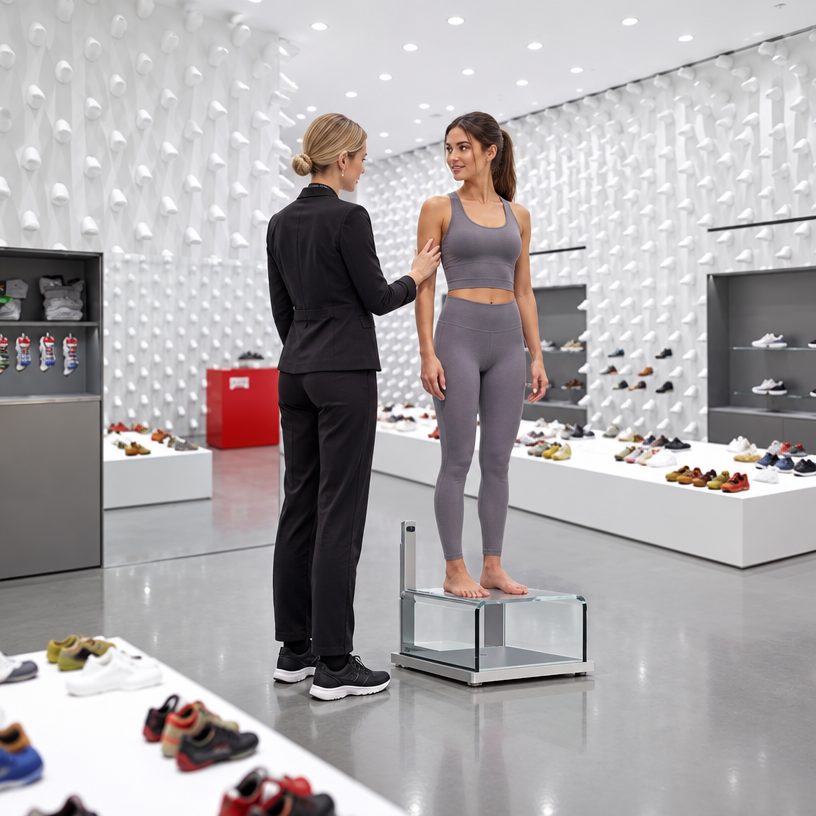
A customer sits down at a shoe shop counter and is handed four printed pages, and for the next ninety seconds three people read them at once. The customer reads the first page, because it has a picture of her own foot on it. The fitter reads the third, because that is where the numbers are that decide which pair comes out of the stockroom. The podiatrist she mentioned at the start of the conversation — the one she will see next month — will read the second page and skip the first, because a picture tells her nothing she cannot see in the chair. One document, three readers, three vocabularies. A report that is not built for that split wastes the session: the customer leaves with a souvenir, the fitter with a number she cannot explain, and the clinician with a page that stops where her questions begin. This article walks the page set in order, says who each page is actually for, and describes the handover, the filing and the retest that decide whether the document is worth keeping.
One report, three readers, one vocabulary problem
The first design decision in any report is not what to measure but who will read it. A customer wants to see her own foot and understand whether the shoes she is about to try will suit it. A fitter wants a small number of items that map onto a shelf. A clinician wants the values without the sales language, in a form that can be filed beside an examination. Those three wants are not in conflict, but they cannot be served on one page, which is why the reports that work are layered rather than summarised.
The layering has a rule behind it: each page carries one kind of statement. A page of description, a page of load, a page of alignment, a page of summary. When a report mixes them — a picture with a recommendation under it, a value with a verdict beside it — the reader cannot tell which part is measurement and which part is somebody’s opinion, and in a dispute the whole document becomes arguable.
There is also a commercial argument for the split. A shop that hands over four pages has handed over something a customer keeps, photographs and shows to a friend. A shop that hands over one page with a logo has handed over a leaflet. The difference in perceived substance costs nothing at the printer and everything at the design stage.
Page one: the foot as it stands, in the customer’s language
The opening page describes shape and type without arguing about either. Arch type, foot type, the footprint’s length and width, and the shoe size that follows from them. These are the items a customer can check against her own experience, which is why they belong first: she can see that the length matches the shoes she wears, and that agreement buys attention for the pages that follow.
The vocabulary on this page matters more than the numbers. A description such as a low arch presenting at rest is a statement about how the foot looks under load in this position on this day. A label such as a flat foot is a classification, and a classification invites a customer to hear a condition where the report recorded a shape. Staff who use the descriptive version keep the conversation open; staff who use the label find themselves answering questions that belong in a clinic.
The shoe size suggestion is the most-used line on the page and the one most often misread. It is a suggestion derived from a measured footprint, not a promise about a particular pair. Brands run differently, lasts differ, and a shoe that fits in one model can pinch in another at the same nominal size. The honest sentence is that the measurement gives a starting point and the fitting confirms it, which is also the sentence that keeps a customer in the chair rather than at the door.
What this page cannot do is tell anyone what the shape means. It describes a presentation. Whether that presentation matters for this person, and what if anything should be done about it, is a question for a qualified professional — and a page that says so in small type at the bottom is doing its job better than one that implies an answer at the top.
The picture deserves a word of its own, because it is what makes the page work. A photograph of the sole as it rests on the plate, with the outline marked and the arch visible, is the one item on the page a customer needs no training to read. That is precisely why it should carry no interpretation: an image that persuasive will be believed, and a caption that says here is how the foot presents at rest keeps the belief where it belongs, on the observation rather than on a conclusion.
Page two: where the load actually sits
The second page is the one the fitter uses. A pressure map of the sole with the load concentrated in coloured regions, contact area, peak and mean values under defined zones, and — where the session includes a walking pass — the path the centre of pressure takes from heel to forefoot. This is the page that answers the question a stockroom cannot: where does this person’s weight land, and does the pair about to be tried leave room for it.
Read properly, the map is a description of distribution rather than a picture of a problem. Two feet with the same arch type can carry load very differently, and it is the distribution that decides whether a build needs to spread load away from a region or simply hold a position and leave the rest alone. A fitter who reads only the arch type is choosing a pair from half the information.
The values are what make the page comparable later. A coloured region is persuasive and imprecise; a peak value under a defined zone can be put beside the same value from six months ago. This is the reason we keep both on the page — the map for the conversation, the values for the file — and the reason a retest that produces only a picture is a retest that cannot be used as a comparison.
The limit is worth saying out loud at the counter, because customers ask. A pressure map shows load; it does not show tissue health, it does not show where anything hurts, and it does not explain why. A customer who points at a red area and asks what is wrong there is asking a question the page cannot answer, and the staff member who says so plainly earns more trust than the one who improvises.
Page three: the line above the foot
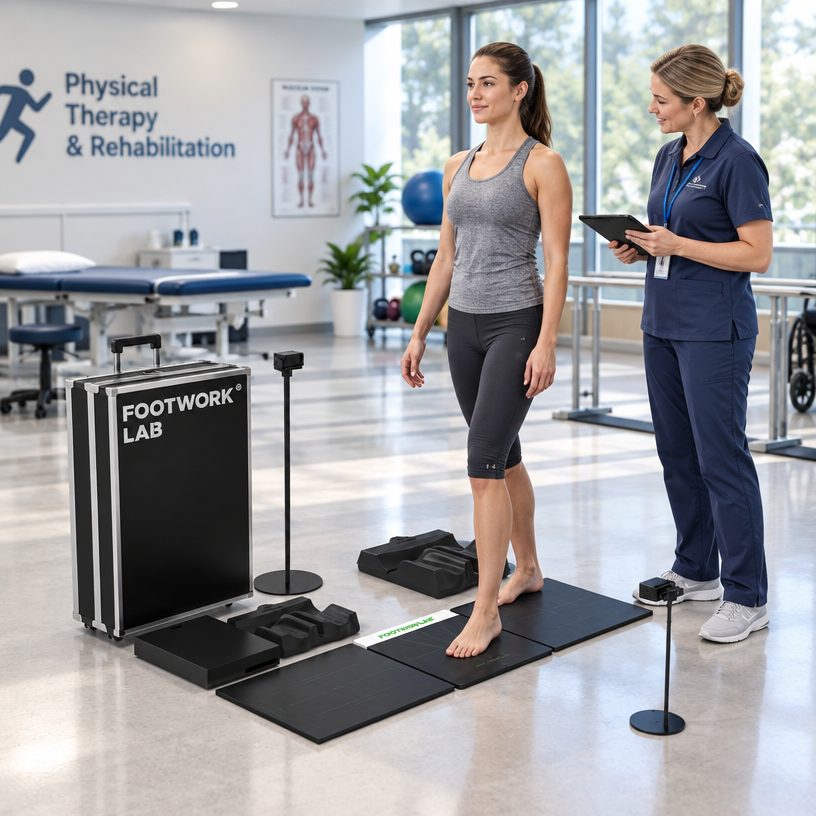
The third page moves up the leg, and it is the page a clinician reads first. Heel position described as calcaneal eversion, the direction the shin carries described as tibial rotation, knee alignment as it tracks over the foot, and where the session includes posture capture, the angles of the column above. These are the items that explain why the load on page two sits where it does, and they are the reason a foot record is more useful with a leg attached.
This page is where the report earns its keep in a clinic and where it is most easily over-read in a shop. A recorded calcaneal position is a measurement of where the heel sits relative to the leg under the conditions of the session. It is not a severity, and it is not a cause. Putting it beside a load map lets a professional form a view; putting it in front of a customer as a finding is how a fitting turns into a consultation nobody asked for.
The practical use at the counter is narrower and still valuable: alignment pages explain why one customer wears the outer edge of every pair and another wears the inner, which is a question shop staff are asked constantly and usually answer from folklore. A recorded angle answers it without a story.
The boundary belongs here too. The camera records position and angle; it does not assess joint health, muscle behaviour or anything under the skin. Where the alignment page suggests something a clinician would want to examine, the correct action is a referral, not a longer conversation at the till.
Page four: the page that must not read like a verdict
The summary page is the one customers photograph and the one most likely to be quoted back months later, which makes it the most dangerous page in the set. Ours carries a line stating that the content is for reference and that anyone with a medical concern should see a professional service. That line is not decoration and it is not legal padding; it is the sentence that keeps a summary a summary.
What belongs on the page is a restatement of what was recorded, in plain order, with the date and the session type. Arch type and foot type, the load distribution in words, the alignment items, the shoe size suggestion, and — where the shop offers it — a note that a particular build in the range was discussed. What does not belong is a diagnosis, a severity, a risk score, a predicted outcome, or a sentence beginning with the words this means.
There is a craft to writing the page so that it is useful without being a verdict. The useful version describes and offers: the load sits toward the inner edge of both feet, the left heel sits further out than the right, a build with more control along the midfoot was discussed and a pair was tried. Every clause is something that happened in the room. None of them requires anyone to have decided what the foot needs for the rest of its life.
We print the reference line on the page rather than in a footer because of how the document travels. A summary that is forwarded to a relative, a coach or a clinician arrives without the conversation that produced it, and the only part of the context that survives the journey is what was printed. A page that states its own limits travels honestly; a page that assumes a verbal caveat travels as a verdict.
Shops sometimes ask whether the summary can be shorter, and the answer is that it can be shorter but not thinner. Three sentences will do if each one names what was recorded and the date it was recorded on. What makes a summary long is usually not the content but the reluctance to leave something out, and the cure for that is a second page of values rather than a longer page of prose.
Handover, filing and the retest
The handover is a thirty-second script, and shops that write it down get consistent results. Here is what was measured, here is the page that matters for the shoes you are trying, here is the copy for your own file, and here is the line about seeing a professional if anything concerns you. Staff who improvise this end up either overselling the report or apologising for it, and both cost the shop the same customer.
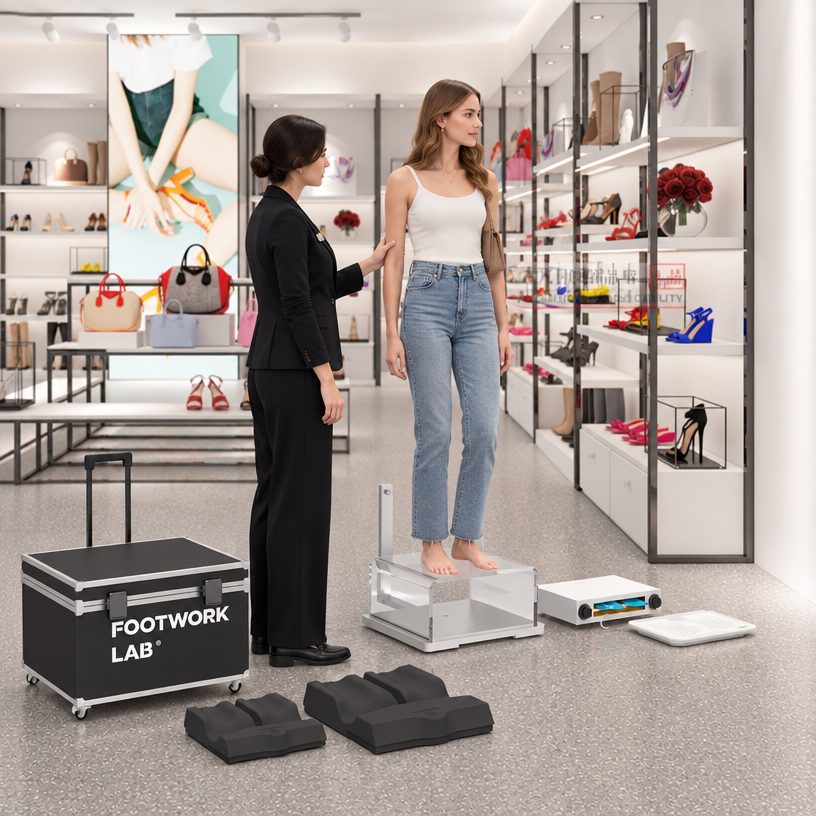
The file itself can leave in three ways: printed on site, sent by email, or opened from a code on the page. Which one a shop uses should follow the customer rather than the software — an older customer usually wants paper, a younger one usually wants the file, and a clinic receiving a record usually wants whichever format it already archives. The naming should carry the customer’s reference and the date in a fixed order, so that the second visit can be found beside the first without a search.
The retest is what turns a report into a record. A second session taken under the same routine — same device, same sequence, same instruction about stance, same decision about shoes and socks — can be laid beside the first and read as a comparison. A second session taken casually produces two attractive documents and no information. Shops that book the retest at the point of sale, rather than hoping the customer returns, are the ones whose files are worth keeping.
Two things we do not do, stated here as plainly as on the page. We do not diagnose, and no item on any of these pages is a finding — each is a recorded value, and reading it belongs to a qualified professional. And we do not produce a shape model of the foot: there is no surface reconstruction and no laser in the unit, so a workshop that mills shells from individual geometry is shopping in a different category, and we say so before a quotation rather than after.
Frequently asked questions
How many pages does a foot assessment report have?
Four in the set described here: shape and type, load distribution, alignment above the foot, and a summary. Each page carries one kind of statement, which is what allows three different readers to use the same document without arguing about what it says.
Who is each page written for?
The first page for the customer, the second for the fitter choosing a pair, the third for a clinician, and the fourth for whoever receives the file later. The split is deliberate; a single summary page cannot serve all four.
Does the report tell me what is wrong with my feet?
No. It records shape, load and alignment, and states that the content is for reference. Whether anything needs attention is a question for a qualified professional, and the summary page says so in print rather than relying on a verbal caveat.
What does the shoe size suggestion mean?
It is a starting point derived from a measured footprint, not a statement about a particular pair. Brands and lasts differ, so the fitting confirms the size. Treat it as the first number in the conversation rather than the last.
Can two reports be compared?
Yes, if the routine repeats: same device, same session sequence, same stance instruction, same footwear decision. That is what makes a retest useful, and it is why the routine is worth writing down and training.
How should a shop store the reports?
As a file rather than only on paper, named with the customer reference and the date in a fixed order, backed up away from the machine that ran the session, and released to a third party only with the customer’s knowledge.
Is the report accepted by clinicians?
A clinician will read the values and the alignment page and form their own view. The report is written to be read that way, without conclusions, so that nothing in it competes with the professional’s own examination.
What we would do next
Ask for a sample page set rather than a specification, and read it the way a customer would: start at the top of page one and see how long it takes before the document tells you something you could say out loud at a counter. The contact page reaches the team that designs the layout, and we will send the pages as printed.
The Q1P system page lists the items on each page and the session sequence that produces them, including the on-site customisation step that most shops use at the end of a fitting. Four articles extend the argument: a podoscope for the shoe store describes the counter routine, a podoscope foot screening takes minutes covers the timing, foot type is a record, not a verdict makes the vocabulary case, and biomechanical analysis ends in a report follows the document from capture to handover.
This article is intended for professional and educational reference. It is not medical advice. Foot assessment equipment produces measurements and images; clinical interpretation and any decision about care remain the responsibility of a qualified professional. Certification scope is limited to the documentation we hold: European Union certification and ISO quality system certification.