
The mould sat on the shelf with its job number written on the side, the pressure printout lay in the folder on the counter, and the customer asked which of the two the pair had actually been made from. The fitter needed a minute to answer, because the honest answer was neither one alone. A custom pair is not built from a single input. The mould or the cast answers one question: what does this foot look like, where are its edges, where does the arch sit, what shape has to be under the sole. The pressure record answers a different question: where does the weight fall, when does it arrive, how does it travel through the step. The posture and alignment capture answers a third: where does the leg sit relative to the foot, and does the knee pass over it or fall away from it. Shape, load, relationship. Buyers who search for a mould cast pressure record insole build often expect one machine to hand over all three at once, and the answer is that ours can collect them in one session but they do not merge into one image, because they are not one question. This article separates what each input decides in a finished pair, what a workshop loses when only one of the three is available, which input the bench follows first on a short day, and how we explain the whole thing to a customer who has folded the three into a single idea.
Three inputs, three different questions
Every workshop that builds a pair has to settle three things before the first material is cut. What shape the shell must hold. What the foot does to the ground and what the ground sends back. And how the leg above the foot is positioned when the foot is doing its work. These are not three views of one subject; they are three subjects, and they are captured by different means. A shaped model of the foot carries the first. A pressure platform carries the second. A camera standing beside the platform carries the third.
The reason they are separate is simple: no single instrument can record all of them honestly at once. A mould holds shape but says nothing about behaviour, because the foot is still when it is being shaped. A pressure record captures behaviour but has no depth, because it registers what arrives at a flat surface, not the contours that a shell will have to fit. A posture frame shows the relationship of leg to foot but cannot see either the contact area or the model. Each input is complete within its own question and silent on the other two.
This is why a well-run session usually produces three documents, not one: a model or mould with its number on it, a pressure report with the standing and walking passes, and a posture sheet with the alignment frame on it. The three documents travel together into the build conversation. When one of them is missing, the fitter can still build, but the decisions that belonged to the missing document get made by guesswork dressed up as judgement, and that is the kind of guesswork that comes back through the door as an adjustment.
The order matters as much as the collection. In our plant and in the workshops we supply, the build conversation runs in the same sequence almost every time: shape first, load second, relationship third. The following sections take the three in that order, because that is the order in which they get written onto the job card.
What the mould answers: the shape of this foot
The mould is the oldest input in the trade and still the one that settles the most. Whether it starts as a foam box impression, a plaster cast sent in from a clinic, or a shaped model produced in the workshop, its job is the same: it fixes the contours of this particular foot in a form that material can be formed over. Where the arch sits and how high it rises. Where the heel cup must close. How wide the forefoot spreads when it is unloaded and allowed to take its natural outline. These are shape facts, and the shell cannot be built without them.
On the bench, the mould earns its keep in the unglamorous steps. The shell is warmed and formed over the model, and the fitter lays out the perimeter with a pencil before any trimming happens, because the line where the shell ends is decided against the shape of the foot and against the shoe it is going into, not against habit. A shell that fits the model but not the shoe gets trimmed back until it does, and every one of those trims is a small compromise that the mould made visible. Without the model, the fitter is trimming against imagination, and imagination does not leave a record.
The mould also carries the identification that everything else hangs on. Each one goes onto the shelf with a job number written on the side, and that number appears on the job card, on the build specification and on the box the finished pair ships in. When a reorder arrives two years later, the first thing the workshop does is look for that number, because the shape of the foot has not changed enough to matter but the model either has or has not survived, and the file needs to match the physical object before anyone cuts material.
What the mould does not answer is equally worth naming. It says nothing about how hard this foot presses, where the pressure concentrates when the person walks, or whether the load arrives through the heel or through the inner edge of the forefoot. Two customers can have nearly identical shapes and completely different load behaviour, and a build made from shape alone treats them as the same person. They are not.
What the pressure record answers: where the load falls and when
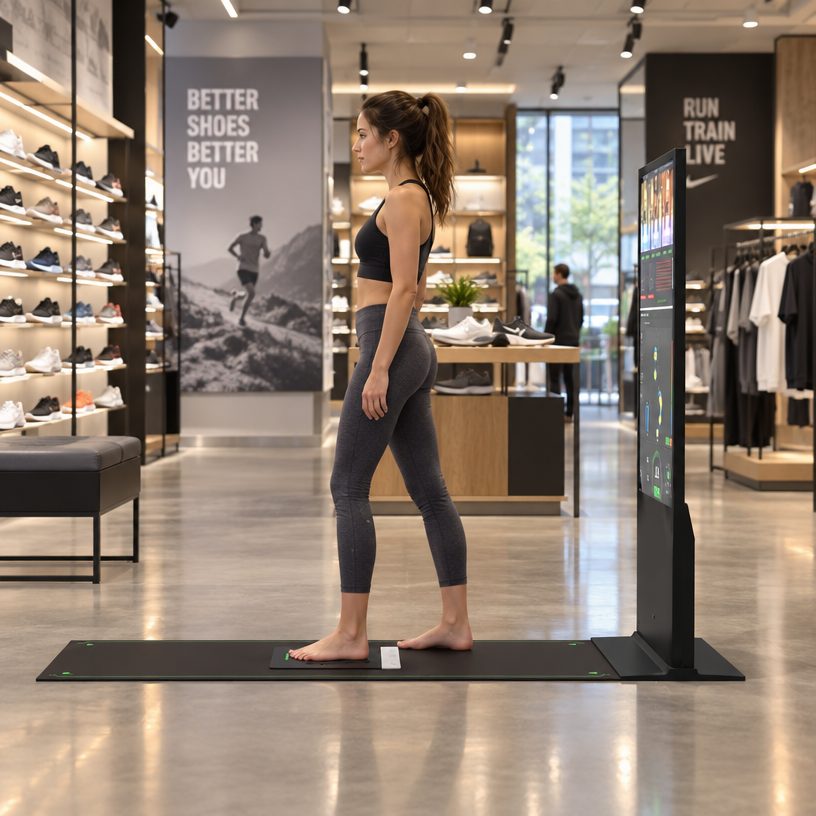
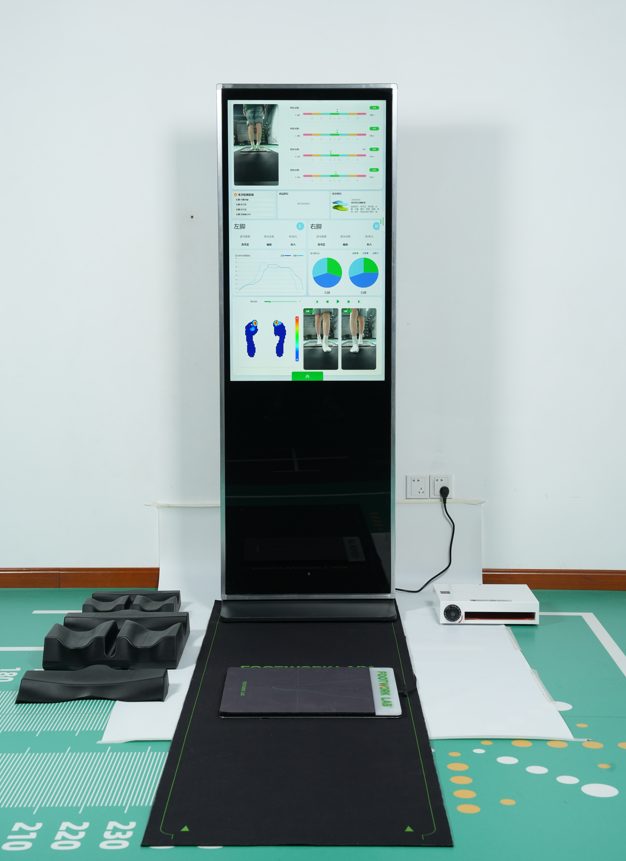
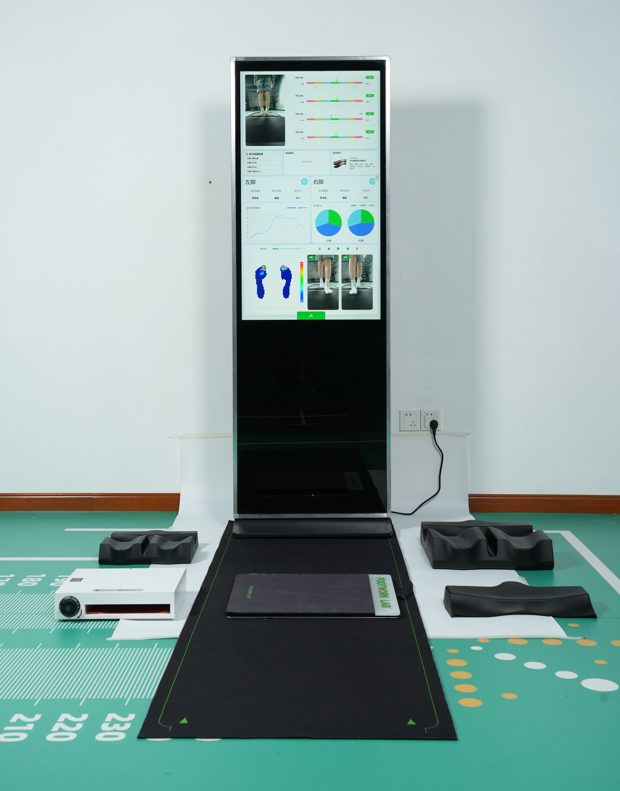
The pressure record is the input that describes behaviour rather than construction. On the X3 system, the customer takes standing passes and walking passes across the sensing surface, and the software assembles the images and figures the report carries: how the contact area distributes between heel, midfoot and forefoot, where the load concentrates at each phase of the step, and how it travels from first contact through to push-off. The force lines drawn over the pressure image describe direction, which is the part of the record that the build conversation leans on hardest when posting decisions come up.
The record answers the questions the mould cannot see. A foot with a well-formed arch can still arrive through its inner forefoot on every step, and a foot with a low arch can spread its load evenly and politely. The shape document would call these two customers similar. The pressure record calls them different, and the difference decides where material is added, where relief is cut away, and whether the posting note on the job card reads in one direction or the other. Load, not shape, is what the pair has to manage once it is inside a shoe and under a person.
The record also brings time into a conversation that the mould flattens. A standing image freezes the foot; the walking passes show it working. Contact that begins at the heel and rolls outward reads differently from contact that slaps down through the midfoot, and the difference is a behaviour, not a shape. This is why our own guidance to clinics is to record both standing and walking in the same session and file both: the standing pass keeps the record comparable across visits, and the walking passes give the fitter the movement information that the build actually needs.
What the pressure record cannot do, no matter how good the image looks, is describe the shape the shell must hold. It registers what reaches a flat sensing surface. It does not carry the contours of the arch, the height of the instep, or the width of the heel at the point where a cup has to close around it. A pressure image hung on the wall is a record of behaviour. It is not a model of a foot, and no amount of colour in the image turns it into one.
What the posture capture answers: the leg above the foot
The third input sits above the other two. Alongside the pressure sensing, our systems carry camera capture of posture and alignment, and its subject is the relationship between the foot and everything standing on it: how the lower leg lines up over the heel, whether the knee tracks forward over the foot or drifts inside or outside of it, and how the pelvis sits relative to the two sides. None of that appears in a mould, and almost none of it appears in a pressure image, because pressure registers the foot and the leg only reaches the sensor through the foot.
Yet the leg is where half the build decisions actually live. A posting decision is not only about where load concentrates; it is about what the leg is doing to put it there. Load gathering along the inner forefoot with the knee tracking outward points a fitter in a different direction from the same load pattern under a knee that falls inward. The pressure image supplies the where, the posture frame supplies the relative position, and the two together are what let the posting note be written with confidence rather than with a shrug.
The posture sheet also protects the record from a common misreading. When a customer sees pressure gathered on one side of the image, the tempting conclusion is that the foot is the problem. Sometimes it is; sometimes the foot is doing honest work under a leg that has been positioned unevenly above it, through habit, through a work posture, or through the way the person has stood on the platform that day. The alignment frame gives the fitter a second document to check before the first word of interpretation is spoken, and that check has defused more than one overconfident opening sentence.
What the posture capture does not do is carry the other two questions. It shows relationships, not contours and not load. It is also the most condition-sensitive of the three inputs, which is why the operator notes how the customer stood, in what, and on which pass. A posture sheet without its conditions is a picture without a caption, and pictures without captions get quoted in arguments they were never taken for.
What each input cannot do on its own
Workshops rarely lose an input on purpose; they lose one because of the way an order arrived. A clinic sends a pressure report by message and asks for a pair built from it. A partner sends a cast with no load information at all. A customer arrives having read a report from a previous visit and wants the pair built from the picture on the page. Each of these is a build with one input, and each one shows exactly what the missing document would have settled.
Build from a pressure record alone and the shape question is unanswered. The fitter does not know the height of the arch to form under, the width the shell must close to at the heel, or whether the forefoot will need the perimeter trimmed back for the shoe. Any shape decision becomes an average, and an average shape is what a ready-made insert already is. If the pressure image could be turned into a shell, the custom trade would not exist, and this is the shortest honest answer to the customer who asks why the picture on the report is not enough on its own.
Build from a mould alone and the load question is unanswered. The shell will fit the foot, and it will hold the foot, but the decisions about where load should be encouraged to travel and where it should be kept off are made from the fitter’s general reading of the shape rather than from this person’s actual behaviour under load. The result is not wrong, exactly. It is unspecific, and unspecific is the difference between a pair that manages this person’s walking and a pair that would fit a great many people.
Build without the posture input and the relationship question is unanswered, which shows up mostly in posting. A wedge placed in a direction that the leg’s position would have contradicted is a wedge placed on incomplete information, and the fitter will not know it, because nothing in the mould or the record tells them. Of the three absences, this one is the quietest on delivery day and the loudest two weeks later, which is why we push clinics to capture all three in one session while the customer is standing there and can be asked once more.
The order the workshop actually follows
When all three inputs are on the bench, the work runs shape first. The shell has to exist before it can do anything: it is formed over the model, laid out and trimmed against the shape, and only then does it become an object that load decisions can be applied to. A posting note written before the shell exists has nothing to attach to. This is why the first station in our build sequence is forming and why the job card opens with the mould number, the shoe the pair is going into, and the perimeter decisions taken at the bench.
Load comes second. With the shell shaped, the pressure record decides where the build leans: where material is added to invite load to spread, where relief is cut to keep a pressure point clear, and how much of the shell’s edge survives trimming when the load pattern asks for a platform further out than the shoe’s volume allows. This is also the stage where the record and the mould can disagree, and when they do, the workshop follows the record for posting direction and the mould for contour, because that is what each document is authoritative on. A fitter who lets the pressure image override the contour of the shell is using a behaviour document to make a shape decision, and the pair will show it.
Relationship comes third, but it is not the least. The posture and alignment frame is what turns a load observation into a posting decision with a direction attached. On the job card the sequence is visible in the notes: mould number, then the posting line, then the alignment note that explains why the posting line reads as it does. A reader who picks up the card a year later can reconstruct the reasoning in the order it happened, which is the point of writing it down at all.
When an order arrives with an input missing, the workshop asks before it builds. A pressure report without a shape input gets a request for an impression or a model, and we would rather add three days to a sampling schedule than build to an average shape and call it custom. A mould without a load record can be built, because a shape-led build is a legitimate product, but the load wording on the specification stays general and says so. The workshop priority is not a hierarchy of importance; it is a sequence of what can physically be decided first, and it holds whether the day is quiet or the bench is backed up.
When the customer folds the three into one
The most common version arrives as a sentence: the machine showed that I need support here, so build it there. The customer is pointing at the pressure image, and the sentence has quietly done three things at once. It has read a load concentration as a conclusion, skipped the shape question entirely, and skipped the alignment question behind it. The fitter’s job is not to argue; it is to unfold the sentence back into its three questions, and the unfolding takes about two minutes at the counter.
The language that works is plain. The picture shows where your weight gathers when you walk. The mould shows what shape the pair has to hold underneath you. The camera sheet shows how your leg sits over your foot, which decides which direction any posting should face. Three documents, three subjects, one pair. Customers take to this quickly once it is said in that order, because it matches their own intuition that a foot has a shape, a job and a position, and that a good pair has to deal with all three rather than one of them loudly.
The second common version is the customer who wants to skip the session because a report already exists. Sometimes the report is from another room, sometimes from a previous season, and the request is always reasonable from the customer’s side: they have a document, it has pictures on it, why is it not enough. The answer we train partners to give is the one from earlier in this article. The picture records behaviour, not shape, and the pair has to hold a shape. Then the counter offers the short session to complete the missing input, and most customers accept once the reason is stated without hedging.
The third version is quieter: the customer who conflates the three because two of them came in the same envelope and the third was never mentioned. A clinic that reports the pressure findings but files the posture sheet internally produces customers who think the record is the whole story. This is a reporting habit, not a customer failing, and the fix belongs to the clinic: name all three inputs on the printed report, even briefly, so the customer knows the story has three chapters. A report that lists what was captured is also a report that can be compared honestly with the next one, which is where the habit pays for itself a season later.
Frequently asked questions
Does a pressure record replace a mould or cast?
No. A pressure record describes load behaviour on a flat sensing surface; it does not carry the contours the shell has to hold, such as arch height, instep depth or heel width at the cup. Shape and load are different questions, and the build needs both answered. A pair built from a pressure image alone would be an average shape with specific load notes, which is not what the custom trade sells.
Can you build a pair from a mould alone?
Yes. A shape-led build is a legitimate product: the shell is formed over the model and trimmed to the shape and the shoe. What the specification loses is load specificity, so the load wording stays general and states that it is shape-led. When a load record can be added later, the posting decisions can be revisited against the same mould number.
Can a pair be built from a pressure report sent in by a customer?
We ask for a shape input before building. A pressure report sent on its own describes where load falls but not what the shell must hold, and building to an average contour is not a custom build. Most customers accept a short session to complete the missing input once the reason is explained plainly at the counter.
What does the camera capture add beside the pressure mat?
It records the relationship of the lower leg, knee and pelvis to the foot, which no pressure image shows. That relationship decides the direction of posting decisions. It also protects the record from misreadings: load gathered on one side can belong to the leg’s position as much as to the foot, and the alignment frame is the document that settles it.
Which input wins when the mould and the pressure record disagree?
They govern different things, so the workshop follows the record for posting direction and load placement, and the mould for contour and perimeter. Disagreement between them is normal, because one describes behaviour and the other describes construction. A fitter who lets the pressure image override the shell’s contour is making a shape decision from a behaviour document.
What is kept on file so a reorder can be matched?
The mould with its job number on the side, the job card carrying that number, the build specification with the posting and alignment notes, and the pressure and posture records from the session. A reorder starts with the number, because the physical mould and the file have to match before any material is cut.
Does the equipment decide how the pair is built?
No. The equipment produces measurements, images and records; the build decisions belong to the qualified fitter or clinician reading them. The three inputs exist to give that person better material to judge with. Our own guidance is that a record never substitutes for judgement, and a judgement never overrides what the documents actually say.
What we would do next
If your room collects only one of the three inputs, add the missing one before your next build conversation rather than after. The X3 system page describes the session types that capture load and alignment together, and the FAQ page carries the counter answers we give most often by message. For the trimming decisions that follow the mould, building to a foot or trimming to a shoe size covers the perimeter choices at the bench, reading direction from force lines explains what the posting note is actually based on, and what a wedge under the heel or forefoot does takes the posting question one layer further than this article does.
This article is intended for professional and educational reference. It is not medical advice. Foot assessment equipment produces measurements and images; clinical interpretation and any decision about care remain the responsibility of a qualified professional. Certification scope is limited to the documentation we hold: European Union certification and ISO quality system certification.