
The runner arrived ten minutes early, set a gym bag on the bench, unzipped it, and produced three pairs of running shoes in the manner of a man dealing cards. Which ones do you want me in, he asked. The operator looked at the pairs, picked up the most beaten of the three, turned it over, read the wear off the outsole like handwriting, and said: this one first, the way you ran on Sunday. The runner was surprised the question had an answer at all. Many are. The platform under the belt records whatever walks across it, and what walks across it is never a bare foot in the abstract; it is a foot inside a shoe, at a speed, on a day. Choosing the pair is therefore not admin before the real measurement. It is part of the measurement, and it decides what question the record can answer. This article works through that choice the way experienced rooms handle it, with the questions and phrases they actually use in the room.
The platform records the foot and the shoe together
The first thing to settle is what the machine is actually measuring. A pressure platform under a running belt records the load that arrives at the belt surface, and that load has already passed through midsole, outsole, sock and foot before it gets there. The record is a measurement of the foot-shoe system in motion, not of the foot alone, and every honest reading of a gait report starts from that fact. Two sessions on the same runner can differ because the foot behaved differently, or because the shoe between the foot and the belt behaved differently, and the record itself cannot tell you which.
This is why the shoe is treated as a condition of the measurement, the same way speed and pass count are conditions. A static standing capture and a dynamic walking pass describe different situations; a dynamic pass in a heavily cushioned trainer and one in a lightweight racing shoe are also different situations. Neither is more true. Each answers its own question, and the room’s job is to pick the pair whose question matches why the runner walked in. Our article on belt speed as a protocol decision makes the same argument about pace.
So the shoe conversation happens before the runner ties laces, not after the first pass looks strange. Five minutes at the bench, shoes in hand, saves the session from the worst outcome, which is not a bad record but an unlabelled one: a report nobody can later connect to a pair of shoes, because nobody wrote the pair down.
Start with the shoes the runner actually runs in
The default answer, and the right one most weeks, is the shoes the runner is currently training in. The reasoning is practical rather than philosophical. The session exists to describe how this person moves in the conditions they actually move in, and the conditions include the shoe that has been on their feet for the last few months. A record taken in that pair describes the runner’s ordinary running week. A record taken in a pair bought last Tuesday describes the runner’s ordinary week plus one unusual variable, and nothing on the report will flag the difference.
The operator’s question at the bench is specific, not general. Not do you run in these, but which pair did you wear for your longest run this month, and how old would you guess it is. The runner’s answer goes on the session sheet in one line. The worn pair that comes out of the bag is usually the honest one, and runners know it: they bring the old shoes precisely because they suspect the shoes are part of the story. The outsole wear, the lean of the midsole when the shoe sits on a flat surface, the compression visible at the heel, all of it is context the room can use, and all of it came free before the first pass.
Our piece on reading a footbed you did not make makes the companion argument from the insole side: an insert that arrives already worn carries a history, and the history is information, not contamination. The same holds for outsoles, and putting the worn pair on the belt lets the two records be read against each other.
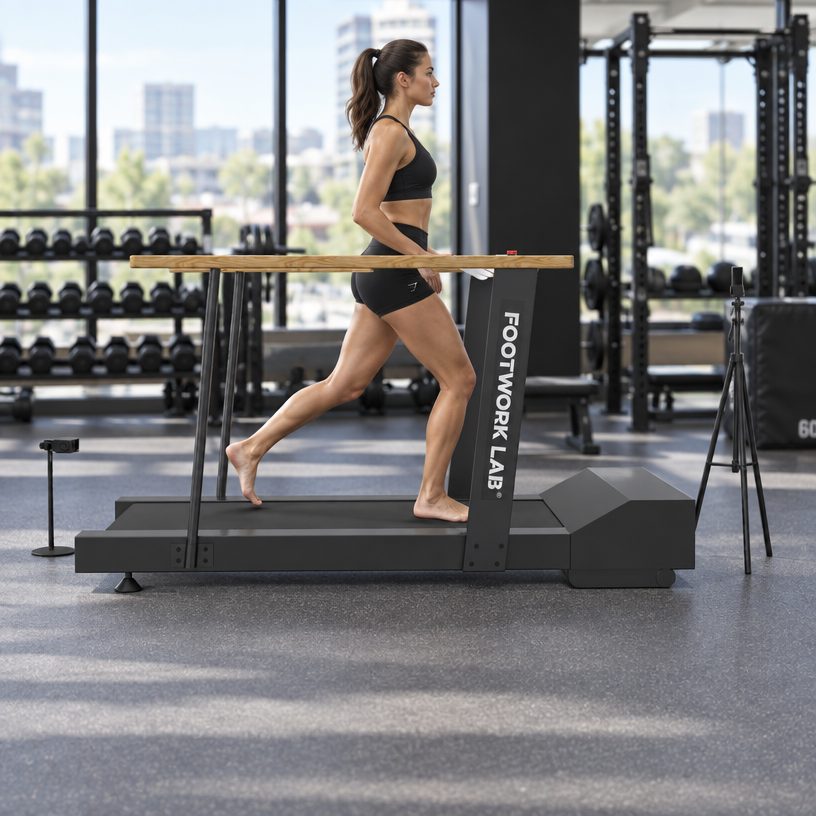
The worn pair and the fresh pair answer different questions
There are sessions, though, where the runner’s question is about the new shoe. They are mid-decision on a purchase, or they have been sold a different category of shoe and want to know what changes, and in those cases the fresh pair on the belt is exactly the point of the visit. The room’s task is not to refuse the new pair but to be clear about what the session will then describe. A record in a brand-new pair says: this is how contact and load presented in this shoe, unworn, on this runner, at this speed, on this day. It does not say how the runner usually moves. The two statements sound similar and are not interchangeable, and the difference is entirely in the labelling.
Rooms that handle this well run the worn pair first, then the fresh pair, in that order, and say the order out loud. The first pass describes the runner’s baseline condition, the second describes the same runner under a changed condition, and any difference between the two passes belongs to the change, provided everything else held.
What the room should not do is run the fresh pair alone and file it as the runner’s gait. That folder, reopened in a year, will be read as how this person runs, when it is actually how this person ran once, in new shoes, while being observed for the first time. A condition that is not written down is a condition that will eventually be misread. The shoes are the easiest condition in the whole session to record; they are sitting on the bench the entire time, with the model name printed on the side.
The barefoot pass and what it is for
A barefoot pass on the belt is a legitimate session component, and rooms offer it for a specific reason: it shows the foot’s contact and load behaviour with the shoe layer removed. For a runner wondering what their foot does without structure under it, or for a room building toward a custom insole and wanting the foot’s own shape under dynamic load, the barefoot pass answers a question the shod pass cannot. It belongs in the session deliberately, announced the same way every pass is announced, and filed with a label that says barefoot.
What the barefoot pass is not, in this configuration, is a more truthful version of the runner’s gait. The runner does not run barefoot; the runner runs in shoes, on surfaces, for kilometres. A barefoot record is not the runner’s real gait revealed, with the shoes as distortion. It is one more condition, and an unusual one for the runner’s body, which shows: first-time barefoot passes on a belt are typically shorter, more careful, and more tentative than the passes in familiar shoes, because the surface is unfamiliar and the runner is protecting an unfamiliar feeling. A cautious stride is still a stride, but it should be read as one taken under those conditions.
The working pattern in rooms we see: shod passes in the training pair as the spine of the session, a barefoot pass or two where the question warrants it, and every pass labelled by condition before it leaves the machine. Where the session feeds a build, the barefoot dynamic record and the shod record serve different parts of the spec, as our article on three inputs to one build sets out. Neither substitutes for the other.
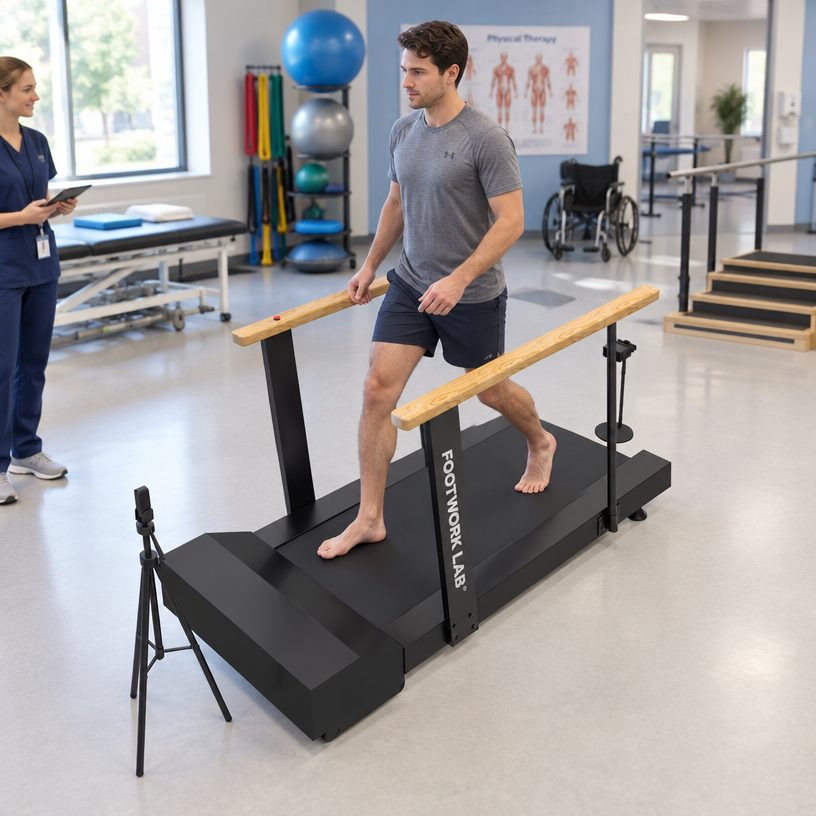
What the shoe itself says before the runner steps on
Before any pass, the operator has a second measurement instrument that never plugs in: the shoe itself. Two minutes with the worn pair on the bench yields observations worth a line on the sheet. The outsole wear, concentrated where the rubber met the road most often, gives a long-run summary of contact the runner cannot self-report. The midsole lean, checked by setting the shoe on the bench and looking at it from behind, shows asymmetry between the pair, which is sometimes matched in the record and sometimes not, and either way is context. The upper’s crease pattern and the insole inside the shoe, if there is one, carry the same kind of history.
These observations stay observations. They are not findings, they are not reported to the runner as conclusions about their feet, and they do not substitute for the measurement. Their role is to make the room smarter about what to look for in the record, and to give the session sheet texture: outsole wear heaviest at the lateral heel on both shoes, midsole lean visible on the left pair only, stock insole still present. Lines like that cost a minute and turn the folder from a report into a session.
Runners engage with this part of the visit more than with any other. The shoe is their object, they have opinions about it, and the conversation at the bench is where the session’s real question usually surfaces: not measure my gait, but something more specific the runner has been unable to articulate. The operator who asks to see the shoes first often hears it there.
Comparing two shoes without fooling yourself
Shoe comparison sessions fail in predictable ways, and all of the ways are controllable. The first failure is changed conditions: the worn pair tested at one belt speed and the fresh pair at another, or one tested after a full warm-up and the other cold. Any difference between the records then belongs to the session, not the shoes, and the folder reports a verdict the shoes did not earn. Speed is fixed across the comparison, warm-up state is matched, pass count is matched, and the order stays baseline-then-change. Our article on keeping video and pressure in step makes the same demand of synchrony inside a single pass; the comparison version of the same discipline is holding the surroundings constant across passes.
The second failure is asymmetry of attention. The runner knows which pair is the new one, wants it to feel different, and runs it differently: a little lighter, a little faster, unconsciously performing the purchase. The operator sees this on the belt when the cadence shifts between shoes for no stated reason, and naming it helps: same pace as the last pass, if you can, nothing about these shoes changes how we run today. The record from a performed pass is a record of performance.
The third failure is the verdict. Two records, two conditions, one runner, one day: the data supports a statement about how contact and load compared between the two shoes on that day, and nothing beyond it. Whether the difference matters for this runner is a professional’s judgement, made with more in front of them than this single folder. Rooms that keep the record and the recommendation in separate columns keep the trust of the runners who come back, as our piece on building a left-and-right comparison argues for the same reasons.
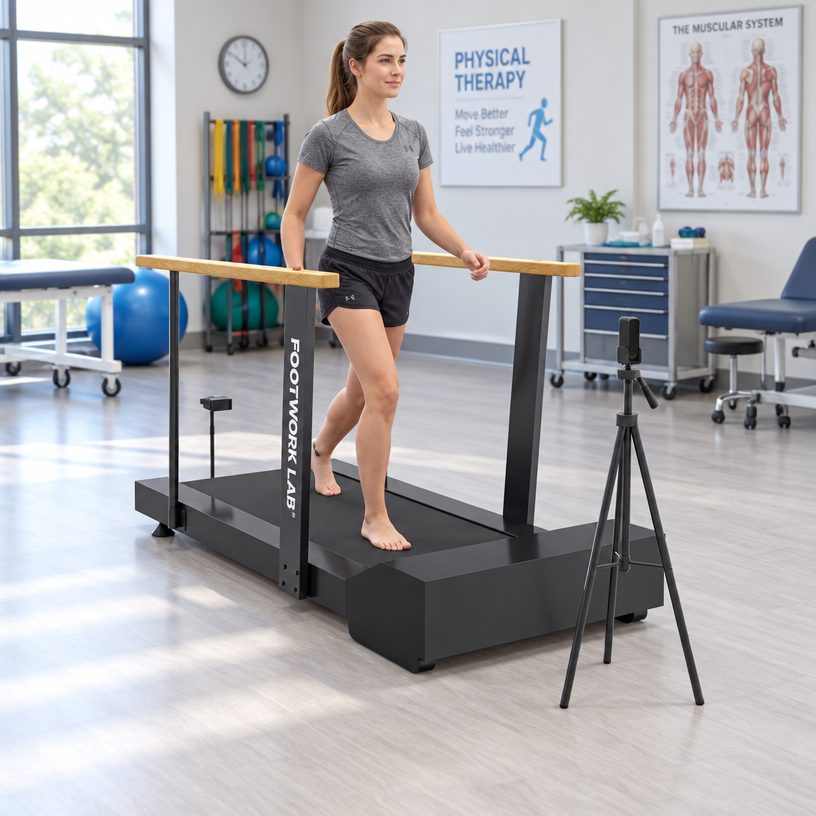
Writing the shoe into the record
Everything above collapses if the pair is not recorded. The session sheet carries one line, and the line is short: shoe make and model as printed on the side, the runner’s estimate of its age, worn or fresh, stock insole removed or still in, and socks noted if the room standardises them. A second line if a second pair ran: same fields, plus the order. If a barefoot pass was taken, it appears in the same list, labelled like the rest.
The printed report carries a shortened version of the same line, because reports travel to a coach, a second professional, or back into the runner’s own folder a year later, and none of those readers were in the room. A report that says dynamic capture, running, without naming the shoe invites the reader to assume the record describes the runner in general. A report that says the model and the approximate age closes the gap for the cost of a few words.
The habit also protects the room in the conversation that follows a purchase decision or a build decision. When the conditions are on the page, the discussion starts from shared fact: this record, in this pair, at this speed. When they are not, the discussion starts from memory, and memory is where sessions go to be rewritten. The line on the sheet is the cheapest insurance the room owns.
Frequently asked questions
Should the runner be tested in their own shoes or barefoot?
Start with the pair they currently train in, because the session should describe how they actually run. A barefoot pass is a useful additional condition where the question calls for it, but it is an unusual condition for the runner and should be labelled as such. Neither pass is more truthful; they answer different questions and the sheet records which was which.
Can we test two different shoes in one session?
Yes, and the working order is the training pair first, then the pair being compared, with belt speed, warm-up state and pass count held constant across both. The difference between the two records then belongs to the shoe change rather than the session. Each record is labelled with its shoe before it leaves the machine.
Does a brand-new pair change the record?
It can, and that is expected rather than a problem. A new shoe is a changed condition: unworn midsole, different contact, and a runner who knows the shoes are new. The record describes how load presented in that shoe on that day. It should not be filed as the runner’s general gait, and the label keeps it from being read that way.
The runner forgot their usual shoes. What should the room do?
Run the session in whatever pair they arrived in, record the make and model on the sheet, and note that the usual training pair was not available. A barefoot pass can be added if the question warrants it. The record stays valid as a record of stated conditions; it simply should not be compared against earlier folders taken in other shoes.
Should socks be standardised between passes?
Where the session will be compared across visits or across shoes, keep the socks the same within the session and note them. Sock thickness sits between foot and shoe like every other layer, and a change of socks is a change of condition. One word on the sheet, running socks or everyday, is enough to hold the line.
How many passes per shoe does a comparison need?
Enough settled passes to choose from, taken the same way for each shoe, with resets between them. The room files a chosen pass per condition rather than an average of everything, and the number of attempts is noted on the sheet. If the runner needs many attempts to settle, the room takes them; the repetition is the method, not a delay.
Can the record tell the runner which shoe to buy?
The record states how contact and load compared between the shoes under the session’s conditions. What that difference means for this runner, and any decision about what to buy or change, is a judgement for the qualified professional working with the runner, made with more in front of them than one folder. The equipment produces measurements and images; it does not issue verdicts.
What we would do next
Put the shoe line on the session sheet this week: make, model, approximate age, worn or fresh, barefoot where taken. Pull the last ten running folders and check whether the shoe is recoverable from them; where it is not, mark the gap honestly rather than comparing across it. Our piece on what a gait record can support when a runner returns to sport covers how far one folder’s claims should reach, and capturing gait in a small room handles the space side of the same protocol discipline. The F5-LAB platform page describes the standing and running capture modes in the equipment’s own terms, and the FAQ page carries the operational answers we send most often by message.
This article is intended for professional and educational reference. It is not medical advice. Foot assessment equipment produces measurements and images; clinical interpretation and any decision about care remain the responsibility of a qualified professional. Certification scope is limited to the documentation we hold: European Union certification and ISO quality system certification.