
The pair comes out of a plastic bag and is set on the desk: edges furled like pastry, the topcover polished through under the ball of the foot, a hand-cut line along one side that has been trimmed twice. The customer made the appointment for one sentence — is this pair still any good — and then watches your face while you look at it, which is the part of the appointment that decides how the next forty minutes go. There is a wrong answer available in the first ten seconds, and it is the one most rooms give: a verdict.
A verdict is satisfying to give and expensive to own. It puts you in judgement over somebody else’s work, on the strength of an object with no history, for a customer who may only want permission to replace something she has worn for three years. What follows is how we would run the appointment instead: separating the three questions that arrive as one, reading the pair before switching anything on, using a capture for what it can actually say, and writing the whole thing down in a way that would survive being read by the person who made the pair.
Three questions inside one sentence
Is this pair still any good is at least three questions, and they have different answers, different evidence and different consequences.
The first is a materials question: has this pair reached the end of its working life. That one can usually be answered by looking and touching, in a couple of minutes, and it is the question the customer is most often actually asking.
The second is a fit question: is this pair still right for me. That one needs the foot, the shoes and the customer’s own account of how the pair behaves across a day. It cannot be answered from the object alone, because the object was made for a foot that has been living in it since.
The third is a judgement question: was this made well. That one is rarely answerable, almost never useful, and it is the one that gets answered by accident when a practitioner picks up a pair and says the first thing that comes to mind. A pair made for a tight shoe, at a customer’s request, on a limited budget, may look crude and be entirely correct for its conditions. You were not there.
Sorting the three takes one sentence at the start of the appointment: let us look at what this pair is doing now, and then decide whether what it is doing is still what you need. Said before the bag is opened, it puts the appointment on the right footing and quietly removes the invitation to pass judgement.
Read the pair before you switch anything on
Six checks, in this order, and none of them needs power.
The topcover first, at the two places it always goes: under the ball of the foot and at the heel. Polished through to the base means the surface has done its work and the pair is at the end of its life as a surface, whatever the base underneath is still capable of. Wrinkled and lifting at the edge means moisture has been getting in, and the layer beneath is the next thing to fail.
The edges second. A furled or cracked edge is the most reliable sign of age, because it is where the layers separate and where every pair fails first. Run a thumb along both sides. If the layers part, the pair is finished as a unit even if the middle still looks sound.
Third, the shape. Bend the pair gently and let it go. A base that returns to its curve has life left; one that stays bent, or feels soft in the middle and hard at the edges, has taken a set. Compare left and right. Asymmetry is information: it tells you one side was loaded more, and it is worth asking the customer whether she knows why.
Fourth, the hand work. Look for glued additions, pads added later, grinding marks, a second trim line. These are not faults. They are the record of a previous adjustment, and they tell you what somebody was trying to solve. Ask about them rather than around them.
Fifth, the trim line against the shoe it lived in. Put the pair back in the shoe, or ask for the shoe. A piece trimmed inside the shoe’s own footbed edge will curl; one trimmed past it will rub. This check is also the fastest way to find out whether the customer is judging the pair in the shoes it was made for or in a different pair entirely.
Sixth, smell and moisture history. It is not a delicate subject in this trade. A pair that has been worn damp for months will delaminate whatever else is true of it, and the conversation about drying belongs in the same breath as the conversation about replacement.

What a platform adds, and what it does not
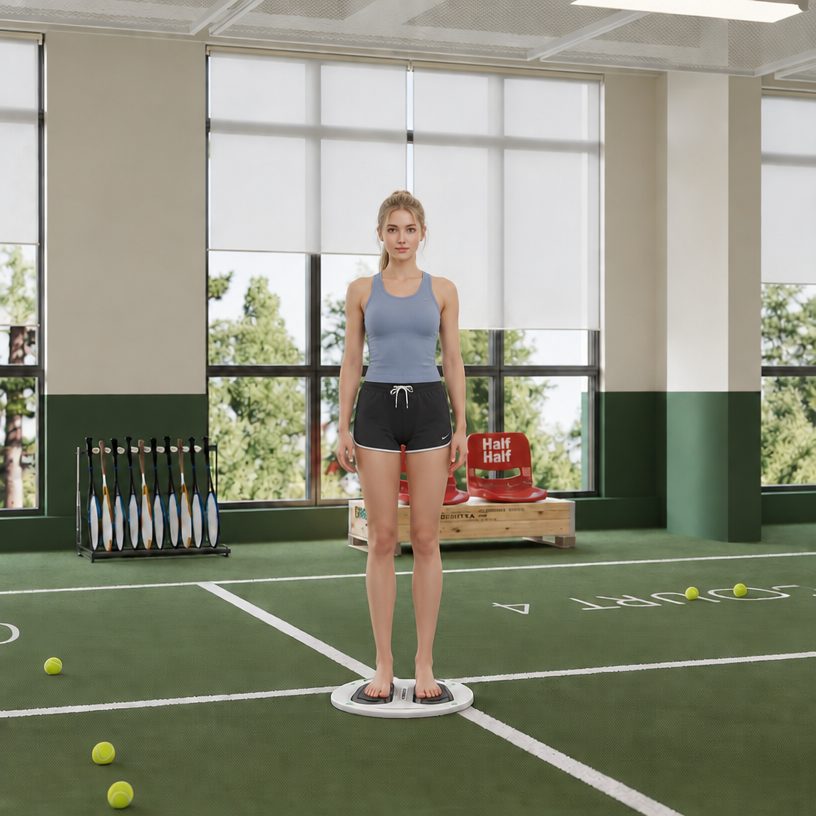
A pressure platform answers a narrow question well: how load distributes under this foot, in these conditions, at this moment. Used on a customer who has arrived with an old pair, it gives two useful views — the barefoot pass, and a pass with the old pair in the shoes she wears them in. The difference between the two shows what the pair is doing to the interface right now, which is a real finding and often a surprising one.
What it does not do is grade the pair. There is no measurement for craftsmanship. A capture taken in a pair that looks rough may show a perfectly even distribution; a capture taken in a beautifully finished pair may show load concentrated exactly where the customer says it feels wrong. Neither result tells you whether the maker did a good job, because the conditions the maker worked under are not in the room.
There is a second limit worth stating before the customer sees a screen. The equipment produces measurements and images of load distribution under stated conditions; it does not produce a diagnosis, and it does not pronounce on somebody else’s clinical reasoning. Whether this pair is still appropriate for this person is a professional judgement made from the whole record — the object, the foot, the shoes, the history and the customer’s account.
Our own use of a platform in this appointment is deliberately modest: one barefoot pass, one pass in the old pair inside the shoes, and a note of the conditions. On the F2 system the two passes sit side by side on one screen, which makes the comparison easy to explain to a customer without turning the screen into a verdict. The rest of the appointment happens in words.
Four questions for the customer
The pair cannot speak, so the customer has to. Four questions cover most of what the object cannot tell you.
When was it made, and how much has it been worn? A pair made two years ago and worn daily is a different object from one made two years ago and worn at weekends. Customers underestimate wear and overestimate age, so ask about days per week rather than months.
What has changed since? A new job, a move to a different floor, a change in activity, a new pair of shoes, a change in weight, a pregnancy, a season. Pairs do not stop fitting because they changed; they stop fitting because the conditions around them did, and this question finds those conditions.
What does it feel like at hour six? Not at the appointment, not on the first step. The useful description lives late in the day: tired, hot, sliding forward, pressing here, fine until the walk home. Ask the customer to describe the last hour of her longest day, and write it down in her words.
Which shoes does it live in, and are those the same shoes it was made for? This is the question that resolves the most cases. A pair that is fine in one shoe and unbearable in another is not a bad pair; it is a pair in the wrong shoe half the time, and no amount of inspection of the object will reveal that.
Ask all four before the capture, not after. The answers decide which shoes go on the platform, and a capture taken in the wrong shoe produces an argument rather than a record.

Saying it has done its job without a verdict
Most old pairs that arrive on the desk have done their job and reached the end of it. That is a complete and honest finding, and it can be delivered without a single word about the maker.
The sentence that works describes evidence rather than quality: the surface has worn through where your foot pushes hardest, the edges have started to separate, and the base has taken the shape of your foot rather than returning to its own. Then the conclusion, in the same calm register: this pair has given you what it had. Nothing in that sentence is a criticism, and nothing in it is vague.
It also gives the customer something to hold. People who have worn a pair for years are often reluctant to replace it, not because they think it is perfect but because replacing it feels like an admission that the money is gone. Framing the end of a pair’s life as wear rather than failure lets her spend again without feeling foolish.
Three phrasings to keep, and one to avoid. Keep this pair has done its work; the surface is the part that has gone; the base has taken a set. Avoid anything that begins whoever made this, because the moment the sentence starts that way it has stopped being about the pair. Our article on the photo a customer argues with deals with the neighbouring problem, when the evidence on the screen and the customer’s memory of a pair disagree, and the discipline is the same: describe, do not rule.
There is one more case, and it is commoner than practitioners expect. The pair is genuinely finished, the customer knows it, and she has come for permission. Giving that permission cleanly, in two minutes, with a reason she can repeat to her partner, is a service. It is also the fastest way to a second appointment that is about the next pair rather than the last one.
When the build itself looks wrong
Sometimes the finding is not wear. There is a hard ridge under the arch, a gap at the heel where the piece lifts when the foot does, a trim line that cuts inside the shoe’s footbed edge, an addition that has come unbonded. These are observations, and they can be stated as observations.
What cannot be stated is causation. You can say the ridge is there and that it sits under the arch; you cannot say it is why her foot feels the way it does, and you should not try. You also cannot know the constraints: the shoe may have been tighter than it looks, the customer may have asked for something the maker advised against, the budget may have decided the material. A build that looks wrong in your hands may have been the best available answer to a question you cannot see.
So the language narrows to what is visible. There is a ridge here, about where your arch sits. The edge has lifted at the heel, which usually means the piece is moving inside the shoe. The trim line is inside the shoe’s own edge, so the piece is likely to curl. Each of those is checkable by the customer, in her own shoe, in front of you, and none of them requires anybody to be at fault.
Then the practical question: does it need to change. A ridge the customer has never felt is a note in the file, not a reason to rebuild. A lifted heel that she feels on every step is a reason. The customer’s account decides, which is why the four questions come before the inspection rather than after it.
The boundary is worth saying out loud in the room, because it protects everybody: what is being inspected is a piece of footwear, and what the foot needs is a clinical question. This trade measures and describes; the interpretation belongs to a qualified professional, and the customer should leave knowing which of the two she has just received.
The handover: what goes in the file, what goes back in the bag
The pair itself has to go somewhere. The default should be back to the customer, in the bag it came in, with a note of what was found. Keeping somebody’s old pair without a clear reason creates a storage problem and an awkward phone call; the only good reason to keep it is a comparison you intend to make, and then it should be labelled with the date and the customer’s name and returned at the next visit.
The file needs four lines. What was inspected, in enough detail that a colleague could repeat it: topcover, edges, shape, hand work, trim line, moisture. What was found, described rather than judged. What was measured, with the conditions of each pass, including which shoes were on the platform. And what was recommended, together with what the customer decided — including the case where she decided to do nothing.
That last half-line is the one people leave out, and it is the one that matters in a dispute. A record that says the pair was worn through and the customer chose to keep wearing it is a record that protects both sides. A record that says only what the practitioner advised is a record with a gap in it.
Where another professional is involved, a short note is worth more than a long report: the pair was inspected on this date, the surface has worn through at the load point, the customer reports it is comfortable until the last hour of the day, and the decision was hers. Our article on a pair sent by post covers the version of this appointment where the customer and the shoes are somewhere else entirely, and the same four lines do most of the work there too.
Nothing in this appointment requires a verdict, and nothing in it is diminished by the absence of one. The customer leaves knowing what she has, what it is doing, and what her options are. That is a better outcome than a judgement, and it is the one she can act on.
Frequently asked questions
Can you tell whether another workshop made a pair well?
Not reliably, and it is rarely the useful question. You can describe what you see — a worn surface, a separated edge, a ridge, a trim line — but not the conditions the maker worked under: the shoe, the request, the budget. Answer the questions the customer actually has about wear and fit instead.
The pair looks worn but the customer says it still feels fine. What then?
Believe her about how it feels and describe what you see about the materials. The two are different findings and both belong in the file. A worn surface with no complaint is a note and a suggested replacement date, not a reason to insist. Ask her to report back if the last hour of the day starts to change.
Should I capture with the old pair in the shoes?
Yes, where the shoes are available. A barefoot pass and a pass in the old pair, in the shoes she actually wears, show what the pair is doing now. Label both passes with their conditions, and keep the comparison in the record rather than only on the screen.
Do I need to take the old pair out to assess it?
For the edge, shape and trim-line checks, yes. Lift it out, look at both sides, put it back and see how it seats. The one thing to avoid is removing a pair that is glued or bonded into a shoe, because that usually ends the shoe as well as the pair.
How do I tell a customer a pair is finished without criticising the maker?
Describe the wear and stop there: the surface has gone through at the load point, the edges have separated, the base has taken a set. Then say plainly that the pair has given what it had. Wear is not fault, and the sentence stays true whether the pair was made well or badly.
The old pair was made for different shoes. Can it be trimmed to fit new ones?
Sometimes, if the new shoe has a removable footbed and the old piece is larger than the new outline. Trimming only removes material; it cannot add length, change a heel seat or restore a worn surface. Check the new shoe’s depth first, because a piece that fitted one shoe may be too thick for another.
Should the customer keep the old pair?
Usually yes, and it should go back in the bag it came in with a note of what was found. Keep it only if you intend a side-by-side comparison, and label it with the date and the name. An unlabelled pair in a cupboard is a phone call waiting to happen.
What we would do next
Next time a pair arrives from somewhere else, open the appointment with the sorting sentence, then run the six checks before anything is powered up. Ask the four questions, take the two passes, and write the four lines while the customer is still in the room. If you want a template for the note that goes with the pair, the FAQ page has the operational version we send to partners, and it is deliberately short enough to fill in between appointments.
The commercial argument for this approach is not softness. A customer who is given a description instead of a verdict learns what to look for, comes back when the next pair is due, and tells other people that the appointment was worth the time. A customer who is told her old pair was badly made learns only that somebody in the trade disapproves of somebody else, which is not a reason to trust either of them.
So: if a customer brings in a pair that is worn out but comfortable, and asks whether she should replace it, what do you actually say — and do you charge for the look?
This article is intended for professional and educational reference. It is not medical advice. Foot assessment equipment produces measurements and images; clinical interpretation and any decision about care remain the responsibility of a qualified professional. Certification scope is limited to the documentation we hold: European Union certification and ISO quality system certification.