
The email arrives from a golf shop that has just started taking insole orders. It reads: “Customer pronates. Which build do we order?” Attached is a photograph of a pair of shoes and a screenshot of a report with a coloured pressure map on it. The question is reasonable and slightly wrong, and the correction is the whole subject of this article. Pronation is not one thing that a build is chosen against; in the record it is a direction and a timing, and those two readings point at different grades. The same measured pattern can lead to a firm posted build for a hiker, a softer and more enveloping build for a snowboarder, and a flexible forefoot for someone doing gym work — not because the feet differ much, but because the sport asks the insole to do a different job. Below: what the record actually holds when the word pronation is used, how the four FX Sport grades are read off it, and how the mapping changes from golf to trail to snow to court.
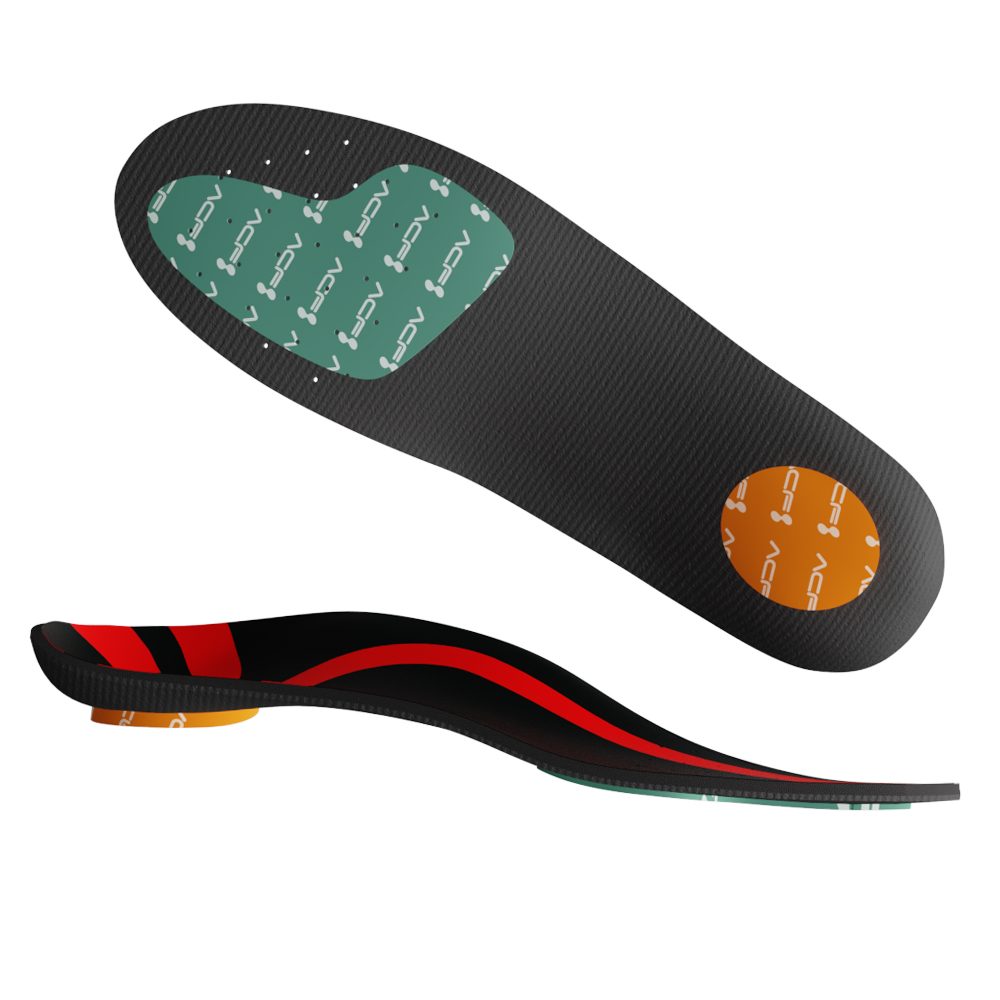
The FX Sport range is the sport line of our custom insole series, built with BODYFIT AI assessment and senthmetic flexible-fabric sensing, and configured from assessment data captured on our detection systems. Every pair is specified through four grades: support, anti-torsion, cushioning and starting ability. The grades are not a quality ladder. A high support grade is not better than a low one; it is a different answer to a different question, and the question is set by the sport before it is set by the foot.
The word arrives before the record does
In practice a sport insole order rarely begins with a measurement. It begins with a sentence — the customer rolls in, the shoe wears on the inside, a coach noticed something in a video. The fitter translates that sentence into a request, and the request usually names a condition rather than describing a movement. That is how a single word ends up carrying an order for a pair of insoles that will be worn for a specific activity several times a week.
Our position is dull and consistent: the word opens the file, the record writes the order. A person who pronates while walking on a plate in a clinic room is not necessarily pronating in a rigid ski boot, and is certainly not pronating in the same way at the end of a long descent as at the start of one. The record captured in a session describes a foot under stated conditions. Everything downstream — which grade, which posting, which forefoot flex — is a reading of that record by a person who also knows what the sport demands.
That division of labour protects both sides. The fitter is not asked to diagnose, and the equipment is not asked to prescribe. What the equipment contributes is a set of comparable quantities, captured the same way each time, so that the build chosen in March can be explained in September. What the fitter contributes is the sport, the shoe, the training load and the conversation.
We also decline a shortcut that arrives in maybe one enquiry in five: building from a photograph of the wear pattern on an old pair of insoles. Wear marks record where material compressed, which is a fact about the material as much as about the foot. It is a useful conversation starter and a poor specification.
Direction and timing: what is actually written down
Three families of record carry the pronation-relevant picture, and they are captured in one session rather than three appointments. The foot axis angle describes how the foot sits relative to the line of progression — an angle printed beside a reference band, not a pass mark. The calcaneal reading describes the heel viewed from behind: how the back of the heel tilts relative to the lower leg at rest and under load. The pressure path describes where the centre of pressure travels as the foot takes load and hands it on.
Direction is the part everyone looks at first. When load concentrates along the inner column — the medial heel, the midfoot, the first and second metatarsal heads — the path drifts inward and the heel reading tilts accordingly. That is a direction, and on its own it tells you which side of the build needs material.
Timing is the part that gets skipped, and it changes the answer. A drift that appears early, as the foot first takes load, is a control question at contact: the build needs to be shaped and posted so the foot meets the ground in a supported position. A drift that appears late, as load hands off toward the big toe, is a question about the end of the step, and a build that controls the contact phase hard may simply make the push-off feel blocked. Two records with the same angle and the same inward path can sit on opposite sides of that distinction, and the grade profile should differ.
Neither reading is a diagnosis, and each gains meaning from repetition. A single capture is a photograph of one afternoon. Captured again under the same protocol — barefoot, same instructions, same operator where possible — it becomes a trend, and a trend is what a season of training actually produces.
Four grades, each answering a different question
Every FX Sport pair is specified through the same four fields, which is what makes orders comparable across sports and across seasons. Each field reads a different part of the record.
- Support grade
- Read from the midfoot. Where the record shows sustained load through the midfoot or a long flat phase, the build carries a shaped support structure and an arch contour designed to share load the midfoot is taking. High support suits a foot that needs the midfoot held; low support leaves room for a foot that does not.
- Anti-torsion grade
- Read from side-to-side behaviour — the lateral and medial shifts visible in the pressure path and in the heel pair. A build with more torsional resistance holds the foot steadier when the ground or the movement pushes it sideways. It is the grade most often over-specified, because it feels like safety and is easy to sell.
- Cushioning grade
- Read from where peak load concentrates. The documentation’s load map puts the heavy regions at the first to third metatarsal heads and both heel regions, so cushioning is placed where the record shows peaks rather than spread evenly through the build. More cushioning means more material under the foot, which has consequences for volume inside a tight shoe.
- Starting ability grade
- Read from the push-off record — how load hands off to the big toe and forefoot at the end of contact. It governs how much responsive flex the build keeps under the forefoot. A build tuned for starting ability feels alive at toe-off and gives away some of the steadiness a stiffer build provides.
The four fields trade against each other, and the trade is the design work. Material that steadies the midfoot adds volume and reduces the sense of the ground. A stiff forefoot that helps a turn takes away the spring a runner wants at toe-off. Cushioning that protects a heel changes how the shoe fits around the ankle. There is no configuration that maximises all four, which is why the sport has to enter the conversation before the grades are set.
Our factory builds to a grade profile rather than to a description. An order arrives with the four fields specified, the layers are cut and assembled to that profile, and the pair is checked before it ships. The plant runs roughly five hundred to a thousand pairs a day, the minimum order is two hundred pairs and can mix styles and sizes, and a sample pair ships within three days. Those terms exist because a grade profile makes an order repeatable: the second order is a copy of the first, not a new conversation.
Golf and court sport: the record read for rotation
Golf is the sport that most often arrives with the wrong question attached, because the movement is a rotation and the record is a walk. The record still does useful work. The balance pass shows how weight shifts side to side while standing, and the alignment view shows where the knee and pelvis sit above the foot. For a player whose weight moves late onto the lead foot, or whose trail foot loses the ground through the swing, those readings describe the platform the swing is built on.
The build follows: support grade at the midfoot rather than at the arch crown, because the player is standing on the insole for four hours rather than running on it; a moderate anti-torsion grade to give the lead foot something to turn against; cushioning kept low and thin, because a golf shoe is already close to the ground and a tall build changes the feel of the turf. Starting ability matters less here than in a running sport, and specifying it high is a common error that produces a pair the player describes as unstable.
Racquet sport inverts the emphasis. The movement is lateral, repeated, and often played on a hard court where the foot has to stop and restart in the same second. The anti-torsion grade goes up, the support grade sits in the middle, and cushioning is placed under the forefoot and the outer heel where the record shows the landing. A player who slides into a shot puts load through the outside edge, and a build with a soft lateral border feels vague at exactly the moment it is needed.
The instructive case is a pair of records that look alike. Two players, similar foot axis angle, similar inward drift on the walking pass. One plays golf twice a week and walks the course; the other plays squash four times a week on a sprung floor. The golf build comes out with more support and less torsional resistance; the court build comes out the other way round, with a firmer lateral structure and a thinner midfoot. Same reading, different sport, different pair.
Trail, snow, gym and basketball: where the same record lands differently
Trail and hiking push anti-torsion to the top of the list. The ground is uneven for hours, the foot is asked to hold its shape on slopes and cambered paths, and the boot or shoe already provides some support that the insole should complement rather than duplicate. Support grade runs high, cushioning sits under the forefoot for descents, and volume is checked against the boot, because a build that fills a walking boot makes the lacing tight across the instep.
Snow sports change the question again. Inside a rigid ski or snowboard boot the foot is already held, so torsional resistance from the insole is largely redundant; what the foot needs is cushioning against impact and a shape that fills the boot evenly, so the shell holds the foot rather than a few pressure points. Cushioning runs high, support sits in the middle, anti-torsion is deliberately modest, and the whole build is kept thin enough not to change the boot’s fit. Cold also matters: a build that feels right in a warm shop is firmer on a lift at the top of the mountain.
Gym work and basketball sit closest to the starting-ability end. A basketball player lands repeatedly and then has to move again immediately, so cushioning and starting ability rise together, with anti-torsion in the middle for the lateral cuts. Gym training is broader: a session might include loaded carries, squats, jumps and a short run. The record usually shows a fairly even distribution, and the build tends to be moderate across all four fields, with cushioning placed at the heel and the first metatarsal head and enough forefoot flex that a lunge does not feel like a plank.
One rule survives all of it. Where the record and the shoe disagree, the shoe wins. A build that will not sit inside the last is a build that stays in the box, however well it matches the pressure map. This is why we ask for the shoes — the actual pair, photographed inside and out — before a grade profile is finalised, and why a fitter who has not seen the shoe is guessing at the last two fields.
Writing the order so production can repeat it
A grade profile is only useful if it survives the journey from the fitting room to the bench. The version that survives is written in the same four fields every time, with the sport and the shoe named beside them, and with the record attached rather than summarised. “High support, moderate anti-torsion, low cushioning, low starting ability, golf, leather shoe, wide last” is an order. “Custom sport insole, pronation” is a conversation that will be had again next season.
The practical benefit shows up at the second order. A club that reorders for the same player six months later can compare the new record with the old one and decide whether the profile should move; a club that reorders from memory simply repeats the first pair. Neither is wrong, but only one of them is a programme. Distributors see the same effect at stock level: a four-field vocabulary lets a retail buyer describe what is on the shelf without translating it, and lets a customer’s file travel between two shops.
What we do not do is claim that a build changes the way a foot moves over a season. The insole is a support and load-distribution object, specified from a record and a sport; what happens to the person wearing it is a clinical or coaching question, and the answer belongs to whoever is managing the case. We also do not read a record for a customer we cannot see the shoe for, and we do not put a grade profile on a quotation as though it were a promise about the outcome.
The rest is manufacturing discipline. Samples in three days so a fitter can put the build in the shoe before committing to a run. Two hundred pairs minimum, mixed styles and sizes, so a club can carry golf and court builds in one order. Five hundred to a thousand pairs a day, so a season’s stock does not arrive in one lump at the wrong end of the year. None of that decides which grade is right; it only decides whether the right grade arrives in time to be useful.
Frequently asked questions
Is pronation a diagnosis the system makes?
No. The record holds a foot axis angle, a heel reading and a pressure path, each printed beside a reference band. Whether those readings amount to overpronation, and what should be done about it, is a judgement for a qualified professional. The equipment supplies comparable measurements; it does not conclude.
Why does the same record produce different builds for different sports?
Because the four grades trade against each other and the sport sets the priority. A rigid ski boot already provides torsional resistance, so the insole spends its material on cushioning and fit. A court shoe on a hard floor needs lateral steadiness and gets it from the anti-torsion grade instead.
Which grade is most often specified too high?
Anti-torsion. It sounds like safety and is easy to justify in a sales conversation, but a build that is stiffer than the sport requires feels dead under the forefoot and can make a golf or gym session uncomfortable. We ask buyers to justify each field from the record rather than from habit.
Can a pair be built from a photograph of worn insoles?
No. Wear marks describe how material compressed, which is partly a fact about the material and the shoe. It is a useful opening for a conversation and a poor basis for a specification. A grade profile needs a record captured under stated conditions plus the shoe the pair will go into.
What does the order need to contain?
The four grades, the sport, the shoe with its last width, and the record attached. Written that way, a reorder is a copy rather than a new discussion, and a second fitter can produce the same pair without asking the first one what was meant.
How are samples and production handled?
A sample pair ships within three days of the profile being agreed. Production minimum is two hundred pairs with styles and sizes mixed in one order, and the plant runs roughly five hundred to a thousand pairs a day. Equipment minimum is one unit where a system is part of the order.
Does the insole correct the foot’s movement?
The build is designed to support the foot and distribute load in a stated direction. Whether a person’s movement changes over time is a clinical or coaching question, and any decision about care belongs to the professional managing the case. We describe what the construction is designed to do and stop there.
What we would do next
Send the record with the sport attached, and send the shoe. Those two items settle more of the grade profile than any conversation about the word pronation, and they let us tell you which of the four fields your current orders are over-specifying. If you are starting a sport line from nothing, tell us which sports your customers actually play rather than which ones appear in a catalogue; the mix decides the stock, and the stock decides whether the programme survives its first season.
We will not put a grade profile on a quotation for a customer nobody has measured, and we will not describe a build as a correction of a movement pattern. What we will do is read the record with you, name the trade you are making between the four fields, and quote the pair and the tooling honestly. The insole categories page sets out the three series and the sport range; the contact page reaches the team directly, and the customer notes show how other fitters have structured their first season.
This article is intended for professional and educational reference. It is not medical advice. Foot assessment equipment produces measurements and images; clinical interpretation and any decision about care remain the responsibility of a qualified professional. Certification scope is limited to the documentation we hold: European Union certification and ISO quality system certification.