
A podiatry clinic two streets from the water has had the same plate in the same room for three years, and a patient who came back after eighteen months. The two reports sit side by side on the desk and the centre-of-pressure path under the left foot does not run the same way it did. The clinician’s question is the one worth asking: has the plate drifted, or has the session changed? Both explanations are possible, and they are settled by different evidence. A drifted plate is a hardware question, answered by a zero check and a calibration reference. A changed session is a routine question, answered by asking who gave the instruction, what the person was wearing, and whether the same number of passes was recorded. The sensing layer only enters the conversation after those two have been dealt with.
That order is the opposite of how plates are usually discussed. Buyers compare the layer first, because it is the part with a name and a material and a set of figures attached to it, and they reach the routine last, if at all. This article takes the layer seriously and then draws its edges: what a sensing surface genuinely decides about a record, what it leaves to software, and what it leaves to the person reading the screen.
Three layers, and only one of them is being sold to you
A pressure plate looks like a single object on a showroom floor. Underneath it is a stack: a surface the person stands on, a sensing layer below that surface, and software that turns the two into a picture. Catalogue copy collapses the stack into one word, which is why so many first conversations start with a material and end with a shrug. When a buyer asks what the sensing layer is, the real question underneath is narrower and more useful: will this give me the same picture twice.
Stated plainly, the layer decides three things. It decides whether a standing pass and a walking pass can come off the same surface without changing hardware between them. It decides whether a foot that stands slightly off-centre still has its whole contact area inside the sensing region. And it decides whether a record taken this season can be set beside one taken next season without an argument about what changed. Those three are properties of the layer and of the mechanics holding it, and nothing else in the stack can supply them.
It does not decide the layout of the report, the colour scale, the reference band printed beside a value, or the sentence a clinician says while pointing at the screen. Those come from software and from a person. Two clinics can run the same plate and produce records of very different quality, and the difference will be in the routine rather than in the sensor. That is not a small point for a buyer, because it means the cheapest way to improve a record is usually free.
A word about specification sheets. A sensing layer gets described by figures because figures are printable and comparable across a table. Those figures are taken under conditions a foot does not reproduce: a flat press, a steady load, a controlled temperature, a single application of force. A foot arrives with an arch, a heel strike, a roll, and a habit of standing on one side. The duller demonstration is more informative. Take the same person across the plate three times and put all three records on the table.
Fabric, and why bending is the difficult part
The sensing layer in the F2 is a textile. Sinmec Fabric is a fabric with conductive elements worked into its structure, and the reason to build a plate around a textile rather than a rigid array is mechanical. A foot is not flat, and the load under it never sits still. As weight rolls from the heel through the midfoot and out to the forefoot, the surface beneath it deforms, and the layer has to follow that deformation while still reporting the load it was given.
Inside the fabric family the constructions differ, and the difference that matters on a plate is not the headline figure. It is behaviour while the material is conforming and bending. A layer that reads a load accurately on a flat press can still creep under a sustained load, lag when the load comes off, or read differently after a hundred walking passes than it did on the first. That cluster of behaviours is what decides whether two records belong in the same conversation.
The three behaviours are worth naming in ordinary language. Hysteresis is the gap between the load going on and the load coming off: the same weight traces two different lines depending on direction. Creep is what happens when a load is held and the reading keeps moving underneath it. Recovery is how quickly the layer returns to zero between one footfall and the next. On a standing pass, creep is the enemy, because a person can stand still for the length of a conversation. On a walking pass, recovery is the enemy, because a slow layer smears one step into the following one.
The construction around the textile does as much work as the textile itself. An acrylic cover plate spreads a local load across a wider area and protects the sensing surface from grit and heel edges. The frame holds that cover in a fixed seat so the same foot meets the same plane on every visit. Take the cover away and the measurement becomes more direct and the plate much shorter lived. We do not sell a sensing layer on a resolution race; the useful claim is a repeatable one.
The two passes a layer has to survive
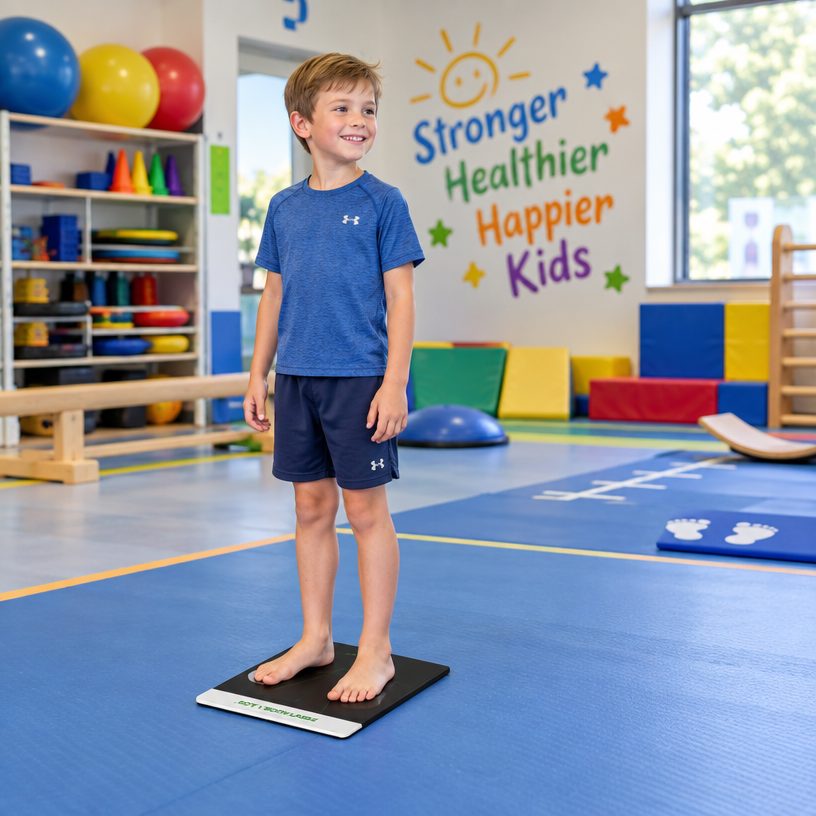
The standing record is the one people underestimate. It holds the distribution of load at rest, the shape of the contact area, and the left-right comparison, and it is also the base for the balance pass. Its demand on the layer is quietness. A person standing still while a clinician talks through a report is a sustained load of several minutes, and a layer that creeps under sustained load will drift during the pass it is supposed to be recording. A drift of that kind does not look like a fault on screen. It looks like a finding.
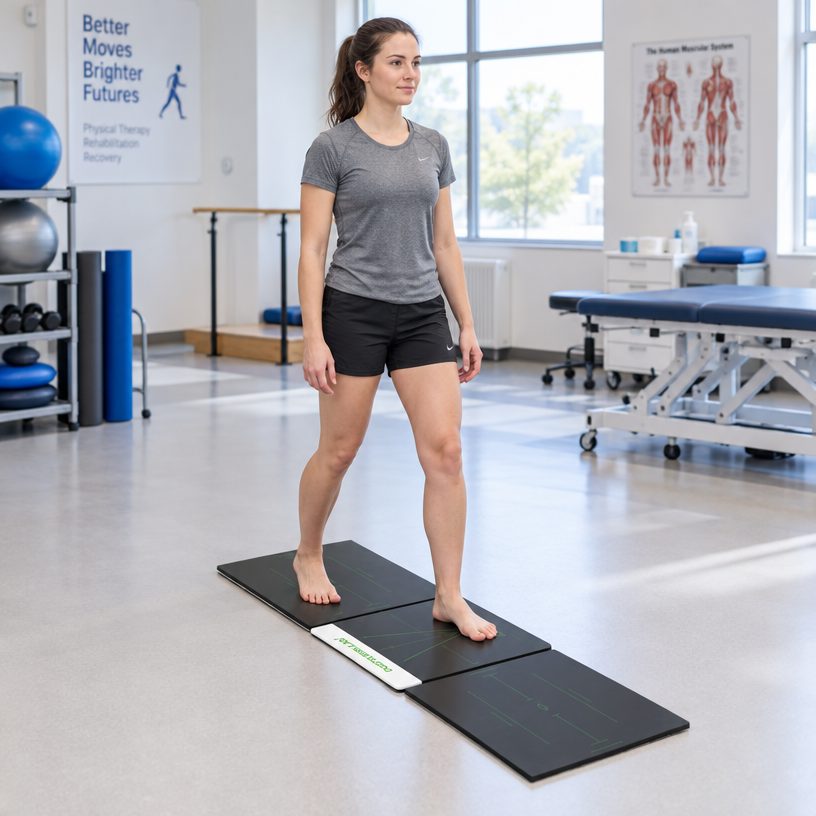
The walking record asks for something different: the order in which regions take load, the share of the contact and flat phases, and the path the centre of pressure travels as the person crosses. Here the layer must reset between footfalls, and the plate geometry starts to matter as much as the material. A step that lands half off the plate produces a truncated contact area, and a truncated area reads as a foot that never loads its lateral border. That is an artefact of placement, not a property of the foot, and it is the most common bad record we see from new owners.
The balance pass is a third demand again. What is recorded is the small correction a person makes to stay upright, followed over time, which is a stability question rather than a load question. The signals are small, the duration is long, and the record is read as a path rather than as a map. A layer that is good at peak load is not automatically good at this, which is why the three passes are commissioned separately rather than assumed.
Above the plate, the F2 pairs the pressure layer with a lower-limb camera and a posture camera, so a session ends with load and alignment in one file rather than two folders. The boundary is worth stating clearly, because buyers frequently expect more. The cameras read the line of the leg and the posture above it. The plate reads load. Neither of them produces a surface model of the sole, and a buyer who needs a geometry file for a milled shell is looking at a different capture category and should be told so early.
Zero check, calibration, and the routine that keeps a plate honest
The zero check is the cheapest procedure in the building and the one most often skipped. Cover seated, nothing on the plate, no chair leg resting against the frame, no cable pulled across a corner. The display should be flat. If a corner shows load with nothing standing on it, one of three things has happened: something is trapped under the cover, the cover is not seated in its frame, or the floor is pushing the frame. The check takes a couple of minutes at the start of a day and it prevents the most embarrassing category of record.
Calibration is a different procedure with a different purpose. A known load is applied at known positions and the reading is checked against it. Every unit runs its test before it leaves the plant, and the question for an owner is when to repeat it: after transport, after the plate is moved to another room, after a season of heavy use, and after anything has been dropped on the surface. Calibration does not make a record clinically meaningful. It only establishes that the surface still reports what it should when it is given something known, and that is a hardware statement, not a clinical one.
Day-to-day care is unglamorous and decides most of a plate’s working life. The cover is cleaned with a damp cloth and mild soap, never a solvent, never an abrasive pad. Sharp objects are the obvious hazard, but the usual culprit is not a heel: it is a chair leg, a dropped tool, a folded trolley, or a customer standing on the cover in a narrow shoe. Moisture is the quiet one. A plate kept in an unheated room through a wet season collects condensation under the cover, and the first symptom is a record that no longer matches yesterday’s.
Storage deserves its own line because it causes the failure nobody expects. A plate left for months with a carton of files, a folded floor mat or a bag of stock resting on the cover takes a set in that corner, and the set does not announce itself. We have seen it in a gym that stored the plate under a rack, reasoning that the bag made it safe. Twelve months later one corner read high on every standing pass, and the cause was a cover that had been holding weight it was never meant to hold while switched off.
What the presentation is not
Software sits above the sensing layer and is where most of the visible difference between two systems actually lives. Report order, page layout, the colour scale applied to the map, the bands printed beside each value, whether both feet appear on one page or two: all of that is presentation. A clinic with a house format can have the report laid out to match it, and that work is quoted separately from the hardware because it is a different kind of work. Change the layout and the record underneath does not move.
Reading comes next, and it is where the reference band earns its keep. A band describes a population, not the person on the plate. A peak under the second metatarsal head on someone who has loaded that way for twenty years is not news; the same peak on someone who has just changed how they walk may be worth a conversation. The band tells an operator where a value sits relative to others. It does not tell them what the value means for this foot, and a report that implies otherwise is doing the reader a disservice.
The conclusion is further up again and belongs to a qualified professional. The plate produces records, the cameras produce alignment views, and the pair of them produce a document that a clinician can reason with. We do not print a diagnosis on the report and we would not want a software update to start doing so. Anyone selling a plate on the promise that it will tell an operator what to conclude is selling the part of the work that carries the most responsibility and the least evidence.
The operator is the last layer and the one buyers budget for least. A trained operator with a modest plate produces records that can be compared across a year. An untrained operator with an expensive plate produces a folder of pictures that cannot be compared with anything, including each other. Most of the disappointment that reaches us in a support call traces back to this, and it is why we ask new owners what their routine will be before we ask what they want to spend.
Keeping two records comparable
Return to the clinic by the water. Three conditions decide whether those two reports can be read against each other, and none of them is the sensing layer. The first is the zero check: was the plate flat on both days, and would anyone have noticed if it was not. The second is footwear. Barefoot, socks and shoes produce three different records, and a comparison that crosses from one to another is measuring the change of condition as much as the change in the foot. The third is the instruction, which is where most clinics lose the thread without noticing.
An instruction is a small piece of protocol and it needs to be written down rather than remembered. The same person should give it, in the same words, at the same point in the session. Walk at your normal pace. Look at the mark on the wall rather than at your feet. Four passes, then we stop. A patient who is watched while walking walks differently from one who is not, and a patient who is told to walk normally on one visit and asked to slow down on the next has produced a change that belongs to the instruction.
Recording the conditions takes one line and saves an argument later. Footwear, socks or barefoot, operator initials, number of passes, and whether the person walked in from the street or had been sitting in a waiting room. Add whether the plate had been used earlier that morning. None of this is technical. All of it is what allows a second record to be read as a comparison rather than as a standalone picture that happens to have the same name on it.
When the conditions did change, say so on the comparison instead of quietly presenting it as clean. A comparison with a stated caveat is still useful, and it is honest about what the difference might contain. A comparison presented as like-for-like when the shoes changed between visits is worse than no comparison, because it invites a conclusion the record cannot support. The sensing layer’s job ends at producing a stable record. Everything after that is craft, and craft is where a clinic’s records either accumulate value or do not.
Frequently asked questions
Does the sensing layer determine how accurate a plate is?
It determines repeatability more directly than accuracy. Accuracy needs a reference load and a calibration procedure; repeatability only needs the same foot twice. For clinic work the second matters more, because almost every useful question is a comparison between two records rather than an absolute value. We publish no resolution race and we would rather demonstrate repeatability.
Can one plate record standing and walking?
On the F2, yes. Static, dynamic and balance are three separate records taken on the same surface in one session, with a lower-limb camera and a posture camera capturing alignment alongside. The walking pass needs a clear run-up and a step that lands fully on the plate, which is a room-layout question more than a hardware one.
How often should a plate be calibrated?
Every unit is tested before dispatch. After that, repeat calibration after transport, after the plate moves to a different room, after a season of heavy use, and after any impact on the surface. The daily task is the zero check, not calibration: cover seated, nothing on the plate, reading flat. The two are often confused and they answer different questions.
What damages a fabric sensing layer fastest?
Point loads and moisture, in that order. A chair leg, a dropped tool or a trolley wheel on the cover concentrates force in a way the cover cannot spread. Condensation under the cover in an unheated room is the slow version of the same problem. Solvents and abrasive cleaners damage the cover surface and eventually the layer beneath it.
Is a fabric layer less stable than a rigid array?
Not in itself, and the question is better asked about a specific construction. Textiles conform to a bending surface, which is what a foot requires; the engineering work sits in limiting creep, hysteresis and slow recovery. A rigid array avoids some of those behaviours and introduces others at the edges of contact. Neither family is automatically better.
Can records from two different operators be compared?
Only with care. If both operators use the same instruction, the same footwear condition and the same number of passes, the records are broadly comparable. If the wording or the protocol differs, part of any difference belongs to the operator. Writing the conditions on the record is the practical fix, and it costs nothing.
Does the plate measure the shape of the foot?
No. It records pressure distribution and, with the cameras, the alignment of the leg and posture above the foot. There is no surface model of the sole at the end of a session. Buyers who need a shape file for a shell are looking at a different capture method, and we say so before quoting rather than after.
What we would do next
Before comparing layers, write down what the record has to survive. If the answer is a comparison between two visits months apart, the priority is repeatability and a written routine, and the plate in the F2 system page is specified for exactly that sequence: standing, walking, balance, with alignment captured in the same session. If the answer is a one-off picture for a customer to hold, the conversation changes and we will say so.
Send us three things and the reply gets specific: the room, the routine you intend to run, and the footwear your patients or customers arrive in. We will tell you where the routine is likely to break before you buy anything, and if the honest answer is that a plate is not the constraint, we will say that too. The core technology page sets out how the sensing and camera layers are put together, and the contact page reaches the team directly.
For owners who already have a plate and a drawer of records that do not compare, the useful next step is a protocol rather than a purchase. The article on dynamic plantar pressure mapping on the F2 walks through the same session in more detail, and dynamic balance measurement covers the third pass, which is the one most often recorded without a fixed routine.
This article is intended for professional and educational reference. It is not medical advice. Foot assessment equipment produces measurements and images; clinical interpretation and any decision about care remain the responsibility of a qualified professional. Certification scope is limited to the documentation we hold: European Union certification and ISO quality system certification.