
The customer arrives at four, and by twenty past she has been measured, matched, ordered for and briefed — assessment and customisation completed in a single sitting instead of two appointments a fortnight apart. Most businesses that sell custom insoles have trained their customers to accept the gap: come in for the assessment, wait while the record is read and the build is arranged, come back to collect. A room where the foot scanner and the customisation bench share a floor collapses that gap, and the difference is not merely convenience. When the record is fresh, the recommendation is made in front of the customer, the order is written against it on the spot, and the report that travels home with her is the same document the order was written from. This article follows one visit minute by minute. It covers what the X3 records before anything is ordered, why the shoe library has to exist before the AI shoe recommendation can say anything useful, how the record becomes an order without anyone improvising, what the customer leaves holding — a report by code, email or paper — and the limits we keep in a room that does both halves of the business in one sitting.
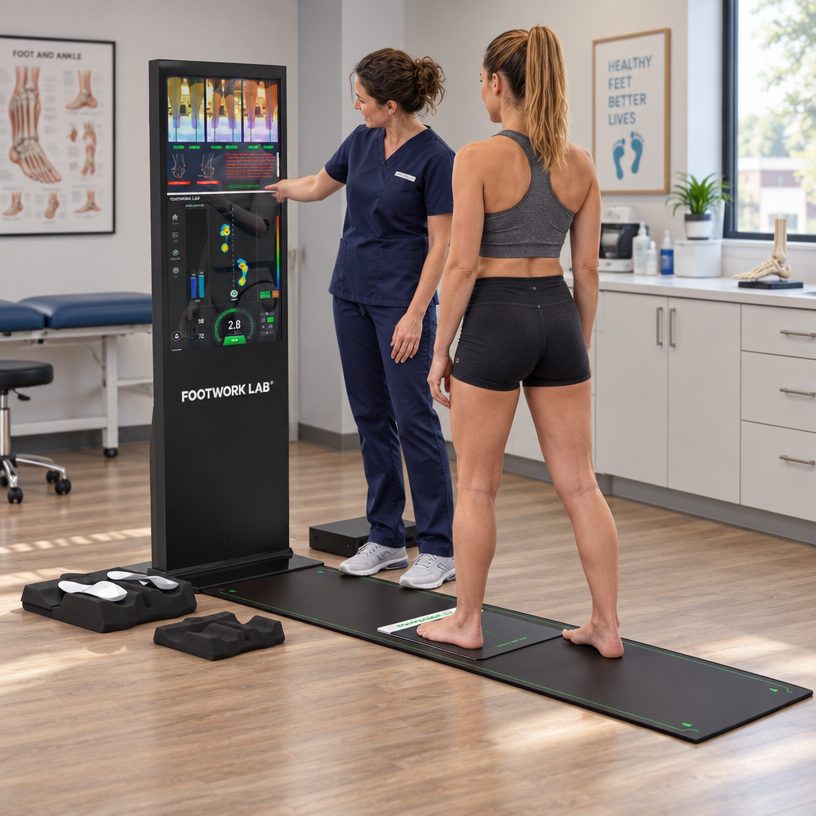
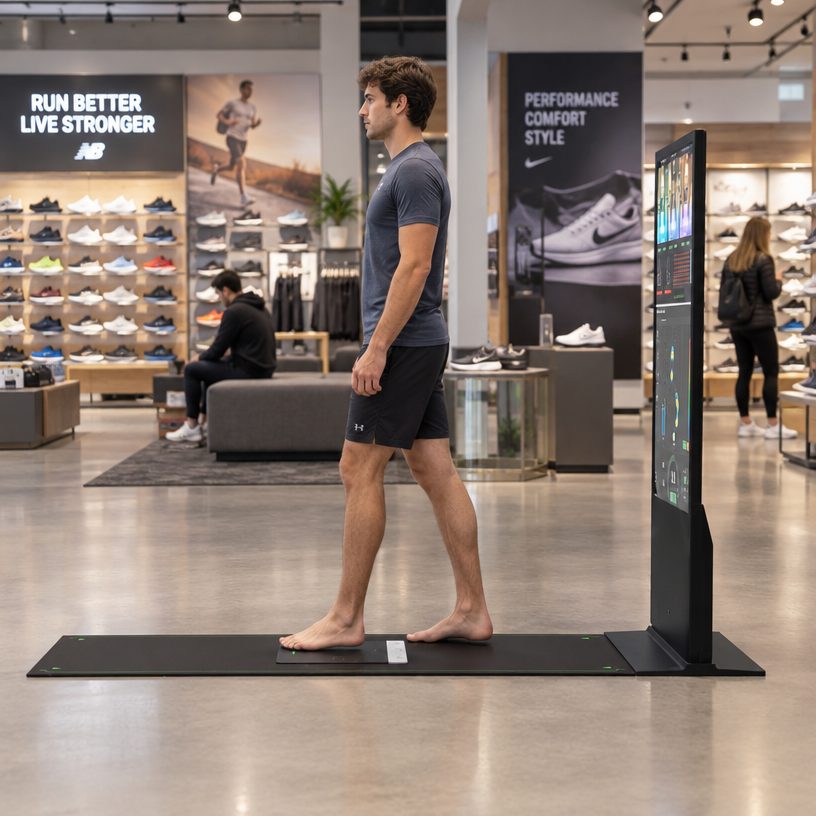
The X3 is a foot pressure and force-line system built for exactly this combined workflow: arch detection, lower-limb alignment, static pressure, dynamic gait and a to-and-fro gait video, feeding into insole customisation, with the report delivered by scan code, email or an on-site printout. It was designed for children’s fitness centres, podiatry clinics, shoe stores and foot therapy centres — rooms where one operator runs the whole sequence.
Why the two halves usually live in different rooms
Splitting assessment from customisation is not stupidity; it is history. The equipment that measures feet and the bench that builds for them evolved in different trades, and most businesses inherited the split along with the trades. The assessor produces a file; the file travels; somebody else turns it into an object; the object travels back. Each handoff is a chance for the record to be misread, and each waiting week is a chance for the customer’s motivation to cool. Businesses run this way for decades anyway, because the alternative required the same person to own both halves.
Owning both halves is precisely what the combined room asks, and it changes the quality of everything between the measurement and the mould. When the operator who took the record is the one who writes the order, the questions that a middleman would have to guess at get answered by looking up from the screen. When the customer watches the recommendation being made from her own data, the recommendation arrives with its evidence attached, and the sale — for want of a better word — is a reading rather than a pitch.
The one-visit structure also disciplines the session itself. A business that promises assessment and order in one sitting has to decide, in advance, how many minutes each stage gets and what each stage must produce, because there is no second appointment to recover a fumbled stage with. In our experience the rooms that run this well are the ones with the timetable written on the wall, not the ones with the fastest equipment.
There is a failure mode worth naming at the start, because it is the commonest one: the combined room that becomes a sales funnel. If the assessment exists only to justify the order, the customer senses it, and the record loses the credibility that makes the whole structure work. The room works because the assessment is honest first and the order follows. Reverse the order and the structure collapses into what the customer suspected it was all along.
The capture stage: what the record holds before anything is ordered
Everything in the visit leans on the first stage, and the first stage is deliberately unglamorous. Shoes and socks off, a static pass on the plate with weight settled and eyes ahead, then the dynamic passes — a few recorded crossings, same starting foot each time, plus the to-and-fro gait video that lets the operator replay the walk rather than rely on a glance. The cameras record how the lower limb aligns above the foot while the plate records what happens beneath it. None of this takes long; all of it has to be taken properly.
What the record holds is a set of quantities: the arch presentation at rest and under load, the distribution of pressure across each sole, footprint length and width, the foot axis angle, the split between contact and flat phases, and the alignment images sitting alongside. These are the raw material for every later stage. A record taken carelessly does not announce itself as careless — the report still prints, the numbers still appear — which is why the routine, not the hardware, is the thing we press hardest on during installation.
The dynamic stage deserves particular patience. A first crossing of the plate is a performance; a third or fourth is a walk. Operators running one-visit sessions are tempted to record the first crossing because the clock is running, and the temptation is worth resisting: the recommendation and the order both draw on the dynamic record, and a walk that was hurried on the plate will be hurried again inside the shoe.
One boundary belongs to this stage and to every stage after it: the equipment records, it does not read. Every report carries a line stating the data is for reference, and the interpretation — what these quantities mean for this person, on this day — belongs to the professional running the session. The combined room concentrates that responsibility rather than diluting it, which is why the operator’s training matters more here than in any single-purpose room.
The shoe library, and why the recommendation waits for it
The X3’s AI shoe recommendation has a precondition that surprises buyers reading the specification for the first time: it needs a shoe library entered first. The system does not recommend shoes in the abstract; it matches a foot against the shoes the business has put into its own library — the lasts, the categories, the characteristics of what is actually on the shelf or in the catalogue. An empty library produces an empty recommendation, and this is by design rather than limitation.
The design reason is honesty. A recommendation made in the abstract is a guess wearing a lab coat; a recommendation made against a library of shoes the business actually stocks is a statement about things the customer can be shown. The library entry step — done once, updated as stock changes — is what pins the recommendation to reality. Businesses that skip or rush the entry step get recommendations that sound authoritative and cannot be honoured at the shelf, which is the fastest way to waste the technology.
Building the library is a modest job if it is planned. The shoes that matter are the ones the business sells or fits: the models it can supply, described in the terms the system asks for. A shoe store enters its range; a clinic enters the footwear it refers patients toward; a children’s fitness centre enters what it recommends to parents. The library is a living document, and the businesses that maintain it treat it like stock — updated when the range changes, archived when a model goes.
Only then does the recommendation step run, and it runs as a matching: this foot record, against these shoes, produces these candidates. The operator reads the candidates with the customer present, and the reading is the conversation — why this one matched, what the record said about width, what the walk suggested about support. The recommendation is a shortlist with reasons attached, not a verdict, and the customer who watches the shortlist being formed trusts it in a way no printed claim can buy.
From record to order: the customisation step
The order is where the record stops being information and starts being a specification, and the one-visit structure makes this step unusually clean because everything it needs is still in the room. The record defines the foot. The library match defines the shoe. The conversation defines the use — the hours, the floor, the customer’s own account of what she wants the build to do. The insole specification is written from those three, not from a template, and it is written while the customer can still answer questions about it.
Writing the specification in front of the customer has a side effect buyers come to value: it produces a document rather than a memory. The build’s position, grade and surface — the vocabulary of the range — are set down against the record, and the same document that defines the order later defines the retest. When the customer returns for her second pair, the comparison is written comparison, not folklore, and the reorder inherits the first order’s decisions instead of restarting them.
The customisation order also carries the boundaries with it. The specification describes an object: a contour in a position, a grade on each dial, a surface for a shoe. It does not promise what the object will do for the person — that judgement belongs to the professional fitting it, and where a customer’s question is a medical one, the session’s job is to say so and refer rather than to bend the specification toward a promise. Rooms that hold this line keep it because it is written into their order form, not because someone remembers to mention it.
For businesses adding this workflow to an existing counter, the practical advice is to run the whole sequence on staff first. Every operator should be measured, matched, ordered for and briefed by a colleague before a paying customer goes through it. The rehearsal surfaces the timetable’s soft spots — the stage that always overruns, the sentence nobody has practised — while the cost of a mistake is an inside joke rather than a first impression.
What the customer leaves holding
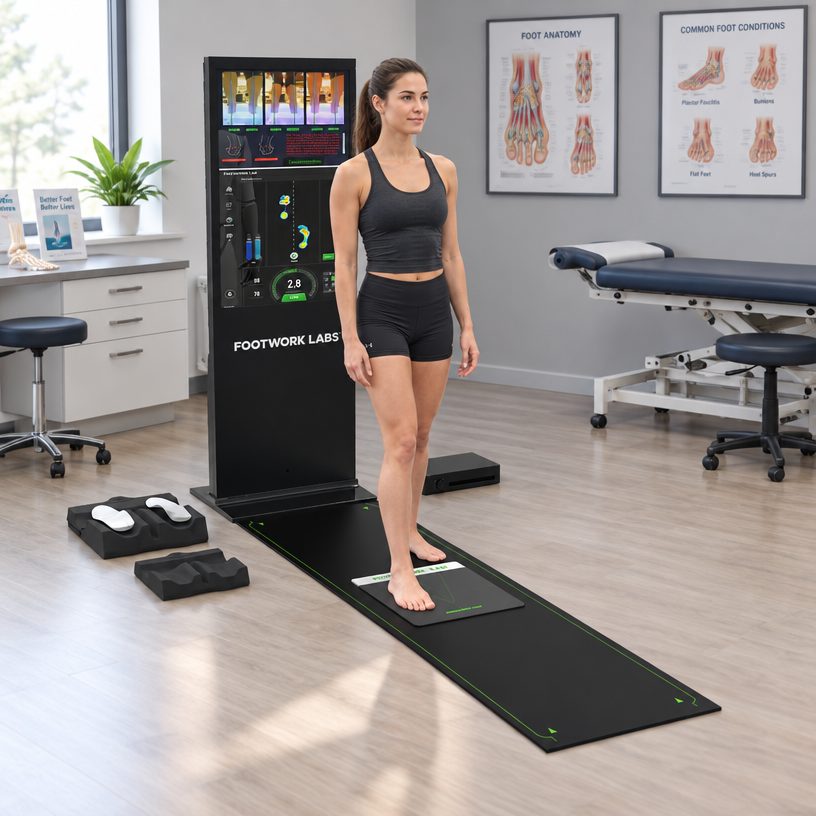
The report is the visit’s takeaway, and the X3 offers it three ways: a code she can scan on her phone, an email that lands before she reaches the car, or a printout she carries. The choice is less trivial than it sounds, because the format shapes what the report does next. A scanned code lives in a camera roll; an email can be forwarded to a clinician; a printout gets shown to a spouse at the kitchen table. Businesses that ask the customer which she prefers usually discover the room’s traffic splits into all three.
Whichever form it takes, the report’s content is the same: the static and dynamic findings, the alignment images, the gait video reference, and the specification of what was ordered. It is simultaneously a receipt, a baseline and a briefing — the document the retest will be compared against, the file a clinician can start from, and the plain-language summary of a visit the customer experienced in under an hour. Reports that try to be more than this — verdicts, predictions, promises — break the boundary the whole structure depends on.
The reading of the report belongs to the session, not to the paper. A good operator walks the customer through the findings in plain language before the format is chosen: what the footprint shows, what the walk did, what the build is meant to do about it and what it is not. The customer should leave able to retell the session in two sentences. Those two sentences are the part that survives, and they are also the part her friends will hear, which is how the one-visit room’s reputation actually spreads.
The follow-up belongs on the same timetable as the report. The insole wears on a schedule, the retest compares against this visit’s file, and the business that books the retest window before the customer leaves closes the loop while the visit is still fresh. Rooms that leave the follow-up to memory lose it; rooms that write it into the visit’s last five minutes keep it, and the second visit runs as smoothly as the first because the file was kept from the start.
The limits we keep in a room that does both
The first limit is the search-term one, and we put it in the first conversation with any buyer: if you arrived here typing phrases about three-dimensional scanning, note that what the X3 records is pressure and force-line data, not surface geometry. We do not build shape-scanning hardware, and a business whose plan depends on a mesh file of the foot needs a different category of equipment. Saying this before the order prevents the disappointment that saying it after the order causes.
The second limit is the professional one, and it is structural rather than rhetorical. The equipment produces measurements and images; the reading of those measurements belongs to a qualified professional; the report says so on its face. In a one-visit room the same person may take the record and write the order, but the two acts keep different characters — the first is capture, the second is judgement — and the operator’s training exists to keep them from blurring. A room where the machine appears to decide has drifted past its design.
The third limit concerns the recommendation itself. The AI shoe matching runs against the library the business maintains, and its output is a shortlist for the operator to read, not an authority to obey. We do not present the recommendation as a diagnosis of the foot or as a substitute for the professional’s judgement, and we do not promise any particular outcome from a build ordered through the workflow. What we can stand behind is the process: record, library, match, specification, report — each stage checkable, each document honest.
What remains when the limits are drawn is the part worth building a room around. One visit, one record, one order, one document that travels home — and a second visit, on a schedule, that starts from the same file. Businesses that run this sequence well do not describe it as technology; they describe it as the day being shorter for everyone, and the record being the same one in everybody’s hands.
Frequently asked questions
Can assessment and customisation really happen in one visit?
Yes, when the room is arranged for it: capture, library match, specification and report are all completed in one sitting, typically inside an hour including the conversation. The precondition is not equipment but discipline — a written timetable for the stages and an operator trained to run them in order. Without the timetable, the one-visit promise quietly becomes two visits after all.
Why does the shoe library have to be entered first?
Because the AI recommendation matches the foot record against the shoes the business has actually entered — the models it stocks or refers to. A recommendation made in the abstract cannot be honoured at the shelf. The library is a modest one-time job per range and a living document thereafter, updated as stock changes.
What does the X3 record in the capture stage?
Arch detection, static pressure, dynamic gait through recorded crossings, a to-and-fro gait video, and lower-limb alignment images from the cameras. The findings arrive as recorded quantities — footprint dimensions, pressure distribution, axis angle, phase splits — laid out in one report the operator reads with the customer.
How is the report delivered to the customer?
Three ways: a scan code on her phone, an email sent from the room, or an on-site printout. The content is the same in each format — findings, images, and the specification of what was ordered. Many rooms ask the customer’s preference, because the format decides where the report travels next.
Is the recommendation a diagnosis?
No. The recommendation is a shortlist of library matches with reasons attached, read by the operator; the reading and the order are the professional’s judgement. Every report carries a line stating the data is for reference. Where a customer’s question is a medical one, the room’s job is to describe the record and refer onward.
Does the system produce a three-dimensional model of the foot?
No — and we say this plainly because the market’s search vocabulary is misleading. The X3 records pressure and force-line data, not surface geometry, and we do not build shape-scanning hardware. A business whose plan depends on a mesh file of the foot needs a different category of equipment, and we would rather a buyer knows that before the order than after.
What should a room prepare before the first customer visit?
The written stage timetable, the shoe library for the current range, and operators rehearsed on the full sequence — ideally on each other before any paying customer goes through. On the supply side, the machine carries a one-unit minimum order, seven days of plant testing before dispatch, and a twelve-month warranty against non-human damage with free parts.
What we would do next
Sketch the one-visit timetable before shopping for equipment: capture minutes, library state, who reads the recommendation, who writes the order, and which report format your traffic will choose. Send the sketch through the contact page and we will mark the stages that usually overrun. The X3 system page lists the record types, the library step and the report formats in the equipment’s own wording.
For the boundary between the record and the judgement, a foot orthotic scanner does not write the prescription is the short version, and an insole scanner sells the assessment covers how the same session supports the retail side. Both pair with this article as a staff briefing.
This article is intended for professional and educational reference. It is not medical advice. Foot assessment equipment produces measurements and images; clinical interpretation and any decision about care remain the responsibility of a qualified professional. Certification scope is limited to the documentation we hold: European Union certification and ISO quality system certification.