
The head of a rehabilitation department holds up her phone at a trade stand and shows the search results: a wheeled frame with a harness, a treadmill with a harness, and a plate on the floor with two cameras beside it, all listed under the same two words. She has been asked to buy a gait trainer for a ward that takes people after orthopaedic surgery and after a stroke, and the phrase has travelled from her director to the procurement office to the search bar without anybody stopping to ask what it means. On the stand, the conversation cannot begin with a quotation, because those three results are three different purchases: one teaches a person to walk with assistance, one lets a person walk under load while somebody watches, and one only records what the walking looks like. Sorting that out takes ten minutes and saves a year of argument. This article is about the sorting. It sets out the families of machine that share the name, gives the single question that separates them, explains what a record-first system actually produces in a session, and is candid about the part we do not build. It is written for the buyer who has been handed the phrase and now has to turn it into a specification.
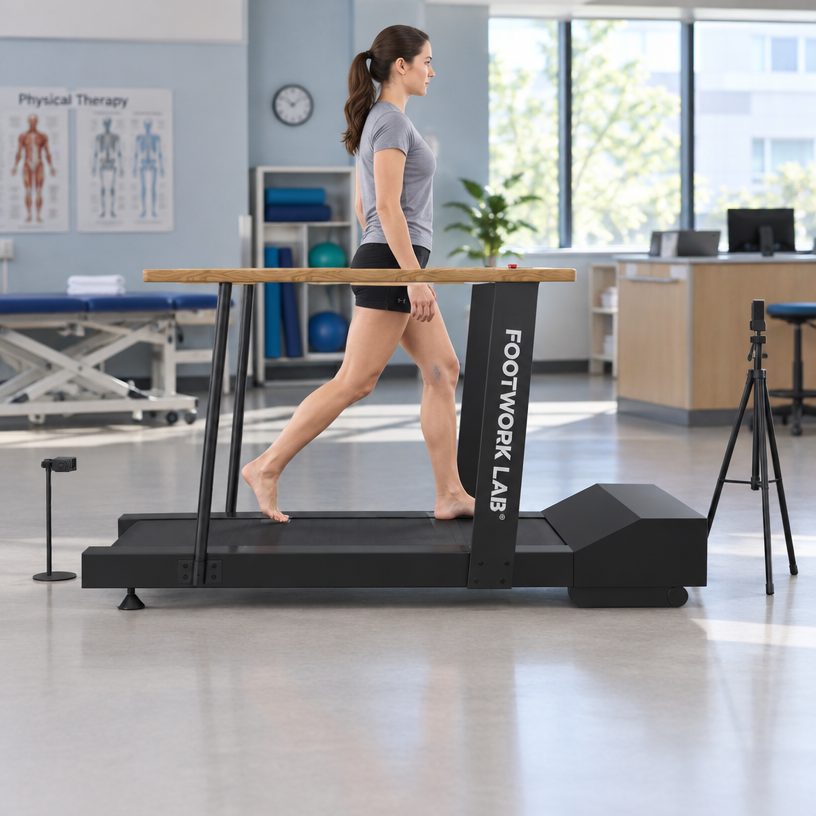
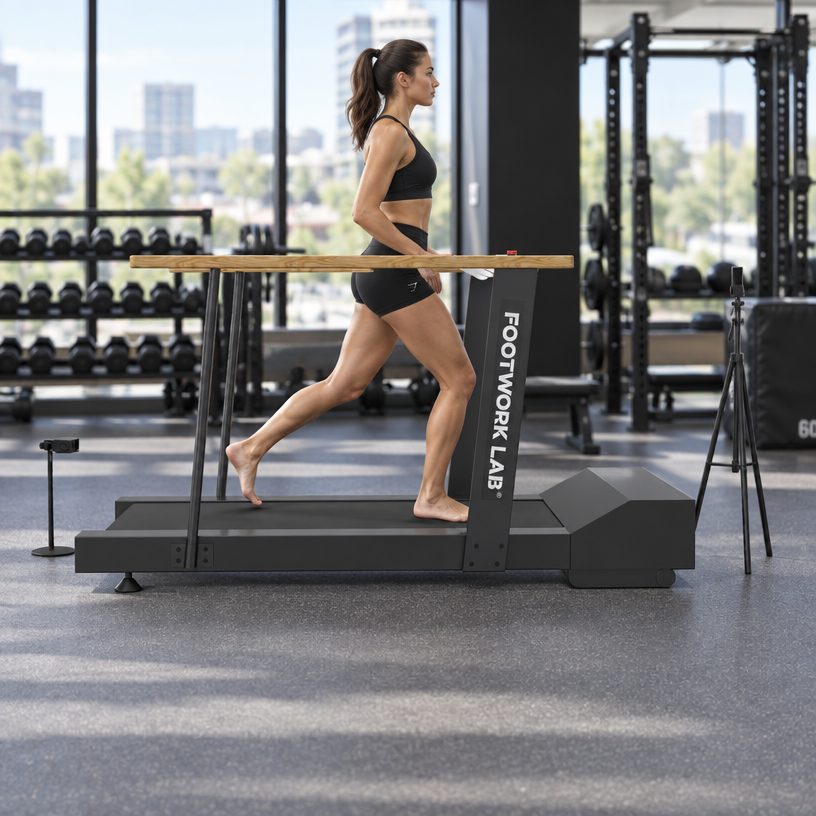
The F5-LAB is a dynamic gait system: a treadmill-form host, two cameras on stands, a hub, and software that assembles the session into one report. It records the gait cycle, movement posture, dynamic pressure beneath both feet and the paired butterfly lines that show how load travels through each step, in a walking mode and a running mode. It is a capture system in the sense used throughout this article, which is to say it does not assist anybody’s walking.
Three machine families answer to one name
The first family is the training frame. Parallel bars, a harness overhead, castors, sometimes a lift. Its job is to let a person practise steps before they can carry their own weight, and it is bought by wards, neurological rehabilitation units and paediatric services. The buyer’s questions are about handling rather than measurement: how many therapists are needed to run it safely, how many patients pass through in a morning, whether the ceiling can take a hoist, and whether the corridor outside is wide enough to move it.
The second family is the loaded treadmill. A walking belt inside a harness, sometimes with body-weight support, sometimes with handrails and a mirror. The person walks on a moving surface and the room stays still. Its job is sustained practice at a controlled pace, and the buyer’s questions concern speed range, fall protection, the height of the harness attachment and how much supervision a session needs. Nothing in that list is a measurement.
The third family is the capture system, and it is the one that causes the confusion, because it looks like the second family and behaves like neither. It does not move the person along a corridor and it does not hold them up. A plate, or an instrumented belt, records the load beneath the foot while cameras record what the body does above it, and the output is a document. You buy it to see walking, not to change it.
The confusion is structural rather than stupid. The phrase describes an intention — training gait — and not a mechanism, so every listing that serves the intention can borrow it. Add the adjacent names that circulate in the same results page, gait analysis system, gait laboratory, walking plate, instrumented walkway, and a buyer with a purchase order in her hand has no way of knowing which shelf she is standing in front of.
The one question that sorts the search
Ask it plainly: do you need to change how this person walks, or to see how this person walks? The first answer points at the training families, the frame and the loaded treadmill, where the machine is doing something to the session. The second answer points at the capture system, where the machine is doing something after the session, in the report. Almost every bad purchase in this category begins with a buyer who wanted one and ordered the other.
Both answers are legitimate, and a department with a real budget often needs both, but they are separate lines in the plan, separate rooms and separate staff. A capture system placed in a ward that needed walking practice becomes a machine that occupies a corner and records four people a week. A training frame bought by a clinic that needed documentation produces no document at all, and the audit that prompted the purchase is no better off than before.
A second question follows closely: who is in the room? A training frame needs handlers, people who can support a patient safely and are strong enough to do it repeatedly. A capture system needs an operator who can run the software without hesitating and a reader who can interpret what comes out. Those are different people with different training, and a department that has not named them yet is not ready to order either machine.
The third question is about the month’s end. What does the purchase have to produce — a patient who walks further, or a document that can be filed, compared and shown to a funder? Being blunt about that in the procurement meeting settles more than any brochure. If the answer is both, say both, and budget for both, because no single machine in this category delivers them.
What a record-first system actually produces
A session runs shorter than most buyers expect. Shoes and socks off, a briefing, a walk on the belt at a speed the person chooses, then a second pass, cameras running from the side and the front. The walking itself is often three or four minutes. The rest of the appointment is setup, explanation and the export, and that proportion surprises departments that budgeted for the walk alone.
The report holds quantities. The gait cycle and its phases, the share of the cycle spent in stance and in swing, the double-support period, step and stride length, cadence, peak and mean pressure under each foot, contact area, the path and speed of the centre of pressure, the paired butterfly lines, and the posture angles the cameras pick up through the trunk, pelvis and knee. Each of those is a recorded number or an image, not a conclusion.
That distinction is the whole discipline of the category, so it is worth stating in the plainest terms we can: the system records, a qualified professional reads. Every report we ship carries a line saying the data is for reference, and the interpretation of a gait pattern belongs to a clinician who has examined the person. A salesperson who reads a report aloud at a stand is doing something the equipment was never intended to license.
What the record is genuinely good for is comparison, and comparison is where the commercial case lives. A baseline before a course of work, a second record at discharge, a third a season later: three documents that show direction rather than assert it. It is also good for teaching, for a second opinion requested from a colleague, and for the paperwork that a funder or an insurer asks for when a course of care has to be justified after the fact.
Walking and running are two different records
Walking and running are not the same measurement at a higher speed. Walking keeps a double-support phase, when both feet are briefly on the ground; running removes it and adds a flight phase, when neither foot is. Contact time falls, peak load rises, cadence climbs, and the way load travels along the sole changes shape. A platform that offers both modes is offering two protocols, not one protocol with a dial.
That matters when a room tries to buy one machine for two audiences. A rehabilitation ward wants the walking record, because the people it sees are rebuilding a walk. A sports service wants the running record, because the people it sees are returning to a sport and the loads that matter arrive at speed. Both are defensible; a single purchase serving both needs a named person who will actually run the running sessions, not a hope that somebody will.
There is an honest limitation on the belt that belongs in this section. A person who is afraid of a moving surface, or who uses a walking aid, or whose balance is uncertain, may produce a record that describes their relationship with the belt rather than their ordinary walk. The operator has to notice that and say so in the notes. A record taken under duress is still a record, but it is a record of a bad afternoon, and comparing it with a confident session three months later will mislead everyone.
Which is why the conditions are written down before the first session and repeated at every retest: the same footwear or the same bare feet, the same speed instruction, the same starting foot, the same aid if an aid is used, the same time of day where the department can manage it. Change two of those and the difference in the report may be the difference in the routine, and no reader can tell which is which.
What the room is committing to
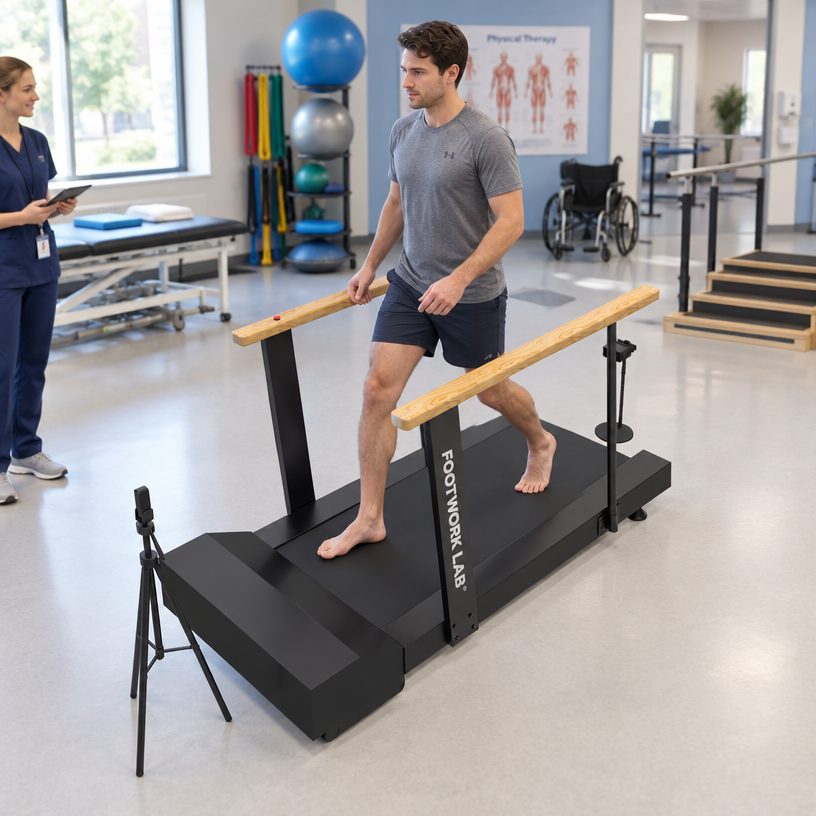
Floor space comes first and is usually underestimated. A treadmill-form host needs its own footprint, the camera stands need clearance in front of and beside it, the screen needs to be visible from where the operator stands, and the door has to admit whatever is being delivered. We have seen units installed in rooms that were measured for the machine and not for the person walking beside it, which turns a capture session into an obstacle course.
Time is the second commitment. The appointment is not the walk. Add the booking, the shoes, the briefing, the walk, the second pass, the export and the conversation about what the document means, and a realistic slot is closer to half an hour than to five minutes. Departments that plan on the walking time alone book four sessions into an hour and finish the day with three unfinished reports.
Staff is the third, and it is the one that decides whether the machine earns its place. One operator who can run the whole routine without reaching for a manual, one reader who can interpret the output, and a written routine that a new colleague can follow in a week. Training a person takes longer than installing a machine, and a capture system standing in a room where nobody has been trained is a very expensive table.
Throughput deserves a straight answer too. A capture system serves fewer people per hour than a training frame, by a wide margin, and it should never be bought against a target expressed in minutes of walking practice per patient per day. It is bought against a target expressed in documents, comparisons and decisions. Departments that confuse the two targets end up defending a purchase they cannot justify with the numbers they promised.
Where we stop, and what we will not claim
We do not build the training families. No harness frames, no body-weight support, no motors that carry a step, no treadmill that lifts a person against gravity. If the purchase in front of you is walking practice with assistance, we are the wrong stand and we will say so at the exhibition rather than after the deposit. This is not modesty; it is the boundary of what our plant makes.
We also do not read your reports for you, and we do not promise that owning a record improves anybody’s walk. A record is a description. What a department does with the description is clinical work done by people with qualifications we do not hold. Any supplier who tells you the machine will improve outcomes has moved from selling equipment to selling a result, and the result is not theirs to sell.
There are commercial limits we state as plainly. We do not put prices in an article, because a quotation depends on the configuration, what is included in the shipment and where it is going. We do not promise exclusivity for a region, and we do not name competitors in a comparison. Buyers who need those three things in writing before they will talk are buyers we will disappoint early, which is the cheapest moment for it.
What we do put in writing is the ordinary machinery of the order. One unit is the minimum, so a single department can buy without a group purchase. Every unit runs a seven-day test at the plant before it is dispatched. The warranty covers twelve months against non-human damage with free parts, support runs through a dedicated messaging group with engineers answering directly, and a unit that is online can take software updates remotely.
Frequently asked questions
Is a gait trainer the same thing as a gait analysis system?
No, although the search results blur them. A gait trainer in the common clinical sense is a frame or a supported treadmill used to practise walking. A gait analysis system records the walk and produces a report. The first changes the session, the second describes it, and they are separate purchases with separate budgets.
Can the F5-LAB be used for training as well as recording?
It records while a person walks or runs on the belt, and the belt can be set to a pace the person is comfortable with, but it is not a body-weight support and it does not assist a step. Departments that need assistance buy a harness frame or a supported treadmill, and often run both machines in the same room.
What is the difference between the walking mode and the running mode?
Two protocols. Walking retains a double-support phase and lower peak loads; running removes double support, adds a flight phase, shortens contact time and raises load. The belt speed is part of the protocol, not a preference, and a record taken at a jog is not comparable with one taken at a walk.
How long does a capture session take, and who runs it?
Plan on half an hour for the appointment, of which the walking is a few minutes. One trained operator can run the routine, and a second person should be able to read the report. The operator needs a written routine rather than a manual, because the repeatability of the session is what makes later comparisons possible.
Do we need both a training frame and a capture system?
Many departments do, and the order matters less than the staffing. A ward that cannot spare a handler should not buy the frame; a department that cannot name a reader should not buy the capture system. Buying both and staffing neither is the most common mistake we see in this category.
Does the report diagnose anything?
No. The report contains measurements and images: phase timings, lengths, pressures, contact areas, centre-of-pressure paths, posture angles. Reading a pattern and deciding what it means is the work of a qualified professional who has seen the person. Every report we ship carries a reference line to that effect.
What are the order, testing and delivery terms?
The minimum order is one unit, each unit is tested at the plant for seven days before dispatch, and the warranty runs twelve months against non-human damage with free parts. Express shipping takes six to seven working days, air freight ten to twelve days, and sea freight thirty to thirty-five days.
What we would do next
Write the sentence your director gave you on one side of a page, then write underneath it which of the three families it points at, who will operate the machine and what the month’s end has to produce. If those four lines hold together, the specification writes itself. If they do not, the phrase is doing the work that a brief should be doing, and no quotation will fix it.
Send that page through the contact page and we will tell you which family it describes, including when the answer is not ours. The F5-LAB page lists the record items and the two modes in the equipment’s own wording, and what a gait analysis system is made of takes the hardware apart for buyers who want the components before the conversation.
Two shorter pieces are worth a look before the next meeting. A gait treadmill changes the capture explains why the belt is a condition rather than a detail, and gait training protocols on the F5-LAB shows how a department sequences sessions once the machine is installed.
This article is intended for professional and educational reference. It is not medical advice. Foot assessment equipment produces measurements and images; clinical interpretation and any decision about care remain the responsibility of a qualified professional. Certification scope is limited to the documentation we hold: European Union certification and ISO quality system certification.