
A coach at a sports training centre in Bogotá types pisada analysis into a marketplace search bar at midnight and by morning has three shortlisted listings that promise three different things. One shows a foot print on glass, one shows a runner on a treadmill wired to cameras, one shows a mat with coloured pressure zones — and every one of them claims to do pisada analysis, because the Spanish word pisada simply means the footfall: the print a foot leaves, the way a foot lands, the whole event of stepping. The word carries both readings, and the two readings are different purchases. A static print answers what the foot looks like at rest under load. A dynamic gait record answers what the foot does while the body moves through a step — and increasingly, while it runs. This article separates the two readings properly: what a static print holds and what it cannot tell you, what a dynamic capture adds and why it costs more attention to run, where a pressure plate and a walk-and-run platform genuinely differ as machines, what a dual walk-and-run mode changes for the rooms that buy one, and the limits we state plainly from the factory side before any order is signed.
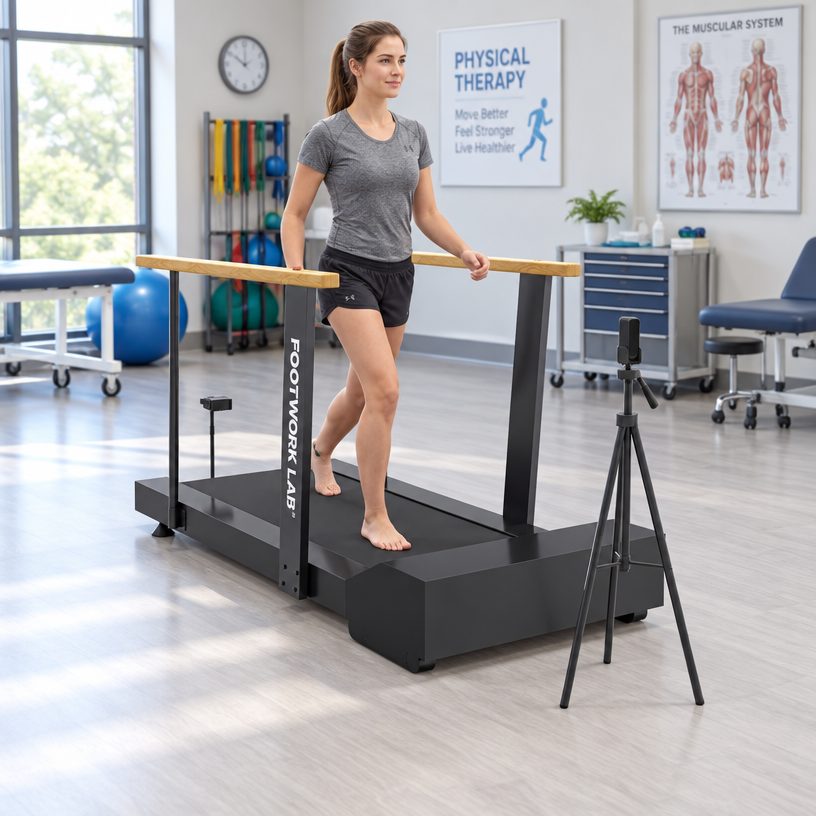
Context first, because the machine behind this article has a specific shape. The F5-LAB is a dynamic gait detection system built around a treadmill-form main unit, two cameras on stands doing posture and gait capture through machine vision, and a hub that ties the sensors together. Fabric sensing under the belt records pressure while the machine vision watches the body above it, and the software assembles gait cycle, movement posture, dynamic pressure and a dual-foot butterfly trace into one report. It was built for rooms where people walk and run — rehab hospitals, sports fields and training facilities, podiatry clinics, gyms.
What a static print holds, and where it stops
The static record is the cheapest capture in the trade and the easiest to explain to a customer. The person steps onto a plate or a sensing area, stands still, and the system records the footprint: its length and width, the contact area, how pressure distributes across the sole, and how the arch presents when the body is still. It takes under a minute, it needs no instructions the customer can misunderstand, and it produces the numbers most conversations start from — including the small discovery, repeated daily in shoe shops everywhere, that the size a customer believes she wears and the size the plate records are not always the same number.
What the static record cannot hold is time. Standing is one frame; walking is a film. The moment a foot leaves the ground, loads through midstance and pushes off, a dozen behaviours appear that a still frame cannot contain: where load travels, how the foot axis points, how long the foot spends in each part of the step. Two customers can hand you nearly identical static prints and behave completely differently ten seconds later, which is the single most useful demonstration a fitter can run on a busy floor.
This is why static-first listings dominate the low end of the search results. A print is easy to capture and easy to show, and there is nothing wrong with it as far as it goes. The trouble begins when a buyer with a dynamic question — why does this runner’s shoe wear on that edge, why does this athlete favour one side — buys a static tool and discovers the gap at the first fitting. The print was honest; it simply was never asked the question the buyer needed answered.
The professional rule we keep repeating to buyers is to match the tool to the question, not to the budget reflex. If the room’s work is sizing, quick screening and shelf fitting, a static record may be all the appointment needs. If the room’s work is training load, rehabilitation progress or running, the dynamic reading of pisada is the one the record has to serve — and the next sections are about what that reading requires.
What a dynamic capture adds once the foot is moving
A dynamic gait record is a time series. Each pass over the sensing area captures the whole sequence of the step: how contact begins, how load travels forward under the foot, where pressure peaks and how it averages out, how fast the centre of pressure moves, how the foot axis points through the phase, and how the two sides compare with each other. The report turns those into figures and curves a professional can read — phase percentages, pressure traces, the foot axis angle — all of them recorded quantities, none of them verdicts.
Two features of a dynamic record deserve a buyer’s attention because they never appear on a static print. The first is symmetry: the comparison between left and right as the body moves, which is where compensations show themselves long before a customer notices anything. The second is repeatability under motion: whether the foot behaves the same on the third crossing as on the first, which is the difference between a snapshot and a characteristic. A room that captures one hurried pass has a picture; a room that captures several clean crossings has a record.
The cameras extend the record past the sole. Machine vision watching the lower limb and the posture above it captures how the leg aligns over the foot while the sensing layer beneath is doing its work — the knee’s tracking, the direction the shin carries, how the column above sits over the base. Pressure alone says where the load sits; alignment says how the body is organising itself to put it there. A report that carries both lets the professional read cause and location in the same document instead of stitching two sessions together.
The honest cost side belongs here too. Dynamic capture asks more of the room: space to walk or run through the sensing area, instructions the customer follows, a routine kept identical between visits. A buyer who cannot commit the floor space or the session time to a consistent routine will not get the value a dynamic system is priced to deliver — and we would rather say that before the order than after it.
Pressure plate and walk-and-run platform: two different machines
Behind the same search phrase sit two machine families that share a customer and almost nothing else. A pressure plate is a fixed sensing area set into the floor: the customer steps onto it or crosses it, and it records what happens over its surface. It is compact, quick and excellent at the static record and short dynamic passes. A walk-and-run platform is built around continuous movement — in our case a treadmill-form main unit with sensing under the belt — so the record does not end when the customer runs out of walkway. The machine asks the question differently: not what happened over this patch, but what happens across a sustained gait.
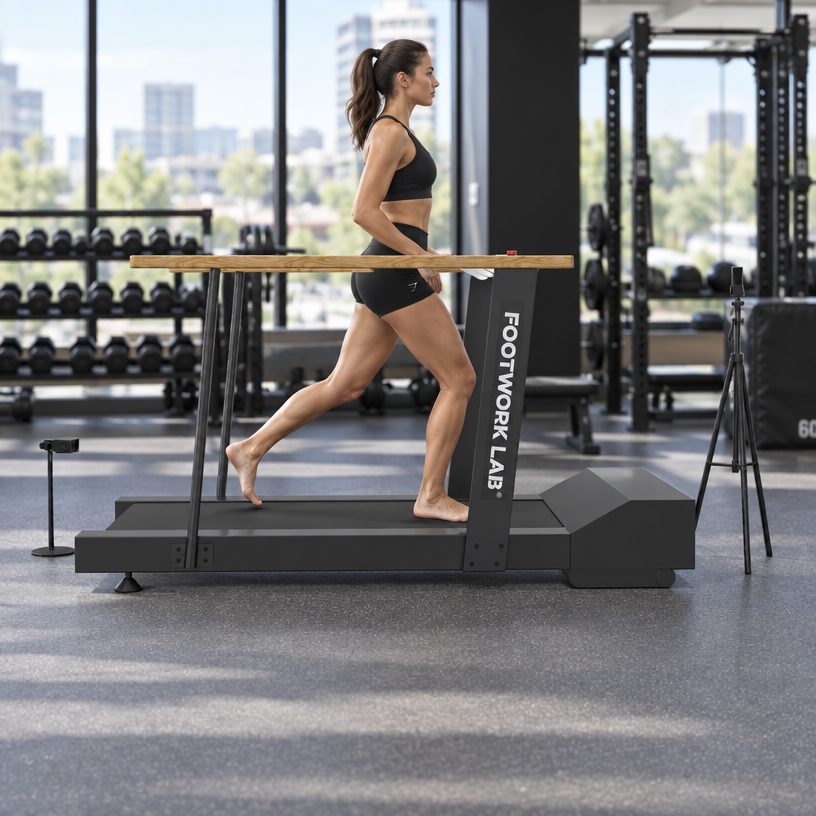
The practical difference shows up first in the running question. On a fixed plate, a runner gets a strike or two of capture per pass, and gathering a reliable picture of running means repeated passes, each timed to land on the sensing area. On a platform built for it, running is simply a mode: set the pace, let the person run, record the cycles. For a room whose caseload includes runners — a podiatry clinic with a sport-heavy list, a training facility, a gym with a running community — that difference decides the purchase more than any spec sheet.
The second difference is what the cameras can do when the body is in continuous, repeatable motion. Machine vision aligned with a treadmill’s steady pace captures the gait cycle in a way stop-and-go passes struggle to match: the same frame of the cycle appearing again and again, the butterfly trace of the two feet building across minutes rather than being assembled from fragments. Gait cycle, movement posture, dynamic pressure and the dual-foot trace arrive in one session instead of being reconciled afterwards.
Neither family is the better machine in the abstract. A shoe shop counter wants the plate’s footprint and speed; a clinic that runs ten-minute running assessments wants the platform’s continuity. What a buyer should refuse is the listing that blurs the two — a plate sold with running photography or a platform described as if it were a counter device. Ask where the customer’s body is when the record is being taken, and the machine family answers for itself.
What a dual walk-and-run mode changes in the room
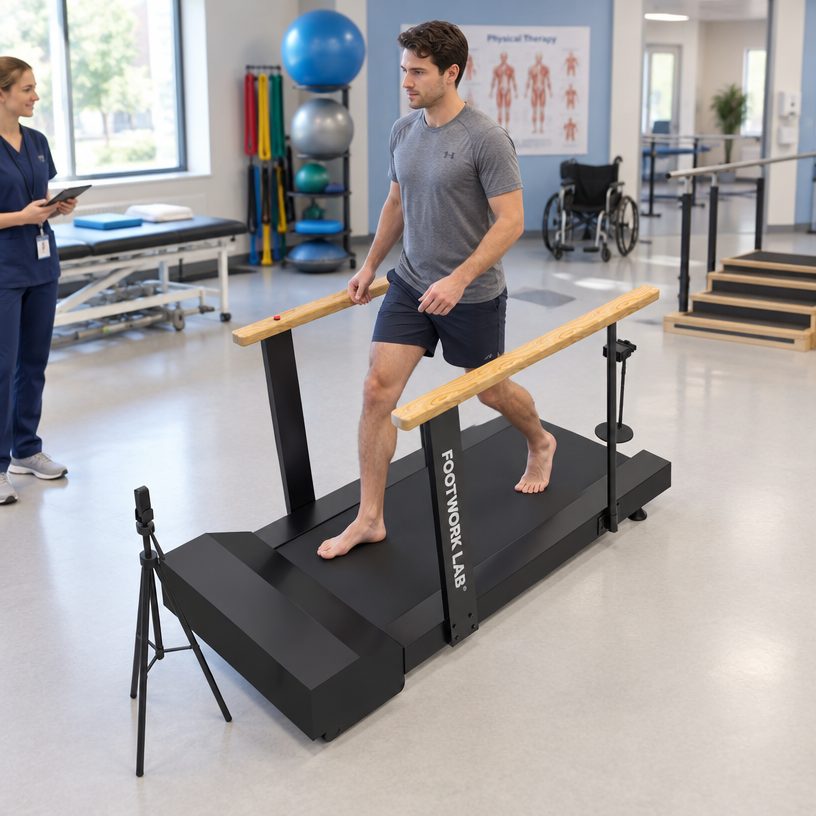
A single machine that walks and runs changes the appointment book before it changes anything else. One room can now serve the customer who needs a walking assessment at ten and the marathon trainee at eleven, on the same floor, with the same routine and the same report format. For a rehab hospital the walking mode carries most of the caseload; for a training facility the running mode earns the machine’s keep; for a clinic or gym with both populations, the dual mode is the reason the purchase makes sense at all rather than becoming two purchases.
The mode change also changes what the record is used for over time. Baseline and retest stop being a formality: a runner returning after a training block, or a patient returning after a programme, gets captured with the same mode, the same pace settings and the same instructions, and the comparison lands on one page. Progress in a rehab programme, or the effect of a shoe change on a runner, becomes a documented difference rather than a professional’s impression — recorded values, read by the qualified professional, with the interpretation staying in the room that owns the licence to make it.
There is a commercial reading too, and it is worth saying plainly because buyers arrive with it half-formed. A walk-and-run platform is a session product, not a shelf product. The rooms that get value from it sell appointments against it — assessments, retests, programme checkpoints — and the machine’s report becomes the receipt that brings the customer back. Rooms that buy it hoping it will sell itself from the corner of the floor are usually disappointed, and no catalogue copy fixes that.
What the mode does not change is the boundary this article keeps returning to. The gait cycle numbers, the butterfly trace, the posture angles — all of it is a record, and reading it is the professional’s work. The machine’s job is to make the record consistent enough that the professional’s comparison means something. Everything we ship is aimed at that consistency: same routine, same report shape, same items in the same order, visit after visit.
Reading a pisada listing before you order it
The listing test has four questions, and they take ten minutes. First: static, dynamic, or both — and if dynamic, walking only or running too? Second: what does the report actually carry, named item by item — footprint, pressure distribution, phase percentages, centre-of-pressure travel, alignment images? A vendor who cannot list the report in its own words is selling the search phrase. Third: where is the customer’s body during capture — standing on a patch, crossing it, or moving continuously — because that single fact tells you which machine family the listing belongs to regardless of the headline.
Fourth, and buyers skip this one most often: how does the record survive between visits? Export formats, where the report goes — scanned code, email, printed on the spot — and whether the session routine is written down somewhere the staff can follow. A dynamic record’s value is mostly realised at the retest, and the retest only works if the first session left behind a routine that a different operator can run six months later. Ask the vendor to show you the routine, not the brochure.
Then run the same four questions against us, because the comparison only works if the questions are identical. Our answers, in order: the F5-LAB is a dynamic system with walk and run modes on a treadmill-form platform with fabric sensing under the belt and machine vision above it; the report carries gait cycle, movement posture, dynamic pressure and the dual-foot butterfly trace; the customer’s body is in continuous motion during capture; and the session routine is part of what we hand over with the machine, alongside the seven-day plant test every unit goes through before dispatch and a twelve-month warranty against non-human damage.
What we will not do in that conversation is claim the record says more than it does. We do not diagnose from a report, we do not promise outcomes from a baseline, and we do not publish prices in an article — a quotation follows a configuration, a destination and a service package, and a number printed in copy would be wrong for nearly every reader. Structure we will state: minimum order of one unit, ODM accepted on machines, after-sales through a dedicated WhatsApp group with engineers reachable directly and remote assistance available when a room needs it.
Frequently asked questions
What does pisada analysis actually cover?
The Spanish word pisada means the footfall, so the phrase covers two different records: the static print — footprint, contact area, pressure distribution and arch presentation at rest — and the dynamic gait record, which captures how load travels through the step over time. Matching the tool to the question is the first purchase decision, before any brand comparison.
Is a static print enough for a shoe shop?
Often, yes. If the room’s work is sizing, quick screening and shelf fitting, a static record may be all the appointment needs. It cannot answer questions about movement — why a shoe wears unevenly, how an athlete loads through a run — because it holds one frame and no time.
What does a dynamic gait record add?
Time and motion: how contact begins, how load travels forward, where pressure peaks, foot axis angle, phase percentages, centre-of-pressure speed, and left-right symmetry while moving. Feet that look identical standing often behave differently in motion, which is why several clean crossings matter more than one hurried pass.
What is different about a treadmill-form platform?
Continuity. A fixed plate captures what happens over its patch; a platform records sustained movement, so running becomes a mode rather than a repeated dash across a sensing area. Gait cycle, posture and pressure arrive in one session, and the dual-foot butterfly trace builds across minutes instead of being assembled from fragments.
Who reads the gait report?
A qualified professional. Every item — gait cycle numbers, pressure traces, alignment images, posture angles — is a recorded quantity, not a verdict. The equipment makes the record consistent; interpretation and any decision about care belong to the professional in the room.
Can retests be compared reliably?
Yes, if both sessions ran the same routine: same mode, same pace settings, same instructions, same report format. The routine is part of what we hand over with the machine, and rooms that keep it get comparisons that mean something; rooms that improvise usually discover the problem at the retest.
What are the order and after-sales terms?
Machines carry a minimum order of one unit and accept ODM. Every unit is tested at the plant for seven days before dispatch and covered by a twelve-month warranty against non-human damage with free parts. After-sales runs through a dedicated WhatsApp group with engineers reachable directly and remote assistance available.
What we would do next
Write the four listing questions on one page and send it to every vendor on your shortlist, including us — the comparison only works if the questions are identical. Send it through the contact page and we will return answers in our own wording. The F5-LAB platform page lists the walk and run modes, the capture hardware and the report items in the equipment’s own terms.
Three articles go deeper on the dynamic reading. What a gait analysis system is made of unpacks the hardware stack, running gait analysis platform takes the run mode apart, and a gait treadmill changes the capture explains what continuous motion does to the record. Pair them with pressure plate gait records for the fixed-plate side of the comparison, and a flat foot gait reads differently for why static and dynamic records of the same foot can disagree.
This article is intended for professional and educational reference. It is not medical advice. Foot assessment equipment produces measurements and images; clinical interpretation and any decision about care remain the responsibility of a qualified professional. Certification scope is limited to the documentation we hold: European Union certification and ISO quality system certification.