
The search box shows a phrase that stops halfway: foot scanner for. The cursor blinks after the preposition while the buyer decides, or gets interrupted, or simply trusts the autocomplete to finish the thought for him. Anyone who reads enquiry inboxes for a living learns to treat that unfinished sentence as the most informative thing the buyer typed all day, because the word after for is the brief: for clinics, for runners, for kids, for a shop counter — each completion names an audience, and each audience asks a different thing of the same device word. This article works through the completions we meet most often, sets out what each one asks of a system in the way of records, sessions and reports, and then shows what a dynamic gait platform built around walking and running answers — and, just as deliberately, what it leaves to the professionals on the other side of the record.
The unfinished phrase is the brief
Searches stop after a preposition for ordinary reasons. The buyer is typing on a phone between customers; the translation tool he runs the phrase through has already turned his own language into something half-English; or he simply knows what he wants the machine to do and assumes the engine does too. Whatever the cause, the fragment that survives is not noise. A noun phrase that ends in for announces purpose, and purpose is the single most useful thing a supplier can know about an enquiry that has not yet named a product.
The completions cluster into a short list, and the list is stable across markets and seasons. For clinics is the professional buyer, an assessment room that wants records it can file and compare. For runners is the sport buyer, someone who wants the machine to keep up with motion rather than a stance. For kids is the short-session buyer, a school, a training centre or a family-facing shop where attention runs out in minutes. For shops and for the counter name the retail buyer who wants a report that ends in a fitting. The same two words — foot scanner — sit under all of them, but the demand underneath differs word by word.
That difference is practical, not academic. The clinic completion asks for repeatability: the same session run the same way, next month and next quarter, so the numbers can be lined up. The running completion asks for depth: a full cycle captured while the person is actually moving, not standing. The children completion asks for speed and a screen that keeps a young subject still for long enough. The retail completion asks for a last page that a customer can carry to the shelf. One device cannot be all four things equally well, and a buyer deserves to know which demand a given system was built around.
What we do not do is claim that one box serves every completion at once. Our own answer to the running question is a dynamic gait system in treadmill form, and we say plainly that it was built for motion; a buyer whose completion was for kids may be better served by one of our other systems. Naming the audience before naming the hardware is the honest order, and this article keeps that order throughout.
For clinics: a completion that asks for records
The clinic buyer finishes the phrase quickly and types for clinics, and what follows in the enquiry is usually a question about files rather than features: can the system produce a record the department can keep, compare and file against a patient’s next visit. The clinical use of assessment equipment is archival before it is anything else. A baseline taken on a first visit matters only if the same session can be repeated on the fifth, under the same conditions, and read beside it.
The record itself has a known shape. A standing pass gives the footprint’s outline, the contact area, the distribution of load across the sole and the arch presentation at rest. A walking pass adds the foot axis angle, the proportions of contact and flat phase, peak and mean pressure, and the speed at which the centre of pressure travels forward. Cameras add the alignment picture — how the heel tracks, how the leg sits above the foot — which is often the part the clinician turns to first when the two visits are compared side by side.
Who reads all this is settled before the machine is installed: the clinician does. The equipment records; the report states that the values are for reference; and the judgement about what changed and what to do about it belongs to the qualified professional in the room. Suppliers who blur that line in their marketing create problems for the clinics that buy from them, and we keep the line explicit in every report and every manual we ship.
The questions a clinic should ask a supplier, in order, are therefore about the record rather than the housing: which items appear on the report, whether the session script can be fixed, how the files are named and exported, and how a second visit is compared against the first. A supplier who can answer those four questions in plain sentences is worth a longer conversation than one who leads with the shape of the enclosure.
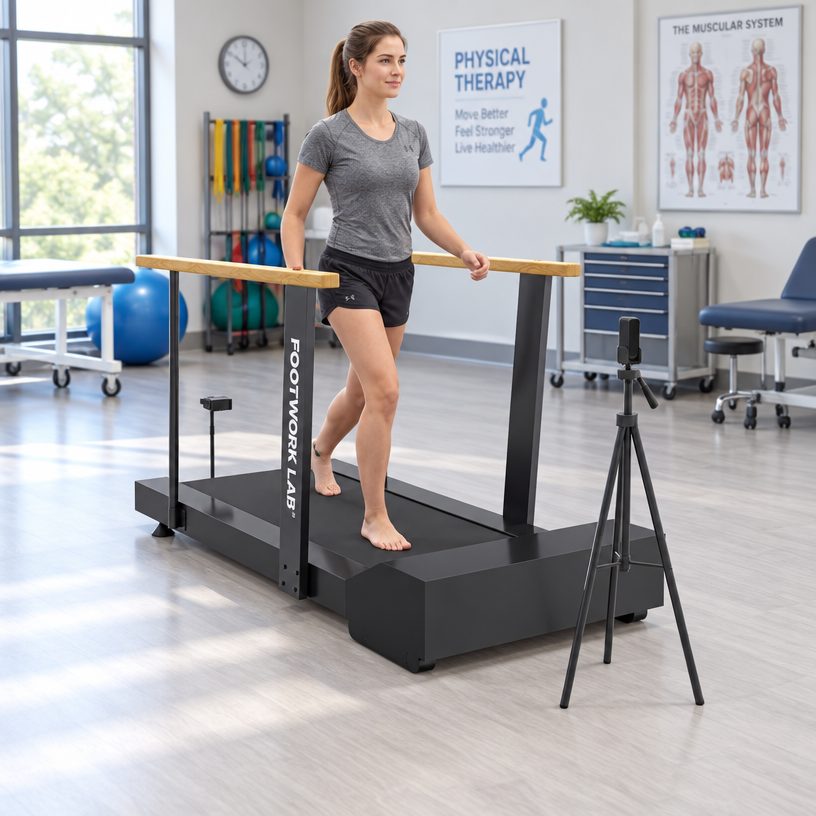
For runners: a completion that asks for a cycle
The sport buyer types a different completion — for runners, for running, for athletes — and the enquiry shifts from filing to motion. A runner does not want to be recorded standing; the whole point is what happens when the foot strikes, loads and leaves the ground, over and over, at a pace the person actually trains at. That demand rules out the short standing platform as the main instrument and points at something that can capture a person moving continuously.
This is where treadmill form earns its place. A dynamic gait system built on a treadmill frame lets the subject walk and then run in place while the pressure surface beneath records continuously, and the cameras on their stands watch the movement from fixed positions. The record that comes out of a running pass is different in kind from a standing one: gait cycle parameters, movement posture, dynamic pressure through each stride, and the paired curves of both feet — the butterfly lines — that show how the two sides share the work.
The room constraint deserves a sentence before any brochure does. A treadmill system plus two camera stands and a hub needs floor that a shop counter rarely has and a training facility usually does; the buyer whose completion was for runners is often a gym, a sport academy or a clinic with a dedicated movement room, and the honest advice is to measure the room before falling for the record. We would rather a buyer configured around the space he has than bought a platform that blocks a doorway.
And the boundary holds here too, though sport makes it tempting to blur. The platform records the run; it does not coach it. What the cycle data means for a particular runner’s programme — what to adjust, what to leave alone — is work for the coach or clinician who knows the person. We supply the record and the report; the programme belongs to the professional, and saying so has lost us no serious buyer yet.
For kids and for shops: the short-session completions
The children completion comes from schools, training centres and family-facing shops, and its defining constraint is attention. A young subject will cooperate for minutes, not half an hour, so the session has to be short, the screen has to hold interest, and the report has to assemble itself before the subject wanders off. Systems aimed at this completion are judged on whether the whole routine fits inside a child’s patience, not on the depth of any single parameter.
The retail completion — for shops, for the counter — has a different economy. The session competes with a queue, so it runs in the time a customer spends taking off a shoe, and the report’s value is concentrated on its last page: the record on one side, the fitting recommendation beside it, and the size taken from the measured foot rather than the shoe label. What the shop does not need is the full cycle apparatus; depth that never gets read is cost without return at a counter.
Both completions share one requirement that buyers underestimate: the script. Staff at a counter or a children’s session need a fixed routine — stand, walk, read, hand over — that they can run the same way every time without deciding anything on the fly. A system that demands judgement from its operator at every step will be run differently by every member of staff, and the records will stop being comparable almost immediately.
Matching the completion to the configuration is therefore mostly an exercise in honesty about trade-offs. The clinic wants depth and archiving; the runner wants the cycle; the child wants speed; the counter wants the last page. We sell systems into all four, but rarely the same model into all four, and an enquiry that arrives with its completion intact saves everyone the trouble of discovering that the hard way.
What the F5-LAB puts under these completions
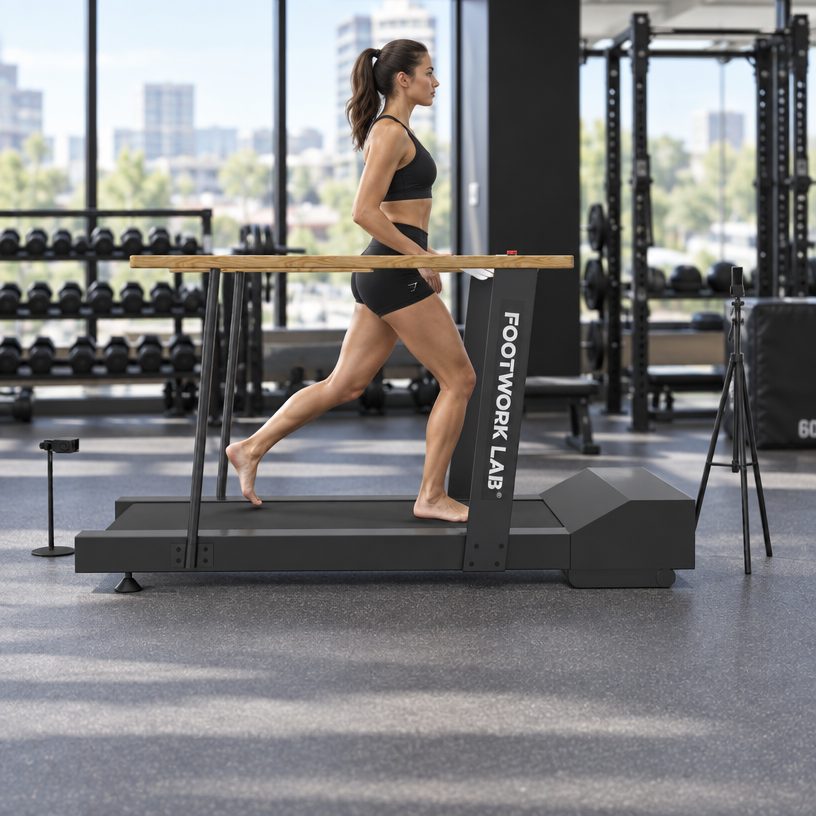
Where the completion was for runners, or for a movement room that wants both, our answer is the F5-LAB: a dynamic gait detection system in treadmill form, shipped with two cameras on their stands and a hub that ties the streams together. The subject walks or runs on the belt; the pressure surface records continuously underneath; the cameras capture movement posture from fixed angles; and the report assembles the streams into one document the professional can read.
The record divides cleanly by mode. Walking mode captures the gait cycle at walking pace — suitable for the clinical completion, where the baseline and the retest matter most. Running mode raises the pace and captures the cycle under running load: dynamic pressure through each stride, the movement posture of the whole body, and the butterfly lines of both feet as they cross and mirror each other through the session. The two modes are the same hardware wearing two different session scripts, which is what keeps the records comparable within each mode.
Two boundaries should be stated in the same breath as the capability. First, this is not a shape scanner and we do not present it as one — the shorthand buyers type into search boxes about depth and surface geometry describes a different category of instrument, and what our system captures is pressure and alignment, recorded over time. Second, the report does not diagnose: every page carries the note that the values are for reference, and the reading of them belongs to the clinician or coach who knows the subject.
Practicalities complete the picture, and they are the same terms we state anywhere: machines start from a single unit and accept ODM; every unit leaves the factory only after seven days of testing; the warranty runs twelve months on non-human damage, with parts supplied free within it; after-sales runs through a dedicated WhatsApp group with engineers reachable directly and remote assistance where the connection allows; and delivery moves at six to seven working days by courier, ten to twelve days by air or thirty to thirty-five by sea.
Reading any listing with the completion in hand
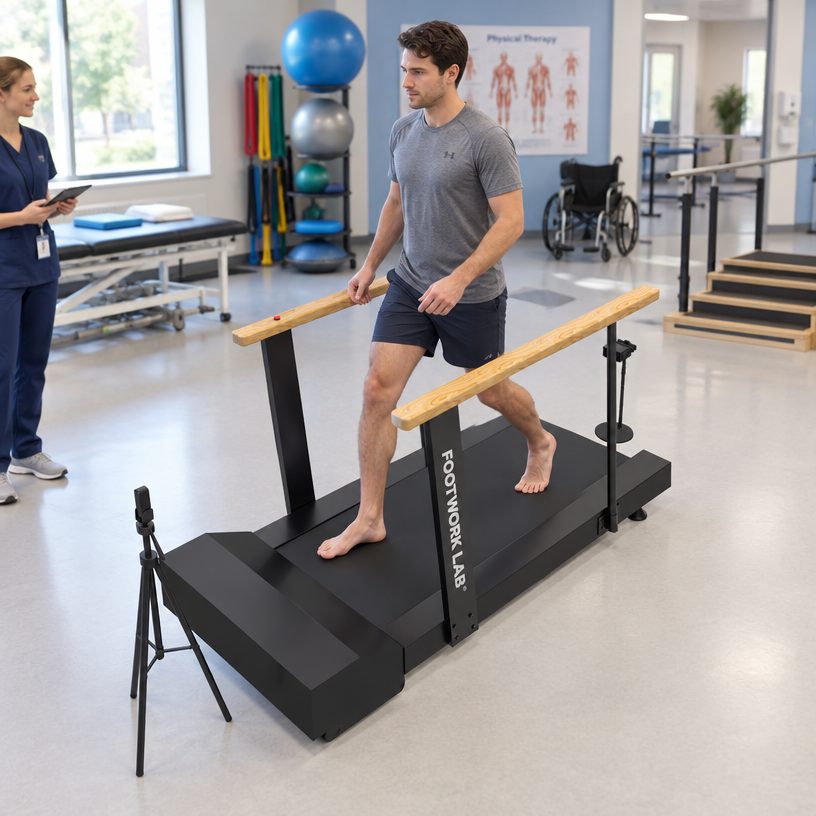
Armed with its completion, a buyer can read any listing — ours or anyone’s — as a checklist rather than a brochure. If the completion was for clinics, the questions are: which report items, how the session is scripted, how files export, how a retest compares. If it was for runners: what the running mode actually captures, where the cameras stand, what the room needs. If it was for kids or for a counter: how long a session runs and what the last page says. A listing that cannot answer its own completion’s questions is telling the buyer something.
The same discipline applies to the words in the listing. Where a page says dynamic, the buyer should ask what moves and what is recorded while it does; where a page leans on the market’s shorthand for shape capture, the buyer should ask whether the instrument measures surfaces or pressures, because the two answer different completions. Suppliers who answer those questions in plain sentences are the ones who have thought about the audience behind the search.
And the completion travels beyond the purchase into the first weeks of use. A system bought for the clinic completion should be installed with its session script fixed on day one, so that the first baseline and the first retest share conditions; a system bought for the counter completion should be installed with the staff script drilled until the routine runs without decisions. The buyer who names his audience to the supplier at enquiry stage gets an installation built for it; the buyer who lets the completion drop usually rediscovers it in month two, when the records stop comparing.
The fragment that started all of this — foot scanner for — is then what it always was: the buyer telling the supplier who the machine is for before the machine has a name. Read generously, it is the most precise three words in the inbox. The rest of the conversation is just the supplier honouring the word that followed.
Frequently asked questions
What does the search phrase foot scanner for mean?
It is a truncated search: the buyer stopped after the preposition and the next word named the audience — for clinics, for runners, for kids, for a shop counter. The fragment still carries intent, because the completion decides what the system must record and how a session runs.
Which completion does the F5-LAB answer?
The motion completions. It is a dynamic gait detection system in treadmill form, with walk and run modes, two cameras on stands and a hub. It suits clinics with a movement room, sport facilities and gyms; a short-session counter completion is usually better served by one of our other systems.
What does a running session record?
Gait cycle parameters, movement posture, dynamic pressure through each stride, and the paired butterfly lines of both feet. Walking mode records the same family of items at walking pace, which is what makes a baseline-and-retest routine possible in a clinical setting.
Is the system a 3D scanner?
No. The 3D in search phrases is market shorthand for shape capture, which is a different category of instrument. What our systems record is plantar pressure and alignment over time, and we keep that distinction explicit rather than borrowing the shorthand for our own specification.
Who interprets the reports?
A qualified professional — the clinician or coach who knows the subject. Every report states that the values are for reference; the equipment records, and decisions about any programme belong to the professional side of the room.
What are the order and after-sales terms?
Machines start from a single unit and accept ODM. Each unit is tested at the factory for seven days before shipping, the warranty runs twelve months on non-human damage with parts free within it, and after-sales runs through a dedicated WhatsApp group with engineers reachable directly.
How long does delivery take?
Six to seven working days by courier, ten to twelve days by air, or thirty to thirty-five days by sea. A first installation should be planned against the slowest of the three windows rather than the fastest.
What we would do next
Tell us the completion before the hardware: finish the phrase — for clinics, for runners, for kids, for the counter — and add one line about the room, its floor and who will run the sessions. We will answer with the system that matches the audience and the session script it installs with, through the contact page. The F5-LAB product page sets out the treadmill-form platform, its two modes and the record each one captures.
Four pieces continue the theme. What a gait analysis system is made of unpacks the layers behind the device word, and a gait treadmill changes the capture explains what the treadmill form does to the record. Running gait analysis platform follows the sport completion specifically, and gait training protocols on the F5-LAB shows how the professional side builds a programme on the records.
This article is intended for professional and educational reference. It is not medical advice. Foot assessment equipment produces measurements and images; clinical interpretation and any decision about care remain the responsibility of a qualified professional. Certification scope is limited to the documentation we hold: European Union certification and ISO quality system certification.