
The room is rented, the deposit is paid, and there is a photograph on the phone of an empty space with good light and a single socket. The owner has been reading about insole production for a month and has a shortlist of equipment, a rough idea of three product styles, and a start date that a landlord has already written into a contract. What is missing is the order in which things have to be decided. In a small workshop, the machine is the last decision, not the first, because everything the machine needs — the power, the extraction, the bench, the mould storage, the person who will stand at it — has to exist before it can be switched on, and most of those take longer to arrange than the delivery does. This article sets out what a small insole lab should have settled before a line is even quoted: how the order book shapes the room, what the room needs before it needs equipment, why the series and the size curve come before the hardware, and how the daily output of a real workshop compares with the figures a factory quotes.
The order book decides the room, not the catalogue
Start with the question that sounds least technical: who is going to buy these pairs, and how many of them, and how often. A clinic that fits a dozen people a week needs a bench that can turn out a dozen pairs without a production run, which is a different requirement from a shop that wants a shelf of stock in six sizes before the season starts. The first needs flexibility and short changeovers; the second needs consistency and a size curve that does not shift between batches.
The second question is what the pairs are for. Comfort builds sold over a counter, care builds fitted against a record, and sport builds ordered by discipline are three ranges with different tolerances, different materials and different expectations of the person fitting them. A workshop that tries to open all three at once usually ends up with a bench covered in half-finished experiments. The one that opens with a single range and adds a second after the first is running smoothly will spend less money and lose fewer pairs.
Then comes the size distribution, which is where most first orders go wrong. A range is not a product; it is a product in a set of sizes, and the sizes a workshop actually needs depend on the feet it will see. A clinic serving adults in one region may need a narrow band of sizes and a lot of depth in it. A shop buying stock needs the whole curve and will sell the middle hard and the ends slowly. Writing that curve down before ordering moulds or blanks saves a shelf of pairs nobody asks for.
Only after those three answers should anyone open a catalogue. The catalogue is organised by equipment; the workshop is organised by work. A buyer who starts from the catalogue ends up arranging the room around a machine, which is exactly the wrong way round, and it is the most common mistake I see in a first setup.
A room needs three things before it needs a machine
The first is air. Any process that shapes, trims or finishes a build produces dust or vapour, and a room with one window and a closed door will concentrate it. Extraction does not have to be elaborate, but it has to be positioned where the work happens rather than where the ceiling is convenient, and it has to be decided before the bench is fixed in place, because retrofitting a duct behind a bench is a week of lost production.
The second is power, and the useful question is not how much but where. A bench with equipment at both ends and one socket in the corner will run an extension lead across the working floor, which is both a hazard and a habit that never gets corrected. Sockets should be above the bench rather than below it, on the wall the operator faces, and there should be more of them than the first equipment list requires, because the second range always adds something.
The third is a floor that can be cleaned. Offcuts, dust and adhesive residue accumulate faster than anyone expects, and a carpeted room is a decision that cannot be undone cheaply. A hard floor, a bench height that suits the person who will actually stand at it, and a clear metre behind the operator are worth more than any additional piece of equipment in the first year.
None of this is glamorous, and that is the point. A workshop that gets the room right finds that the equipment is easy to place; one that buys the equipment first finds that every later decision is a compromise with a wall.

Choose the series before the hardware, because the series sets the bench
The care range is the one that punishes a badly planned room most. A build that spreads load away from a sensitive region needs a shaping plate that holds its form under a walking body and a cushioning layer that does not collapse in a month, and both of those need consistent forming temperature and consistent pressure rather than a hurried job at the end of the day. It also needs more sizes held in stock, because a care fit has less tolerance for a compromise than a comfort fit does.
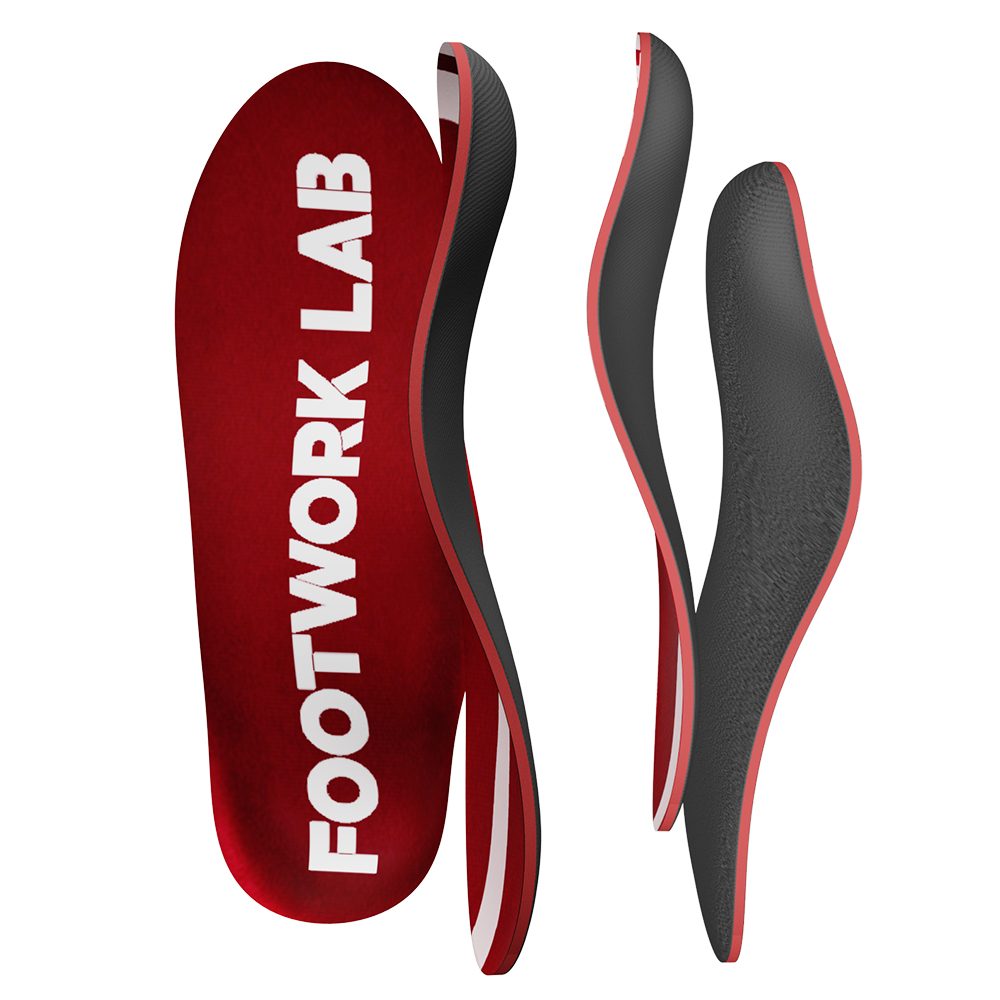
The comfort range is more forgiving and therefore a better first line. A mesh face, a cushioning layer and a shaped polymer plate form a stack that a small bench can produce reliably, and the grading between soft and firm builds can be handled by changing one layer rather than by rebuilding the process. It is also the range a shop can sell without a clinical conversation, which matters when the staff are still learning.
The sport range is the one to add last, not because it is harder to make but because it is harder to specify. Builds are graded for support, resistance to twisting, cushioning and how much return the forefoot gives at push-off, and the right combination depends on the sport rather than on the foot alone. A workshop that has not yet produced a hundred pairs of anything will not have the vocabulary to discuss that grading with a customer.
The practical consequence for a new lab is a sequence rather than a selection. Open with one range in a narrow band of sizes, learn what the bench does with it across fifty pairs, then widen the sizes before adding the second range. The materials behave differently enough between ranges that a workshop which has only ever formed comfort builds will misjudge the care build on its first attempt: the plate wants longer under heat, the cushioning layer springs back faster, and the trim line sits differently. Those are not things a brochure conveys, and they are the reason a second range should arrive after the first one is boring.
What we will not do is pretend that a series name carries a clinical promise. A care build is a construction chosen for a foot that needs load spread; whether it helps a particular person is a judgement for the professional who fitted it. We describe materials and grading, and we leave outcomes to the people qualified to discuss them.
The bench: what has to be within arm’s reach
A working bench for insole production has a sequence, and the sequence should be readable from the layout. Shaping happens at one end, finishing in the middle, and checking at the other, with the finished pairs leaving the bench rather than returning to it. An operator who has to walk around the bench to finish a pair will eventually stop walking around it and start finishing in the wrong place.
The tools that belong within reach are the ones used on every pair: the trimming tools, the measuring tools, the marking pen, the record sheet. The ones that belong on a shelf are the ones used twice a day. This sounds trivial and it is the difference between a bench that produces steadily and one where the operator spends a third of the time looking for something.
Light matters more than equipment catalogues admit. Finishing work is judged by eye, and a bench under a single overhead fitting casts a shadow exactly where the edge is being checked. A second light at bench height, angled across the work rather than down onto it, is cheap and changes the reject rate.
The bench also needs a place for the record. Every pair that leaves a workshop should be traceable to a session, a size, a build and a date, and that only happens if the paperwork lives at the bench rather than in an office. A clipboard at the end of the bench, filled in as the pair is finished, is the cheapest quality system a small workshop will ever install.

Moulds, blanks and the discipline of storage
Storage is the part of a small workshop that gets designed last and causes the most waste. Moulds and forms are size-specific and shape-specific, and a set that is stored loose will be damaged, mislaid or used for the wrong size. The rule that works is dull: one location per size, labelled, and nothing else allowed in that location, including the pair currently in progress.
Material storage has its own rules. Sheets and blanks that are stored flat stay flat; the same material stored on edge takes a set that shows up in the finished pair. Heat and humidity change how a cushioning layer behaves during forming, so a store room next to a heater is a store room that produces inconsistent batches in winter and none of the staff will know why.
There is also a counting discipline that pays for itself. Every mould has a life, every batch of material has a batch number, and a workshop that writes both on the record can answer the only question a customer ever asks about a returned pair: was this the same as the one that was fine. Without that line, every complaint becomes an argument about memory.
We do not sell the storage or the moulds as a package, and we do not claim that any particular arrangement is the right one for a given room. What we will say is that a workshop with an unglamorous, labelled, size-by-size store will out-produce a better-equipped one that keeps everything in a box.
Staff, sequence and what the first month will actually produce
Two people can run a small lab, and the division that works is not the one buyers expect. The person who assesses and specifies should not be the person who finishes, because the two jobs need different attention and one of them always wins when time is short. In a one-person workshop the same person does both, and the schedule has to protect the finishing time rather than letting it absorb every interruption.
Throughput is the number that gets quoted most and understood least. Our insole line turns out roughly five hundred to a thousand pairs on a working day, and our equipment line builds roughly three to five machines a day; neither figure describes what a workshop of two people will make in its first month. A realistic first month is measured in dozens of pairs, with most of the time going into setting the routine rather than into production, and a buyer who plans against a factory figure will be disappointed by week three.
What the factory figures are good for is lead time. Samples ship within three days, which is fast enough to hold a structure in your hand before committing to a range. The minimum order is two hundred pairs, mixed across styles and sizes, which is the smallest quantity that lets a workshop open a real curve rather than a single build. Insoles accept both ODM and OEM, so a workshop can build its own specification and its own branding inside the same terms, and the standard range stays fixed so that records keep mapping onto the shelf.
The sequence for the first month is worth writing on the wall: settle the room, settle the range, settle the size curve, make ten pairs, check them against the record, adjust one thing, make ten more. A workshop that follows that order reaches a steady output in the second month. One that starts with a large batch and a full shelf spends the second month explaining returns.
Frequently asked questions
What should be decided before ordering insole equipment?
The order book, the range and the size curve. Who buys the pairs, which of the three series you will open with, and which sizes the feet you will see actually need. Equipment placed before those answers tends to define the room rather than serve it.
How much space does a small insole lab need?
Less than buyers fear and more than one bench. The room has to hold a bench with working space at both ends, a store for moulds and material, and a clear metre behind the operator. A second room is useful for storage but not essential in the first year.
What matters most in the room itself?
Extraction where the work happens, sockets above the bench on the wall the operator faces, and a floor that can be cleaned. Each of those is cheap before the bench is fixed and expensive afterwards.
Which series should a new workshop open with?
Usually the comfort range, because the stack is forgiving, the grading is handled by changing a layer, and the staff can sell it without a clinical conversation. The care range needs tighter tolerances and more sizes held; the sport range needs a vocabulary that comes with experience.
How does factory capacity relate to my own output?
Loosely. Five hundred to a thousand pairs a day describes a factory line, and three to five machines a day describes equipment assembly. A two-person workshop should plan in dozens of pairs for the first month and use the factory figures for lead time, not for ambition.
What is the minimum order, and can styles and sizes be mixed?
Two hundred pairs, mixed across styles and sizes, which is what allows a real curve rather than one slow build. Samples ship within three days so the structures can be handled before the order is placed.
Do you supply the assessment equipment as well as the insoles?
Yes, and they are separate purchases. Machines start from a single unit, accept ODM, and leave the plant only after seven days of testing. The insoles and the equipment share a vocabulary of sizes and builds, which is what keeps a record mapping onto a shelf.
What we would do next
Sketch the room on one page before opening another catalogue: where the bench stands, where the extraction goes, where the moulds live, where the finished pairs leave. If two of those four have no answer, the equipment list is premature, and no quotation will fix it.
The insole range page sets out the three series, the four grading levels and the structure of the comfort build, which is where most first workshops start. Send the room sketch and the intended range through the contact page and we will say which parts of it we would change, including the parts that have nothing to do with what we sell. Two articles go further: your first orthotic insole making machine covers the equipment question directly, and in-house or factory sets out the case for making your own pairs at all.
This article is intended for professional and educational reference. It is not medical advice. Foot assessment equipment produces measurements and images; clinical interpretation and any decision about care remain the responsibility of a qualified professional. Certification scope is limited to the documentation we hold: European Union certification and ISO quality system certification.