
The build was finished on Thursday, and on Monday the partner clinic sent back one question: which foot is this? The scan was fine. The pressure map was fine. The build sheet was fine. What travelled badly was everything around the files: a folder named with an internal customer code nobody outside the company could decode, photographs taken from an angle that hid the arch, and a note that said weight loaded without saying what it was loaded onto. Three time zones and a shared language later, the partner had rebuilt half the record from guesswork that a week of naming discipline would have made unnecessary.
For clinics and workshops that send capture work to a partner abroad, whether a sister clinic, an orthotic workshop or a manufacturing partner, the record set is the product. It has to arrive readable by people who never saw the customer walk. This article describes what a complete travelling record set contains, the naming and folder conventions that survive translation, the photograph angles a build partner actually needs, and the communication loop that keeps the first set from becoming the last one sent.
What actually travels in a record set
Start by listing what the receiving side genuinely needs, because the honest answer is more than the scan and less than the whole file. The core is the measurement data itself: the static record showing how the foot organises itself at rest, and the dynamic pass or passes showing how load moves through the step. Around that core sit four things that make the data usable. The capture conditions: date, time of day, shoes-on or shoes-off, and the protocol used for the walking passes. The photographs: the views of the foot that a pressure map cannot show, taken from agreed angles. The context notes: body weight as a factor in reading the map, the customer’s working conditions, and anything the practitioner observed during capture. And the brief itself, if a build is wanted: what the sending practitioner wants the receiving workshop to produce.
What does not need to travel is just as important to agree. Identity documents, anything beyond the minimum the partner needs to do the work, and raw files nobody on the receiving side can open all add weight without adding meaning. A record set that arrives with forty files, half of them duplicates at different export resolutions, teaches the partner to stop trusting the folder. Fewer, cleaner, purposeful files beat a complete dump every time, and the discipline of deciding what stays home is part of the discipline of sending.
One principle holds the whole list together: the set is complete when a person who never met the customer could open the folder and reconstruct the session in their head. That is the test to apply before sending. If any single file needs a phone call to explain, the folder is not finished, because the phone call may not be possible when the partner actually sits down to work, and a build that waits on a call waits in a queue.
Naming conventions that survive translation
The cheapest fix in cross-border record work is also the one most often skipped: agree the file and folder naming with the partner before the first set is sent, then never deviate. A workable convention has one line per customer and fixed fields in fixed order. A practical pattern runs like this: sending-site code, customer reference, date, then the file’s role. For example, a site code of two or three letters, the customer number the partner uses, the date written year-month-day so that sorting by name sorts by time, and then the role: static, dynamic, left, right, and the photo angles. Every file the partner receives for the rest of the partnership sorts itself, and no file ever has to be opened to find out what it is.
The customer reference deserves its own rule, because it is where most sets go wrong. The sending clinic’s internal codes mean nothing abroad, and a name spelled two ways in two files breaks every lookup the partner runs. Agree one reference per customer, use it identically in the folder name, in the measurement file names, in the photo names and in the note document, and never abbreviate it differently between files. If the partner assigns their own production numbers on receipt, record the mapping in the note document, one line per set, so that a returned build can be traced back without archaeology.
Date formats deserve one sentence of their own, because they cause silent damage. A day-month reading of a month-day file puts the session in the wrong month, and nothing errors out to warn anyone. Writing every date year-month-day across the whole set removes the ambiguity, costs nothing, and means that folder listings read chronologically in every country. These conventions sound bureaucratic until the first set comes back with a question that one naming rule would have prevented; after that, they feel like what they are, which is packaging.
The photographs: angles a pressure map cannot give
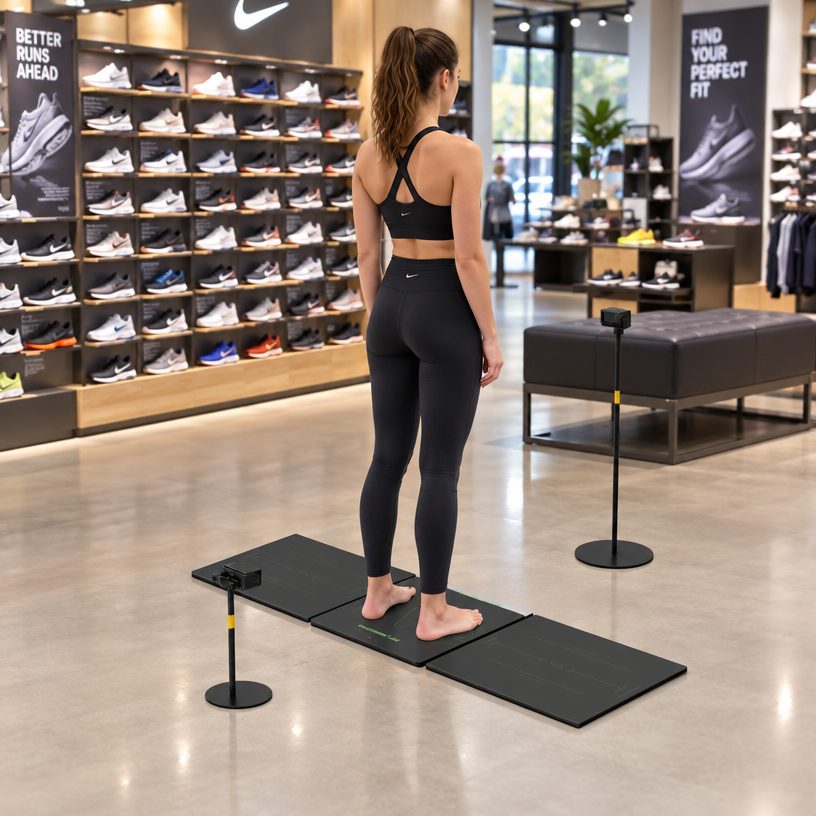
The measurement files show how load distributes; they do not show the foot itself. The receiving workshop needs to see what the sole looks like, how the arch presents, how the toes sit, and how the ankle aligns, and that comes from photographs taken to an agreed standard. Five angles cover nearly everything. Straight from above, sole flat and toes relaxed, which shows the overall shape. From the side, both feet, which shows the arch profile and how it changes between sitting and standing. From behind, which shows the heel alignment and how it sits under the leg. And one of the shoes the customer actually works in, sole up, because the wear pattern on the shoe is the cheapest second opinion the partner will get on everything else in the folder.
The way the photographs are taken matters as much as the angles chosen. Consistent distance and height, plain background, even light without shadows across the arch, and the same standing weight on both feet for every standing view. Photographs taken standing versus sitting show different arch presentations, so agree which one the set uses and label it; an unlabelled photo forces the partner to guess, and a wrong guess quietly shapes the build. Where the practitioner wants to show a comparison, such as the arch seated versus standing, take both and name them with the angle and the condition, so the pair is readable without a caption.
Resist the temptation to annotate the photos heavily before sending. Circles and arrows drawn by the sending side can anchor the receiving workshop’s reading before they have looked at the data themselves, which is not always the outcome the sender intends. State observations in the note document instead, where they sit as text next to the facts rather than drawn across them. The partner’s own eyes on a clean photo are part of the value of sending one; over-annotated photos spend that value.
The note document: what to write so the set speaks
Every set should carry one short text document that holds everything the files cannot say. Keep it to a page, keep it in agreed headings, and it becomes the single place a partner checks before asking anything. The headings that earn their place are these. Capture conditions: date, time of day, footwear on or off, protocol for the dynamic passes. Observations: what the practitioner saw during capture, described rather than interpreted, such as how the customer walked when asked to choose their own pace. Working context: what the customer does for work and on what floors, because a build for warehouse mornings differs from one for office days even on identical maps. And the brief: what is being asked for, in plain sentences, with the shoes it has to fit named.
Two writing rules keep the note document honest. First, separate description from interpretation: a line that says the arch presents lower under standing load is a description; a line that says what should therefore be built is an instruction, and the note should carry instructions only in the brief section, clearly marked. Second, quantify what can be quantified without inventing precision: body weight as a factor belongs in the note because load readings read differently at different weights, stated as the fact it is. Anything the practitioner is unsure about should be written as a question rather than smoothed over, because a question in the note travels safely while a confident wrong answer travels badly.
The note document is also where the mapping between the sending clinic’s references and the partner’s production numbers lives, one line per set, updated each time. That single line, set date, sending reference, partner reference, turns every later conversation from a search into a lookup. Partners who receive well-noted sets send builds back faster and with fewer questions, not because the receiving side got smarter but because the folder finally answers its own questions.
Building the loop: samples, revisions and the first three sets
The first few sets a partnership exchanges are really a calibration of the relationship, and it is worth treating them that way rather than as ordinary work. Send the first set, then deliberately over-communicate around it: a message to say it is on its way, a check that it arrived intact and readable, a short call after the partner has read it to hear what they had to guess at. Every question the partner asks about the first set is a naming rule or a note heading that the second set should have answered on its own. By the third set, the folder should be arriving with no accompanying explanation at all, and that is the sign the conventions have taken hold.
Agree the revision loop explicitly, because builds come back and the second round is where partnerships fray. Who photographs the returned build, who measures it, what counts as acceptable, and what happens when it is not. A revision request should travel in the same format as the original set: named files, dated, referenced, with the reason stated in the note document rather than in a thread of messages that will be unsearchable in three months. Partners respect a written loop; it protects both sides and it makes quality conversations factual instead of remembered.
On the supply side, this is also where production facts belong in the conversation. Custom insoles are produced at scale, with a minimum order that allows mixed models and sizes, and samples can ship within days so that a partner can hold the product before committing to volume. Machines for the sending side’s own capture are supplied with ODM customisation accepted, every unit tested for seven days before it ships, and after-sales runs through a dedicated messaging group with engineers available directly and remote assistance when a capture question crosses a time zone. None of these facts replaces the record discipline; they sit behind it, because the hardware and the supply terms only matter if the files between partners stay readable.
Why the record itself has to be trustworthy before it travels
Everything above assumes the measurement files mean the same thing on both ends of the line, and that assumption is only as good as the device that produced them. A partner abroad cannot see the capture room, cannot watch the session, and cannot tell from a folder whether the platform was consistent that week. What they rely on instead is the instrument’s consistency, and consistency comes from two places: a stable capture protocol on the sending side and hardware that was proven before it shipped. This is why the pre-shipment testing period matters to record partnerships and not just to procurement. A device that has run a full week of testing before leaving the factory arrives with its behaviour already exercised, and the sending side’s job is to keep it that way with regular use and the protocol discipline described earlier.
A pressure and posture customisation system such as the one on our F2 FMP gait scanner page is built for exactly this kind of workflow: capture on one side, records that hold their meaning, and custom insole production that can be carried out by the partner or supplied from the factory against the same data. When both sides of a partnership work from compatible capture and a shared build vocabulary, the record set stops being a translation exercise and becomes what it should be, a shared document. The equipment produces the measurements and images; how they are interpreted and what is built remains the professionals’ decision at both ends, and the set should be framed that way to everyone who touches it.
Keep the protocol sheet beside the device and treat it as part of the partnership, not internal housekeeping. When a new staff member runs captures, they should be running the same protocol the partner has learned to expect, because the partner builds against a year of records, not against this week’s variation. Practices that write their capture protocol down, one page, steps and conditions, find that record sets travel well across staff changes, holidays and growth, which is exactly the resilience a cross-border partnership needs.
When the partnership grows: a second site, a second partner
Conventions that work for one partner get tested the day a second one appears, because two partners rarely agree on the same naming habits, and a sending clinic caught between them tends to improvise per shipment, which is how everything unravels. The answer is to keep the sending side’s convention single and fixed, and to do the adaptation on the receiving end of each partner’s own reference. One sending convention, one customer reference scheme of your own, and a mapping line per partner: your reference, that partner’s reference, the date the set went out. The mapping table grows with the partnerships instead of the folder names, and no set ever has to be renamed for a specific recipient.
The same logic applies to the capture protocol when a second capture site joins the sending side. The partner has learned to trust records that behave a certain way, and a new room, a new device or a new staff member can quietly change that behaviour without anyone intending to. Before the second site sends its first set, run a bridging exercise: capture the same volunteer feet at both sites, under each site’s written protocol, and let the partner read the two sets side by side. If the records agree, the partner’s trust extends to the new site with evidence rather than hope. If they do not, the difference is found before it has contaminated a year of builds, and the fix is usually a protocol detail rather than a hardware question.
Scale the note document the same way. The headings that survived the first partnership become the house standard, and each new partner receives the same template with their own mapping section rather than a fresh invention. What tends to happen, and it is worth watching for, is drift between partners: one starts asking for extra angles, another prefers a different brief wording, and within a year the sending side is running three private dialects. Some adaptation to each partner is healthy and honest, but it should be written into each partnership’s own document, so that staff changes on the sending side do not take the dialect knowledge with them out the door.
None of this needs new equipment or new software. It needs the same discipline that made the first partnership work, applied deliberately: one convention, written down, mapped outward rather than improvised inward. Clinics that keep to it find that adding a partner costs an afternoon of setup and a bridging exercise, not a season of confusion, and the records that travel keep meaning the same thing no matter how many hands they pass through on the way.
Frequently asked questions
What should a travelling record set actually contain?
The measurement files, static and dynamic, plus the four things that make them usable: capture conditions, photographs at agreed angles, a one-page note document, and the build brief if one is wanted. Everything beyond that, duplicates, raw exports, unrelated documents, stays home. The test for completeness is simple: could someone who never met the customer reconstruct the session from the folder alone.
What file naming convention works across borders?
One line per file with fixed fields in fixed order: sending-site code, agreed customer reference, date written year-month-day, then the file’s role such as static, dynamic, left, right or the photo angle. Agree it with the partner before the first set, apply it identically in every file name, and never abbreviate the customer reference differently between files.
Which photograph angles does a build workshop need?
Five cover nearly everything: straight from above, side views of both feet, the rear view for heel alignment, a seated-versus-standing arch comparison if relevant, and the sole of the actual work shoe. Consistent distance, even light and labelled standing or sitting conditions matter as much as the angles themselves, because an unlabelled photo forces the partner to guess.
What belongs in the note document?
Capture conditions, observations described rather than interpreted, the customer’s working context, and the brief with the target shoes named. Keep description and instruction in separate sections, state body weight as a reading factor, and write uncertainties as questions rather than smoothing them over. One page, agreed headings, updated with the reference mapping each time.
How should the first exchanges with a new partner be run?
Treat the first three sets as calibration. Over-communicate around the first one, collect every question the partner had to guess at, and turn each question into a naming rule or note heading before the second set. By the third set, the folder should arrive needing no explanation at all, which is the sign the conventions have held.
Can the partner produce the insoles from the same records?
Yes, and that is the point of a well-built set: records that hold their meaning let the build happen on the receiving side or be supplied from the factory against the same data. Custom insole production runs at scale with mixed models and sizes within the minimum order, and samples ship within days so the partner can hold the product before committing to volume.
What does the sending side owe the partnership on the equipment side?
A stable capture protocol applied by every staff member, and hardware whose consistency was proven before it shipped; our own devices are tested for seven days before leaving the factory, with ODM customisation accepted and support running through a dedicated group with engineers and remote assistance. The set is only as trustworthy as the instrument and the protocol behind it.
What we would do next
The working order, in short: agree the naming convention before the first set, standardise the five photograph angles, write the one-page note document with description and brief separated, treat the first three exchanges as calibration, and put the revision loop in writing. Then write the capture protocol down beside the device, because the partner builds against a year of records, not against this week’s variation. Partnership and supply questions, from machine configuration to sample logistics, run through our become a partner page.
The failure mode we would flag for colleagues is the invisible question. The first set almost always comes back with questions, and the temptation is to answer them in chat and move on. Answer them in the conventions instead: every question the first set generated should die in the second set’s folder, not in the thread. Partnerships that do this get quieter in the best way, because silence starts meaning the folder answered everything.
So the question we would put to anyone already sending records abroad: when your partner last came back with a question about a set, did the fix become a rule in your folder, or just a reply in your messages? And a second, harder one: could your own team, given only the folder and no staff who were in the room, reconstruct the session themselves? We ask because we sit on the production side of these exchanges, and the partnerships that answer both questions honestly tend to stop needing us in the middle of them.
This article is intended for professional and educational reference. It is not medical advice. Foot assessment equipment produces measurements and images; clinical interpretation and any decision about care remain the responsibility of a qualified professional. Certification scope is limited to the documentation we hold: European Union certification and ISO quality system certification.