
Search for “podiatry instruments” and you get a trolley of hardware: a pressure plate, a camera stand, a treatment bench, a podoscope. The list tells you what each item is called. It does not tell you that each one answers a different question, and that the question asked most often in a working week is the smallest one — the one that has to be answered while the person is still taking their shoes off. A podoscope is the instrument built for that moment. The Q1P is ours, and it is the piece most buyers underestimate when they plan a room, because it produces a page of findings in minutes and then hands the case back. This article is about where that instrument sits among the others and where its report deliberately stops. It is not a buying list; there are enough of those already.
The Q1P manual calls the system a Foot & Leg Detection Insoles Customization System: foot data detection, lower limb biomechanical alignment detection, ankle data detection, and an on-site customization module for biomechanical insoles, all in one unit that ships in a suitcase. The manual’s own scenario line names the shoe store, and that is where most units end up. The same record is what a clinic uses on a first visit, which is why the two trades keep buying the same box for different reasons, and why a unit filed under retail keeps turning up on lists of podiatry instruments.
What a podoscope does that other podiatry instruments do not
A pressure plate records load: how much weight passes through each region of the sole, in what order, over how long. A podoscope records something else — the underside of the foot as it meets the ground, plus the line of the leg above it, captured by camera rather than by sensors under the skin of the plate. Neither one is a lesser version of the other. A room that owns only the plate will keep meeting people whose question is not about load at all; a room that owns only the podoscope will keep meeting people whose question is entirely about load and have nothing to show them.
What the Q1P contributes is the first pass. The person stands, the cameras take the three views the software asks for, and the system writes a page: arch type, foot type, the position of the big toe, the angle of the heel, rotation at the tibia, foot length and width with a shoe-size suggestion. In a clinic that sees a high proportion of new patients, that page does two jobs at once. It gives the practitioner something on paper before the hands-on part of the appointment begins, and it tells the room whether this visit is a fitting conversation or something that belongs further up the referral path.
There is a practical way to tell which record a given room needs. Listen to how the question is phrased. People ask “does my arch look flat” and “which size should I take” — those are shape and position questions, and the podoscope answers them on the spot. People ask “why does the same foot hurt after a long shift but not in the morning” — that is a question about load over time, and no still image answers it. A room that hears the first kind of question all day will use the screening unit every hour. A room that hears the second kind will use it once per patient and then reach for the plate.
At a Canton Fair booth a clinic owner once asked which of the two instruments he could leave out of a second treatment room he was planning. The honest answer was that the choice depends on what the room is for. If the room’s job is to decide quickly whether a person needs a fuller assessment, the podoscope carries that job on its own and does it inside a normal appointment slot. If the room’s job is to compare load before and after an intervention, the plate is the instrument that produces the comparison, and the podoscope will not stand in for it. He bought the screening unit first and said he would add the plate when the second room had a full appointment book. That sequence is common, and it is the reverse of what most catalogues imply.
What the Q1P report puts on the page
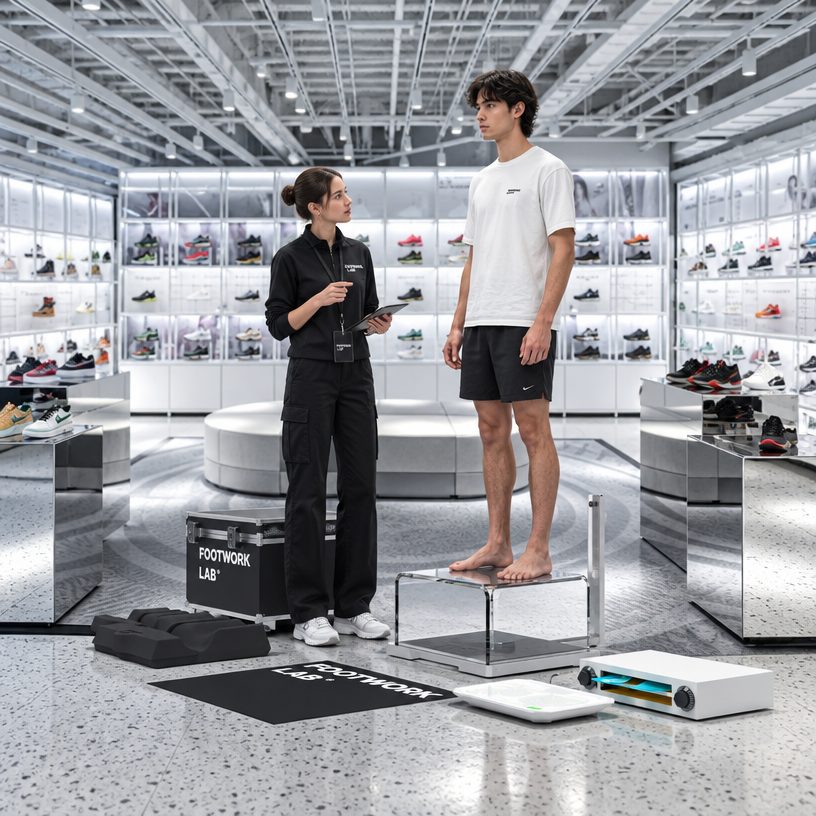
Capture takes three stances, and the software prompts for each one with a picture: standing straight, then a half-squat with the knees bent, then standing with the toes lifted. The camera accessories sit on the mat and are aimed once; after that the operator follows the prompts. This is the part that decides whether the data is worth reading. A person who shifts their weight between the first and third shot gives the software a different foot in each frame, and the report will faithfully describe three different people.
The page that comes back is a set of named findings rather than a single score:
- Arch type — where the medial arch sits against the reference range, described as a type rather than as a severity.
- Foot type — the toe-length pattern (Egyptian, Greek) and the width band, including the wide-foot case where a customer has been sizing up to escape a narrow toe box.
- Big-toe position — the angle at the first ray, recorded and labelled, with the note that a normal reading today is worth watching rather than filing away.
- Heel position — how the calcaneus sits under load, and which way the line leans when the whole foot is on the ground.
- Tibial rotation — internal or external rotation recorded at the lower leg, the finding that most often explains why a foot that looks unremarkable still wears one side of a shoe.
- Length and width, with a shoe-size suggestion — the pair of measurements a retail floor actually uses, and the reason the same unit sells into shoe shops.
Below the findings the report drafts a suggested insole direction and the reasons behind it, which is where the on-site module comes in: the heating box and the shaping pillow set ship with the unit, so a pair can be formed in the same visit as the measurement. The suggestion is written as a proposal with a rationale attached, not as an instruction, and the wording matters. A reader should be able to disagree with the reasoning and say why, and the report gives them the sentence to disagree with.
The layout is also the thing buyers judge first, usually within thirty seconds of seeing a demo. Two things decide whether they trust it: whether the left and right foot are shown together rather than one after the other, and whether the finding that drove the suggestion is visible on the same screen as the suggestion. When a report hides its reasoning one page away from its recommendation, staff stop reading it aloud to customers and start summarising it from memory, and the summary drifts.
Where the report stops, and what the room does on either side of it
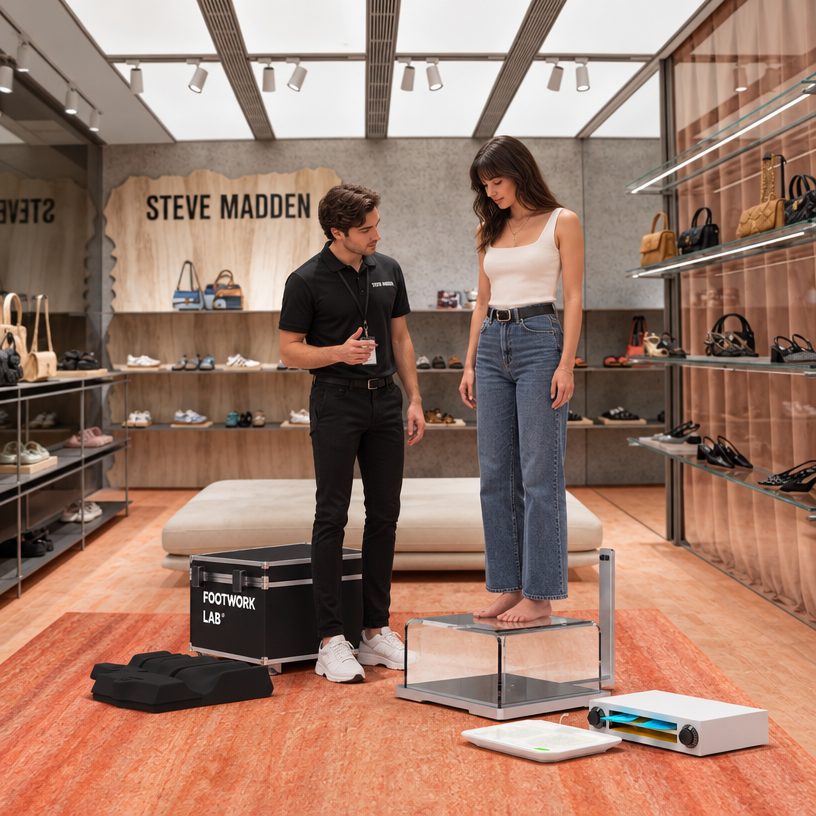
Every Q1P report carries a line under the conclusion: the analysis is for reference only, and if there is a medical need the person should go to a professional institution for further examination. That sentence is not legal decoration bolted on at the end. It describes the instrument’s actual position. What the unit produces is a measurement record — an arch type, an angle at a joint, a length in millimetres, a suggested size — assembled by machine vision and written up with AI-assisted report generation. What it does not produce is a clinical conclusion, a diagnosis, or a plan. The difference between those two things is the whole discipline of using the instrument well.
The failure we see most often is not technical. On support calls, a retailer will describe reading the tibial rotation line aloud to a customer as though the word on the screen settled the matter, and the customer leaves believing something has been decided about their body. Our engineers walk those stores through a simpler script: this is what the machine measured, this is the range it is being compared with, and this is the point at which a clinician should look at it. Nothing in that script is weaker than the original claim. It is simply true, and it survives a customer who asks a follow-up question.
On the other side of the line sits everything the room does with the record once it exists. A second visit can be compared with the first if the same three stances are used, the camera has not been moved, and the person is measured in the same footwear or lack of it. Records are held against a named account in the SaaS side of the system, so the comparison does not depend on someone keeping a printout. Where a clinic wants the report to carry its own fields, its logo, or a different order of findings, the software can be customised, and that work is quoted separately from the hardware.
The commercial terms are deliberately plain, because most of the questions at the booth are about them rather than about the technology. The minimum order for equipment is one unit, which is what makes a single-room trial possible. Every unit is tested for seven days before dispatch. Support runs through a dedicated WhatsApp group with our engineers, remote assistance where a screen can be shared, and over-the-air updates for the software. A twelve-month warranty covers non-human damage with free parts. None of that turns a screening record into a clinical one, but it does decide whether the instrument is still being used in month eighteen.
Frequently asked questions
Does a podoscope replace a pressure plate in a clinic?
No. The Q1P records foot data, lower limb alignment and ankle data from camera capture; a pressure plate records how load is distributed and how it travels. They answer different questions and a room that needs both comparisons will end up with both instruments. What the podoscope does is carry the first pass, in minutes, before a fuller assessment is booked.
Which findings appear on a Q1P report?
Arch type, foot type including the toe-length pattern and width band, the position of the big toe, heel position, tibial internal or external rotation, and foot length and width with a shoe-size suggestion. The report closes with a suggested insole direction and the reasons behind it. The conclusion page states that the analysis is for reference only and that a medical need should be taken to a professional institution.
Is the report a clinical finding or a screening record?
It is a screening record. The system measures and labels; it does not diagnose and it does not write a care plan. The wording on the conclusion page says so, and staff should say the same thing out loud rather than paraphrasing it into something stronger.
Can a pair of insoles be made in the same visit as the screening?
Yes, where the on-site customization module is part of the order. The unit ships with a heating box, a shaping pillow set for adults and children, and the accessory pieces the forming step needs, so the measured data can become a formed pair before the person leaves. That is the reason the manual groups detection and customization in one system rather than as two products.
Who operates the unit, and how long does a screening take?
A trained member of staff, not necessarily a clinician. The software prompts the three stances with pictures and the capture itself is short; the time is spent on positioning the person and explaining what the page means. In a shoe store that is a fitting conversation, and in a clinic it is the opening record of an appointment.
What are the order and support terms?
The minimum order for equipment is one unit, each unit is tested for seven days before dispatch, and the warranty runs twelve months against non-human damage with free parts. Support is handled through a dedicated WhatsApp group with our engineers, remote assistance, and over-the-air updates. Software customisation is quoted separately from the hardware.
What we would do next
Before ordering, write down the three questions your room is asked most often in a week, and mark which of them a screening record can answer on its own. Send us that list with a photograph of the space and the name of the person who will run the unit, and we will tell you whether the Q1P covers those three or whether one of them belongs to a pressure system. Our FAQ page carries the order, warranty and transit terms in full.
If you already run a podoscope and the reports are piling up unread, the fix is usually a two-minute script for staff rather than new equipment. Send us the wording you use now and we will point out the sentence that turns a measurement into a verdict. The instrument itself is described on the Q1P podoscope page.
This article is intended for professional and educational reference. It is not medical advice. Foot assessment equipment produces measurements and images; clinical interpretation and any decision about care remain the responsibility of a qualified professional. Certification scope is limited to the documentation we hold: European Union certification and ISO quality system certification.