
A retailer from Valencia picks up a sport insole from the sample tray at our exhibition stand, bends it gently, and asks the question in her own vocabulary: is this the termoformable one? The word arrives from Spanish shop floors, from supplier catalogues, from the way the market has learned to describe a category rather than a process. Behind it sits a real and quite ordinary step — heating a formed board until it accepts a contour, and letting it set — but the word itself has collected meanings it never carried, and buyers order against it without knowing what they have ordered. So the first thing worth putting on the record is that termoformable is a market word, not a mystery process, and nothing about it requires belief. This article takes the word apart in order: what the phrase actually names in the trade, what the structure underneath a formed insole looks like and why one layer matters more than the others, how the forming cycle runs when it happens in front of a customer, which stages belong in the shop and which belong back at a factory, why the sport series is ordered by sport rather than by feel, and the limits we state plainly from the factory side of the table.
One note on vocabulary before the sections begin. The insoles in question come from our FX range, built on BODYFIT AI assessment and a flexible fabric sensing approach, and specified against four grading scales: support, anti-torsion, cushioning and starting ability. Where the sport context matters, the article draws on the sport series — golf, outdoor, skate, skiing, fitness, basketball, racket sports and the rest — because that is the range most buyers carry in mind when they use the termoformable phrase.
What the word termoformable actually names
Strip the market language away and the word describes a single step: heat-forming. A semi-rigid forming board inside the insole is warmed until it becomes workable, positioned over a contour — a shaping pillow or a positive model — and pressed into that contour while it cools. When it sets, it holds. The process is old, widely understood, and used across footwear and orthotic workshops everywhere. There is no secret ingredient hiding behind the Spanish adjective; there is a heating box, a contour, and a material chosen because it takes a shape and keeps it.
The word became a category label because it answered a question customers used to ask about flat, off-the-shelf inserts. A flat insert has one geometry and asks the foot to accept it. A formed insole has taken on a contour, either a family contour from a shaping pillow or an individual contour from a personal record, so the phrase “can it be moulded to me” turned into a shorthand for the whole custom conversation. Retailers began asking suppliers for termoformable product the way they ask for washable or lightweight — as a shelf descriptor.
That shorthand is serviceable on a shop floor and unreliable in a purchase order. Two listings can both say thermoformable and describe entirely different builds: one may have a genuine forming board that holds a contour through months of daily wear, the other a foam that relaxes back toward flat within a season. The word says that heating happened once. It says nothing about which layer did the work, how the contour was chosen, or whether the shape can be refreshed. Those three questions are the real specification, and the rest of this article answers them.
It is also worth saying what the word does not mean. It does not mean the insole re-forms itself on the foot through body heat alone in the way some marketing implies; our builds are formed deliberately, on a fixture, by an operator. It does not mean the shape is adjustable forever. And it does not carry any statement about the foot itself — what a formed contour does for a particular customer is a judgement for the professional running the session, not a property of the material.
The structure underneath: which layer takes the contour and why
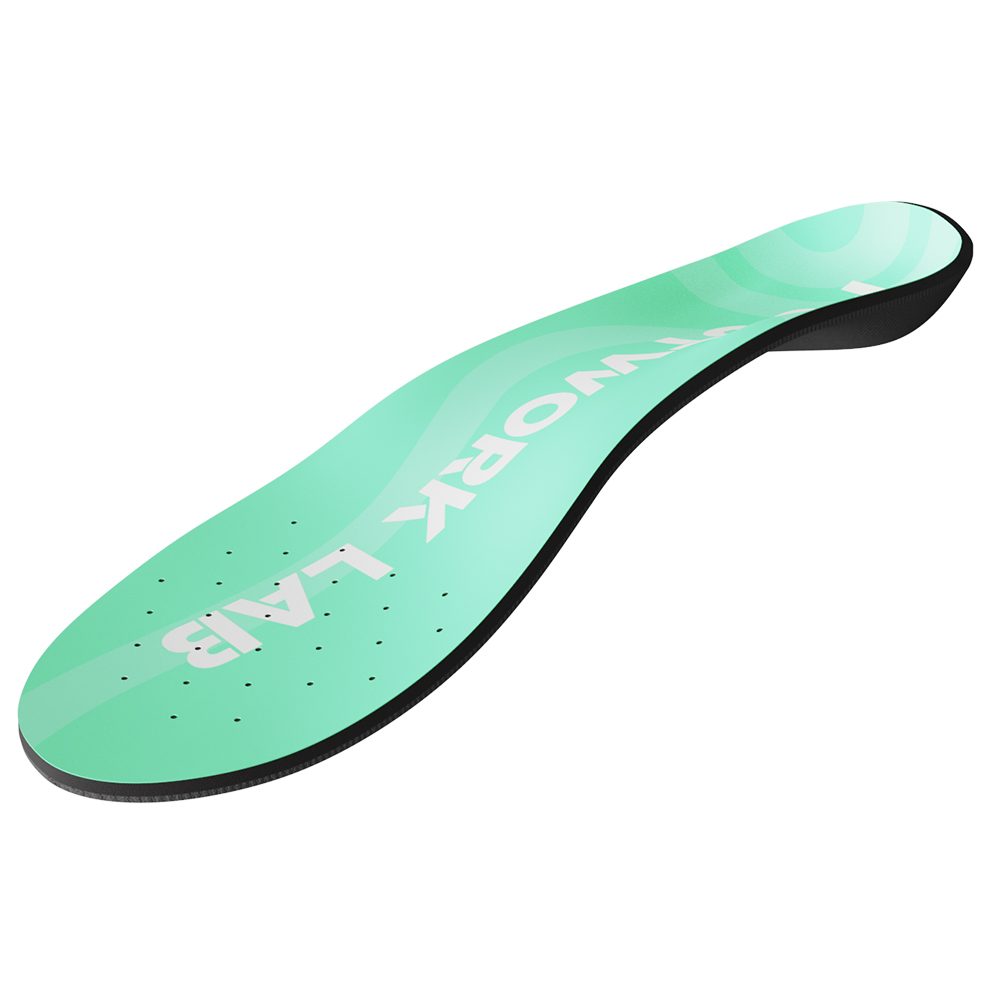
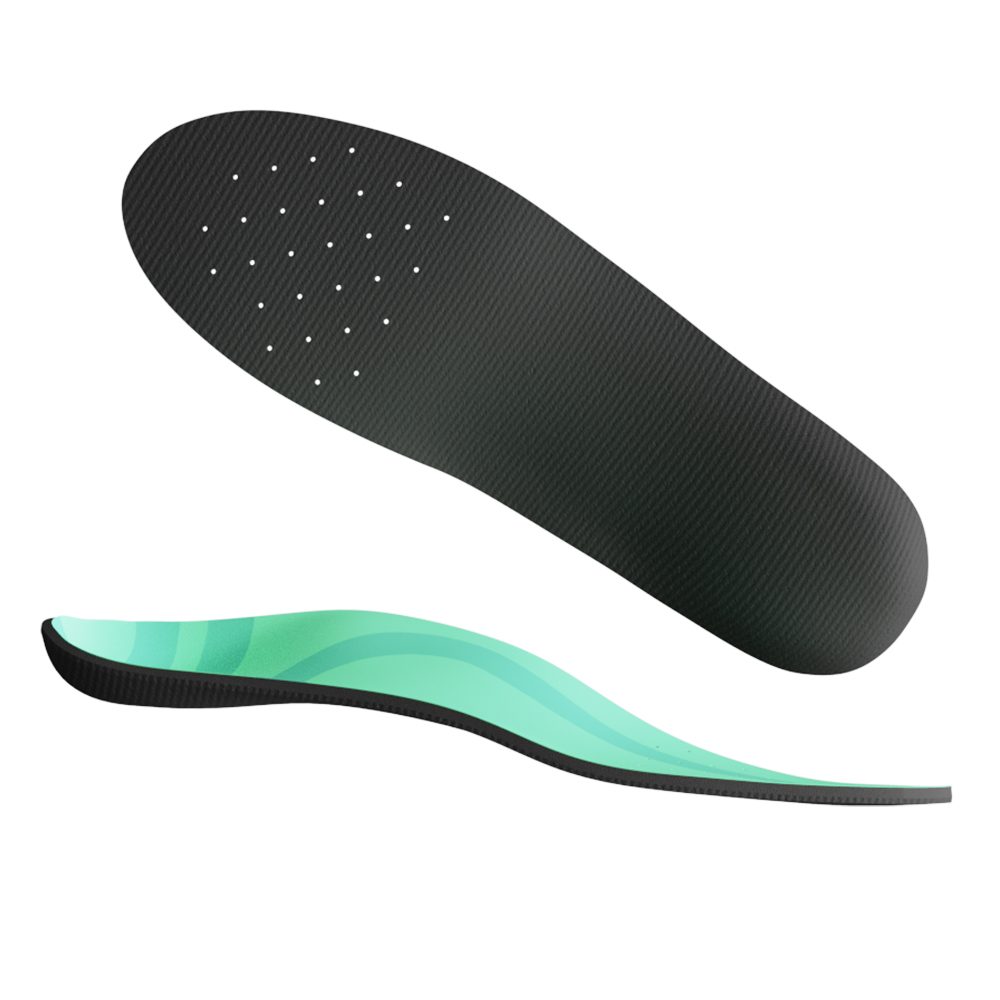
A formed insole is a stack, and each layer has one job. In our daily builds the stack runs from a mesh fabric cover at the top, through an Osolite cushioning layer, down to an AQ polymer forming board at the base, with a heat-activated adhesive underside binding the assembly. The layer that answers the termoformable question is the last one. The forming board is the semi-rigid skeleton: it is the component that softens under controlled heat, takes the contour of the pillow or model, and keeps that contour through daily loading. Everything above it either manages the skin interface or manages shock.
This division of labour explains most product differences that buyers find hard to articulate. A build with a substantial forming board holds its contour for a long service life and feels structured underfoot. A build where the cushioning layer does most of the work feels plusher on day one and gives up its shape earlier. Neither is wrong; they are different answers to different customers. But a buyer who understands the stack can read a sample in thirty seconds instead of relying on the catalogue adjective.
The sport series adjusts the stack for its purpose. Support, anti-torsion, cushioning and starting ability are graded independently, so a basketball build and a golf build can share the same fabric and the same general architecture while differing sharply in how much the skeleton resists twist and how the cushioning is distributed. When a formed contour is added on top of that graded structure — as happens in on-site customisation — the shape and the behaviour are specified separately, which is exactly what makes the result predictable across a batch.
For the retailer, the practical takeaway is a habit: when a supplier says thermoformable, ask which layer forms. If the answer is a named structural board with a defined role, the word means something. If the answer is a shrug or a promise about the whole stack, the word is decoration. We answer the question the same way every time because the stack is the same every time, and we would rather a buyer quote the stack back to us than quote the adjective.
The forming cycle in the shop, step by step
When on-site customisation runs in a store or a clinic, the cycle has four beats, and the first one is not heating at all. The record comes first: an assessment session captures the pressure distribution, the footprint, the force line through the lower limb, and the arch presentation, and a professional reads that record and decides what the build is meant to do. Only then does the physical work begin. Skipping the first beat is the most common shortcut in the trade, and it converts a fitted product into a shaped one — shaped to a pillow rather than fitted to a person.
Heating comes second. The blank goes into the heating box for a fixed interval, long enough for the forming board to become workable. The interval is written down and kept the same every time, because an under-heated blank never takes the full contour and an over-heated one marks its cover layers. Third comes forming: the warmed blank is seated over the shaping pillow — adult or children’s size depending on the customer — and pressed until the contour takes. Fourth comes setting: the pair rests until it is stable before it is trimmed, covered where needed and checked against the specification.
The elapsed time matters more than the machine time. The forming itself is a few minutes; the cooling and finishing around it decide how many appointments a day the room can honestly hold. Workshops that book against the press cycle alone run late by the middle of the first week, and the lateness shows up as lifted pairs — because somebody pulled a blank off the pillow early to catch up. The schedule is part of the equipment, and buyers who accept that run calm rooms.
One habit separates good on-site operations from mediocre ones: letting the customer watch. The forming step is visible, physical and quick, and a customer who sees a flat blank take a contour over a pillow understands the product in a way no leaflet achieves. It is worth arranging the room so the forming happens in view — and worth never rushing the setting in front of the customer, because the pair they watch being hurried is the pair they will judge the whole visit by.
Which stages stay in the shop and which go back to the factory
The split follows the appointment, not the ambition. In the shop stay the stages that attach to a customer sitting in the chair: the assessment, the reading of the record, the forming cycle, the trimming and fitting check. These are short, personal and profitable per visit. Back at the factory go the stages that scale: producing the blanks themselves, laminating the stacks, holding the size range on the shelf, building volume orders for the range that sells without an appointment. A shop that tries to absorb factory stages hires for capacity it uses twice a week; a factory that tries to do shop stages by courier loses the visit that justified them.
Our own operation sits deliberately on both sides of that line. The plant produces the FX range at volume — roughly five hundred to a thousand pairs a day across the three series — while the customisation module that pairs with our assessment equipment brings the forming step into the store. Buyers sometimes read those as alternatives, in-house versus outsourced, and the honest answer is that almost every working retailer runs both in the same month: formed pairs for the appointment book, factory pairs for the shelf, and a reorder rhythm that connects the two.
The connection is worth writing down before the first order. A shop needs to know which styles and sizes it forms locally and which it pulls from stock, how quickly a sample order ships — ours leave within three days — and what the minimum order looks like: two hundred pairs, mixed styles and mixed sizes, so the shelf can carry the range without the cash tied up in depth. ODM and OEM work are accepted on the insole side, which lets a retailer build an own-label line on the same stack and the same forming workflow.
The retest closes the loop and is the part most often left unplanned. A formed pair delivered today deserves a comparison record in a few months, taken with the same routine as the first session, and the comparison only means something if both records were captured the same way. Shops that book the retest at handover — the same way dentists book the next appointment before the patient leaves — build a returning customer base without discounting, because the record gives the customer a reason to come back that is about them rather than about price.
Sport use: why the sport series is ordered by sport
A formed contour is only half of a sport build; the other half is behaviour under the specific demands of the game. That is why the sport series is ordered by sport — running, football, basketball, cycling, racket sports, golf, skiing, skate, outdoor and fitness each sit in their own slot — rather than sold as one athletic product. The loads differ in direction and timing: a racket player repeats lateral pushes, a cyclist loads the forefoot in a fixed position, a golfer rotates through the lead foot. The four grading scales exist so that those differences can be specified instead of guessed.
The pairing of record and build matters most in this series, because sport customers arrive with opinions and leave with verdicts they act on. A gait or pressure session before the build gives the fitter a document to specify against — where the load peaks, how the foot axis travels, how the two sides compare — and the same session routine repeated after a break gives both parties a fair comparison. The equipment produces the record; the interpretation belongs to the qualified professional in the room, and we keep that line bright in everything we publish.
Retailers sometimes ask whether a sport customer needs the formed pair or the shelf pair, and the honest answer is that the appointment decides. A customer whose demands sit within the graded range is often best served from the shelf, tried in the shoe that matters. A customer whose record shows something the shelf range does not cover is the case for forming on site. What the shop should not do is form first and assess later, because a contour imposed on the wrong behaviour grade is a well-made mismatch.
Wear and honesty belong in the same conversation. High-intensity use shortens the service life of any formed build and reduces its support and cushioning over time — our own handbook says so plainly — and a sport retailer who tells customers that at the point of sale earns the reorder rather than the complaint. Daily wear sits in a different band from hard training, and the difference is a product fact, not a defect, however a competitor’s catalogue may phrase it.
What we state plainly from the factory side
Three statements, because this phrase attracts more than its share of soft talk. First: we do not publish prices in an article, because a quotation depends on the configuration, the quantity and the destination, and a figure printed here would be wrong for nearly every reader. What we state is structure — minimum orders, sample timing, capacities — and a buyer who sends a configuration gets a quotation, which is the order a commercial conversation should follow.
Second: the equipment and the insoles do not make promises about outcomes. A formed pair is specified to support, to distribute load, to align — structural verbs — and whether that is the right intervention for a particular foot is the professional’s call, made with the record in hand. We do not write copy that promises a customer will run faster or hurt less, and we ask our retail partners to hold the same line, because the line is what keeps the category credible.
Third: we are a manufacturer, not a trading company, and the thermoforming workflow in this article runs on our own floor, not a supplier’s. Machines accept ODM; insoles accept ODM and OEM; every machine is tested at the plant for seven days before dispatch and carries a twelve-month warranty against non-human damage, with after-sales through a dedicated WhatsApp group where engineers answer directly and remote assistance is available. A buyer who wants to see the process before ordering can watch it — at the stand or in the room — which is the advantage of buying from the people who run it.
What we offer beyond the hardware is the conversation this article has tried to model: replace the market word with the stack, the cycle, and the split of stages, and then decide. A retailer who can quote those three things back to any supplier is immune to catalogue adjectives, including ours.
Frequently asked questions
What does termoformable actually mean on a product listing?
It is a market word for the heat-forming step: a semi-rigid forming board inside the insole is warmed, seated over a contour, and pressed while it cools so it holds the shape. It describes that a forming happened, not which layer did the work or how the contour was chosen — so the useful follow-up question is which layer forms.
Which layer takes the contour in your builds?
The AQ polymer forming board at the base of the stack. Above it sit a mesh fabric cover and an Osolite cushioning layer, which manage the skin interface and shock but do not hold the contour. The board is the skeleton: it softens under controlled heat, takes the shape of the pillow or model, and keeps it through daily wear.
Can the insole be re-formed later?
A formed pair can be refreshed in the right conditions, but it is not designed to re-shape itself on the foot or to be re-formed casually at home. Refreshing belongs to the shop, with the heating box and the fixture, and makes sense mainly when the original specification needs to be revisited by the professional who read the record.
Does the customer need an assessment before forming?
Yes. The record — pressure distribution, footprint, force line, arch presentation — is what the specification is written against, and its interpretation belongs to a qualified professional. Forming without a record produces a pair shaped to a pillow rather than fitted to a person, which is the most common and most expensive shortcut in the trade.
What stays in the shop and what comes from the factory?
Assessment, reading, forming, trimming and the fitting check stay with the appointment. Blanks, laminated stacks, the shelf range and volume orders come from the factory. Most working retailers run both in the same month: formed pairs for the appointment book and factory pairs for the shelf.
What are the order terms for the insole range?
Insole orders start at two hundred pairs, mixed styles and mixed sizes, with samples shipped within three days. ODM and OEM work are accepted on the insole side. The daily-wear service life of a formed build shortens under high-intensity sport use, which we state at the point of sale rather than after.
Do you claim the insole will relieve a particular complaint?
No. The builds are specified in structural terms — support, anti-torsion, cushioning, starting ability, and a contour fitted to a record. Whether a formed pair is the right intervention for a particular foot is the judgement of the professional running the session, and our reports and marketing keep that responsibility where it belongs.
What we would do next
Take one supplier’s thermoformable listing and ask the three questions this article set up: which layer forms, how the contour was chosen, and which stages stay in the shop. Then ask us the same three, through the contact page, and compare the answers rather than the adjectives. The insole range page lists the three series and the four grading scales a build can be specified against.
For the surrounding workflow, heat moldable orthotic insoles and heat-mouldable custom insoles cover the forming question from the product side, while a custom moulded insole begins with a mould explains what the contour actually sits on. Custom orthotic insoles for sport and orthotic sport insoles are ordered by sport carry the sport-series logic further, and in-house or factory maps the stage split for a retailer deciding where forming belongs.
This article is intended for professional and educational reference. It is not medical advice. Foot assessment equipment produces measurements and images; clinical interpretation and any decision about care remain the responsibility of a qualified professional. Certification scope is limited to the documentation we hold: European Union certification and ISO quality system certification.