
A pair of heat moldable orthotic insoles is decided in under an hour at the counter, and most of that hour has nothing to do with heat. The forming cycle runs through six steps — a measurement record, a base structure and grade, heating, forming, cooling and trimming, then delivery with a recheck — and each step hands a specific responsibility to the next. Buyers usually arrive asking about the heating step because it is the most visible one. The steps before and after it decide far more: the record fixes what the shell should support, and the cooling step fixes whether the shell stays where forming put it. This guide walks the full cycle for the FX custom insole line and is written for shoe-store fitters, clinic staff and distributors who need to know which steps belong at the counter and which belong in a factory.
“Heat moldable orthotic insoles” is the phrase the market uses for any insole with a forming board that softens under heat and stiffens again as it cools. The phrase describes one step of a longer job, not the whole job. A board that can be shaped is a material property; an insole that holds the right support position under a particular foot is the outcome of the entire cycle, starting well before the sheet goes into the heater. The sections below take that cycle apart one step at a time and point out where each step most often goes wrong.
The cycle starts with a record, and the record picks the structure
The FX line is built as biomechanically assessed custom insoles: the assessment and the insole are one programme, not two purchases. Data capture runs on BODYFIT AI assessment combined with senthmetic flexible-fabric sensing technology, and the manual specifies that the insoles are shaped on specific equipment from the data features — in our configuration, together with the X5 biomechanical detection and customization system. That record answers the questions the forming step cannot: which regions of the foot carry the heaviest load, how the arch behaves under weight, how the two feet compare. The manual’s own design notes concentrate on the loaded regions — the first through third metatarsal zones and the inner and outer heel — and those are exactly the regions a forming cycle alone has no opinion about.
The record then drives two selections. The first is the series: daily comfort, rehabilitation care or sport, each with its own build directions. The second is the grade. Every FX insole carries four build grades — support level, anti-torsion level, cushioning level and starting ability level — and these are read off the record rather than chosen by preference. A wearer whose record shows load stacking through the midfoot reads a different support grade from one whose record shows forefoot loading, even if both end up with the same visible outline.
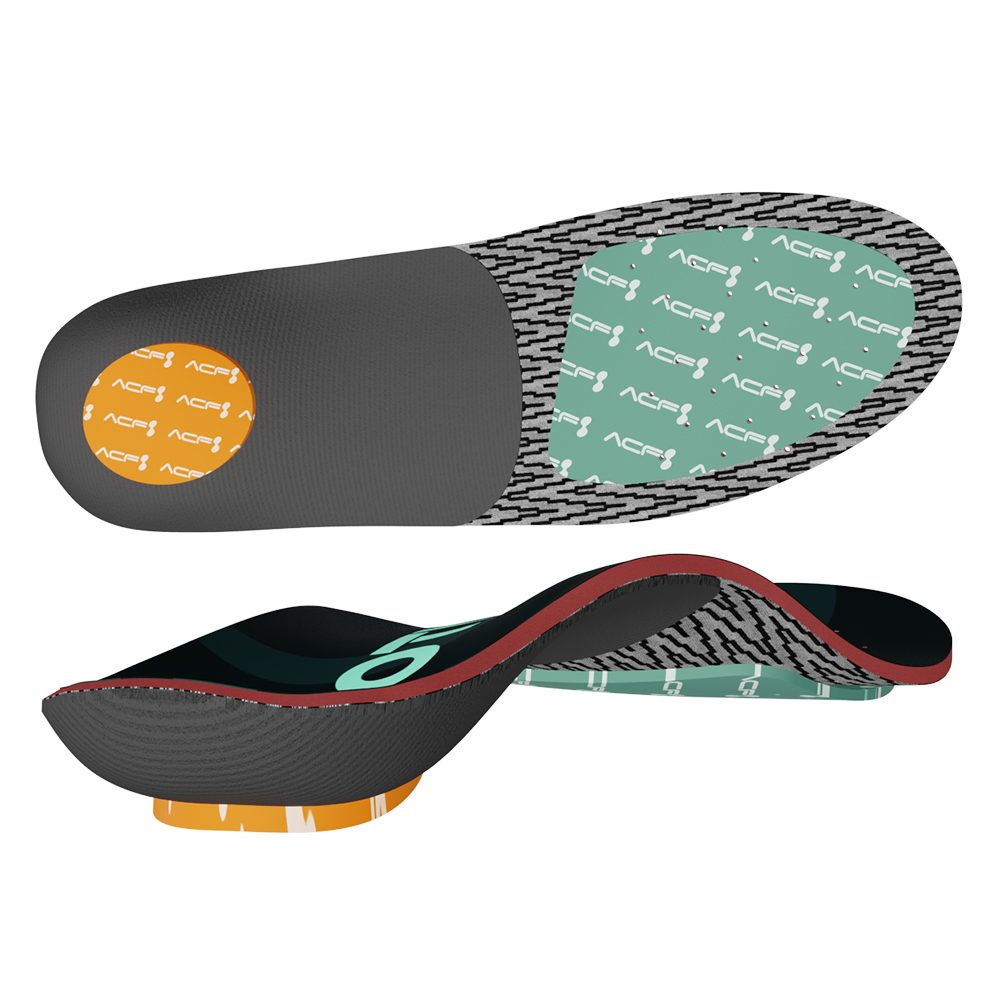
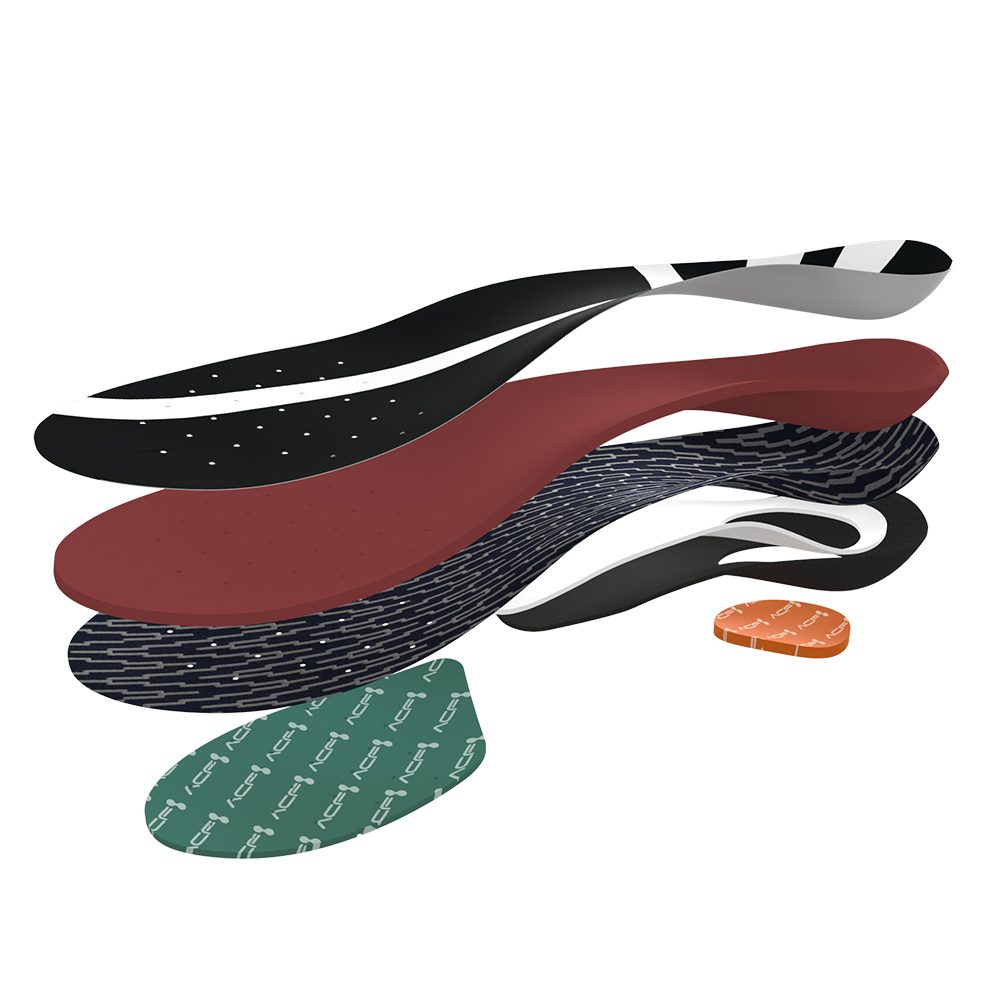
The structure that gets heated is a stack, and each layer has a different job: a fabric top for contact and moisture, an Osolite cushioning layer, and an AQ polymer forming board that becomes the shell. Distributors sometimes read the grades as packaging, and we understand why — nothing on the shelf shows the difference. In pre-sales conversations we keep coming back to the same explanation: the grades describe how the stack is built and how stiff the forming board is specified, and the record is what justifies each choice. Without the record, the grade is a label; with it, the grade is a specification the forming step has to respect.
Heating: what should soften, and what should hold its shape
The heating step is where the two materials in the stack behave differently, and telling them apart is the whole skill. The AQ polymer forming board is the material that is meant to soften: it goes from a flat, stiff sheet to one that drapes under light pressure, ready to take the posture the fitter sets. The Osolite layer is not the material being formed. It is meant to survive the same heating pass without taking a set — it stays a cushioning layer, and if it slumps or thins during heating, the pass has gone on too long or been run too close for that stack.
The practical sign of readiness is a change in how the board handles, not a reading on a dial. On a production visit to our Ruichang plant, the operator running the forming station checked each sheet by feel and drape before it ever met a mould — lifting it by one end to see how it bowed under its own weight, and pulling it from the heat the moment the stiffness dropped. When we asked how long a sheet should stay in, the answer was that the clock only sets the outer bound; the sheet itself announces when it is ready. That judgement is teachable in an afternoon, which is one reason the on-site customization module works in a store at all — but it does need to be taught, not guessed.
What goes wrong at this step is almost always the same two things. One: the stack is heated as one object and the cushioning layer is treated as if it were also forming material, which costs the finished pair part of its cushioning before it is ever worn. Two: the board is worked while it is past its working state — floppy rather than drapeable — so it takes an impression too easily, including impressions nobody intended, such as the curve of the surface it was rested on. Both errors are invisible at the counter and show up only when the wearer reports that the support sits differently from what the session promised.
Forming and cooling: where the support position is actually decided
Forming sets the posture; cooling locks it. On the FX on-site module, the heated stack is formed against the foot with the forming pillow set holding the foot in the posture the record called for, and the board takes that shape as it cools. This is the step where the shell’s position is fixed for the life of the pair, and it is also the step with the least forgiving window. If the foot shifts during setting, the board remembers the shifted posture just as faithfully as it would have remembered the correct one. If the forming pillow set is skipped because the queue is busy, the fitter is asking the wearer to hold still unaided, and most wearers cannot.
Cooling deserves more patience than it usually gets. The shape is not final when the board stops feeling warm to a quick touch; it is final when the material has fully stiffened through. Trimming before that invites drift — the edges pull as the cutter works, and the arch line that looked right at the bench moves by the time the insole is slipped into the shoe. We had a store on the support WhatsApp group that kept re-fitting the same customer because the arch contact felt different every visit; walking through their sequence call by call, the engineer found they were trimming warm and finishing the fit in the shoe before the board had set. Nothing was wrong with the equipment. The order of the last two steps had been swapped.
Trimming itself is a fitting decision, not a tidying job. The trim line decides how the shell interacts with the shoe — a shell trimmed tight to the shoe’s footbed outline behaves differently from one trimmed proud of it — and the arch edge is the line most worth leaving conservative until the fit check. The delivered pair should be checked in the actual shoe, on both feet, after the board has cooled, with the record from the first step open beside the fitting. The recheck closes the loop: the session produced a record, the cycle produced an object, and the two are compared before the customer walks out.
When heat moldable orthotic insoles are the right call, and when a graded pair is enough
Heat molding earns its place where the fitting is the product: a one-off pair shaped at the counter, delivered in the same visit, for a wearer whose needs sit within what a forming board can express — posture setting and load spreading through the shell. The on-site module covers assessment, shaping and delivery in one session, which is why shoe stores, gyms and foot-care shops build the module into their flow rather than sending every customer away for a week.
There are cases where the forming step should not be asked to carry the job. A high support requirement, a sport-specific build, or an order of many pairs does not belong at a counter — it belongs on the factory line, where the series, the four build grades and the structure are specified against the record before anything is heated. The FX line is designed for both: the on-site module handles the immediate fitting, and the factory programme — with a minimum order of two hundred pairs that can mix models and sizes, ODM and OEM accepted, and samples dispatched within three days — handles the batched production against a specification. Buyers at trade fairs sometimes ask which of the two is the “real” custom method; the honest answer is that they are different jobs. The counter sets the fit, the factory sets the structure, and the two meet in the record.
Delivery is not the end of the cycle either. The manual is explicit that a first-time wearer may feel the insole before feeling comfortable in it, and that wear time should be extended gradually rather than all at once — that instruction is part of the delivered pair, not an afterthought. It is equally explicit that daily wear runs on a defined service life, and that sustained high-intensity sport shortens it along with the support and cushioning behaviour, so the recheck conversation should include when the pair is due for review rather than presenting the insole as a fitting that never needs review. An insole handed over with a wearing-in plan and a review date is a fitting; an insole handed over in a bag is a sale.
Frequently asked questions
What are the four build grades on the FX line?
Every FX insole carries four grades: support level, anti-torsion level, cushioning level and starting ability level. They are read from the assessment record rather than chosen by preference, and they describe how the insole is built — how the forming board is specified and how the layers are stacked. A record that shows load concentrated through the midfoot justifies a different support grade from one that shows forefoot loading.
What do the AQ forming board and the Osolite layer each do?
The AQ polymer forming board is the shell: it softens under heat, takes the posture set during forming, and stiffens again as it cools, which is what holds the support position. The Osolite layer is the cushioning layer: it is not meant to take a set during the heating pass. If the whole stack is treated as forming material, the pair loses cushioning before it is ever worn.
Can heat moldable orthotic insoles be shaped in a store, or only in a factory?
Both, and they do different jobs. The on-site customization module — assessment, heating box and forming pillow set — covers a one-off pair shaped and delivered in the same visit. The factory line handles batched production where the series, grades and structure are specified against the record first, with a minimum order of two hundred pairs that can mix models and sizes and samples dispatched within three days.
Is there a wearing-in period for a newly formed pair?
Yes. The manual notes that a first-time wearer may feel some discomfort initially and that wear time should be extended gradually. We treat that instruction as part of the delivery: the fitter explains the wearing-in plan at handover, and the fit is reviewed once the wearer has settled into the pair.
How long does a formed pair last?
The manual specifies a defined service life for daily wear and notes that sustained high-intensity sport shortens it, along with the support and cushioning behaviour. We build that into the delivery conversation: the wearer should know when the pair is due for review rather than treating the forming as a fitting that never needs review.
Does the forming cycle replace the assessment record?
No. The record comes first and drives every selection the cycle makes — series, grades and structure. The record is a measurement document read by a professional; it is not a clinical conclusion, and the forming step cannot substitute for it. A pair shaped without a record is shaped to guesswork, however carefully the heating and cooling are done.
What we would do next
Write down which steps you intend to run at the counter and which you intend to buy from the factory — assessment and on-site shaping, or batched pairs specified against records. Send us that split along with your floor space and the staff who will run the session, and we will tell you where the FX on-site module fits your flow and where the factory programme takes over. Our FAQ page carries the order minimums, sample terms and support arrangements in full, and the insole categories page shows the series and build directions the line covers.
If you already run an on-site module and your refits cluster around the same complaint, the cause is usually in the order of the last steps — forming, cooling, trimming, fit check — rather than in the equipment. Send us the sequence your staff currently follow and we will point out where two operators would produce two different shells. For a look at how the insole ranges are organized by series and use, start from the insole categories page.
This article is intended for professional and educational reference. It is not medical advice. Assessment equipment and insole customization produce measurements and products; clinical interpretation and any decision about care remain the responsibility of a qualified professional. Certification scope is limited to the documentation we hold: European Union certification and ISO quality system certification.