
Three listing pages are open on the buyer’s laptop and none of their columns line up. The first page promises a capture in seconds and lists a number it calls accuracy. The second shows a foot rendered as a smooth object that turns under a cursor, and lists a count of points. The third shows a printed report with a coloured sole on it and lists the pages included. All three sit under the same two words typed into the same search bar, and all three use the word technology somewhere in the first paragraph. The buyer is not being careless; the market has given three different trades one vocabulary. This article separates them: the three routes by which a foot is actually captured, what each route measures and what it cannot, how to read a specification page so that the columns start to line up, and the claims we deliberately keep off our own pages — including the one about shape.
Technology is a promise word before it is a specification
In a listing, the word does a job that has nothing to do with engineering. It signals that the product is current rather than dated, and it invites the reader to assume that newer means more complete. That is a reasonable assumption about phones and a poor one about instruments. A foot can be captured in at least three ways, and each way answers a different question; none of them is a later version of another. They are parallel trades that happen to share a market page.
The confusion is compounded by the search behaviour around the word. Buyers type the name of a technology when what they want is a result: a document they can hand to a customer, a file they can send to a milling step, a number they can compare with last season. The listing responds to the phrase rather than to the need, and the buyer concludes that the category is one thing with tiers of quality. It is not. It is three things with different outputs.
A useful first move is to stop reading the adjectives and find the noun. Every one of these systems produces something: a set of values with names, a surface model, a set of angles, a report page. That noun is the product. The technology is only the route to it, and two routes can arrive at the same room without being interchangeable, in the way that a thermometer and a camera can both be pointed at a person.
So the question to carry into any demonstration is not which technology is newer. It is which of the four outputs the buyer’s work actually needs, and whether the session that produces it can be repeated next season under the same conditions. Everything else on the page is decoration until those two are settled.
Route one: load, recorded as a series in time
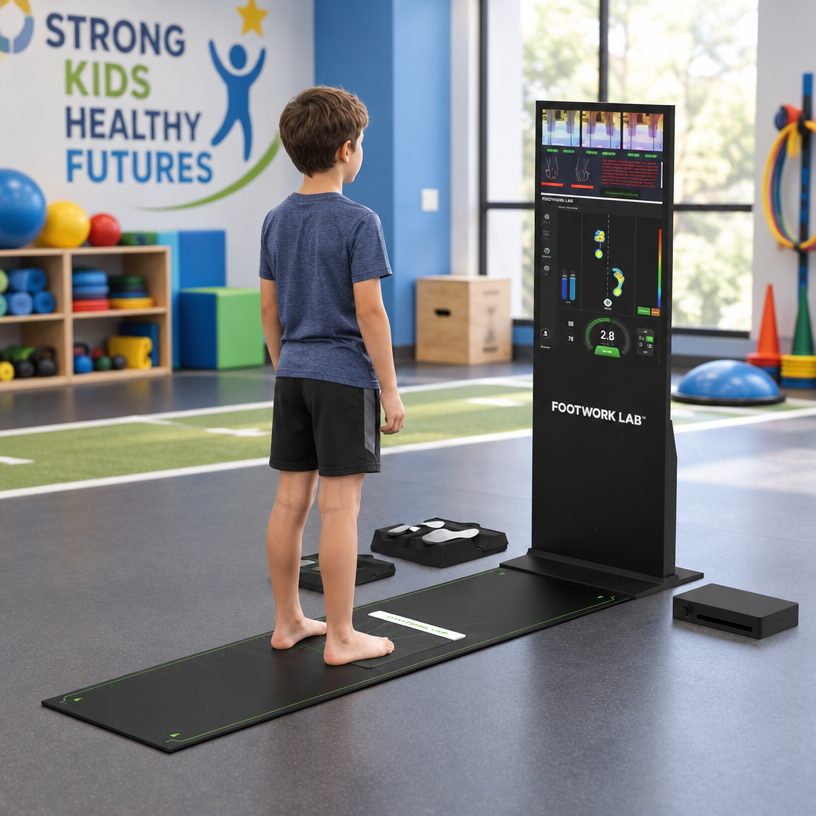
The first route puts a sensing surface under the foot and records how much load passes through each part of the sole, and when. The sensing element in our own units is a woven fabric — Sinmec Fabric — rather than an array of rigid pads, which matters for a surface that a bare foot has to stand and walk on comfortably. What comes out is a set of named quantities: peak and mean pressure by region, contact area, the path of the centre of pressure, the proportion of the step spent in contact and the proportion spent flat.
This route measures behaviour under load. That is a narrower claim than it sounds, and a more useful one than buyers expect. A foot that looks unremarkable standing can produce a very different series once it is walking, and a foot that presents a low arch at rest may behave quite differently under weight. Because the output is a set of values with names, the same values can be put beside the same values from a previous visit, which is what makes a retest worth booking.
What the route cannot do is describe shape. A pressure record says nothing about the outer surface of the foot, the height of the arch in space, or the volume a shoe has to accommodate. It describes an interaction between a foot and a surface, and it is silent about the geometry of the foot itself. Buyers who need a file for a carving or printing step are shopping in a different aisle, and no amount of extra sensors will move them into this one.
It is also worth saying what the route does not decide. A peak value is a measurement, not a finding. Whether a particular distribution matters for a particular person is a judgement that belongs to a clinician, and the software’s job is to present the values clearly enough for that judgement to be made by someone qualified to make it.
Route two: the outline, captured as an image
The second route builds a model of the foot’s outer surface. Buyers search for it under a handful of phrases, and the phrase most of them type names a dimension rather than a method. The hardware behind those listings varies: some project a pattern onto the foot and read its deformation, some use several cameras and solve for the surface, some combine both. The output is broadly similar — a digital surface that can be rotated, sectioned, measured and exported.
Shape is the right answer to a specific family of questions. How wide is the forefoot, how long is the heel-to-ball line, where does the toe box need room, what does the arch look like as a curve rather than as a load pattern. A workshop that builds a shell from a positive model needs that surface, because the model is the thing the shell is formed over. For that workshop, a pressure map is interesting and useless.
Our own units do not take this route, and we say so before the demonstration rather than after it. There is no projected pattern, no surface reconstruction, and no laser in any unit we build. A buyer who has been told that every modern system includes shape capture has been told something convenient rather than true, and the correction is easier to hear in the first conversation than in the third.
The trade is not a matter of quality. A shape capture is silent about load: it will tell you the arch is high and not tell you what happens under it when the person walks. A pressure record is silent about geometry. A clinic that wants both is asking for two instruments or for one instrument plus a casting routine, and pretending otherwise is how buyers end up with a file they cannot use.
Route three: alignment above the sole
The third route points cameras at the person rather than at the sole. A lower-limb camera records heel position, knee tracking and the direction the shin carries as the foot rolls forward; a posture camera records how the column above sits over the base — shoulder level, pelvic tilt, the line through the trunk. What comes out is a set of angles and offsets, described in the vocabulary of alignment rather than of pressure.
This route answers a question the other two cannot: under what structure is the load travelling. The same pressure map means something different beneath a knee that tracks inward than beneath one that tracks straight, and the same arch height means something different under a level pelvis than under a tilted one. Putting the two records side by side is what turns a footprint into a force-line record, and it is the pairing that footwear and insoles are actually specified against.
The camera route has its own limits, and they are optical rather than computational. It sees what is visible from where it stands, in one plane, at one moment. Loose clothing defeats it. A room with a mirror in the line defeats it. A customer who stands differently from how they walked defeats it, which is why the walking capture matters as much as the standing one. None of this is a defect; it is the nature of looking.
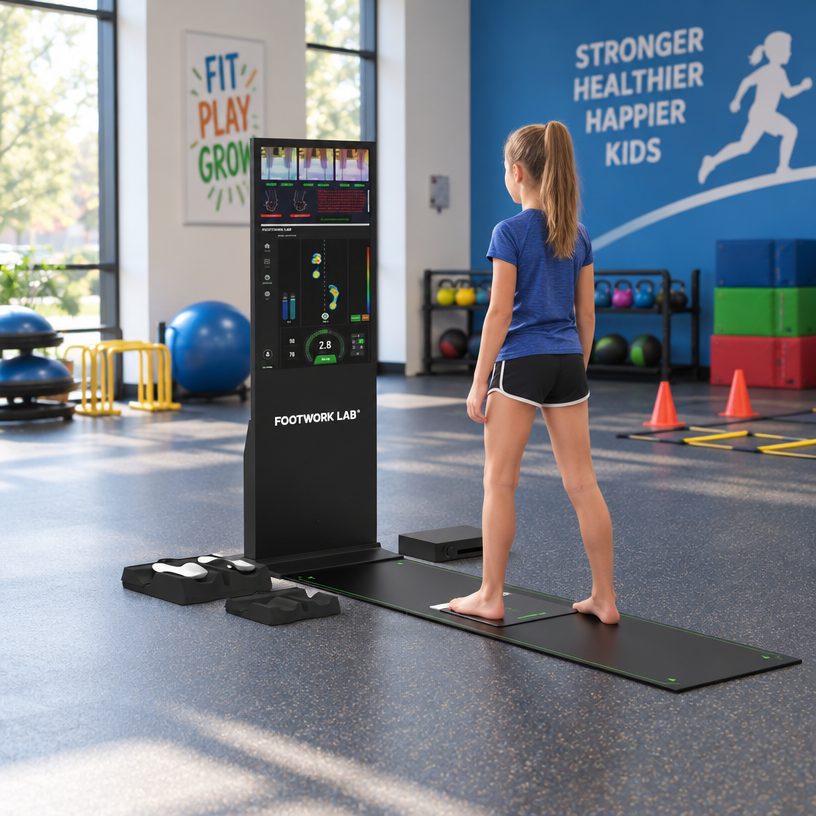
In the X3, the three routes are arranged as a session rather than as a menu: arch assessment and static pressure, a dynamic walking pass, a back-and-forth gait video, lower-limb alignment, and then the insole side of the same visit, where a shoe library has to be loaded before any recommendation can be attached to a pair. The report leaves by code, by email or on paper at the counter.
Reading a specification page without being misled
Five checks will sort most pages in a few minutes. First, are the quantities named and do they carry units? A page that says accuracy without saying of what, measured how, against what reference, is not giving a specification; it is lending the word out. Second, does the page name the document that exists at the end of a session? A report with named items is a different product from a screen with a picture on it.
Third, does the page distinguish what the device does from what the operator concludes? A page that blurs the two is selling an opinion, and the buyer should ask who is accountable for it. Fourth, is the reproducibility of a session addressed at all — the stance instruction, the walking route, the calibration routine? A measurement that cannot be repeated is a photograph. Fifth, is there a stated limit? A page with no limits has either not been written by engineers or has been written to survive a sales meeting.
A short glossary helps here, because the same words travel between trades. Capture is the act of recording; a record is the set of values stored; a report is the arrangement of those values for a reader; a screening is a short session intended to sort, not to conclude; an assessment is a longer session with interpretation attached. When a listing says assessment and means screening, the buyer’s expectation of the document is wrong before the first appointment.
One more habit is worth adopting: read the sample report before the demonstration, not after. The report is the only page in the whole transaction that cannot exaggerate, because every line on it has to be produced by the software in front of a customer. If the sample is a list of named values with a date and a note about who should read it, the machine measures. If the sample is a rendered object, the machine captures shape. If the sample is a paragraph of advice with no values beneath it, the machine is selling a conclusion it cannot support.
What we will not put on our own page
We will not describe our units as shape scanners, because they are not. There is no laser scanning hardware in the range and no surface reconstruction in the software. The shorthand buyers type into search boxes is a habit of the market, and we answer it honestly: the equipment records plantar pressure, alignment and posture, and assembles them into a report. A workshop that needs geometry for a milling workflow should buy geometry, and we will point that out even when it costs us the order.
We will not put a shape accuracy figure on a page, because we do not make a shape instrument and a borrowed number would be a lie with a decimal point. We will not publish prices either, since a quotation depends on configuration, destination and the service wrapped around the unit, and a figure printed in an article is wrong by the time anybody reads it. We will not name other brands or set our units against theirs; the buyer can do that comparison with two sample reports, which is a fairer method than any table we could write.
There is a third refusal that is less dramatic and more useful: we will not answer a question about capability with a demonstration. A demonstration shows a cooperative customer in a quiet room; it does not show the third appointment of a wet Tuesday, when the customer is late and the software has to behave. Ask instead what the routine is, who trains the operator, how a session is repeated, and what the record looks like when the customer returns in six months. Those answers are dull and they predict the second year better than any staged capture.
We will not use the language of diagnosis. Reports contain recorded values, and the reading of them belongs to a qualified professional. Where a page elsewhere promises that a scan will identify a condition, the promise has quietly moved from measurement into medicine, and the equipment has not moved with it. That distinction is the whole reason this article exists.
What we will put on the page is the unglamorous part: which quantities are recorded, what the session involves, how the routine is standardised, what the warranty covers, and what happens when a unit misbehaves in the second year. Those lines are dull, and they are the ones a buyer can plan against.
Frequently asked questions
Is foot scanning technology one category or several?
Several. The phrase covers at least three routes: load recorded over time, the outer surface captured as an image, and alignment read by cameras. Each produces a different document and answers a different question, and none is a later version of another.
Does a pressure record include the shape of the foot?
No. It records how load is distributed and how that distribution changes in time. Footprint length and width appear in the report, but the outer surface, arch height in space and the volume a shoe must hold do not. A workshop building from a positive model needs a different instrument.
Do your units use a laser?
No. There is no laser in any unit we build and no surface reconstruction in the software. Our equipment records plantar pressure through a woven fabric sensing surface, plus alignment from a lower-limb camera and a posture camera, and assembles those into a report.
Why do listings quote accuracy without saying of what?
Because a number with no referent sounds like rigour and invites no question. Ask what is being measured, against which reference, and under what conditions. If the answer does not arrive in a sentence, the figure is decoration.
What is the difference between a screening and an assessment?
A screening is a short session that sorts people into rough groups and is explicit about being indicative. An assessment is longer, records more, and carries interpretation by a qualified person. Confusing the two sets the wrong expectation of the document before the first appointment.
What does the X3 record in one visit?
Arch assessment, lower-limb alignment, static pressure, a dynamic walking pass with gait video, and the insole side of the session, where a shoe library must be loaded before any footwear recommendation is attached. The report can leave by code, email or print.
Can a specification page be trusted at all?
Partly. Named quantities, a stated routine, a sample report and a declared limit are all checkable. Adjectives, borrowed accuracy figures and claims about outcomes are not. Read the sample report first and the specification second.
What we would do next
Send the two listing pages you are comparing — ours or anyone’s — through the contact page, and we will tell you which family each one belongs to and which question it will fail. That answer is free and occasionally ends with us recommending a different supplier.
The X3 system page lists what the session records, including the insole side and the shoe library requirement, in the equipment’s own terms. For the argument in longer form, three ways to capture a foot sets out the three trades side by side, plantar 3D scanning is a search term takes the naming question apart, and 3D foot measurements examines what a measurement can and cannot settle once it exists.
This article is intended for professional and educational reference. It is not medical advice. Foot assessment equipment produces measurements and images; clinical interpretation and any decision about care remain the responsibility of a qualified professional. Certification scope is limited to the documentation we hold: European Union certification and ISO quality system certification.