
Every shoe shop on the street has one: the metal gauge at the door, and the assistant who slides it under the heel and reads the length out loud. The customer stands on it, hears her number, and carries it through the whole store like a passport. It is a good instrument and an honest one, and it answers a real question with real precision — how long is this foot, standing still, on a flat plate, today. The trouble starts with the questions it was never built to answer, because most of what makes a shoe work or fail happens after the measuring stops.
Retailers already know this in their bones: two customers with the same length wear entirely different shoes, and the same customer can need a different fit standing at the counter than she does walking to the bus. This piece is written for shoe retailers, distributors and the clinics that work alongside them: what the sizing gauge genuinely delivers, what it cannot see by design, and where a quick foot screen earns the corner of floor it occupies — without turning the shop floor into a clinic, which it should never try to be.
What the gauge answers, and what it cannot
Give the gauge its due before criticising it. Length is the foundation of fit, measured reliably and quickly, and no screen will ever replace it. A customer who knows her measured length shops better than one who guesses, and the gauge settles arguments between brands whose size labels disagree. Everything the gauge does, it does well, in the hands of any assistant, in seconds.
What the gauge cannot do is watch the foot behave. Length is a static, unloaded, two-dimensional fact about one instant. It says nothing about how wide the foot becomes when it takes weight — and feet spread under load, some of them considerably. It says nothing about the arch: whether it holds its shape standing or gives way, and how that changes between standing and walking. It says nothing about where the weight actually lands — heel, midfoot, forefoot, inner edge or outer — which is the single most useful fact a fit conversation can have. And it says nothing about how the foot moves through a step, which is the state the shoe spends most of its life containing.
The gap explains a familiar retail scene: the customer who buys her measured size, wears the shoes anyway, and reports a fortnight later that they never quite worked. Nothing was measured wrongly. The question that mattered — how does this foot behave under load and in motion — was simply outside the gauge’s jurisdiction, and nobody in the store had an instrument that answered it.
The first action costs nothing and needs no equipment: start noting, mentally or on the fit card, which customers return with shoes that “never quite worked”. The pattern in those returns is the business case for the screen — not the technology, the pattern.
What a quick screen adds
A screen is not a clinic appointment and must never pretend to be one. What it adds is a set of observations the gauge structurally cannot make, captured quickly, in the shop, while the customer is already standing there. Three states matter: standing, leaning, and a few steps of walking.
Standing shows how the foot takes weight when it settles: how the arch behaves under load, whether both feet agree with each other, and how the weight distributes across the plantar surface. Leaning shows what happens when weight shifts forward, which is the state every step begins from and the state most fits never observe. A few walking steps show the roll — how the foot loads and unloads, where it pushes off, whether the two feet work the same way or have quietly divided the labour years ago. Together, those observations answer the question the gauge cannot: not how long the foot is, but how it behaves.
In practice this is where a compact foot screening device such as a podoscope earns its corner: it turns those observations into images and records a screen can hand the customer, in a minute or two, without undressing the process in ceremony. The device produces pictures and measurements. What they mean is a question for a qualified professional — and the well-run shop says exactly that, every time, which is as much a part of the screen’s value as the images themselves.
Notice what the screen does not do. It does not diagnose. It does not replace the gauge — length still gets measured, first, by whoever runs the fitting. It does not turn the assistant into a clinician, and the moment a shop allows that drift, the screen stops being an asset and becomes a liability wearing a white coat.
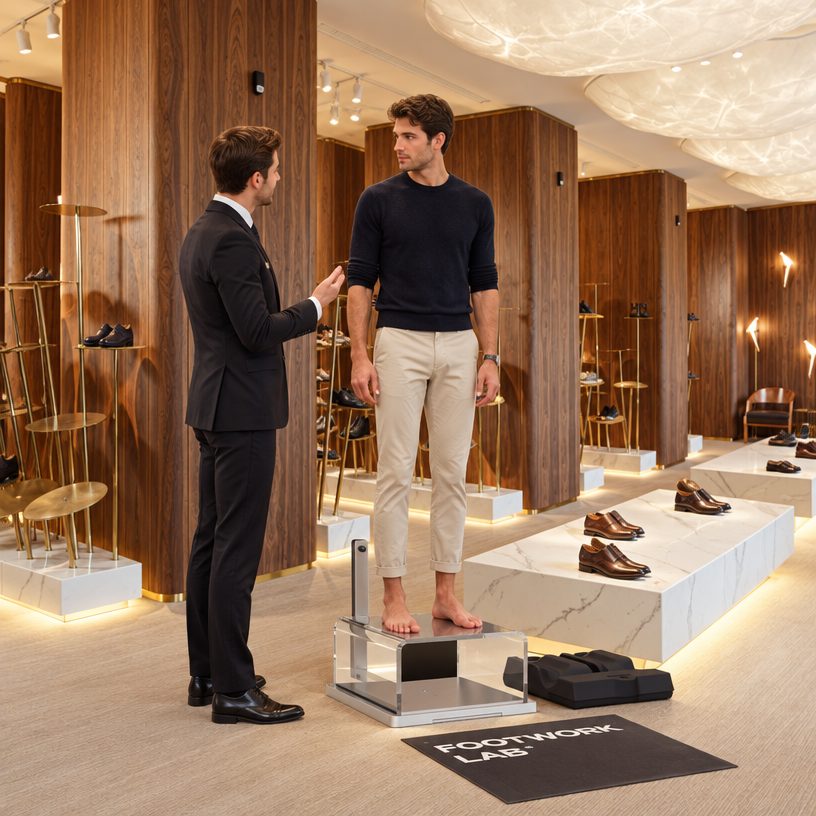
Where the screen sits in the shop flow
The screen succeeds or fails on where it sits in the shop’s routine, and the wrong placement kills it in a month. The right placement is simple: after the length measurement, before or alongside the shoe selection, and short enough that it never becomes the queue’s bottleneck.
The order that works: gauge first, screen second, shoes third. The gauge establishes the foundation and takes seconds. The screen adds its observations while the customer is already engaged and already curious — she has just watched her own feet make pictures, and the images hold her attention in a way no poster ever will. The shoe selection then proceeds with more information in the conversation: width as it behaves under load, the arch’s habit, the fit characteristics the day’s models actually offer. The screen feeds the fitting conversation; it does not interrupt it.
Two operational decisions decide whether the corner survives its first quarter. First, the timing budget: a screen that takes a couple of minutes fits a shop; one that turns into a consultation does not, and staff will quietly stop offering it the first week it causes a queue. Decide the budget, write it on the wall beside the device, and hold it. Second, the handoff language: what the assistant says when the screen shows something worth a professional’s time. That sentence needs writing down, training, and rehearsing, because it is the single moment where a shop either stays a shop or drifts into pretending to be a clinic.
Rooms that already run quick screens at the rack will recognise the discipline from Between the Shoe Racks: Quick Screens Where Shoes Are Sold — the technology changes little; the placement, the timing budget and the handoff language are the whole game.
Reading the screen without diagnosing
The screen produces images. The discipline of the shop is to describe them, not to interpret them, and the difference is the line every member of staff has to be able to walk without looking down. “Your weight sits more on the outer edge of the right foot than the left” is a description, and any assistant can deliver it. “That suggests you overpronate and need a support shoe” is an interpretation, and it belongs to a qualified professional, in a consultation, with the whole picture in hand.
Three habits keep the line clean. First, describe in pairs: what the screen shows, and what the customer can do with that information — “here is the picture, and this is the kind of professional who reads these for a living”. Second, never name conditions. The vocabulary of conditions belongs to the consultation, and a shop that starts naming them has crossed a line it cannot see from the inside, with consequences it will meet eventually. Third, write what was shown on the fit card: date, the images shared, what was described. A card with the screen’s output travels with the customer into the fitting, into the professional’s room if she goes, and into next season’s visit — where the comparison between this year’s picture and last year’s does more for her than any single visit does.
Staff training is where the discipline lives or dies. Rehearse the descriptions until they are boring: the same sentences, the same structure, every customer. Boring is the goal. A screen whose observations arrive in consistent, describable form is a service the customer can trust and compare; a screen whose commentary depends on who is standing behind the counter is a lottery, and customers notice lotteries faster than shops do.
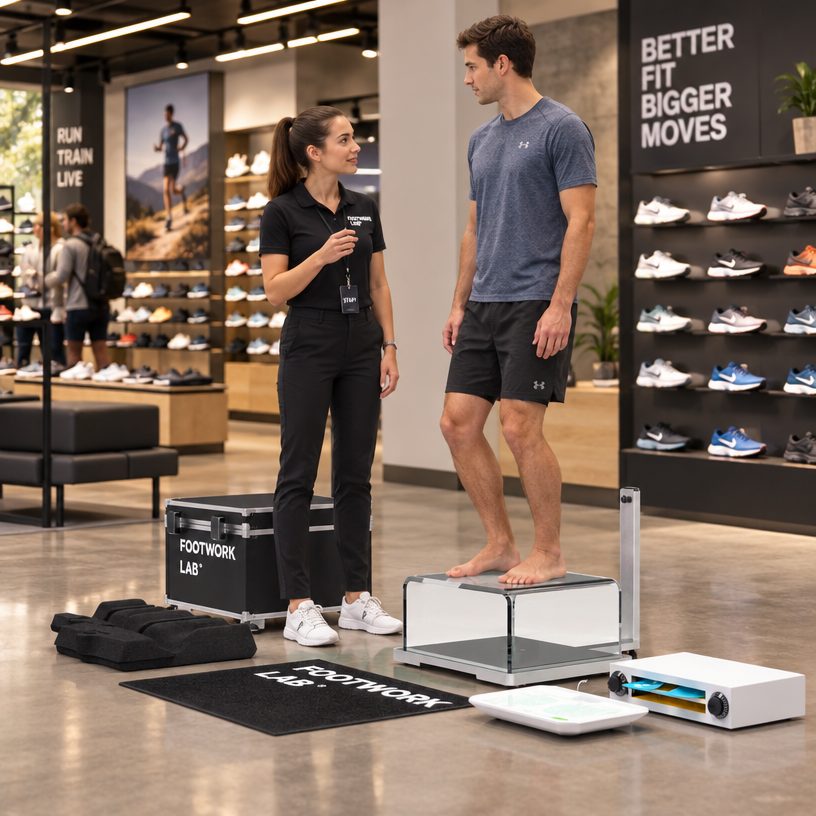
What to say when the screen shows something
Sooner or later, every screened foot shows something the shop cannot answer: one foot behaving differently from the other, weight landing somewhere unusual, an arch that gives way standing and recovers walking. The handoff sentence is the most important sentence in the whole operation, and it deserves to be written down rather than improvised.
The structure that works has three parts. Describe what the picture shows, plainly: “the screen shows your right foot taking weight differently from your left”. Name the boundary honestly: “what that means is not something we can tell you here — that is a question for a foot professional”. Offer the next step without pressure: “if you want, we can note this on your card so you have the images and the date to take with you”. Three sentences, no diagnosis, no condition names, no recommendation to buy anything in the shop as a solution — because a fit changed under fear of a finding is not a fitting, it is a sale wearing a fitting’s clothes.
Rehearse the sentence in the exact words, with new staff and with veterans, because under a queue the improvised version always drifts toward interpretation. The drift is subtle and always the same: “showing something” becomes “maybe you need” in one breath, and the shop has made a clinical claim it is not licensed to make, to a customer standing on its floor. The written sentence is not bureaucratic caution; it is the thing that keeps the screen an asset.
The same boundary holds in rooms that are clinics — the reading belongs to the qualified professional holding the file, whatever the room is selling. We have looked at that division from the clinic side in Standing Sideways: The View a Pressure Map Cannot Give You, and the principle is identical from the shop side: images travel, interpretation stays with the professional.
Training the team to run the corner
The screen’s results depend less on the device than on the person standing beside it, and the training plan is where the shop decides which it gets. The plan does not need to be long, but it does need to be written, because every part of the corner’s discipline — the order, the timing, the descriptions, the handoff — collapses into improvisation the moment it is left to memory.
Four things every member of staff needs before their first screen. The order: gauge, screen, shoes, always, so the customer’s experience is identical whoever serves her. The timing budget and what to do when it is threatened — how to close a screen politely when the queue builds, and when to offer a return visit instead of extending. The description sentences, rehearsed aloud: the same structure every time, first what the picture shows and then where a professional can take it further. And the handoff sentence, learned word for word, because the improvised version drifts toward interpretation within one busy Saturday.
Rehearsal matters more than documentation. Ten minutes of role-play — one colleague as the customer, one as the assistant, a scripted unusual finding — teaches more than a printed procedure ever will, and it surfaces the exact moments where enthusiasm wants to fill a silence with a diagnosis. New starters run their first screens alongside a colleague for a week. Veterans sit in on the rehearsal too, because drift is not a new-staff problem; it is a queue-pressure problem, and it reaches everyone.
Then audit lightly and often: once a month, listen to one screen end to end, and check the fit cards afterwards. The audit is not surveillance; it is quality control for a service the shop has decided to be known for. Shops that audit keep the corner’s promise intact season after season, and the customer’s trust in the images — which is the whole asset — survives on exactly that consistency.
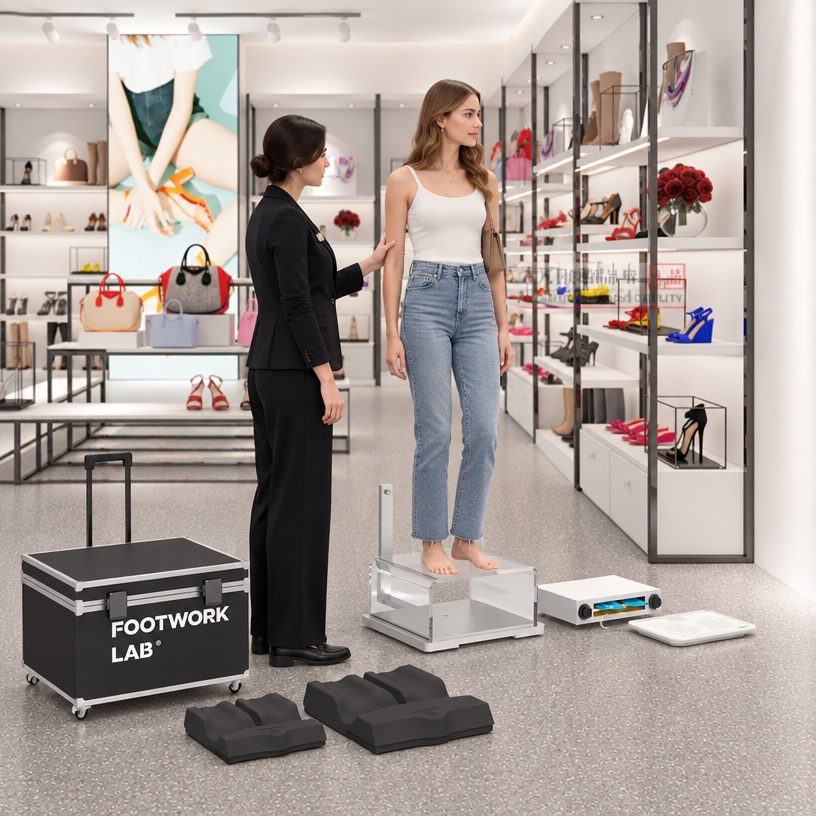
What the corner accumulates over a season
The case for the screen is not made on day one; it is made by what the corner accumulates. Every screen leaves a record — dated, described, comparable — and records are the only part of retail that compounds. A customer whose second visit includes last season’s picture beside this season’s is being served in a way no shop without records can serve her, and the conversation that comparison enables is the kind customers tell other customers about.
The accumulation pays three ways. For the customer: her fit decisions stop starting from zero every season, because the file remembers what her feet were doing last time. For the shop: the screen’s corner produces a reason to return that has nothing to do with discounting, and the fit cards with screen images on them are the most-read pieces of paper in the building by spring. For the manufacturers and clinics downstream: a shop whose records travel with the customer makes every professional downstream faster and more accurate, because the professional starts from history instead of scratch. The longer arc of comparing records season against season is its own discipline, and the shop corner is simply its earliest outpost.
None of this requires the shop to become a clinic, and the strongest version of the corner is the one that visibly refuses to. The screen adds what the gauge cannot — behaviour under load and in motion, as pictures with dates — and hands everything it finds to the people licensed to read it. The gauge stays at the door. The screen takes the corner. The customer leaves with her length, her pictures, and a sentence she can repeat to whoever she consults next.
Frequently asked questions
Does a screen replace the sizing gauge at the door?
No, and it should not try. The gauge measures length quickly and reliably, and length remains the foundation of fit. The screen adds what the gauge structurally cannot: how the foot behaves standing, leaning and walking. Gauge first, screen second, shoes third — the screen feeds the fitting conversation rather than replacing its first step.
How long should a shop-floor screen take?
A couple of minutes, decided in advance and written beside the device. A screen that grows into a consultation causes queues, and staff quietly stop offering it within the first week. The timing budget is an operational decision, not a suggestion, and holding it is what keeps the corner alive.
What three states should a quick screen capture?
Standing, leaning and a few walking steps. Standing shows how the arch behaves under load and how the two feet compare; leaning shows the forward weight shift every step begins from; the steps show the roll of loading and unloading. Together they answer the question the gauge cannot — how the foot behaves, not just how long it is.
Can shop staff tell the customer what the screen means?
They can describe what the image shows, plainly and in rehearsed sentences. They cannot interpret, name conditions or recommend footwear as a response to a finding — interpretation belongs to a qualified professional in a consultation. The handoff sentence should be written down and trained, because improvised versions always drift toward diagnosis under queue pressure.
What should the assistant say when the screen shows something unusual?
Three sentences: describe the picture plainly, name the boundary honestly, offer the next step without pressure. For example — the screen shows the right foot taking weight differently; what that means is a question for a foot professional; the images and date can be noted on the card to take along. No condition names, no recommendations to buy anything as a solution.
Should screen results go on the fit card?
Yes: date, images shared, what was described. The card travels with the customer into the fitting, into a professional’s room if she consults one, and into next season’s visit — where last year’s picture beside this year’s does more for her than any single visit can. Records are the only part of retail that compounds.
Where should the screen sit in the shop layout?
On a corner with a fixed place in the routine: after the length measurement, before or alongside shoe selection, within the timing budget. Placement decides adoption — a screen that interrupts the queue or turns into a consultation gets abandoned by staff, while one that feeds the fitting conversation gets used.
What we would do next
Write two sentences this week. The first is the handoff sentence, rehearsed with every member of staff until it comes out identically under queue pressure: describe, name the boundary, offer the next step. The second is the timing budget for the screen, written on the wall beside the device where the customer can see it too. Both cost nothing, and between them they decide whether the corner becomes a service or a sculpture.
The screen’s logic reaches beyond the high street. Pop-up screening faces the same placement and handoff discipline with even less room (The Pop-Up Booth: Screening Where the Room Is Not Yours), and the shoes on the shelf still have to fit the feet the screen has just photographed. The instrument changes; the placement, the timing and the boundary language are the whole craft.
One question back to the retailers in the reading: when the screen shows something the shop cannot answer, what exactly does your staff member say — and has that sentence ever been rehearsed, or does it get improvised on the spot?
This article is intended for professional and educational reference. It is not medical advice. Foot assessment equipment produces measurements and images; clinical interpretation and any decision about care remain the responsibility of a qualified professional. Certification scope is limited to the documentation we hold: European Union certification and ISO quality system certification.