
A gait analysis system is bought for one reason and then justified by
another, and recognising the difference early saves a great deal of money. The reason it is
usually bought is that the clinic wants to see what happens when a person walks. The reason it ends
up being valued is that it makes the assessment appointment repeatable, comparable across sessions,
and easier to discuss with a colleague who was not in the room. Both are legitimate. But the second
benefit only materialises if the routine around the equipment is designed at the same time as the
equipment is chosen, and that is the part most buyers leave until later.
FOOTWORK LAB manufactures foot assessment equipment at our own plant in Ruichang, Jiangxi
Province, where we have produced since 2018, and the F5-LAB
dynamic gait system is the platform in our range built for walking and running capture. We also
produce the insoles that frequently follow from assessment work. That combination gives us an
unusually clear view of how clinics actually use gait recording after installation, including the
patterns that lead to the equipment becoming a lasting part of the routine and the patterns that
lead to it being quietly retired.
What a gait analysis system adds to an assessment room
An assessment room without instrumented capture relies on observation, measurement with hand
tools, and professional experience. That is a legitimate way to work, and it has been for a long
time. What it cannot do easily is produce a record that can be returned to, compared, and shared in
a form that survives the appointment.
Instrumented recording adds three things. It adds objectivity, in the sense that the measurement
does not depend on who was watching. It adds persistence, in the sense that the record exists after
the conversation ends. And it adds comparability, in the sense that a recording taken today can be
placed beside one taken three months ago.
Those three benefits combine into the thing that clinics describe when they say the system
changed how they work: the ability to have a specific conversation about a specific observation
rather than a general one about an impression. That is a genuine improvement in the quality of the
appointment, and it has nothing to do with how many sensors the platform contains.
What the system does not add is a conclusion. It records what happened. Deciding what that means
for a particular person belongs to the qualified professional doing the assessment, and any supplier
who suggests otherwise is overstating their product. We state that limit plainly in our own
material, because buyers who understand it end up more satisfied with what they received.
The appointment: where the recording sits
Equipment gets used when it sits on the natural path of the appointment. It gets skipped when it
interrupts one. So the first design question is not technical: where in the visit does the recording
happen?
At intake
A recording taken early in the visit provides a baseline for the rest of the appointment and for
later sessions. The advantage is that the record exists before any intervention, which makes
comparison later meaningful.
After examination
A recording taken after examination lets the professional frame the capture with what has already
been established. The advantage is focus; the disadvantage is that the recording is not a clean
baseline.
As a separate session
Some settings schedule recording separately, particularly where walking and running are both
involved or where several passes are needed. This produces better data and requires more
administration.
There is no universally right answer, and clinics differ. What matters is that the answer is
chosen deliberately and then held constant, because a routine that changes from visit to visit
produces records that cannot be compared with each other — which removes most of the value the
system was bought to provide.
What comes out of a session
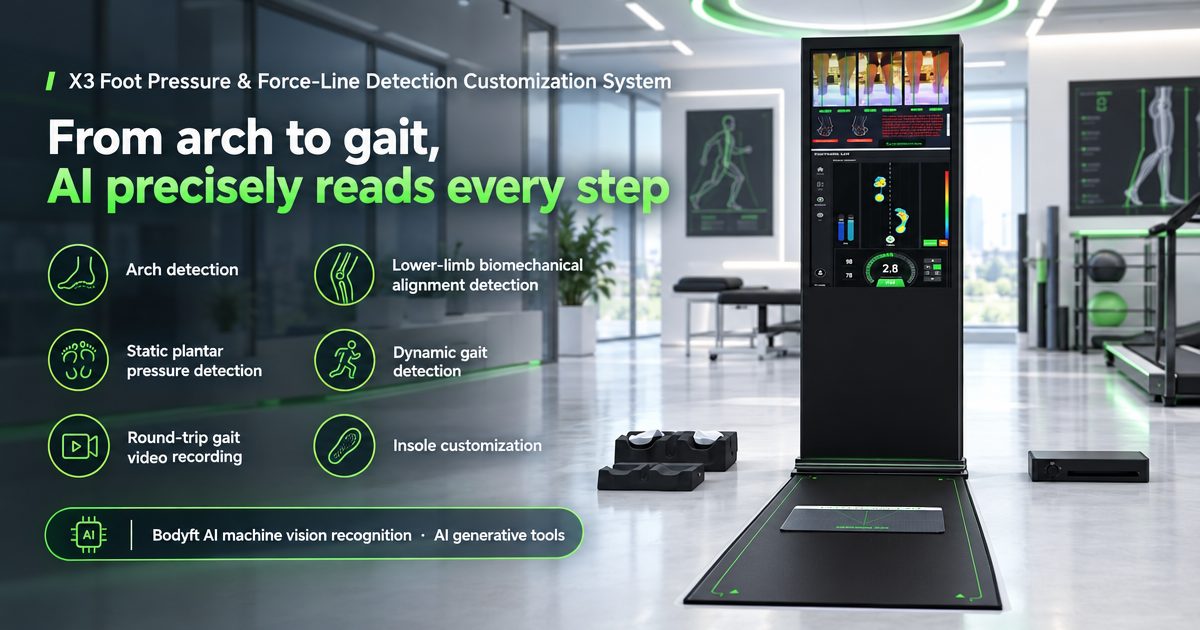
The output of a recording session is a set of measurements and images rather than a verdict, and
knowing the shape of that output helps a clinic explain the service to the people it serves.
- Pressure distribution under each sole, recorded across the contact phase rather
than at a single instant. - Timing information describing when each region becomes loaded and when it
releases, which is where differences between the two sides usually become visible. - The path of the centre of pressure as it travels along the sole during each
step. - Posture and lower-limb alignment capture from camera-based recording, showing
the position the body is in while the loading happens.
Presented together, these describe a sequence. Presented separately, each answers a narrower
question. Most clinics end up using a standard set of views for every appointment, which has the
practical benefit of making sessions comparable and the commercial benefit of making the
conversation easier to explain to a client or patient.
Two habits make the output far more useful. The first is to attach the capture conditions to every
recording: surface, footwear condition, number of passes and who operated. The second is to keep
more than one pass, so that the spread across passes is visible. A single averaged picture hides
variation that is often the most informative part of the record.
Staff, training and the question nobody asks
When clinics evaluate systems, they ask about sensors, software, reports and price. The question
that decides whether the system is still in use two years later is asked far less often: who
operates it, and what happens when that person is on holiday?
Equipment that only one member of staff can run is a single point of failure. In a small clinic
that may be acceptable. In a unit with rotating staff, rotating shifts or multiple sites, it is not.
The practical response is to train at least two people to run a complete session, and to write the
routine down so that it does not live only in someone’s memory.
Our own contribution to this problem is on the support side. Support runs through a dedicated
WhatsApp group with direct engineer access, so a question goes to an engineer rather than into a
general inbox. Remote assistance is available where the setting allows it, and connected units can
receive over-the-air updates, which removes the need for someone to perform manual software
maintenance on a schedule.
There is a second staffing question worth asking before purchase: who will review the recordings?
A system whose output is captured but never revisited produces no benefit at all, and the reviewer is
the person who keeps it in use. Naming that person, and giving them a periodic slot to look at recent
recordings, is the cheapest intervention available to any clinic that has already bought a system.
Records, comparison and the value of consistency
Comparison is where instrumented assessment earns its keep, and comparison depends entirely on
consistency. Three practical points follow.
Keep the method stable. The same surface, the same footwear condition, the same
number of passes, the same operator if possible. Variation introduced by the method can easily exceed
the variation the recording is meant to detect, and the resulting data is worse than no data because
it looks informative.
Keep the record complete. A recording without its conditions and date is not
evidence of anything. A short note attached to each session turns an image into a document, and it
allows a colleague joining later to understand what they are looking at.
Keep the output shareable. Before purchase, confirm export formats, whether
recordings can be attached to the records the team already maintains, and whether the interface
language can be changed. A system that holds data beautifully and shares it badly will be
transcribed by hand, and hand transcription is where routines quietly die.
One further point is worth making for buyers operating more than one site. If a group intends to
compare recordings between locations, the routine has to be standardised across locations before the
second system is installed, not after. Standardising afterwards means the early recordings from each
site cannot be pooled, which is usually the reason for the second purchase in the first place.
Specification points that decide the outcome
Six points cover most of the specification decision once the routine is settled.
- Space for the capture area, including the approach. A platform needs a run-up
and a run-out so the person is moving naturally when they cross the recording surface. This is a
room decision rather than a product decision, and it cannot be set after installation. - The capture conditions required. Barefoot, in-shoe, walking, running. Each
condition answers a different question, and each imposes different demands on the platform. - Staff and training. At least two trained operators, and a written routine that
does not depend on one person’s availability. - Where the data goes. Export, records integration and interface language, agreed
before ordering rather than discovered afterwards. - Support in year two. Ask who answers technical questions, through which channel,
and how spare parts are supplied when something needs replacing. - Starting scale. Our machine minimum order quantity is a single unit, which lets
a clinic run the routine in the real room before extending it to other sites.
On the support point, our answers are published rather than provided on request. A twelve-month
warranty covers non-human damage with free spare parts within that scope. Every unit is tested
in-house during a seven-day testing period before dispatch. Production runs at roughly three to five
machines per day, which is deliberate: it is a rate at which testing and inspection can be performed
properly rather than symbolically.
One commercial note belongs here as well. Clinics often ask what the system will do for their service offering, and the honest answer is that it changes the quality of the conversation rather than the range of what can be offered. What changes is that a specific observation can be shown, discussed and revisited, instead of being described from memory. Buyers who expect a new service line from the equipment alone are usually disappointed; buyers who expect a better assessment appointment are usually not.
What the equipment cannot do
The limits are worth stating, because buyers who understand them make better decisions and are
less likely to be disappointed by any supplier, including us.
A gait analysis system records movement. It does not identify why a movement looks the way it
does, it does not determine what a person needs, and it does not replace assessment, history or
professional judgement. It describes; the professional decides. Equipment marketed as producing an
answer is describing something no measurement system can deliver.
We apply the same restraint to other claims. Our documentation covers European Union certification
and ISO quality system certification, and we describe exactly that scope rather than translating it
into something broader. We do not name or disparage competing products. We do not quote figures for a
configuration in a general article, because the honest number depends on the specification, volume,
service scope and destination; buyers who want a figure get one against their actual requirement.
What we do offer is a manufacturing relationship. We are a factory rather than a trading company,
so technical questions reach the people who wrote the software, and adjustments to report format or
interface language are feasible because the tooling and the code sit in the same building. That is
the difference that tends to matter most in the second year of ownership.
Frequently asked questions
What is the difference between a gait analysis system and a foot scanner?
The question they answer. A foot scanner typically describes the foot itself, including its shape
and how load distributes while standing. A gait analysis system records what happens during movement,
which requires a capture area large enough for a stride and fast enough to resolve a shortened
contact event.
Will the system tell us what a recording means?
No. The system records pressure distribution, timing, the path of the centre of pressure, and
camera-based posture and alignment. Interpreting that output for an individual is a professional
judgement made by a qualified practitioner using the recording as one input.
How much room does an installation need?
More than the platform footprint. A run-up and a run-out are needed so the person reaches a
natural pace before the capture area and does not have to break stride while on it. Room planning is
usually the constraint that determines whether an installation succeeds.
What training and support do you provide?
Support runs through a dedicated WhatsApp group with direct engineer access, remote assistance
where the setting allows, and over-the-air updates for connected units. We recommend training at
least two operators so that the routine survives staff absence.
Can recordings be compared between appointments?
Yes, provided the method is kept consistent. The same surface, footwear condition, number of
passes and where possible the same operator. Without that consistency, variation introduced by the
method can exceed the variation the recording is meant to show.
Can we begin with one system and expand to other sites later?
Yes, and standardising the routine before the second system is installed is what allows
recordings from different sites to be compared. Our machine minimum order quantity is a single unit,
so a first installation can be run in a real setting before wider commitment.
What warranty, testing and delivery terms apply?
A twelve-month machine warranty covering non-human damage with free spare parts within that
scope, a seven-day in-house testing period before dispatch, and typical transit of six to seven
working days by express, ten to twelve by air, and thirty to thirty-five by sea.
What we would do next
Design the appointment before choosing the equipment, then check the room, then confirm who
reviews the output. If you want to understand how pressure and camera-based capture work together in
our systems, start with the technology overview and the
F5-LAB dynamic gait system.
This article on setting up a system in a clinic covers space and flow in
detail, and this one explains what a report shows and what it cannot. For a
configuration discussion against your own rooms, contact the team, and the
FAQ page answers the commercial questions openly.
This article is intended for professional and educational reference.
It is not medical advice. Foot assessment equipment produces measurements and images; clinical
interpretation and any decision about care remain the responsibility of a qualified professional.
Certification scope is limited to the documentation we hold: European Union certification and ISO
quality system certification.