
Camera-based posture capture records where the body sits over the feet,
and it answers a question that pressure measurement alone cannot reach. A pressure
recording describes load under the soles. It does not describe the position of the legs, the pelvis
or the shoulders while that load is being applied. Add a camera and that position becomes part of the
record, which turns two separate observations into one. For an assessment room, that is a genuine
gain, and it is the reason posture capture has moved from a specialist add-on to a standard part of
many installations.
FOOTWORK LAB manufactures foot assessment equipment at our own plant in Ruichang, Jiangxi
Province, where we have produced since 2018, and camera-based posture and alignment capture is built
into our platforms alongside pressure sensing. The X5 system is the
configuration in our range that gives foot, ankle and posture work the most room. This article covers
what posture capture records, how it relates to pressure data, and what buyers should decide before
choosing a configuration.
What camera-based posture capture records
The principle is straightforward. One or more cameras observe the person from a defined position,
and software identifies and tracks body landmarks — the position of the feet, the ankles, the knees,
the pelvis, the shoulders — across a capture. From those positions, the software describes how the
body is arranged over its base of support.
What it produces is a set of measurements and images describing position and its changes. It does
not produce an explanation. A posture recording can state that a shoulder sits higher than the other,
or that the pelvis is level or not, or that the position changes when the person moves. It cannot
state why, and it does not decide what should be done about it.
The distinction between measurement and judgement matters here more than in almost any other part
of assessment work, because posture is a subject on which everyone has an opinion. A recording that
is presented as an explanation rather than a description invites the wrong kind of conversation. A
recording presented as a description gives a qualified professional something concrete to reason
about, and gives the person being assessed something visible to look at while the reasoning is
explained.
It is also worth being precise about terminology. Posture capture describes position.
Force-line alignment describes how load is transferred through the leg relative to the foot. Gait
capture describes a sequence of loading during movement. All three are measurable, all three are
useful, and they are not interchangeable terms.
How posture capture differs from pressure measurement
The two answer different questions, and the value of an installation that does both comes from the
combination rather than from either half.
Pressure measurement records load under the sole. It describes where weight sits,
how it distributes across the foot, and how that changes during movement. It is highly sensitive to
how a person is standing or moving at the moment of capture.
Posture capture records position above the sole. It describes how the body is
arranged over the feet, including the position of the legs and the upper body. It is sensitive to
posture, to clothing, to where the person looks, and to how long they have been standing.
Used together, they allow a professional to see a position and its loading consequence at the same
time. That is more informative than either alone, and it is why we build both into the same platform
rather than offering posture capture as a separate product. It also means the recording can be
discussed as one thing rather than two, which matters for how easily a client or patient follows the
conversation.
One practical consequence deserves emphasis. Both measurements are sensitive to conditions, and a
pressure recording taken in one posture is not comparable with one taken in another. This is not a
limitation of the equipment; it is a property of measurement. The response is to standardise the
capture conditions and record them, which is the same discipline that makes any assessment data
comparable over time.
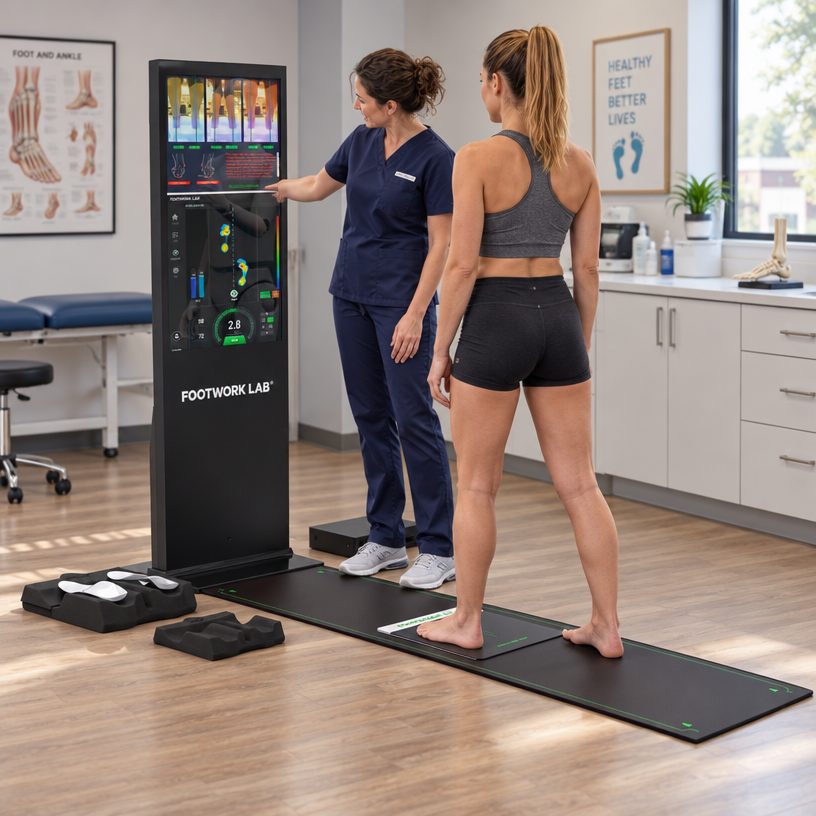
What an assessment room does with posture data
Posture capture finds its way into four common uses, and recognising which apply to your setting
helps determine the configuration you need.
- Baseline recording. A record of position at the start of a course of work,
against which later recordings can be compared. This is the most common use and the one that places
the least demand on the equipment. - Supporting a pressure finding. Where loading under the sole is the main
observation, a posture record shows the position in which that loading occurred, which often makes
the observation considerably easier to explain. - Monitoring change over time. Repeat recordings under consistent conditions,
reviewed at intervals. Comparison is where the record earns its value, and comparison depends
entirely on consistency. - Supporting a product specification. Where insoles or footwear are to be
specified, a position record adds context to the loading and shape data that inform the design.
In all four uses, the practical requirement is the same: the camera has to be in the same place
every time, the person has to be in the same position, and the conditions have to be recorded. The
equipment is capable of far more variation than the routine needs; restraint in how it is used is
what produces usable data.
Where the camera goes, and why position matters
Posture capture is more sensitive to camera placement than pressure capture is to plate placement,
and this catches out first-time buyers.
A camera looks from a position, and what it can describe depends on that position. A camera
directly behind the person describes the rear view; one beside them describes the side view; one in
front describes the front view. Each view makes some relationships visible and hides others, and a
room that uses a single set view is effectively choosing which questions it can answer.
Three practical points follow. First, decide which views the routine requires and place the camera
accordingly rather than by convenience. Second, keep the placement set and mark it, so that a
recording taken this month can be compared with one taken next year. Third, consider background and
lighting in the actual room rather than in a demonstration space; a recording is only as useful as
the person’s position is clear within it.
Distance is the fourth point, and it is usually decided by the room rather than by the equipment.
Too close and the recording cannot show the whole body; too far and detail is lost. Our own guidance
is to choose one placement per routine and test it thoroughly before going live, rather than
adjusting it afterwards based on individual recordings.
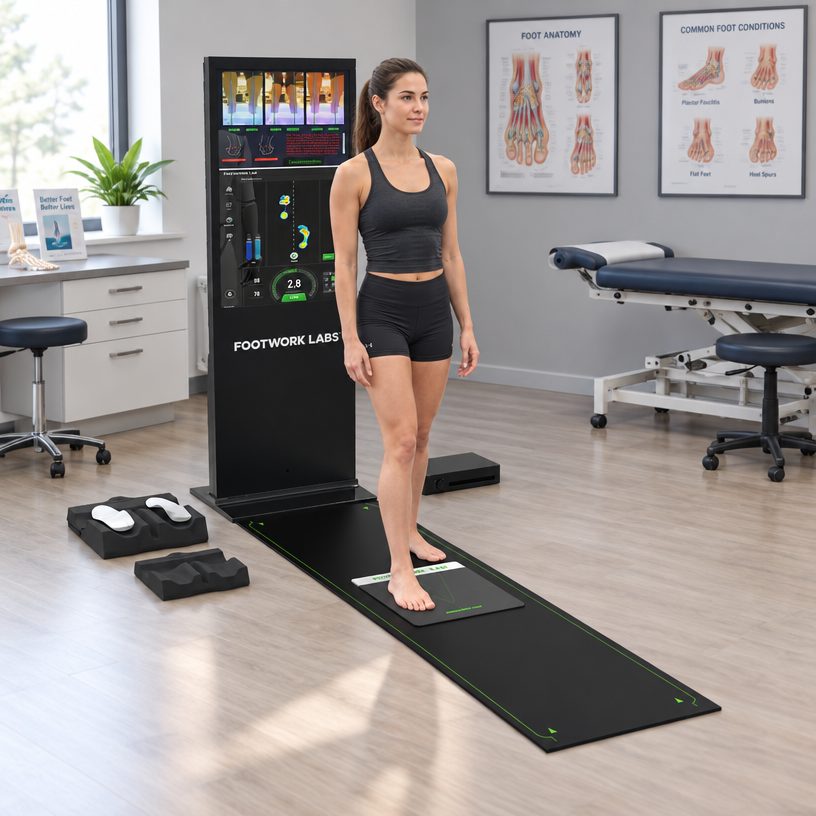
Combining posture with pressure and alignment
Where a platform records pressure, posture and lower-limb alignment together, the three outputs
support each other in ways that are difficult to achieve with separate systems.
The pressure record describes load. The posture record describes position. The alignment record
describes how the leg carries load relative to the foot. Presented together, they allow a
professional to move between what, where and how without leaving the same session, and to check
whether the three are consistent with each other.
Consistency between them is itself informative. Where the loading appears unremarkable and the
posture record shows a clear position difference, that combination raises a question. Where both
point the same way, the observation is more robust. Neither situation is a conclusion, and both give
a professional something specific to reason about, which is precisely the contribution measurement
equipment should make.
Two habits make combined recording practical. Keep the sequence identical between sessions, so
that a reviewer always knows which capture preceded which. And keep all the outputs of a session
together in one record, rather than storing posture images separately from pressure data, because
separated outputs are rarely looked at together afterwards.
One practical habit is worth adopting from the first week: keep a short written protocol for the room. Camera position, the sequence of captures, how long the person stands, what they are asked to wear and who operates the session. Six lines are enough. The protocol is what makes a recording taken next season comparable with one taken this one, and it is also what allows a colleague to run a session correctly when the usual operator is unavailable.
What posture capture cannot show
Being explicit about the boundary is part of an accurate specification.
Posture capture describes position at a moment, under particular conditions. It does not explain
the position, it does not describe what the person does the rest of the day, and it does not
determine what anyone should do about what is visible. It is affected by clothing, by where the
person is looking, by fatigue, and by how long they have been standing. All of these are reasons to
standardise the routine and to repeat recordings rather than to read a single session as a
statement about a person.
It also does not substitute for examination or history. A recording is one input among several,
and the qualified professional conducting an assessment decides how much weight it carries. Our own
wording is deliberate on this point: assessment equipment produces measurements and images, and any
decision about a person’s care remains the responsibility of a qualified professional.
We apply the same restraint to certification language. Our documentation covers European Union
certification and ISO quality system certification, and we describe exactly that scope. We do not
extend the claim, we do not name or criticise competing products, and we do not quote figures for a
configuration in a general article, because an honest number depends on the specification, volume,
service scope and destination. Buyers who want a figure get one against their own requirement.
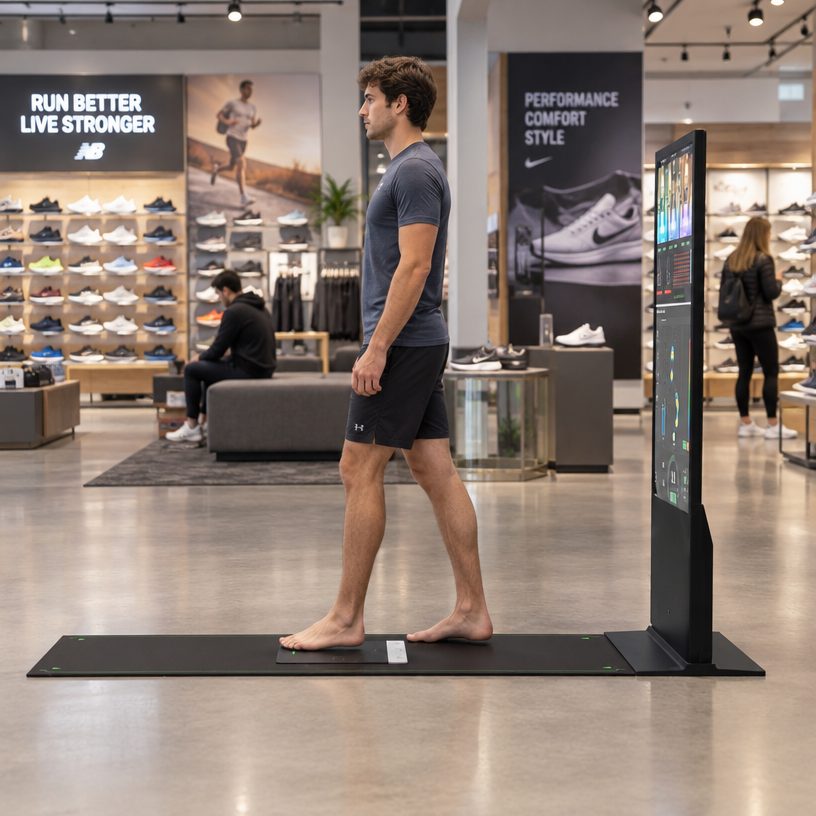
Written down, the protocol also becomes something a supplier can help refine. When a team can describe its routine precisely, a configuration conversation turns into a specific discussion about placement and sequence rather than a general one about features.
Choosing a configuration for your room
Six decisions settle most of the specification.
- Which views the routine requires. Rear, side, front or a defined combination.
This is the first decision and it drives camera placement. - Whether posture is captured standing, moving, or both. Both is more informative
and asks more of the room. - How the capture area is arranged. Enough space for the whole body to be visible,
with a background that keeps the person clear in the recording. - Who operates the system, and how many of them. At least two trained operators, so
the routine survives staff absence. - Where the records go. Export formats, integration with existing documentation,
and interface language, agreed before ordering. - Support in year two. Who answers technical questions, through which channel, and
how spare parts are supplied.
On the last point, our answers are published rather than supplied on request. A twelve-month
warranty covers non-human damage with free spare parts within that scope. Support runs through a
dedicated WhatsApp group with direct engineer access, remote assistance where the setting allows, and
over-the-air updates for connected units. Every machine is tested in-house during a seven-day testing
period before dispatch, and production runs at roughly three to five machines per day, a rate chosen
so that testing and inspection are done properly rather than nominally.
On scale, the machine minimum order quantity is a single unit. That matters for a configuration
like this, because posture capture is a routine that benefits from being trialled in the actual room,
with the actual lighting and the actual staff, before a group standardises on it.
Frequently asked questions
What does a posture analyzer actually record?
Camera-based capture identifies body landmarks and describes how the body is arranged over its base
of support: the position of the feet, ankles, knees, pelvis and shoulders across a capture. The output
is a set of measurements and images describing position, not an explanation of it.
Is posture capture a replacement for pressure measurement?
No, they answer different questions. Pressure measurement describes load under the sole; posture
capture describes position above it. Used together, they show a position and its loading consequence
at the same time, which is more informative than either alone.
How many cameras does a room need?
That depends on which views the routine requires. Rear, side and front views each make different
relationships visible, so the answer follows from the questions the team needs to answer rather than
from a standard configuration.
Does camera placement matter that much?
Yes. A camera describes what it can see from where it stands, so placement determines which
relationships appear in the record. Keeping placement set and marked is what makes recordings from
different dates comparable.
Can posture recordings be compared over time?
Yes, provided the routine is consistent: the same camera position, the same standing or moving
condition, the same sequence and the same operator where possible. Consistency is what makes
comparison possible, and comparison is where the record earns its value.
Can we start with one system for a single room?
Yes. The minimum order quantity for machines is one unit, which lets a team trial the routine in
their real room before standardising it elsewhere.
What warranty, testing and support are included?
A twelve-month machine warranty covering non-human damage with free spare parts within that scope,
a seven-day in-house testing period before dispatch, and support through a dedicated WhatsApp group
with direct engineer access, remote assistance where the setting allows, and over-the-air updates for
connected units.
What we would do next
Decide which views your routine needs, then place the camera deliberately and keep it there. Read
what posture analysis with a foot scanner sees and misses before you commit
to a routine, and this article on what a gait report shows for how the
output is normally presented. The X5 system is our configuration for
foot, ankle and posture work, and the technology overview explains
how pressure and camera-based capture combine. For a discussion about your own room,
contact the team.
This article is intended for professional and educational reference.
It is not medical advice. Foot assessment equipment produces measurements and images; clinical
interpretation and any decision about care remain the responsibility of a qualified professional.
Certification scope is limited to the documentation we hold: European Union certification and ISO
quality system certification.