
Ask what a gait analysis platform costs and you will get either a number or a silence. This article gives a third option: the structure. Quoted prices in this category vary so widely, and quote documents are written so differently, that comparing figures between suppliers is mostly a way of comparing formatting. What compares honestly is the structure underneath — which cost drivers are real, which options move the number most, and how to read a quotation that was written to be unreadable.
We manufacture gait and pressure analysis platforms — including the F5 LAB walking-analysis configuration — and we write quotations for them every week. That position is the reason this article refuses to print figures: the numbers belong to a conversation about your market, your volumes and your configuration. The structure, however, is public knowledge, and publishing it serves buyers better than any price list, ours included.
Read this with a quotation from any supplier open beside it, including ours. Every section is a row the quote should make legible; where it does not, the omission is itself information.
What you are actually buying: the cost anatomy
A platform quotation bundles several products that are worth separating before any figure makes sense. The sensing hardware — the platform itself, its surface, its electronics. The posture layer, where the configuration includes camera capture. The software — capture, analysis, reporting, archiving — which is a product with its own development history and its own ongoing life. And the surrounding items: installation, training, documentation, the first year of support.
Different suppliers bundle these differently, which is the first reason figures do not compare. One quote includes software updates for the product’s life; another sells them annually. One includes installation and operator training; another ships a carton. A buyer who normalises the bundle first — item by item, what is and is not included — is doing the work the numbers cannot do themselves.
The sensing hardware’s cost drivers are mostly physical: the active area, the sensing approach, the build quality of a surface that will be stepped on thousands of times a month. The software’s cost drivers are mostly historical: years of development, the depth of the analysis, the quality of the reporting, the export formats. Neither half publishes its costs honestly through a single figure, which is why the anatomy matters more than the arithmetic.
Where does the platform sit relative to other equipment in the range? Broadly: more capable dynamic platforms cost more than screening instruments and single-room pressure units, because they carry larger active areas and deeper software. That ordering is stable across the market and is a fair prior — until a specific quotation contradicts it, at which point the anatomy above explains why.
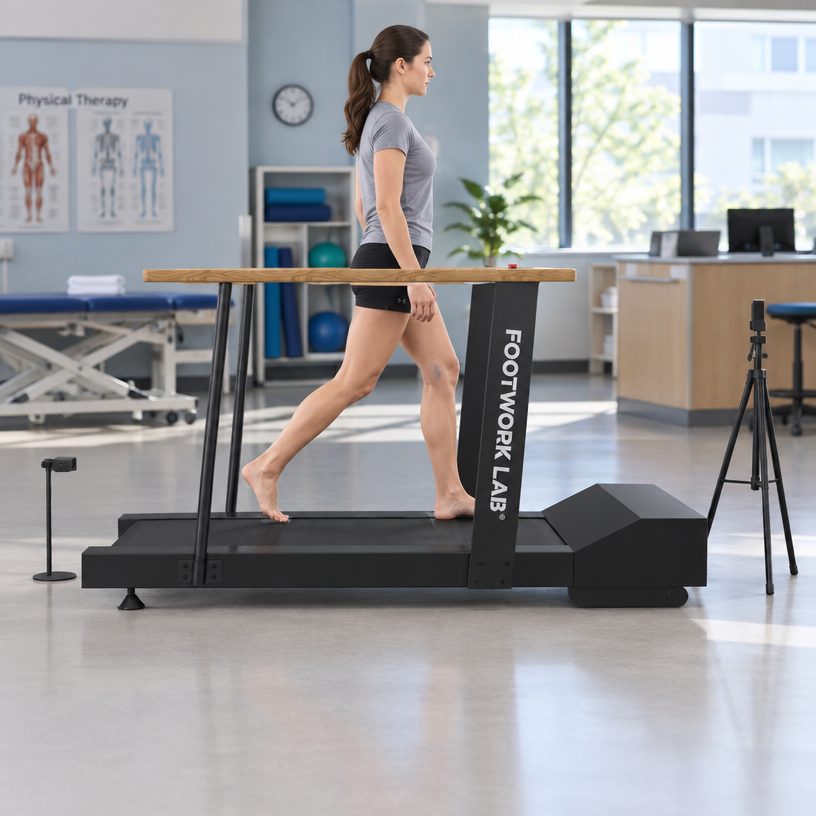
Depreciation is the part of the anatomy nobody writes on a quotation and every owner eventually reads. Platforms are long-lived instruments, and their real cost per appointment falls with use — which is the quiet argument for buying the capability the room will actually run daily, rather than the flagship it will occasionally admire. The figure that matters is not the one on the invoice; it is the invoice divided by the appointments the machine genuinely serves over the years.
The options that move the number most
Not all choices on a configuration sheet weigh the same. Three move the figure most. The first is the dynamic capability itself: a platform built for walking records — longer active area, timing analysis, more robust surface — carries more hardware and more software than a standing-focused unit. Rooms should buy the dynamic capability when the walking record is genuinely part of the service, not as prestige; the price difference is real and the unused capability is invisible in daily work.
The second is the software tier and its terms. Analysis depth, comparison views, export formats, archive behaviour — and critically, whether updates are included or subscription. A quotation with a lower figure and an annual software charge can be the more expensive document over five years, which is why the software row must be normalised before any comparison of totals.
The third is the surrounding bundle: installation, training, documentation, spare surfaces, the support package. These are the rows most often omitted from the headline and most often needed in year one. A quote that includes a real support structure — named channel, engineer access, remote sessions, over-the-air updates — is quoting a different product from one that ships a box, whatever the totals say.
Everything else on the sheet — finishes, accessories, branding — moves the figure less than buyers expect. Read the three heavy rows first; the rest is negotiation space.
A note on bundles inside the quotation itself. Suppliers often package the heavy rows with attractive light ones — a support plan bundled with accessories, training bundled with marketing material — and the bundle is legitimate commerce. The reading discipline stays the same: normalise first, bundle later. What is included, what is optional, what is absent. A quotation that answers those three questions in its own layout is telling you, before any negotiation, how the next five years of invoices will be written.
Financing deserves a paragraph in any honest structure article. Leases, rentals and staged payments change the cash shape of the same purchase, and different suppliers’ willingness to structure them says something about their view of the product’s life. We keep the topic simple: purchase terms are part of the quotation conversation like any other line, and buyers who know their own financing preference should raise it at the same time as the configuration, because the two interact more than most buyers expect.
Why the same platform quotes differently in different markets
A honest complication: the same hardware routinely carries different figures in different countries, and the reasons are structural rather than cynical. Certification and compliance work for a specific market, import duties, local service presence, channel margins where a distributor carries the relationship, currency and financing terms — each shifts the number without changing the product underneath.
Buyers comparing across borders should therefore compare products and structures, not totals: the same configuration, with the same software terms, with the same support scope, quoted into the same delivery terms. Where the structures match and the figures still differ, the difference is market structure — and sometimes negotiable, sometimes simply the cost of a local channel that will answer the phone at eight in the morning.
Buying factory-direct removes channel margin and adds the buyer’s own logistics burden; buying through a distributor adds margin and buys local presence. Neither is the right answer for everyone, and this site publishes both paths openly — direct questions through our contact pages, distributor enquiries through our partner programme — because the honest answer to “which is cheaper” is “cheaper over which years, with whose labour”.
The same logic answers the parallel question of volume. Fleet orders move figures; so do commitments to training, multi-room standardisation and long-term service relationships. A supplier who only moves on quantity is telling you their margin structure; a supplier who moves on relationship terms is telling you something more useful about how they intend to keep you.
Exchange rates deserve a sober sentence. Quotations in the buyer’s currency carry the supplier’s rate risk for the validity period only; quotations in the factory’s currency hand the risk to the buyer. Neither is hidden pricing — both are arithmetic — but buyers comparing a currency-stable quotation against a currency-exposed one should notice which document expires faster, and ask for validity in writing. It is the least glamorous line on any quote and one of the few that moves after signing.
How to read a quotation written to be unreadable
Some quotes are models of clarity; many are mosaics. The reading method that survives all of them is normalisation: rebuild the quote yourself, line by line, in your own template — hardware, software and its terms, installation, training, support, delivery terms, taxes — flagging every line the supplier left blank. The blanks are the comparison’s real findings: what a supplier declines to state is usually what their competitors state.
Watch for four specific silences. The software renewal: what happens in year two, and at what charge? The parts list: which spares exist and how they travel? The support scope: who answers, in which hours, through which channel? The delivery terms: to your door, to your port, or to a word that means neither? Each silence becomes a question, each question becomes a line in the next revision, and the document that survives that loop is the one worth comparing.
Resist comparing one supplier’s total to another’s total. The honest unit of comparison is the configuration-year: the same bundle, through the same years, including the renewals. Written that way, expensive-with-everything and cheap-without-anything become visibly different products instead of deceptively different prices.
And when the figures finally do get compared, compare them against the value structure rather than in isolation: what the room charges per appointment, how many appointments the platform will serve, what the record is worth to the service. A platform is priced against a service, and a buyer who knows their own service’s arithmetic negotiates from knowledge rather than from hope. We deliberately keep this part of the conversation on the buyer’s side of the table — our commercial terms are published plainly on the FAQ page, but the service arithmetic is yours, and no quotation can do that reading for you.
The total-cost view: years, not invoices
The invoice is the smallest number in the ownership story. The larger ones arrive on a schedule: software renewals or their absence, spare surfaces and consumables, shipping for parts, the cost of downtime while anything waits. A platform bought with a complete support structure costs what it costs; the same platform bought bare costs that plus a series of surprises, and surprises price higher than inclusions.
Our own terms are structured for that comparison: twelve-month warranty on non-human damage with free replacement parts, a dedicated WhatsApp group per customer with direct engineer access, remote assistance where the site permits, over-the-air updates for connected units, and a seven-day test before every dispatch. Each line is a cost at the factory and an exclusion of surprises at the clinic — the trade the total-cost view is designed to make visible.
Delivery terms complete the picture: six to seven working days by express, ten to twelve by air, thirty to thirty-five by sea. The lane choice trades speed against cost in ways the buyer’s schedule should decide, and the quote should state the options rather than assume one.
Machine orders start at one unit, which is also a total-cost statement: a clinic evaluating a service should be able to buy the evaluation without buying a fleet. Where a buyer’s plan is larger, the fleet conversation is worth having — but it should be a conversation, not a minimum.
What to ask, in one list
Bring the anatomy to the negotiation as five questions. What exactly does the figure include, item by item? What happens to the software in year two? Which parts exist, where, and how do they travel? What does support look like in our hours, by name? What do the delivery terms actually mean? Five answers turn any quotation — ours or a competitor’s — into a document that can be compared honestly, which is the whole purpose of writing about price without printing any.
The support structure is where the total-cost view either pays off or fails, so close the reading with its three questions: who answers, how fast, with what authority? A named engineer in a dedicated group with authority to connect remotely to the unit is a different product from a ticket queue, even at identical invoice figures. Our structure — group, engineers, remote sessions, over-the-air updates — is published precisely so the comparison can be run against it; we would rather compete on the comparison than on the invoice.
Frequently asked questions
Why do you not publish prices on the website?
Because the honest figure depends on configuration, market, software terms and delivery lane — a single number would be either wrong or misleading for most readers. The structure is public; the figure belongs to a quotation built from your actual requirements.
What is included in the quotation for a platform?
The sensing hardware, the software with its update terms, installation and training scope, support structure and delivery terms — each stated line by line. Our standard support package includes a dedicated WhatsApp group with engineer access, remote assistance where the site permits, and over-the-air updates for connected units.
Are software updates included after purchase?
Connected units receive updates over the air. The quotation states the scope and duration explicitly so the year-two question is answered in writing rather than in year two.
What does the warranty cover?
Twelve months on non-human damage with free replacement parts. The exclusions are stated alongside — a quote’s exclusions matter more than its features.
Can we start with a single unit?
Yes. Machine orders start at one unit. A clinic evaluating a service should not have to buy a fleet to evaluate it; larger orders are a conversation about configuration and support, not a condition of purchase.
How is delivery priced and timed?
Transit runs six to seven working days by express, ten to twelve by air and thirty to thirty-five by sea. The quotation states the options so the lane decision follows your schedule rather than our assumption.
How do we get a quotation?
Through the contact page with your configuration and market, or through a local distributor where one serves your region. Both routes receive the same structure; the difference is where the service years are carried.
What we would do next
Choose the configuration before the figure: the F5 LAB walking platform for the dynamic record, the F2 system for the consulting room, or the full range for everything between. The FAQ page states the commercial terms in writing. For the cost structure of the insole side of the business, what sits inside the price of an insole making machine applies the same no-numbers method.
This article is intended for professional and educational reference. It is not medical advice. Foot assessment equipment produces measurements and images; clinical interpretation and any decision about care remain the responsibility of a qualified professional. Certification scope is limited to the documentation we hold: European Union certification and ISO quality system certification.