
The van leaves at seven, the room is borrowed until five, and everything the day depends on has to close into a suitcase the night before. That is the working reality of foot plantar scanning outside a fixed clinic: community screening days, school visits, sports-ground sessions, pop-up fittings in retail spaces that were never designed for assessment equipment. The questions we hear from buyers planning this work are not about the record types — most have read those — but about the day itself. What gets packed, how long a borrowed room takes to set up, what a session holds when the workshop is an hour away, whether an insole can really be finished on site, and what happens to the files once the van is packed. This article walks through one mobile clinic day with the FMP in the order it actually happens: the case, the room, the session, the customisation module, the handover, and the follow-up after the lights go off.
The FMP is a foot pressure and posture detection insoles customization system, built as a movable scene rather than a fixed installation. Its detection side covers static, dynamic and balance pressure assessment together with full-body limb biomechanical alignment, and its customisation side carries the on-site module: a heating box, a set of shaping pillows for adults and children, and the accessories that go with them. The whole kit travels in a hand-carried suitcase. That last sentence is the entire premise of a mobile clinic day, and everything below follows from taking it seriously.
What fits in the case, and what the case cannot carry
Open the suitcase the night before and the inventory settles the day’s ambitions. Inside: the FMovePro main unit, the pressure test plate, two cameras with their stands, the hub that joins them, the heating box, the floor mat, the shaping pillow set covering adults and children with its auxiliary accessories, and the manuals and toolkit. Everything a session needs is there. What is not there is anything the room must supply — power sockets that work, lighting that lets the cameras see, a quiet corner, a chair, and a table for the report conversation. The case carries the system; the venue carries the rest.
This is why we ask organisers to walk the borrowed room a week ahead, or at least to send photographs. A dark corner with one overloaded socket can stretch a setup from half an hour to most of a morning, and no amount of equipment compensates for it. The two cameras are the item most sensitive to the room: they record alignment above the foot while the plate records what happens beneath it, and they need space, light and stable floors more than they need anything from us.
An honest limit belongs here. We do not pretend the case turns any room into a clinic. A hot, echoing hall with people queueing across the walking approach produces records nobody should read closely, and a professional running the day will say so. Some outreach days end up being screening and demonstration sessions rather than full assessment sessions, and that is the right call when the room is against you.
Setting up foot plantar scanning in a borrowed room
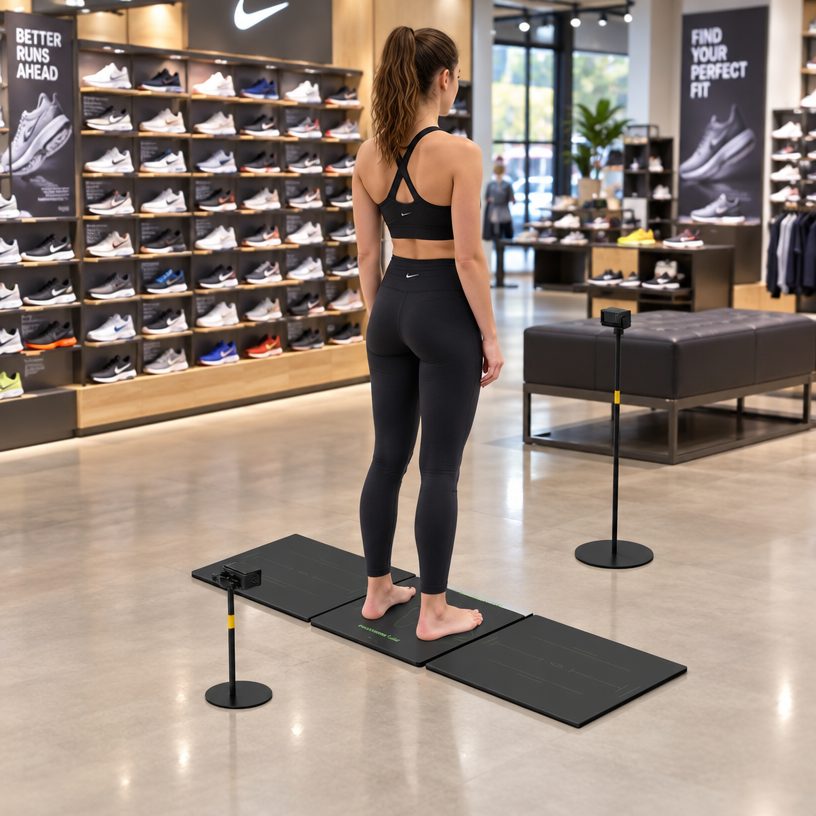
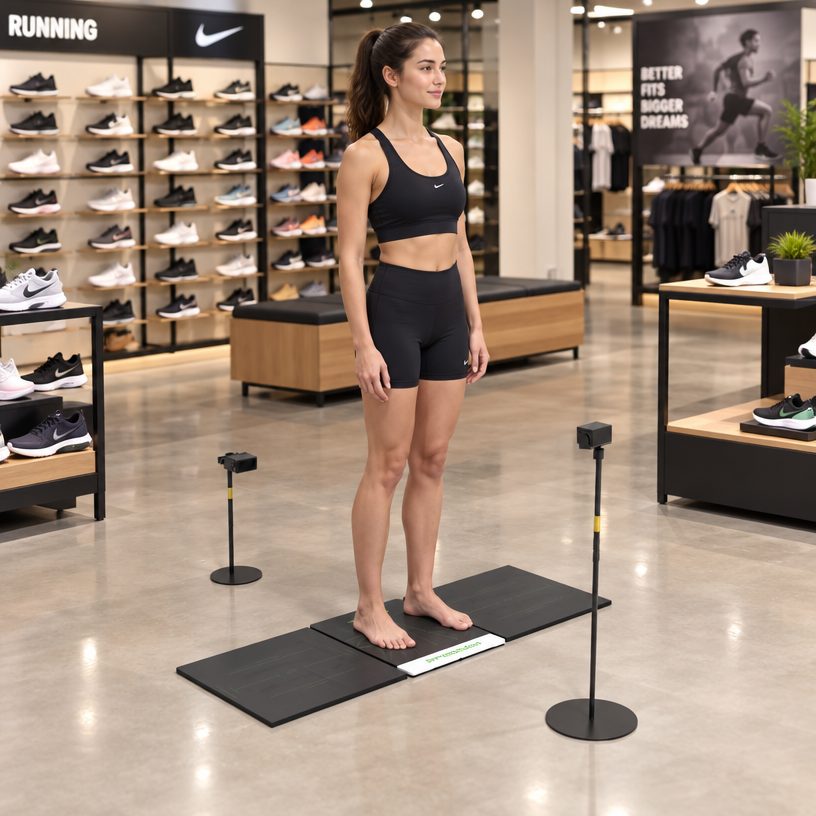
The setup follows the same logic as a fixed installation, compressed. Pick the corner with level, firm flooring and the least foot traffic. Lay the floor mat and position the pressure plate where a person can walk onto it from a clear run-up and walk off without dodging furniture — a borrowed room rarely offers a long approach, so the dynamic record gets planned around whatever straight line the room gives. Mark the camera stand positions on the floor the moment they are set, exactly as we advise for fixed rooms, because a stand nudged by a passing chair changes what the images show.
Power and light come next. The plate, the two cameras and the hub run from the room’s sockets, and extension leads belong in the case’s neighbour — the bag of cables every mobile team assembles within its first two outings. Lighting matters for the cameras rather than the plate: a room dim enough to blur what the lenses see will still produce a pressure record, and the session will look complete while quietly missing half its value. If the room fails the light test, reposition toward the window rather than arguing with lamps, and note the change in the session file.
At one exhibition in Brazil, a distributor ran a full demonstration in a corner of our stand to prove the setup point to himself: he timed it, unpacked to first record in under an hour, with most of that spent on camera positions rather than on the machine. His comment afterwards — that the plate is the easy part — has since become the first line of our own setup checklist for mobile days.
What a session on the road holds
Away from the workshop, the detection side runs exactly as it does in a fixed room. The static record captures how load rests under both feet at quiet stance. The dynamic record captures the walk: contact phase and flat phase percentages, the foot axis angle, peak and mean pressure, the contact area curve, and the speed of the centre of pressure. The balance record captures how the body holds itself when asked to do nothing. Alongside all three, the two cameras put lower-limb alignment and whole-body posture into the same session, which is what makes the FMP a posture system and not only a pressure plate.
The report is assembled by the software with AI-assisted report generation, and it is worth being precise about what that report is. Every item in it is a recorded quantity — a description of what the loaded foot and the aligned body did during the session. Reading it, and turning it into any recommendation for this particular person, is the job of the qualified professional running the day. We do not ship the equipment with a diagnosis function, and we do not let the word slip into demonstrations, because the line between measuring and diagnosing is where safe outreach work lives.
The alignment capture deserves a paragraph of its own, because it is the part buyers most often overlook when they compare mobile systems on price. A pressure plate alone tells you what happened under the foot; it cannot tell you how the leg was stacked above the foot when it happened. The two cameras close that gap — lower limbs and whole-body posture in the same session — and on a screening day they are the reason a record can feed a sensible follow-up conversation instead of a bare map. Teams that only set up the plate because the cameras take longer are buying half a system and paying full price for it.
Pacing matters more on the road than in a fixed room. A borrowed-room day usually has a queue, and queues push operators toward shortening sessions — fewer dynamic passes, a rushed balance trial. The record does not forgive it. Our standing advice to mobile teams is to book fewer sessions than the room could hold and hold the protocol steady, because a consistent record on Tuesday is worth more to the follow-up programme than an extra three hurried ones.
The on-site customisation module, away from the workshop
The customisation module is the reason the FMP exists as one system rather than as a scanner with a factory behind it. On site, the professional chooses the build against the record and the customer’s shoe, and the physical work happens with the heating box and the shaping pillows: heat, shape on the pillow sized for the person, trim, and check inside the customer’s own footwear. The pillow set covers adults and children, with auxiliary accessories for the cases in between, so a family day does not split into people the module can serve and people it cannot.
The order of steps is fixed in our training, and travel days test whether it held. The shoe check comes before the heating box — always — because a build that will not sit inside the customer’s shoe should never be formed in the first place. On the road this matters twice over: the customer brought shoes from home, the operator has not seen them before, and the temptation to shape first and check later grows with the length of the queue. Teams that keep the sequence report the same result as workshops do: almost no on-site remakes.
What the module asks of a borrowed room is a powered socket and a clear table, nothing more exotic. The heating box is compact, the pillows pack around it, and the whole customisation side fits back into the case in minutes. The honest constraint is not equipment but attention: shaping is the step that consumes the operator’s focus, and a day that schedules shaping during a full screening queue will compromise one or the other. Teams that separate the two — screening in the morning, shaping appointments in the afternoon — run the calmest days, and their remakes and complaints show it.
What can be handed over before the van leaves
For most customers on a well-run day, the handover is complete: a report in hand, and a shaped insole checked in their own shoe before they leave the room. That closed loop is the sales argument for the suitcase form, and it is real. The customer walked in with nothing and walks out with a record they understand and a build fitted to their foot and their shoe, in a single visit, in a room that is not a clinic.
Some cases, honestly, do not close on the day. A foot whose record surprises the professional, a customer who needs thinking time, a build that needs bench work beyond what the module does — these leave with the record and a follow-up plan instead of an insole, and we tell operators to treat that as a normal outcome rather than a failure. We do not push the module to close every case on site, and we would rather a mobile day produced twenty good records and six follow-up appointments than thirty finished pairs with three of them regretted.
The report route matters here too. Where the day’s organiser wants every participant to leave with their record, the software’s delivery options — printed on site, sent to a scanned code or emailed — let the team choose per session rather than per customer. Community days tend toward print, because handover on paper travels home with people who may not open an email; retail pop-ups tend toward digital delivery, because the record continues into a fitting conversation later. Both are fine, and the choice is the organiser’s, not the equipment’s.
Packing up: files, follow-up and the line back to the factory
The last half hour decides how useful the day remains in a month. Every session gets named while the memory is fresh — person, date, venue, operator — because a record whose conditions are not written down cannot be compared with anything later. Camera positions that were marked at setup come up on their marks. The pillow set gets counted back into the case; auxiliary accessories are the items that walk away from mobile teams first, and a missing one is felt at the next event, not this one.
The naming habit earns its keep the first time a mobile day repeats at the same venue. A school screened in spring and revisited in autumn should be able to put the two files side by side without archaeology: same operator, same room, same protocol, or else an honest note of what changed. Mobile teams that skip this end up with a folder of one-off records that can never be compared with anything, including each other — which quietly undoes the point of screening the same population twice.
Follow-up is the mobile day’s quiet debt. The records travel back to the organising clinic or retailer’s own system, and the customers who left with reports but no builds become next week’s appointments. Our part in that stretch runs through a dedicated support group with our engineers, with remote assistance when messages are not enough and over-the-air updates for connected systems. The hardware side carries a twelve-month warranty against non-human damage with free parts, and every unit is run through a seven-day test at the plant before dispatch — a promise that travels in the suitcase even when the engineer does not.
Frequently asked questions
How long does setup take in a borrowed room?
Under an hour in a room that has been checked in advance — level flooring, working sockets, usable light and a clear walking approach. The plate sets up quickly; the camera positions take the time, and they are the part that must not be rushed. A room seen only on the day can consume a whole morning.
Can the full session really run away from the workshop?
Yes. Static, dynamic and balance pressure records, lower-limb alignment and whole-body posture capture all run on the portable system exactly as they do in a fixed installation, and the report is assembled on site. What changes away from the workshop is the room, not the session.
Can an insole really be finished on site?
For most cases, yes: the professional selects the build from the record and the shoe, forms it with the heating box and the shaping pillows for adults or children, trims it and checks it in the customer’s own footwear. Cases that need bench work or professional reflection leave with the record and a follow-up appointment instead, which is a normal outcome rather than a failure.
What does the system need from the venue?
Power, light and floor: working sockets for the plate, cameras and heating box, lighting that lets the cameras record cleanly, and firm level flooring with space for the walking approach. The suitcase carries the system; the venue supplies the rest, which is why we ask organisers to check the room in advance.
Are the mobile records the same quality as fixed-room records?
When the room passes the checks and the protocol holds, yes. What degrades a mobile record is a rushed dynamic pass, a moved camera or a noisy queue — conditions, not hardware. Fewer sessions with the protocol held produce better files than a full queue with shortcuts.
Does the report give a diagnosis?
No. Every item is a recorded quantity — pressure distribution, phase percentages, alignment and posture angles — and the reading of it belongs to the qualified professional running the day. We keep that boundary on the report itself and in every demonstration we run.
What support follows a mobile unit?
A dedicated support group with our engineers, remote assistance when a question cannot be settled in messages, and over-the-air updates for connected systems. The warranty covers twelve months against non-human damage with free parts, and each unit passes a seven-day factory test before dispatch.
What we would do next
If an outreach programme is on your calendar, send us the venue photographs and the session plan before the first trip — we have seen enough borrowed rooms to spot the ones that fight the setup, and the advice is free of charge. The FMP system page lists the detection functions and the customisation module in the manual’s own wording, and the FAQ page carries the order, warranty and delivery terms.
For how a portable plate behaves on the road, read a foot pressure plate that travels; for what the report itself holds, biomechanical analysis ends in a report follows the record from capture to page, and heat-mouldable custom insoles covers the shaping side in depth.
This article is intended for professional and educational reference. It is not medical advice. Foot assessment equipment produces measurements and images; clinical interpretation and any decision about care remain the responsibility of a qualified professional. Certification scope is limited to the documentation we hold: European Union certification and ISO quality system certification.