
A rehabilitation department in Johor takes delivery on a Friday afternoon, and by four o’clock the corridor holds two cartons, one long crate and a technician with a spec sheet in his hand. The spec sheet is three pages of measurement claims. The delivery note is one page of part numbers. Neither of them tells him what he is looking at on the floor, and the person who sold him the system is asleep six time zones away. So he does what most buyers do: he opens the small carton first, finds cables, and starts guessing. Two hours later the walkway is assembled in a room that turns out to be shorter than the stride, and the camera stand is bolted to a wall with a window behind it. The equipment is fine. The delivery was read in the wrong order. This article reads the case before the specification: what actually arrives, what the buyer is expected to supply, the five questions worth asking before the invoice is paid, what seven days of factory testing can and cannot tell anyone, and what the first afternoon after delivery should look like when nobody is available to help.
The case contents are the first specification
A foot scan system leaves a factory as a packing list, not as a capability. The capability appears later, when a session runs and a report comes out the other end. Between those two moments sit a crate, a case, a set of parts and a room, and the parts decide what the room can do. A buyer who reads the case before the brochure learns something the brochure cannot say: how much of the work the supplier has done, and how much of it has been handed over.
Open the crate in a fixed order and the delivery becomes legible. The sensing walkway comes out first, because it is the heaviest and it dictates where everything else goes. Then the camera and its stand, which have to see the walkway from a fixed position. Then the host unit, which is the box the operator actually touches. Then the cabling, which is the part that goes missing. Then the software, which in our case is already on the host rather than on a disc in an envelope. And last, the case itself, which is not packaging — it is the thing that lets the system travel to a sports hall or a second site next season.
The system discussed here is the F2-PRO, the longer member of the F2 family. The difference that matters at delivery is length: the walkway has to hold a stride rather than a footfall, which is why it arrives in a crate rather than a carton. What it records is a dynamic cycle — support phase, swing phase, the double-support moment when both feet are briefly down — alongside a pressure map and the camera view of alignment above the surface. That combination is what the buyer is paying for, and none of it is visible in a packing list, which is precisely why the packing list keeps getting skipped.
What is deliberately not in the case is worth listing too, because buyers assume otherwise. There is no computer, no desk, no chair, no printer unless it was ordered, no network connection, no room preparation and no member of staff trained to run a session. Those are not oversights; they are the buyer’s half of the delivery, and a supplier who quietly absorbs them into a quotation is either overcharging somewhere else or planning to disappear after the invoice clears.
Five questions worth asking before the invoice
The first question is the plainest: what is included, item by item, in writing? A quotation that says “complete system” and a quotation that lists fourteen line items may describe the same shipment, but only one of them can be checked on arrival. Ask for the list as a document, not as a paragraph, and compare it against the delivery note before the crate is opened rather than after.
The second question concerns consumables. Something in every system wears: a sensing surface takes load, cables get flexed, camera mounts get knocked, and the surface that people stand on collects what people bring in on their shoes. Ask what is expected to be replaced, how often in ordinary use, and whether the replacement is a part the buyer can fit or a service visit. A supplier who cannot answer this has not thought about the second year.
The third question is about spares, and the fourth about warranty scope, and they are usually asked as one. Our warranty runs twelve months against non-human damage, with free parts. Scope is the word to press on: parts are covered, and freight and on-site labour are a separate conversation that should be had before delivery rather than after a failure. Ask what voids it, ask who decides whether damage is human, and get the answer in the same document as the warranty term.
The fifth question is about software. Ask where it runs, what happens when the unit is offline, whether updates arrive over the air, and who owns the reports once they exist. A system that needs a network to produce a report is a system that stops working in a basement room; a system that keeps records only on the supplier’s server is a system the buyer does not own. Ours runs on the host, updates over the air where the unit is on a network, and exports files the buyer keeps.
What the buyer supplies is more than a socket
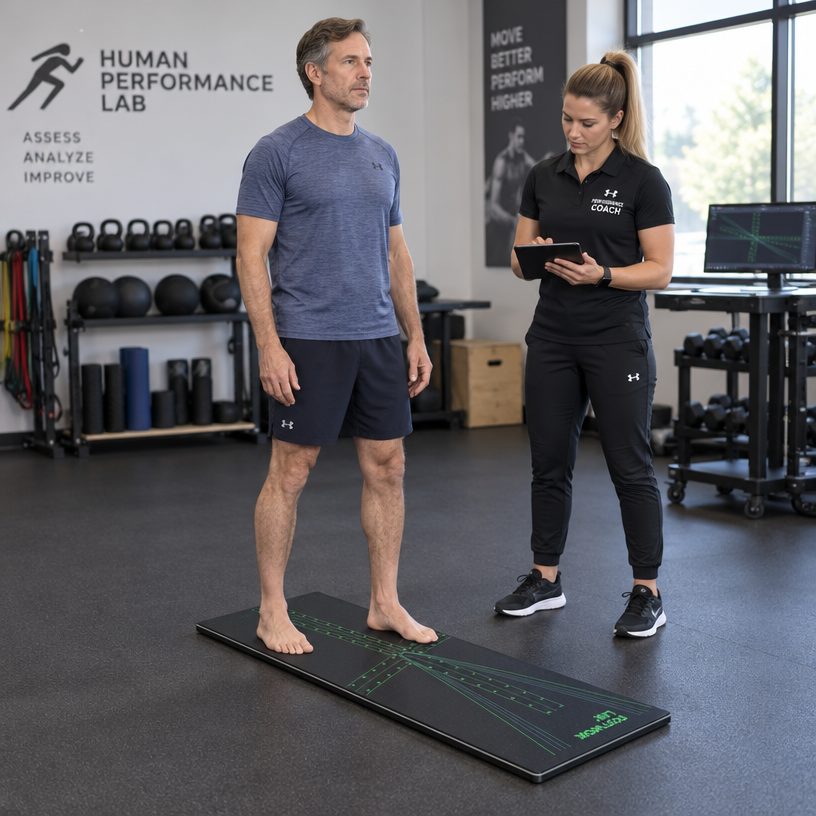
Room comes first, and the mistake is measuring the floor area rather than the clear run. A walkway needs a straight approach long enough for a natural stride and a wall at the far end that nobody walks into. It needs a level floor, because a surface that rocks will report what the floor is doing as well as what the foot is doing. And it needs to be out of direct sun, since a glass wall in an afternoon turns half the surface into a different colour temperature and the camera into a squinting machine.
Power and network come second. One socket in the right place is worth three in the wrong one, and the right place is the operator’s side of the walkway rather than the customer’s. If the room has a network point, the unit can take updates without anyone carrying a drive across the building; if it does not, the update becomes a visit, and visits get postponed. Neither is fatal, but both are decided by the room, not by the supplier.
Furniture comes third. A small table at the operator’s side holds the host at a height where the screen can be read while the customer is still standing on the surface, and a chair two paces away gives the person being scanned somewhere to sit while the report is discussed. Departments that skip the chair end up holding the conversation in the corridor, which is exactly where a record stops being read and starts being handed over unopened.
Staff time is the fourth item and the one most often promised by somebody who will not be present. Somebody has to own the routine: the same stance instruction, the same approach, the same three passes in the same order. That ownership is not a training event, it is a name in a rota. A department that nominates one operator in the first week gets comparable records by the third; a department that lets everyone try it gets a folder of attractive images and no baseline.
What seven days of testing at the plant proves
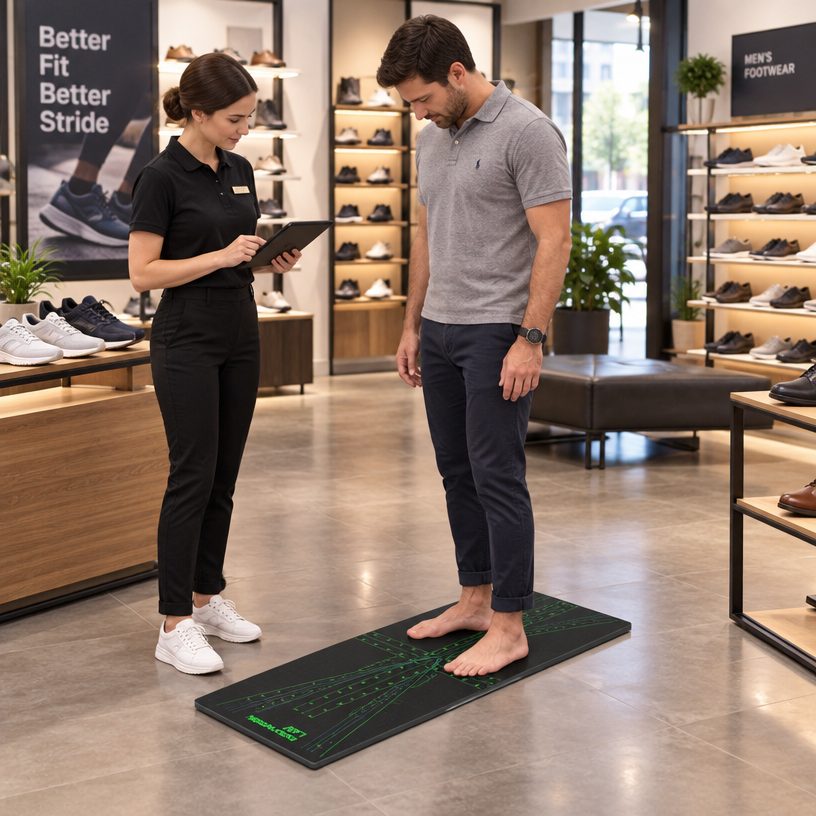
Every unit we ship runs at the plant for seven days before it is packed. In practice that means the surface is loaded, the cameras are aimed and re-aimed, a full session is run in each mode, a report is generated and read by somebody who did not build the unit, and the whole thing is packed and unpacked once so that the case is known to fit what it is supposed to fit. The point is not ceremony. It is that the first person to see a fault should be the person who can fix it in an hour.
What that week proves is narrow and useful: the unit left the factory complete, working, and capable of producing a document. It also catches the failures that only appear after a few days of thermal cycling, which is most of the interesting ones. A cable that is going to work loose will usually do it on day two. A camera bracket that is going to drift will usually drift before the seventh session, not after the seventieth.
What it cannot prove is anything about the buyer’s building. It cannot prove the floor is level, the network reaches the corner where the unit will stand, the room is long enough for a stride, or that the person who unpacks it has ever seen a pressure map. Those are the failures that make a good machine look like a bad purchase, and they are all local. This is why the room questions above are worth asking before the order and not after the crate. We do not inspect the building before delivery, and nobody at the factory will ever see the room the unit ends up in; the measurements have to come from the buyer.
It also cannot prove fit for a particular population. A walkway tested with adults at the plant has not been tested with the children a paediatric clinic will bring through it, or with the runners a sports institute will bring through it. What a buyer can do about that is ask for a session with their own people during a demonstration, and treat a supplier who resists that request as a supplier with something to hide about the routine rather than the hardware.
The first afternoon, in the order that works
Photograph the inside of the case before anything comes out. It takes a minute and it is the only reliable record of how the parts were arranged, which matters in a year when the unit has to travel and nobody remembers which foam block goes where. Then check the contents against the list while everything is still visible, and put the missing items in one message rather than seven.
Assemble in the order the work will happen: walkway first, positioned against the wall and checked for rock; camera second, aimed at the middle of the run and tightened; host third, on the operator’s side with the screen readable from the walkway. Then run a self-check with nobody on the surface, and follow it with one session using a colleague’s feet. A first session with a real person finds in ten minutes what a self-check never will.
Before the first customer arrives, run three sessions and throw the reports away. The purpose is not data, it is the routine: where the operator stands, what they say, how the customer approaches, when the report is printed. Three discarded sessions is a cheap way to buy the consistency that makes the fourth one comparable to the four hundredth. Departments that skip this step spend the first month producing records they cannot compare with anything.
Then write down what went wrong in week one — the cable that was too short, the light that had to be blocked, the instruction that had to be repeated — and send that list to the supplier once. It is the most useful document a buyer will produce in the first year, and it is also the document that tells a supplier whether the account is going to be a relationship or a transaction.
Where the specification sheet stops being useful
A specification describes a unit. A packing list describes a delivery. Neither describes a routine, and the routine is what a clinic or a shop actually buys. Once the case is open and the parts are on the floor, the useful questions are no longer about the hardware: who runs a session, how long it takes, what the report says, who reads it, what happens when the same person returns in six months.
The habit worth building is to ask for the case. Ask for the packing list as a document. Ask for a photograph of an open case with the parts labelled. Ask what the crate weighs and whether a two-person lift is needed, because a delivery that arrives at a clinic with one porter and no trolley becomes a delivery that sits in the corridor. A supplier who can produce that photograph quickly is a supplier who has packed the thing personally.
We are equally clear about the parts we do not do. We do not capture the shape of a foot: the system records load and alignment, and there is no laser in the unit and no surface model to carve from. A workshop that needs geometry for a milling workflow is shopping in a different category and we say so at the first enquiry. We do not diagnose, and no item on a report is a finding — each one is a recorded value, and reading it belongs to a qualified professional. We also do not put figures in an article, because a price depends on configuration, destination and the service wrapped around the unit.
Frequently asked questions
What is actually in the case when a foot scan system arrives?
The sensing walkway, the camera and its stand, the host unit, the cabling, the software already installed on the host, and the transit case. Consumables and spares are separate items and should be listed separately, which is the first thing to ask about.
What does the buyer have to supply?
A room with a clear run for a stride and a level floor, a socket on the operator’s side, a network point if updates are to arrive remotely, a small table, a chair, and one named member of staff who owns the routine.
What does seven days of factory testing prove?
That the unit left complete, working, and able to produce a report, and that faults which only appear after a few days of running were caught at the plant. It proves nothing about the buyer’s building, floor or network.
How long does delivery take?
Six to seven working days by courier, ten to twelve days by air, or thirty to thirty-five days by sea. Plan a first installation against the slowest option rather than the fastest, because a crate that arrives early into an unprepared room is not an advantage.
What does the warranty cover?
Twelve months against non-human damage, with free parts. Freight and on-site labour sit outside that scope, so both should be settled in writing before delivery rather than after a failure.
Does the F2-PRO produce a shape file of the foot?
No. It records plantar pressure, the dynamic cycle, and alignment from the camera layer, and assembles those into a report. There is no surface reconstruction and no file that a carving or printing step could follow.
Who should be trained first?
One person, not the whole team. A single named operator establishes the routine, and the rest of the staff learn from a colleague whose records they can compare against. Spreading the first week across five people produces five different routines.
What we would do next
Write the room dimensions and the clear run on one page, photograph the space, and send both through the contact page with a note about who will run the sessions. We will tell you whether the space works before anyone discusses configuration, and we will say so plainly if it does not.
The F2-PRO system page lists the record items and the session types in the equipment’s own terms, and it is the right page to read alongside the packing list. For the measurement side of the same family, pressure plates and the F2-Pro explains what the longer surface changes, and pressure plate gait records follows one department through its first months of use.
Two more pieces are worth the time before a purchase order. A foot orthotic scanner does not write the prescription sets out where the record stops and the professional starts, and a 3D foot scanner for podiatrists explains why the search phrase and the delivered equipment are not always the same thing.
This article is intended for professional and educational reference. It is not medical advice. Foot assessment equipment produces measurements and images; clinical interpretation and any decision about care remain the responsibility of a qualified professional. Certification scope is limited to the documentation we hold: European Union certification and ISO quality system certification.