
The workshop is a converted garage behind a shoe repair shop, and everything in it is in the wrong place. The grinder stands beside the window because the light is better there, which means the dust goes across the finishing bench and settles on the adhesive. The heat press sits behind the door, so every pair that leaves has to be carried past it. The boxes of finished pairs are stacked under the grinder because that was the only flat space left. Two people work here, they turn out good work, and they lose an hour a day to walking, wiping and hunting for a mould that was used in March. Nothing in the room is broken. The order of the work and the order of the room simply disagree. This article sets out the three zones a small orthotic workshop actually needs, why dust, heat and a clean packed pair cannot share one bench, how moulds and material storage follow the work rather than the wall, what a rework path looks like when a pair comes back, and why the position of two sockets and one extraction hose matters more than the number of square metres on the lease.
A layout is the order of work, drawn on the floor
Every pair that enters a workshop follows the same sequence: a shape or a specification arrives, a shell is formed, the edges are ground, the build is assembled, the pair is checked and packed. That is the work. A layout is nothing more than that sequence drawn on the floor, with the benches placed so the pair moves forward and the person does not move backward. Owners who start from the room rather than the sequence end up with a workshop that looks tidy and behaves slowly.
Sort the benches by what they produce and the zoning becomes obvious. One bench produces dust. One bench produces heat and softened material. One bench produces a clean, packed pair that must not be contaminated by either of the other two. Those three outputs cannot share a surface without a cleaning routine between every single pair, and a routine performed forty times a day is a routine that stops being performed by Thursday.
The usual objection is space. A two-person shop in a rented unit has one room and no budget for partitions, and it hears the word zoning as a word for people with a bigger building. It should not. Zoning is about direction and distance before it is about walls: which end of the room the dust goes, which end the boxes leave from, and whether a pair can travel from forming to packing without passing through the grinding area. A single room can hold three zones if the order is right.
The test is a walk-through with a stopwatch and a pencil. Follow one pair from arrival to box and mark every place it is set down. Every set-down is a queue, and every queue is a place where a pair can be confused with another pair. Workshops that map their own movement usually find two or three set-downs that exist only because a bench is on the wrong side of the room.
The dirty zone earns its name at the grinder
Grinding is the operation that decides the rest of the layout, because it is the only one that throws material into the air. The dust is fine, it travels further than expected, and it settles on anything tacky — an open tin of adhesive, a freshly formed shell, a stack of covers waiting to be fitted. A grinder placed in the middle of a room will distribute itself across that room within a week, whatever the extraction is doing.
Put it at the end of the airflow, near a door that can be opened without a draught crossing the benches, and as far from packing stock as the room allows. Extraction belongs at the wheel rather than at the ceiling, because the point of capture is where the material leaves the work, not where the air eventually arrives. Ducting is the constraint that decides this position more often than any preference about light: a hose has a fixed length and a fixed route, and the grinder has to live at the end of it.
Shells waiting to be ground should sit within arm’s reach of the operator, in a labelled rack, in the order they will be worked. This is the proximity rule that applies to every zone: the material at a bench is the material for that bench’s next hour, not for the week. A rack holding forty unfinished shells beside a grinder becomes a shelf of things nobody can identify, and the pair at the bottom of it is discovered in a month.
The floor in this zone should be sweepable, which rules out carpet and loose matting. A wipe-down of the bench at the end of a session is worth more than a deep clean at the end of the month, because the dust that matters is the dust that lands on a surface which is about to be used. Two cloths, one dry and one damp, hanging where the operator can reach them without walking, is the whole system.
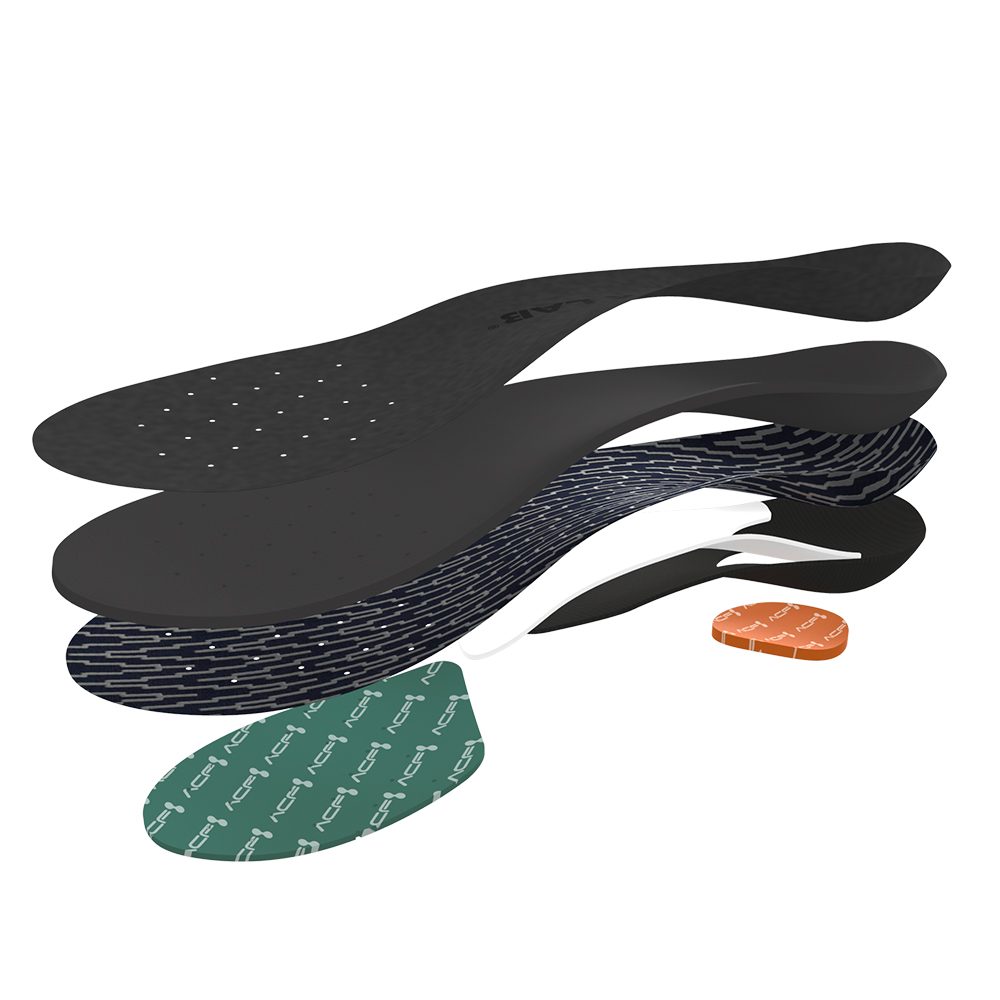
The hot zone is a bench with a heat source and a clock
Forming is a different operation with a different enemy. Heat softens the material so it can take the shape of a mould or a last, and while it is soft it will accept anything it touches — including dust, including the edge of a bench, including a thumbprint. That is why the hot zone cannot sit downstream of the grinder, and why a screen between the two is worth more than a bigger room.
The bench itself needs four things within reach: the heat source, a timer, the forming station, and a flat area where the piece can cool without being disturbed. The cooling area is the part that gets left out of plans and the part that causes the most rework, because a shell moved while it is still warm takes a set nobody intended, and the error only shows up at the fitting stage when the pair is already finished.
Moulds belong here, and the mould library is the most under-rated piece of furniture in a small workshop. A mould is not a tool, it is a record: it is the reason a pair made in March can be remade in September to the same shape. Store it labelled and indexed by the order it belongs to, within a few paces of the press, and treat the moment a mould leaves the shelf as a transaction that gets written down. A workshop that keeps moulds in a box under the bench can produce one good pair and then guess.
Ventilation in this zone is about heat and fumes rather than dust. Adhesive and softened material both give off vapour, and a small room with a closed window turns a two-hour session into a headache by lunchtime. An opening window on the far side from the grinder, plus extraction near the press, gives the room a direction of travel: air comes in at the clean end and leaves at the dirty end, which is also the direction the work should be moving.
The clean zone is where a pair becomes a product
Assembly and packing are quiet operations and they are the ones that decide whether the workshop’s work arrives in the condition it left. Covers are fitted, adhesive is applied, edges are finished, labels are checked against the order, and the pair goes into a box with whatever paperwork the customer expects. Everything in this zone should be either clean stock or a finished pair, and nothing that sheds material should enter it.
Position it at the opposite end of the room from the grinder, and put the stock between the two, so that a cover travels from storage to assembly without passing the dust. Lighting matters here more than anywhere else: an edge that looks acceptable under a single overhead bulb can look unfinished in daylight, and a pair inspected on the bench it was made on is inspected by the person who wants it to be right. A lamp that can be moved to the edge being checked is more useful than a brighter ceiling.
Finished pairs must never travel back through the dirty side. This sounds obvious and is violated constantly, because the shortest route from the packing bench to the door often runs past the grinder. Mark the outbound route — tape on the floor is enough — and keep it clear. A pair that has been packed and then carried across a dust zone has to be opened, checked and repacked, and nobody ever does that, which is how a workshop ships a box with grit in it.
Rework has a path of its own and it runs one way. A pair that comes back — wrong fit, wrong cover, a customer who changed their mind — enters at the dirty end, gets assessed, and then travels forward through the same sequence as a new pair. It does not get fixed at the packing bench, because the packing bench has no extraction and the repair will generate exactly the material the clean zone exists to exclude. A single tray by the grinder, labelled for returns, is the whole control.
One room, three zones, and the cheapest screen is distance
The smallest workable layout is a single room organised along one wall. Grinder at the far end beside the door, with extraction on that wall. Press in the middle, with the mould library beside it and a screen on the grinder side. Assembly and packing at the near end, with stock between assembly and the door. A pair enters at the far end and leaves at the near end, and the operator’s walk is a short loop rather than a crossing pattern.
Screens do not have to be built. A mobile partition on castors, a hanging curtain of heavy fabric, or a shelving unit loaded with stock will interrupt dust and sight lines well enough for a two-person shop, and each of them can be moved when the room changes. What they cannot do is replace cleaning: a screen catches what would have travelled, and the screen itself has to be wiped. The routine is the barrier; the furniture only makes the routine cheap.
Movement is the measure to watch once the zones exist. If the operator carries a pair from the press to the packing bench and then walks back past the grinder for a cover, the zones are in the right order and the stock is in the wrong place. If the operator turns around at a bench to reach a tool, the bench is too small or the tool is on the wrong side. Small corrections of distance are worth more than reorganising the room a second time.
What we do not do is design buildings. We do not survey a unit, we do not specify extraction, and we do not certify that a layout meets a lease, an insurer’s requirement or a local rule about fumes. Those belong to whoever signs for the premises. What we can say is what the equipment needs at a bench — a footprint, a power point, a clear approach — and what the line does not need, which is a room larger than the one most buyers already have.
Two sockets and one hose decide more than the floor area
In practice the layout is settled by services, not by preference. A grinder has to be within reach of its extraction and its power. A press has to be within reach of its power and its ventilation. The packing bench needs light and a surface. Once those three constraints are drawn on the plan, the benches have very little freedom left, and an owner who plans the furniture first will spend the first month moving it. We do not pretend that a layout can be bought. No supplier can install an order of work; the most a supplier can do is deliver equipment that fits the order the owner has already decided on.
Outlets are the constraint buyers forget. A bench placed where the socket is not means an extension lead across a walkway, which is a trip hazard for the operator and a fire risk near a heat source. If the room has one double socket, the honest answer is that the room has one workable bench position, and the layout should be built around it rather than argued with. Adding sockets is a small job before the benches arrive and an irritating one afterwards.
Storage wants to be off the floor and out of the sun. Sheet material and covers take a set if they are stored standing on end against a wall, and adhesive does not enjoy a room that swings between cold nights and hot afternoons. A shelving unit at the end of the room, away from the grinder and away from the window, costs less than the material it protects. Humidity matters in a rented unit with a metal roof, and a closed cabinet is a cheap answer.
Then there is the question of how many pairs the room can actually support, which is a different number from how many the equipment can produce. Our line runs at roughly five hundred to a thousand pairs on a working day, and no two-person workshop will feed it at that rate — the constraint is benches, hands and drying time, not the machine. A room that turns out eighty pairs a day steadily is worth more than a room that can theoretically do more and spends its afternoons waiting for adhesive to cure.
Frequently asked questions
Why can grinding, forming and packing not share one bench?
Because each operation produces something the next one cannot tolerate. Grinding throws dust, forming softens material so it accepts whatever touches it, and packing needs a clean surface. Sharing a bench means cleaning between every pair, which stops happening within a week.
How much space does a small orthotic workshop need?
Less than most owners assume, if the work runs in one direction. A single room organised along one wall — grinder at the door end, press in the middle, packing at the near end — is enough for two people, provided the route is kept clear and the stock sits between assembly and the door.
Where should moulds be stored?
Beside the press, labelled and indexed by order, because a mould is the record that lets a pair be remade to the same shape months later. Moulds kept loose in a box turn every remake into a new guess.
How should a returned pair re-enter the workshop?
At the dirty end, through the same sequence as a new pair. Repairs generate dust and heat, so they cannot be done at the packing bench. A labelled returns tray by the grinder keeps the path one-way.
Do I need built partitions between the zones?
No. Distance, a mobile screen on castors or a loaded shelving unit will interrupt dust and sight lines well enough for a small shop. The barrier that actually works is the cleaning routine, and furniture only makes that routine cheaper to keep.
What services matter most before the benches arrive?
Power positions and the extraction route. A grinder has to sit at the end of its hose and near a socket; a press needs power and ventilation. Adding outlets afterwards is far more disruptive than planning them first.
Does a bigger room make a workshop more productive?
Rarely. Output is limited by hands, benches and curing time rather than floor area. A room laid out so a pair moves forward without being set down repeatedly will outproduce a larger room where the work doubles back.
What we would do next
Draw the room to scale, mark the sockets, the door, the window and the extraction route, then send the sketch through the contact page with the number of pairs you expect in a week. We will tell you where the three zones fall in that room, and we will say so if the answer is that one bench has to move before anything is ordered.
The insole range page shows the three families and the grading that a workshop actually produces against, which is the other half of a layout decision: what is being made decides what the benches have to do. Your first orthotic insole making machine takes the equipment question from the beginning, and an orthopedic insoles machine is a bench makes the point that the machine is a workstation rather than a production line in a box.
Two more pieces are worth reading before a fit-out. Insole molding machine expectation versus the FX line sets out what a small line realistically does, and a custom moulded insole begins with a mould explains why the mould library deserves a wall of its own.
This article is intended for professional and educational reference. It is not medical advice. Foot assessment equipment produces measurements and images; clinical interpretation and any decision about care remain the responsibility of a qualified professional. Certification scope is limited to the documentation we hold: European Union certification and ISO quality system certification.