
A physiotherapist puts two printouts on the desk and asks which of them her department has actually been told to buy. Both came out of the same three words typed into the same search bar. The first printout shows a foot resting on a glass plate, a fan of light across the arch, and a surface that looks like a model of the foot from below. The second shows a coloured footprint with a column of values beside it and a thin line tracing the path load takes from heel to toe. She has a budget line, a room, and a colleague who insists the two machines are the same thing at different quality levels. They are not the same thing at all, and the words she typed will not settle it. This article takes the phrase apart in the order a buyer meets it: what the second word narrows, what the first word refers to in this market, what a pressure record holds across three passes, and where a supplier should stop and hand the reading to someone qualified.
Plantar is the word doing the narrowing
Three words arrive together, and only one of them is doing any work. Plantar is an anatomical adjective: it means the sole side of the foot. Put it into a search and the results change immediately. Without it, a buyer looking for a foot machine is offered everything from shoe-sizing boards to whole-body posture rigs to devices that photograph a foot for a running-shoe recommendation. With it, the results are all about the underside of the foot, and the market has already agreed on that much. The narrowing is useful, and it is also the reason buyers think they have found a category when they have only found a region.
What the word excludes is worth stating, because exclusion is where budgets go wrong. A plantar search removes the workshops that carve a last, the shops that image a whole standing body, and the clinicians who want a knee or a shoulder in the frame. What remains is a group of machines that all look downward at a sole and all produce something on a screen. From the outside they look like variants of one product. From the inside they are different trades: one produces geometry, one produces values in time, one produces a picture for a conversation. The phrase does not distinguish between them, and no amount of scrolling will.
There is a commercial consequence that shows up in the first meeting. A buyer who has narrowed to plantar has usually already decided that the foot is the unit of interest, which is a genuine step forward. What they have not decided is whether they need the shape of the foot or the behaviour of the load under it. Those two answers lead to different rooms, different staff routines and different conversations with customers. A supplier who answers the first question with the second product is not lying; the phrase gave both of them permission to assume.
So the useful reading of the phrase is this: plantar narrows the region and leaves the method open. Once a buyer sees that, the next question stops being which listing is cheapest or newest, and becomes what document will exist at the end of a session.
What the first word refers to in this market
In the search bar, the modifier at the front has become shorthand for a particular kind of screen: something that shows a foot as a modelled object which can be turned, coloured or measured. Buyers type it because it is the word the market uses for the modern end of the category, and sellers use it because that is where the enquiries are. It is a search habit before it is a specification, and a buyer reading listings should treat it as a label on a folder rather than a description of what is inside.
The hardware in our own catalogue is not that. A session runs on a sensing surface woven from Sinmec Fabric, a lower-limb camera, a posture camera and software that assembles the passes into a report. The surface reports load; the cameras report alignment above the surface; the software names the items. There is no light pattern projected across the arch, no reconstruction of the outer surface of the foot, and no file that a carving or printing step could follow. The record is quantitative and it is comparative, and that is a different product from a shape capture.
We say this in the first conversation rather than the fifth, and it occasionally costs us an order. A workshop that builds shells from individual shapes needs geometry, and no amount of pressure data will substitute for it. A clinic that wants to discuss load and compare a record with the one taken last season needs something a contour file cannot give.
What the record holds instead is a set of named quantities that survive being read by someone else. Footprint length and width, contact area, the distribution of load across the sole, the angle of the foot axis, the proportions of contact and flat phase, peak and mean pressure, and the speed at which the centre of pressure travels forward. Each of those is a value with a name, and a value with a name can be put beside the same value from another visit. That comparability, rather than any image, is what makes a retest worth booking.
The standing pass: what a sole shows at rest
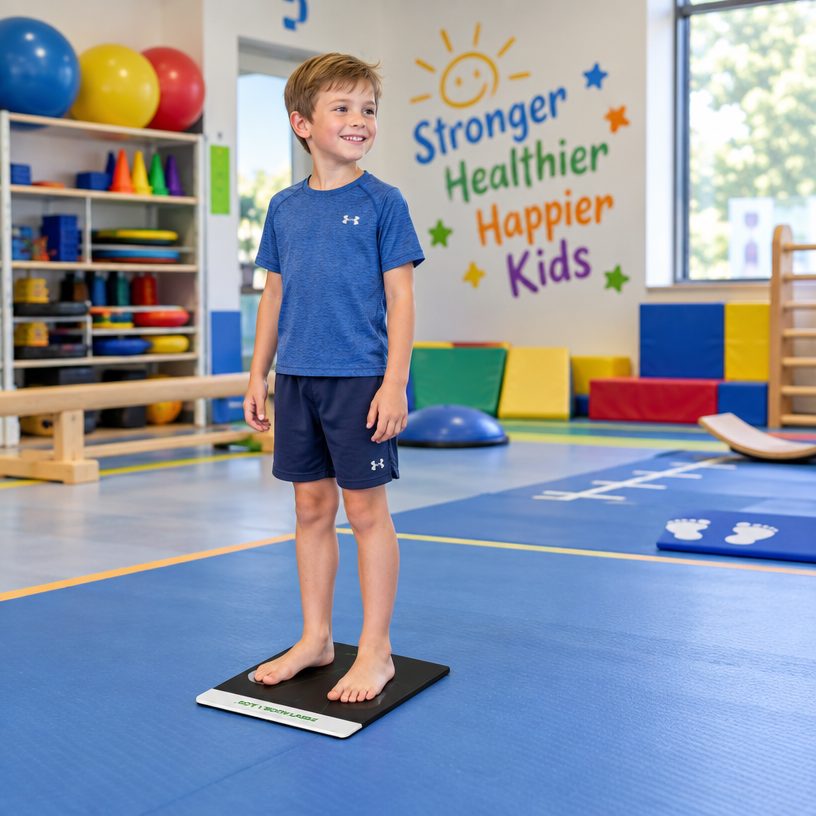
The first pass is the simplest and the one most often skipped. The customer stands still, weight even, looking ahead, and the surface records how the load sits. What comes back is footprint length and width, contact area, a map of where the load is concentrated, and a description of how the arch presents when nothing is moving. It is a still photograph made of numbers, and like a photograph it says nothing about what happens next.
Read properly, a standing pass is a description rather than a verdict. A foot that presents a low arch at rest is not thereby a problem; it is a foot that presents a low arch at rest, and the same foot may behave quite differently once it is walking. The value of the pass is that it establishes a starting condition, in the same way that a measurement taken against a door frame establishes height. What a clinician or a fitter does with that condition belongs to their judgement, not to the software.
This is also the pass where routine matters most, because standing is easy to do inconsistently. Feet apart or together, weight forward or back, arms hanging or folded, head turned to talk to the person at the desk — each of those changes the numbers a little. A clinic that standardises the instruction, the stance width and the position in the room gets records it can compare. One that lets each customer stand as they please gets a set of attractive images and no baseline.
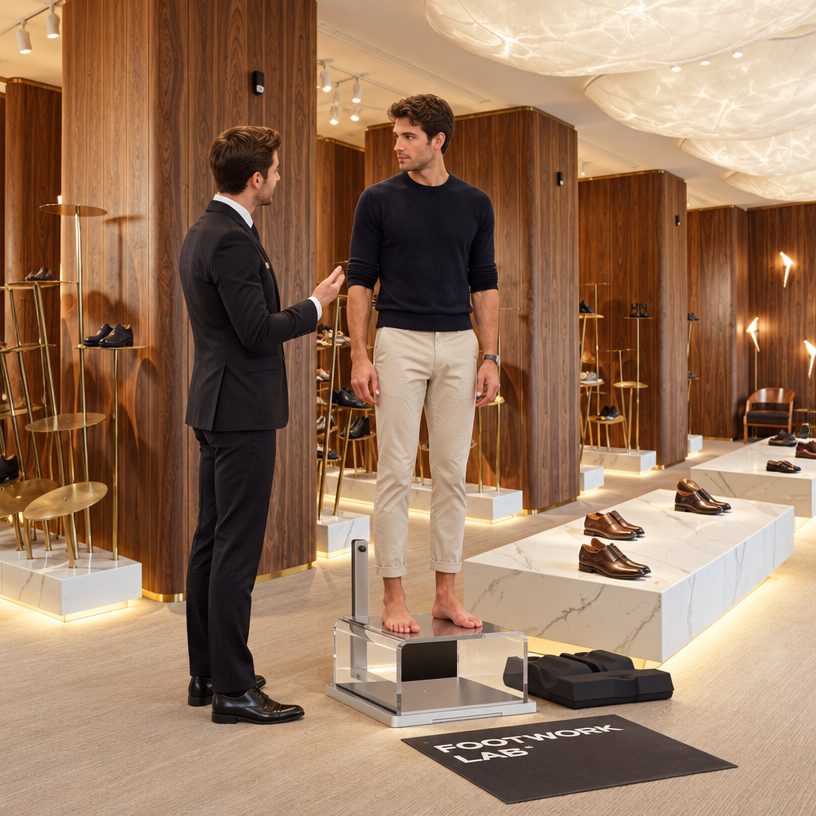
For a shoe shop, the standing pass answers a narrow commercial question well: where does this person’s load sit, and does the pair they are about to try leave room for it. For a clinic, it is the first line of a record that will be extended. Neither use requires the arch to be called normal or abnormal, and we discourage that framing in the report language, because a label on a printout travels further than the caveat printed underneath it.
The walking pass: load in motion
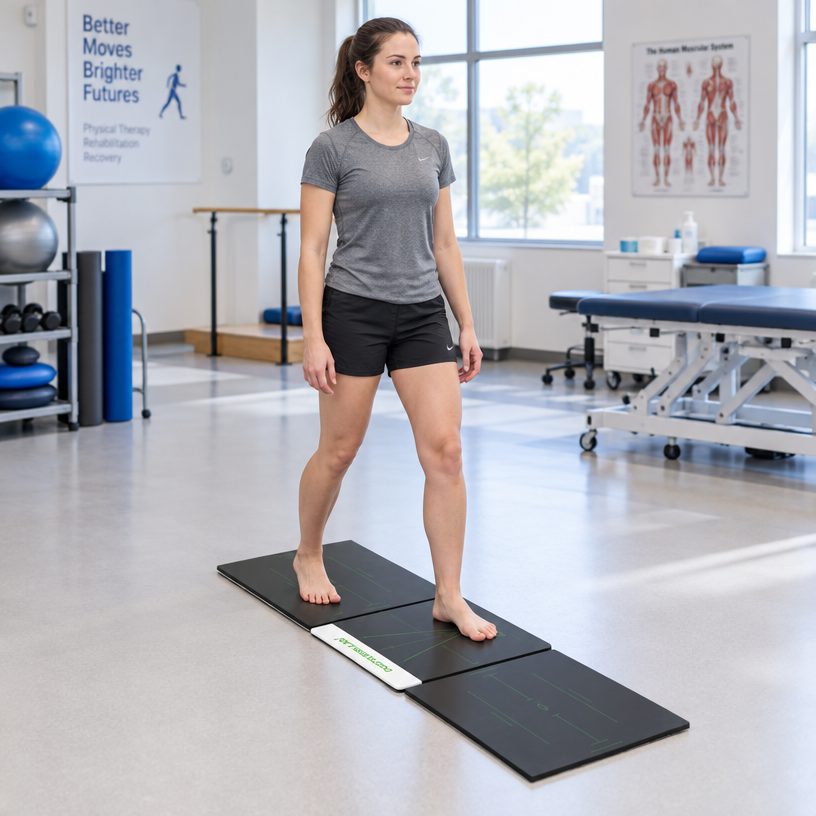
The second pass asks the customer to walk across the surface, and the record changes character. Now the items are about time as well as place: the angle of the foot axis, the proportion of the step spent in contact and the proportion spent flat, peak and mean pressure under each region, and the speed at which the centre of pressure runs from heel to forefoot. A foot that looked unremarkable standing can produce a very different set of numbers in motion, and that difference is usually the reason the appointment was made.
The clearest example is the arch that presents flat at rest and behaves differently under load, or the reverse. On a standing pass alone, the two feet look alike. With a walking pass beside it, one shows a contact phase that runs long and a centre of pressure that drifts inward before pushing off, while the other does neither. Nothing in that description is a diagnosis; it is a difference between two records, and describing it precisely is what allows someone qualified to decide whether it matters for this person.
The camera layer runs during the same pass. A lower-limb camera records heel position, knee tracking and the direction the shin carries as the foot rolls forward, and a posture camera records how the column above sits over the base. Pressure without alignment is half a sentence: the same load map means something different under a knee that tracks inward than under one that tracks straight. Putting the two beside each other is what turns a footprint into a force-line record, and it is the part of the output that footwear and insoles are actually specified against.
A walking pass is not a longer standing pass, and buyers sometimes assume it is only a matter of duration. The surface has to be long enough for a stride rather than a step, the customer has to walk at a natural pace rather than a posed one, and the first pass across any new surface is usually a rehearsal. A clinic that budgets one pass will get one pass; a clinic that budgets three will get a record it can defend when the customer returns.
The third pass asks a separate question
A balance trial is not a harder version of standing. The customer is asked to hold still while the ground under them becomes less predictable, and the record describes how much the centre of pressure moves while they try. The quantities are about excursion and correction over time rather than about where load sits. For a rehabilitation department, that is a different conversation from the one about arch height, and it belongs in a different part of the file.
What the pass adds commercially is a reason to come back. A standing and walking record describes a pattern; a balance record describes a task, and a task can be repeated under the same conditions in three months without changing anything about the setup. That is what makes a review appointment meaningful rather than a chat. It also gives a trainer or a therapist something concrete to show when a customer asks whether the work is doing anything, which is a question that arrives in every programme eventually.
Running three passes in one sitting has a practical consequence that listings rarely mention. The customer undresses their feet once, the operator stays in one place, and the three documents arrive together with the same date and the same routine behind them. In a shop, that fits inside a single visit. In a clinic, it removes the second appointment that a two-machine workflow would require, and it removes the mismatch that appears when a standing record from one device is compared with a walking record from another.
The limits are worth stating as plainly as the uses. A balance trial records a task under the conditions of that room on that day; it is not a risk score, and it does not predict a fall. Feet fatigue, a busy morning, an unfamiliar surface and a customer who is anxious all change the numbers. The record is a description of what happened, and the interpretation of what it means for a person stays with the professional who ordered it.
Where the phrase stops being useful
Once the region is fixed and the method is clear, the phrase has done its job and should be put down. The questions that follow are ordinary procurement questions, and they decide whether the machine earns its place: what document exists at the end of a session, whether two sessions can be displayed side by side away from the unit, how the routine is standardised, who reads the output, and what happens in the years after delivery.
It is worth asking for a sample report in the vendor’s own words and reading it before the demonstration. The vocabulary on that page tells a buyer which family they are in faster than any specification. If the page is a set of named quantities with units and a date, the machine records. If the page is a rendered surface, the machine captures shape. If the page is a list of recommendations with no values behind them, the machine is selling an opinion, and the buyer should ask who is accountable for it.
We are clear about the parts we do not do. We do not produce a surface model of the foot and there is no laser in the unit; a buyer who needs geometry for a milling workflow is shopping in a different category and we will say so. We do not diagnose, and no report item is a finding — each one is a recorded value, and reading it belongs to a qualified professional. We do not publish prices, because a quotation depends on configuration, destination and the service wrapped around the unit, and a figure in an article is wrong by the time it is read. We also do not promise exclusivity by region; that is a distribution agreement, with obligations on both sides.
What we do publish is structure. One unit is the minimum order, machines accept ODM, and every unit is tested at the plant for seven days before dispatch. The warranty runs twelve months against non-human damage with free parts. Support runs through a dedicated WhatsApp group with engineers reachable directly, remote assistance when a session misbehaves, and over-the-air updates where the unit is on a network. Those are the terms a buyer can plan against, and they matter more in the second year than in the first week.
Frequently asked questions
Is a 3D plantar scanner the same thing as a pressure mat?
Not necessarily. The phrase describes a region, not a method. Some listings under it capture the outer surface of the foot, some record load under the sole, and some do both in separate steps. The document produced at the end of a session is the only reliable way to tell which family a listing belongs to.
What does the word plantar exclude from a search?
Everything that is not about the underside of the foot: shoe lasts, whole-body posture rigs, and devices that image a standing body for a footwear recommendation. That narrowing is useful, but it leaves the method open, which is why two listings under the same phrase can be different products.
Does the F2 produce a shape file of the foot?
No. It records plantar pressure, lower-limb alignment and posture, and assembles those into a report. There is no surface reconstruction and no file a carving or printing step could follow. A workshop that builds from shapes needs a different category of equipment, and we say so early.
What is recorded in a standing pass?
Footprint length and width, contact area, how load is distributed across the sole, and how the arch presents at rest. It is a description of a starting condition rather than a verdict, and it becomes far more useful when a walking pass sits beside it.
What does a walking pass add?
Time. Foot axis angle, the proportions of contact phase and flat phase, peak and mean pressure, and the speed at which the centre of pressure travels forward. A foot that looks unremarkable standing can produce a very different set of values in motion.
Why run a balance trial separately?
Because it asks a different question. The customer holds still while the ground becomes less predictable, and the record describes how far the centre of pressure travels while they try. That is a record of a task, repeatable under the same conditions later, not a risk score.
What are the order and support terms?
One unit is the minimum order, machines accept ODM, and each unit is tested at the plant for seven days before dispatch. The warranty covers twelve months against non-human damage with free parts, and support runs through a dedicated WhatsApp group with direct engineer access.
What we would do next
Write the question at the top of a page before opening another listing: what document exists when the session ends. Then send the shortlist through the contact page and we will sort it family by family, including the listings that are not ours, and say which question each one will fail.
The F2 system page lists the record items and the three session types in the equipment’s own terms. Two articles go further into the phrase itself: plantar 3D scanning is a search term makes the argument from the naming side, and a plantar pressure scanner describes the same family from the measurement side. Dynamic plantar pressure mapping on the F2 follows one clinic’s use of the walking pass, and three ways to capture a foot sets out the trades in short form.
This article is intended for professional and educational reference. It is not medical advice. Foot assessment equipment produces measurements and images; clinical interpretation and any decision about care remain the responsibility of a qualified professional. Certification scope is limited to the documentation we hold: European Union certification and ISO quality system certification.