
A clinic buys its first pressure system, and within a month somebody asks it a question it cannot answer. The question is not about the equipment. It is about a person: why does this foot hurt, and is it getting better. The system has produced four pages of values, a coloured sole and a thin line tracing load from heel to toe, and none of those pages contains either answer. That is not a failure of the instrument; it is the boundary of what a pressure measurement is. This article sets that boundary out in the order a buyer meets it: what the device commits to when it calls itself a measurement device, which quantities a session actually records, why the time dimension changes the reading, what the record structurally cannot see, and which questions have to be handed to another instrument or to a qualified professional before anybody says anything to the customer.
Measurement is a commitment, not a claim
Calling a device a measurement device is a promise about a narrow thing: that the numbers on the page correspond, within a stated tolerance, to a physical quantity at a stated place and time. It is not a promise about meaning. A thermometer measures temperature and says nothing about why the temperature is high; a pressure surface measures load and says nothing about why the load sits where it does. Both are useful precisely because the promise is small enough to keep.
Buyers tend to want the larger promise, and suppliers who are competing for a purchase order are tempted to give it. The result is a category in which the vocabulary of measurement and the vocabulary of care have been blended, so that a peak value appears in the same sentence as a recommendation. A clinic that buys into that blend inherits a problem: it has to defend a claim it never had the instrument to support.
Our position is the narrow one, and it is worth stating before the demonstration rather than after it. The equipment records; it does not interpret. Every item in the report is a recorded quantity with a name and a date, and the reading of those quantities belongs to a qualified professional who has seen the person, not only the page. Where a listing promises more than that, the promise has moved from engineering into something else.
The narrow position is also the commercially useful one. A record that says exactly what it measured can be compared with another record, filed, handed over, and defended in a conversation five years later. A conclusion cannot, because it belongs to whoever wrote it and dies with their employment.
The values a session actually leaves on the page
A standing pass produces the still quantities: footprint length and width, contact area, the distribution of load across the sole, and how the arch presents when nothing is moving. A walking pass adds the series: peak and mean pressure by region, foot axis angle, the proportion of the step spent in contact and the proportion spent flat, and the path of the centre of pressure from heel to forefoot. A balance pass produces excursion and correction over time while the customer holds still.
Each of those is a recorded quantity, and each is only meaningful beside something else. A peak value means little without a region and a moment; a contact area means little without a body size; a centre-of-pressure path means little without the direction of travel and the foot it belongs to. This is why a report is laid out as a page rather than a single number, and why a screenshot of one value sent by message is a poor basis for any conversation.
The camera layer adds a separate family: heel position, knee tracking, the direction the shin carries, shoulder level, pelvic tilt. Those are angles and offsets read from an image, described in the vocabulary of alignment. They sit beside the pressure values without being derived from them, which is the point — the same load map under a knee that tracks inward is a different situation from the same map under a knee that tracks straight.
What the page does not contain is equally specific. There is no column for tissue condition, no score for how much load a particular structure can bear, no field for the source of a symptom, and no row that says what to do. Those absences are not gaps to be filled by a future software release. They are outside what a surface under a foot can observe.
Time is the dimension buyers underestimate
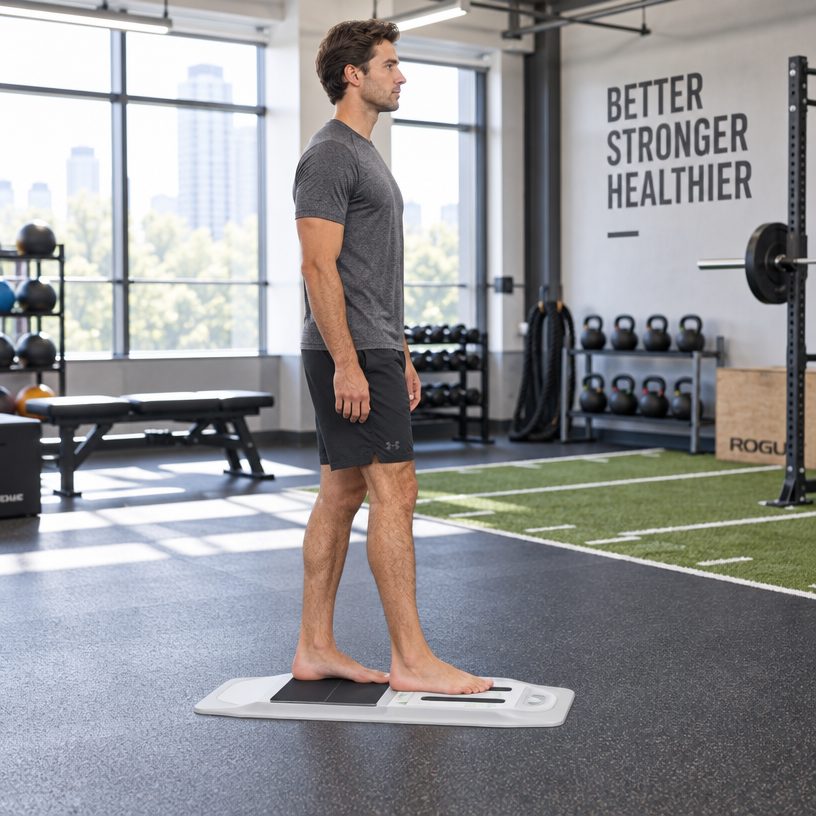
A static image of a sole is easy to sell and easy to misread. The interesting part of a pressure record is not where the load is but when it is there: how long the foot stays in contact, how much of that time it spends flat, how quickly the centre of pressure travels forward, whether the two feet spend the same time on the ground. Two feet can produce identical pictures and completely different timing, and the timing is usually the reason the appointment was made.
This is where the length of the capture surface stops being a specification detail and becomes a clinical one. A short surface records a step; a longer one records a stride, with the approach and the follow-through that make a natural pace possible. The F2-PRO is the extended version of the F2 for exactly this reason: the walkway is longer, the dynamic cycle is captured as a cycle rather than as an event, and the report can describe stance phase, swing phase and the period when both feet are on the ground.
Double support is a good example of a quantity that only exists once you record time properly. It is the moment in a walking cycle when both feet are down, and it changes with pace, with confidence, and with how a person distributes load between two sides. On a short surface the moment is often clipped at one end. On a long one it appears as a proportion, and a proportion can be compared with the same proportion six months later.
The practical consequence for a buyer is a question worth asking in the demonstration: does the session record a step or a cycle, and can the same cycle be reproduced next season? If the answer is a step, the record is a snapshot. If it is a cycle, the record is a baseline, and a baseline is what makes a retest worth booking.
One routine detail follows from the same logic. The first pass across an unfamiliar surface is almost always a performance rather than a walk: the customer slows down, looks at their feet, and places each step deliberately. That pass is a rehearsal and should be treated as one, which means the record used for comparison should come from a later pass, once the customer has stopped thinking about the equipment. A clinic that keeps the first pass and discards the third has kept the least natural walk in the session.
What the record cannot see
It cannot see tissue. A pressure surface reports the force between a foot and a surface; it says nothing about the condition of skin, fat pad, tendon, fascia or bone beneath that force. Two people can produce the same map with very different tissue underneath, and the map cannot tell them apart. Anything a clinician knows about how much load a particular structure tolerates comes from training and examination, not from the page.
It cannot see the source of a symptom. Pain is a report from a person, not a quantity on a surface, and its location does not map reliably onto the place where load is highest. A record can show that load concentrates under the ball of the foot; it cannot say that this is why the customer is limping, or that reducing the load will change anything. Those are hypotheses for a professional to test, and testing them is a clinical act.
It cannot see the shoe. A session is usually run barefoot, and the shoe the customer wears for eight hours a day changes the load far more than most people expect: heel height, stiffness, width at the ball, the wear pattern on the outsole. A fitter who reads the record without looking at the shoe has read half the situation. This is one of the reasons a footwear recommendation belongs to somebody who can hold both in view.
And it cannot see change over a period. A record describes one session on one day. Fatigue, a busy morning, a cold room, a new pair of socks and a customer who is anxious all move the values. The instrument is consistent; the person is not, which is why a single record is a description and a series of records is evidence.
Where another instrument, or a clinician, takes over
Some questions need a different device, and saying so is part of a supplier’s job. A workshop that needs the geometry of the foot needs a shape capture or a cast. A clinic that needs to know what is happening inside a joint needs imaging that no surface under a foot can provide. A practitioner who needs to know how a person walks over a longer distance needs observation, or a treadmill session, or both. None of those is a criticism of a pressure record; they are different questions with different instruments.
Other questions need a person rather than a device. Whether a distribution matters for this customer, whether a pair of insoles should be built to it, whether a referral is appropriate, whether anything should be done at all: each of those is a judgement, made by somebody with training, a licence in their jurisdiction, and the person in front of them. The report’s job is to make that judgement better informed, and its honesty about its own limits is what makes it usable in that setting.
This is also where a supplier’s language matters commercially. A clinic that has been sold a device as a decision-maker will use it as one, and the first difficult case will expose the gap in front of a customer. A clinic that has been told plainly what the device records will use it as a record, build a routine around it, and keep using it in year three, which is a better outcome for everybody including the supplier.
We therefore write the limit into the material rather than the small print: the report is for professional reference, the interpretation is the clinician’s, and any decision about care sits with them. That sentence is not a legal formality. It is the description of where our product stops.
Handover is the practical test of all this. A record that can leave the room — attached to a referral letter, printed at the counter, exported and sent to a colleague — is a record that supports somebody else’s judgement. A record that can only be read on the machine in the corner is a record that supports a demonstration. When clinics tell us the system changed how they talk to other practitioners, the change is usually about the file leaving the building rather than about the software doing more.
Retest discipline: the second record is the useful one
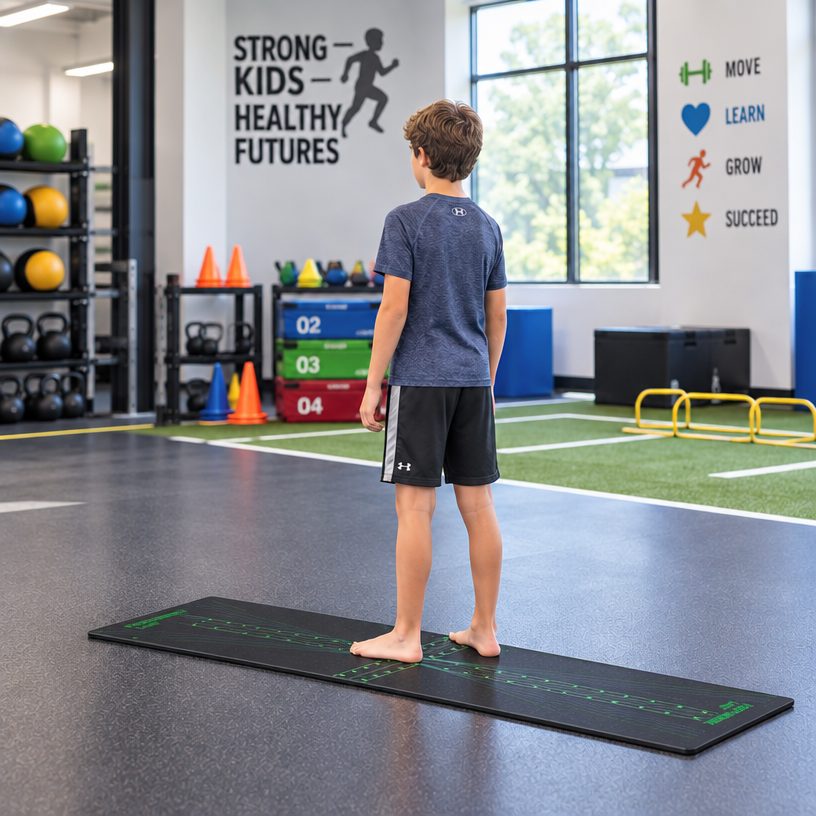
The first record answers a question about now. The second answers a question about change, and change is what most people actually want to know. That makes the routine around the first session the most valuable asset a clinic builds: the same stance instruction, the same walking route, the same number of passes, the same time of day where possible. Without that, two records are two opinions rather than one comparison.
A retest interval should be set by the reason for the retest, not by a calendar. A pair delivered and worn for a season, a training block that has finished, a growth spurt in a child, a change of occupation or shoe: each of those is a reason. A date chosen because a diary had a gap is not. The useful question is what would have to change for the second record to say something the first could not.
Storage matters here more than buyers expect. A record that lives only on the machine is a record that disappears when the machine is replaced. Export by code, by email or on paper is not a convenience feature; it is what lets a clinic hand a file to a colleague, attach it to a note, or produce it in a conversation years later. Ask where the file goes before asking what the file contains.
None of this turns a pressure record into evidence of an outcome. It makes it a sequence of observations taken under consistent conditions, which is a modest and genuinely useful thing to own. Clinics that understand the difference tend to be the ones still running sessions long after the novelty has worn off.
Frequently asked questions
What does a plantar pressure device actually measure?
Load between the foot and a surface, and how that load changes in time: peak and mean pressure by region, contact area, foot axis angle, the proportions of contact and flat phase, and the path of the centre of pressure. Alignment is read separately by cameras.
Can it tell what is causing a person’s foot pain?
No. Pain is reported by a person and does not map reliably onto where load is highest. The record can show how load is distributed; deciding what that means for a particular person is a clinical judgement, and it usually needs examination as well as a page.
Does the report give a diagnosis?
It does not, and it is not built to. Every item is a recorded quantity with a name and a date. The report states that it is for professional reference; interpretation and any decision about care remain with a qualified professional.
Why does a longer capture surface matter?
Because it records a cycle rather than a step. Approach, contact, roll-off and the period when both feet are down all need room to appear. A cycle can be reproduced under the same conditions later, which is what makes a comparison meaningful.
What can the cameras add that pressure cannot?
Alignment above the sole: heel position, knee tracking, the line of the shin, and posture through the trunk. The same load pattern under a knee that tracks inward is a different situation, and only the camera layer shows which one you are looking at.
How often should a record be repeated?
When something has changed or is expected to: a new pair worn for a season, a finished training block, a growth spurt, a change of shoe or occupation. A retest needs a reason and an identical routine, otherwise two records are two opinions.
Where is the file kept?
Exportable by code, by email or on paper, which matters more than it sounds. A record stored only on the machine disappears with the machine. Ask where the file goes before asking what it contains.
What we would do next
Send one sample report and the question you want it to answer, through the contact page. If the question is outside what a pressure record can support, we will say so in the first reply rather than at the end of a quotation.
The F2-PRO system page describes the extended walkway and the dynamic cycle it captures. Three articles follow the same argument: a plantar pressure scanner sets out the family from the measurement side, pressure plates and the F2-Pro explains what the longer surface changes, and biomechanical analysis ends in a report follows the values from the session to the page.
This article is intended for professional and educational reference. It is not medical advice. Foot assessment equipment produces measurements and images; clinical interpretation and any decision about care remain the responsibility of a qualified professional. Certification scope is limited to the documentation we hold: European Union certification and ISO quality system certification.