
Children do not walk like small adults, and the equipment that records them has to be configured for that difference. A gait assessment designed for an adult assumes a settled stride, a predictable walking speed and a client who will stand still while instructions are given. None of those assumptions survive contact with a seven-year-old. The recording still works; the session around it has to change.
The practical problems are unglamorous. Feet are smaller, so the contact area under each sensor is smaller and the recording has less to work with. Attention is shorter, so the number of usable passes in a session is lower. A parent is in the room, which changes both the conversation and the consent. And the report has to be written for someone who will read it as a description of their child, which raises the stakes on every sentence.
We build the F5-LAB platform and work with clinics that screen children as part of a broader service. This article is about the protocol rather than the paediatric question itself: how to prepare a room, a session and a report for smaller feet and shorter attention, and where the limits of an assessment recording sit when the client is still growing.
Why a paediatric session is a different protocol
Adult gait recording relies on repeatability. The person walks at a consistent speed, several passes are captured, and the pattern is read from the average. A child’s walking changes between passes for reasons that have nothing to do with their feet: a new distraction, a request to walk faster, a parent’s encouragement, the novelty of the platform wearing off.
That does not invalidate the recording. It changes what counts as evidence. A finding that appears on every pass is worth reporting; a finding that appears once, usually when the child is hurrying, is a description of that moment. Reading the two as if they carried the same weight is the most common error in paediatric reporting.
The second difference is that a child’s foot changes shape over months. An adult recording can be compared across years and mean something; a child’s recording is a snapshot with a short shelf life. Reports should carry the date prominently and should not be presented as a baseline that will hold.
The room, and the parent in it
Space matters more than usual. A child will walk further than instructed, stop suddenly and occasionally sit down on the platform. A room with a clear run-up and no trip hazards is not a luxury; it is the difference between three usable passes and none.
The parent’s position should be decided before the session. Behind the child and out of the camera line is usually best: close enough to reassure, far enough not to draw the child’s attention during a pass. A parent standing at the end of the walkway produces a child walking towards them, which changes the stride and, in a small room, the speed.
Consent is a conversation with the parent and, where the child is old enough, with the child as well. Explain what is recorded, who sees it and how long it is kept, in language the child can follow. A child who understands what is happening stands still more reliably than one who has been told to cooperate.
Have something for the child to do between passes. Two minutes of walking practice disguised as a game produces better recordings than five minutes of instruction. This is not a technique for managing children; it is a technique for getting data that reflects how they actually walk.
Smaller feet, smaller numbers
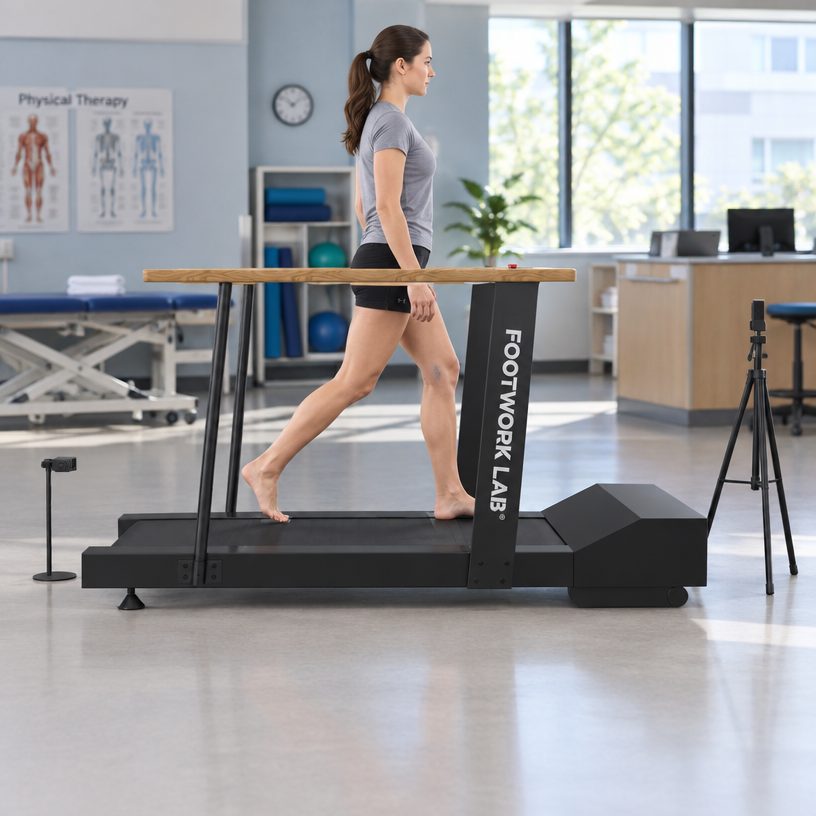
A pressure platform divides its surface into sensing elements, and a child’s foot covers fewer of them than an adult’s. The result is a coarser picture of the same foot. That coarseness is a property of the recording, not of the child, and reports should acknowledge it rather than presenting a low-resolution map as if it were equivalent to an adult’s.
In practice this means reading regional patterns rather than individual elements. A single element reading high under a small foot may be a genuine finding or an artefact of where the foot landed relative to the sensor grid. Averaging across several passes reduces the risk, which is another reason to prioritise repeatable passes over many of them.
It also means being careful with comparisons between a child and an adult reference. A map scaled for adult loading will show a child’s foot as uniformly low, which is not informative. Read the child’s own pattern, and compare it with the child’s own previous recording where one exists.
Session length and attention
Budget the session around the child rather than the equipment. A workable structure is: a short explanation, one practice walk, three to five recorded passes with a break, and a short conversation with the parent while the child sits down. Twenty minutes is usually enough; forty is usually too long for anyone involved.
Decide in advance what you will do if the child refuses. A recording made under protest is poor data, and a practitioner who forces the session teaches the child that the room is unpleasant, which affects every future visit. Better to record what you can, note the conditions, and offer a second appointment.
Keep instructions short and physical. “Walk to the blue line and stop” works; “walk naturally at a comfortable pace” does not, for most children under ten. The measurement depends on the instruction being understood, so the instruction is part of the protocol.
Recording play rather than walking
Some clinics get better data by recording the child at play: running to a marker and back, hopping, walking on a line. These passes are less standardised and often more representative, because the child is not trying to perform a walk for an adult. The trade is comparability: a play pass cannot be compared with a standard walk pass, so the choice has to be consistent within a service.
A useful compromise is to capture both and label them. A standard walk pass for the record, a play pass for the conversation with the parent. The first supports comparison over time; the second often shows the practitioner what to ask about.
Whatever the pass type, note it in the report. Six months later, the difference between a walk and a run is the difference between a changed recording and a changed child.
Writing for a parent
A paediatric report is read by someone emotionally invested in its subject. That changes the language. Descriptive statements about a recording are safe and useful; conclusions about a child’s future are neither, and they are outside what an assessment system can support.
The structure that works: what was recorded, what the recording shows, what it does not show, and what the practitioner recommends as a next step. Keep the measurement and the interpretation in separate paragraphs and sign the interpretation. This is the same discipline as an adult report, applied to an audience that will read it more carefully.
Avoid comparisons with other children. “Lower than typical for the age” invites a question that the recording cannot answer, because typical ranges for a growing foot are wide and the recording is a single moment.
What not to claim
An assessment system measures. It does not establish whether a child’s gait is a matter for concern, and it cannot say what will happen as the child grows. Statements about development belong to a qualified professional who has examined the child, taken a history and considered the whole picture.
The same applies to equipment marketing. A system that claims to identify conditions in children is making a claim that no pressure recording can support on its own. We do not make that claim for our own systems, and clinics should be cautious of any supplier who does.
Equipment settings worth asking about
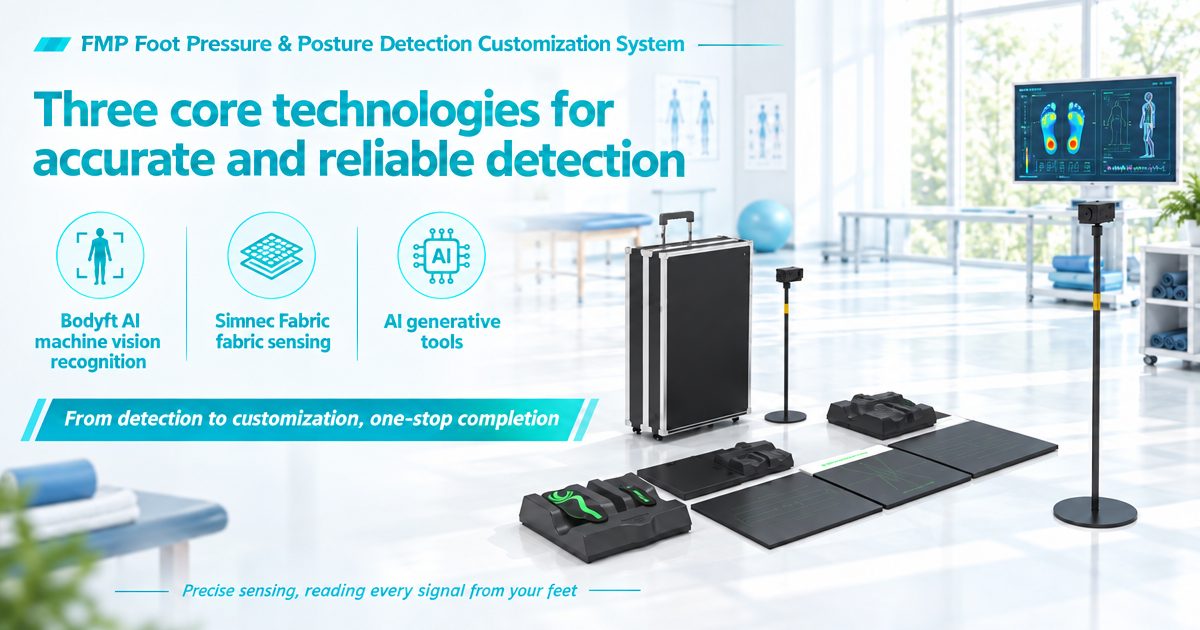
Ask whether the platform can be configured for lower loading ranges, whether the software supports a paediatric display scale, and whether recordings from children can be stored separately from adult records. These are practical features, and their absence turns a usable system into one that requires workarounds.
Ask about the walking surface as well. A platform set into a walkway gives a child a longer run-up, which usually produces a more settled pass than a mat in the middle of a room. In a small clinic the mat may be the only option, and the report should say so.
Finally, ask what the software does with short recordings. Some systems assume a minimum number of frames that a child’s faster cadence may not produce. A system that handles short passes gracefully is better suited to paediatric work than one that requires long recordings to generate a report.
Follow-up and the record you keep
Follow-up intervals for children are usually set by the practitioner rather than the equipment, and the equipment’s job is to make the comparison easy. Store the recording with the date, the pass type and the conditions, and export a copy that will still be readable if the software changes.
A practical habit is to keep one image and one regional summary per visit, rather than the full raw data. The image is what a parent remembers; the summary is what a colleague can read. Together they take little space and answer most questions that arise later.
Training the team
Paediatric sessions are harder to run than adult ones, and the difficulty is in the soft skills rather than the software. Train the team on the script for explaining the session to a child, on where the parent stands, and on how to end a session that is not working. Rehearse it once with a colleague’s child before the first real appointment.
Then review the first ten paediatric reports together. The patterns that need correcting usually appear by the third report, and they are almost always about language rather than data.
The commercial side of a paediatric service
A paediatric session takes longer than an adult one and produces fewer recorded passes. Priced like an adult appointment, it loses money. Priced honestly, it needs an explanation that most parents accept readily, because the time is visible: the practice walk, the break, the conversation afterwards.
The service also has a demand pattern that differs from adult work. Parents book in school holidays, at the start of a sports season, or after a teacher mentions something. A clinic that wants a steady paediatric caseload should plan for those peaks rather than expect a flat calendar.
Staffing is the constraint. A session that needs a second adult in the room for safeguarding and practical help cannot run at full capacity with one practitioner. That cost belongs in the pricing decision, and it is the reason paediatric services are often bundled with a broader appointment rather than sold as a standalone recording.
None of this is a reason to avoid the service. It is a reason to design it deliberately, with a protocol, a price and a calendar that match how children actually attend.
One further planning note: appointments for children run late more often than adult ones, and a schedule built without slack will drift by the end of the morning. Leave a gap after every second paediatric booking, and the day stays predictable even when one session takes twenty minutes longer than planned.
Records deserve the same care as the session. A parent may ask for a copy months later, and a report written in a hurry with the conditions unstated will be hard to defend. Two extra sentences at the time of writing save a difficult conversation later.
Finally, decide what the service is for. If it is screening within a broader appointment, keep it short and say so. If it is a standalone assessment, build the protocol and the time around that. Trying to do both in one slot is how a clinic ends up with a service that satisfies nobody.
Frequently asked questions
At what age can a child be recorded on a pressure platform?
That is a clinical and practical judgement rather than a product specification. What matters is whether the child can follow a short instruction and stand or walk safely on the platform. Discuss the individual case with the qualified professional responsible.
How many passes should a paediatric session include?
Enough to see whether a pattern repeats, and no more than the child can sustain. Three to five recorded passes with a break is a workable target for many sessions; the report should state how many were usable.
Can the software display a paediatric scale?
Ask about the configuration for the model you are considering. Display scaling and storage separation are practical requirements in paediatric work, and they differ between systems.
Do you provide clinical guidance for children?
No. We provide equipment and training on operating it and on what the measurements represent. Clinical interpretation and any decision about care belong to the qualified professional.
What support is included with the platform?
Twelve months on non-human damage with free replacement parts, a dedicated WhatsApp group, direct access to our engineers, remote assistance where the site allows it, and over-the-air updates for connected units.
Can a single unit be used for adults and children?
Yes, with different configuration and protocol. Machine orders start from one unit, and we accept ODM on equipment where a service needs a specific configuration.
How long should recordings be retained?
Follow local requirements and your own policy. A practical approach is to keep a summary image per visit and the full recording for the period your professional body recommends.
What we would do next
Run one paediatric session with a colleague’s child before offering the service, and time it honestly. The F5-LAB product page covers the platform configuration, the FAQ page answers commercial questions, and our article on dynamic pressure mapping explains what a recording can and cannot show. For the clinic workflow around it, the piece on paediatric orthotic insoles covers what a clinic should not promise, and the article on fitting gait analysis into an assessment routine handles the adult version of the same planning question.
This article is intended for professional and educational reference. It is not medical advice. Foot assessment equipment produces measurements and images; clinical interpretation and any decision about care remain the responsibility of a qualified professional. Certification scope is limited to the documentation we hold: European Union certification and ISO quality system certification.