
Custom is the most valuable word in this trade and the least inspected. Buyers order custom made insoles expecting that the product was built from a measurement of a specific person. Factories ship products labelled custom that range from genuinely individual builds to trimmed stock with a name sticker. The distance between those two is not a quality gap — both can be decent products. It is a promise gap, and it surfaces at exactly the wrong moment: when the client asks what makes their pair theirs.
This article defines custom from the production side, because that is the side we run. We manufacture orthotic insoles in a plant in Ruichang, at five hundred to a thousand pairs a day, with a two-hundred-pair minimum that can be mixed across styles and sizes. Volume like that only works with written definitions of what each order promises — so the definitions below are not marketing lines. They are the clauses our own workflow runs on.
The goal is practical: by the end, a buyer can read any supplier’s “custom” offer — including ours — and know which of the five meanings below is actually being sold.
Why does the definition matter so much in this trade specifically? Because the product is invisible at the moment of purchase. A buyer of machinery can open a panel; a buyer of footwear can try a sample. A buyer of custom insoles is buying a promise about something that will not exist until weeks after the deposit, built from data they may never see, by people they will never meet. In trades like that, the definition of words is not pedantry. It is the product’s only advance preview — and suppliers who handle definitions loosely are, knowingly or not, editing the preview.
Five meanings hiding behind one word
The first meaning is bespoke: one pair, designed from one person’s measurement, produced once. This is what clinics imagine when they order, and it is the most expensive meaning to deliver honestly, because it gives the production line nothing to repeat.
The second meaning is made-to-order from a shared design language: the product is assembled from proven components and shapes, but the dimensions, support regions and materials follow the individual’s record. Most serious custom insole production works here, and it is where our line lives. The design is individual; the manufacturing steps are standard; the combination is what the client actually needs.
The third meaning is configurable stock: a base product with choices — arch height, firmness, size — selected without any measurement at all. There is nothing wrong with configurable stock as a product, but it is not custom made, and the word should not be allowed to pretend otherwise.
The fourth meaning is trimmed stock: an oversize product cut down at fitting. Useful in a fitting room, honest when described as trimming, misleading when described as making.
The fifth meaning is a name sticker: stock with packaging printed for the buyer. This one is where OEM branding lives, and it has legitimate uses — but it must never be confused with the second meaning, because the client experience of the two could not be more different. Asking a supplier which of the five they sell is not an accusation. It is the question the category has earned.
What a real production order contains
A genuine custom order can be summarised on one page, and the page has a shape. It starts from the record: what was measured, on what date, under what documented conditions, by which equipment. It states the context: footwear, activity, hours of use, the professional’s goals. It lists the design decisions that followed: support regions, per-side differences, material families, thicknesses by zone, the top cover. And it carries the confirmations: who approved the design, in which version, on what date.
That page is the product’s identity. When the pair ships, the page is what the client’s file should hold; when a reorder comes in two years, the page is what production builds from; when a question arises, the page is what both sides read together. Our workflow attaches exactly this page to every order, and we would encourage buyers to demand the equivalent from any factory they work with.
What a real order does not contain is improvisation after confirmation. Changes happen — a client changes footwear, a goal shifts — but they happen as new versions of the page, dated and confirmed, not as quiet substitutions on the floor. The discipline sounds bureaucratic until the first dispute, when the version history settles in one sentence what memory and goodwill cannot settle in a week.
Buyers can test this in one request: ask the supplier to show an example design summary from a past order, with any identifying details removed. A factory that produces in this way will have examples within minutes. A factory that has never worked from written summaries will send photographs of finished pairs — attractive, and beside the point.
A second test runs in the opposite direction: give the supplier an ambiguity on purpose. Tell them the client’s footwear is not yet decided, or that the activity goal is still being set, and watch what the quotation does. A factory with a working definition of custom writes the ambiguity down and names the assumption it will build on. A factory with a loose definition absorbs the ambiguity into general confidence and sends a confident-looking number. Both responses are legitimate; only one of them survives contact with a real order.
Where the measurement enters the product
The moment a record becomes a dimension is the moment custom stops being a word and starts being geometry. The load record says where pressure concentrates; the design decides which regions carry support and which give way; the decision becomes thicknesses, contours and material choices on a build sheet. Each translation step is small, and each one is where a factory either keeps the record’s authority or substitutes its habits.
Substitution is not always a villain. Production experience earns shortcuts: a shape that has worked for thousands of similar records, a material pairing the line knows well. The honest version of the shortcut is visibility — the design summary shows what came from the record and what came from production convention. The dishonest version hides the substitution and lets the buyer believe everything followed the measurement.
Per-side specification is the clearest visible marker of a record-driven product. Human feet differ, sometimes meaningfully, and a pressure record usually shows it. A production process that mirrors one side onto the other has discarded that information; a process that specifies left and right separately has kept it. Ask the question plainly: are the two sides of the pair built from separate specifications? The answer, more than any brochure, tells you whether measurement actually enters the product.
What the factory adds: materials and process
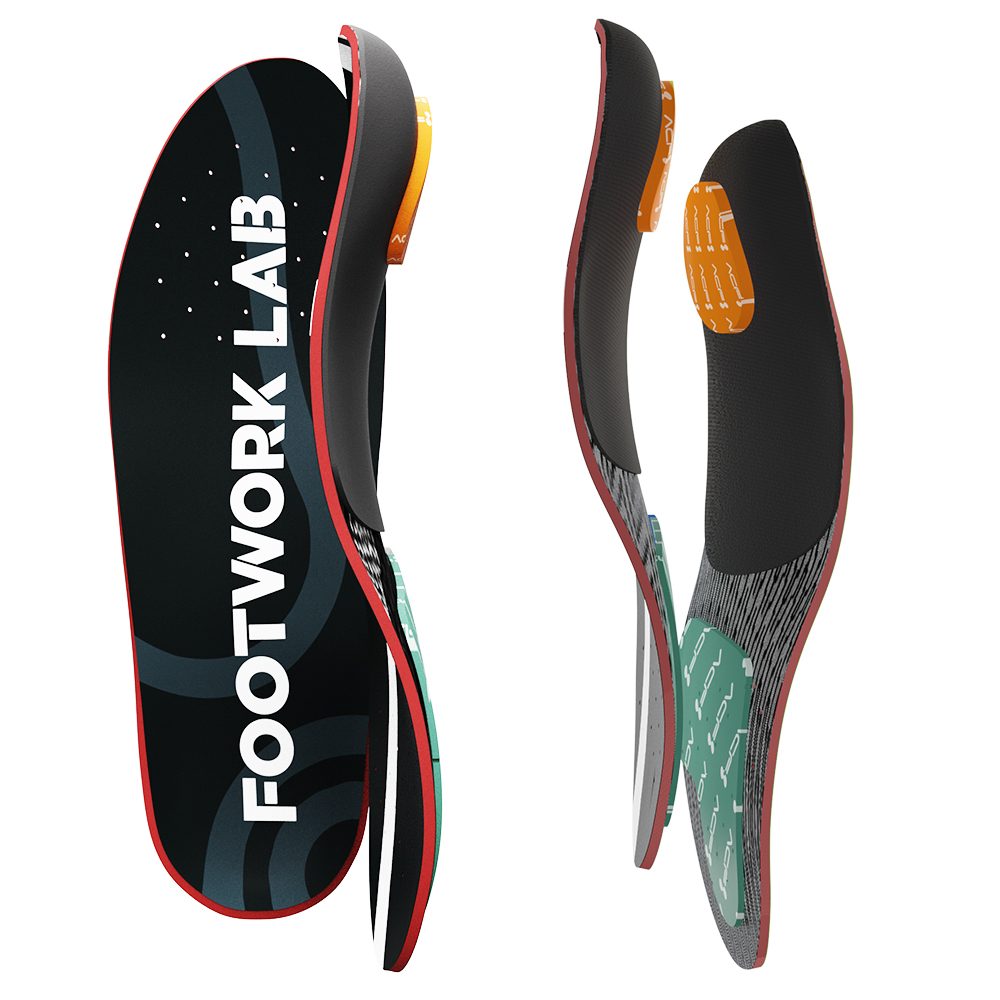
If the record supplies the intent, the factory supplies the physics. Sheet materials differ in stiffness, in how they behave under heat, in how they wear under months of use — and the same design intent built on different materials produces recognisably different products. This is why the material family belongs in the confirmed design rather than in production’s discretion: the client approves a product, and materials are part of the product.
Our line offers several sheet families across stiffness and wear characteristics, and the choice is recorded per pair. The record matters beyond the first delivery: it is what makes a reorder in a year match its predecessor, and what makes a remake — when one is needed — return to the same written base instead of a workshop memory.
Process discipline is the other half. Every pair travels the same stations; each station checks against the build sheet; a pair that fails is traced back to its station and the trace is written down. At five hundred to a thousand pairs a day, this is not perfectionism. It is the minimum structure that lets a mixed order of two hundred pairs ship with its paperwork intact and its pairs matching their specifications.
The top cover and finishing round out the physical product, and they reward specific questions rather than adjectives. How is the cover bonded, what happens to the edges, what does the product look like after months of honest wear? A factory that can describe its own wear-out modes has seen its products age in the field, which is the kind of experience that does not appear in a catalogue and does appear in a phone call.
Between materials and process sits a quieter discipline that buyers rarely think to ask about: how the line handles the mix. A two-hundred-pair order mixed across styles and sizes is not two hundred identical jobs; it is dozens of small jobs sharing stations, materials and a schedule. The station that switches between them must be switchable without drift — cut patterns changed cleanly, material offcuts identified, build sheets matched to the physical blanks. Mixed-batch capability is one of the real technical competencies of this trade, it is invisible in every product photograph, and it is the reason a buyer ordering a mix should weight a factory’s organisational discipline as heavily as its equipment list.
The commercial frame around custom
Custom production has a commercial frame, and the frame deserves the same inspection as the product. Minimums: ours sits at two hundred pairs, mixed across styles and sizes, because mixed batches need a certain size to run economically on the line. Sampling: samples leave within three days of design confirmation, made with the same materials and finishing as production, so choices are validated before a production quantity is committed.
Remake terms: a remake that follows from a production fault belongs to the factory; a remake that follows from a changed design decision is a new order with new terms. The division is written into the order, which is what makes it workable — both sides know the boundary before anything ships, and nobody has to negotiate with an unhappy client standing between them.
Delivery: after production, transit runs six to seven working days by express, ten to twelve by air and thirty to thirty-five by sea. Lead times and lanes are stated per order, not inferred from a previous shipment, because lanes change and the packing that suits one can be wrong for another.
Branding: insoles accept both ODM and OEM, so a distributor can put their own label on genuinely custom work — the second meaning of custom described above — or on configurable stock, whichever their market needs. What we ask is that the two are never mixed in one offer, because the client who ordered one and received the other does not come back, and the word custom is the one that takes the damage.
Questions that test a custom claim
Five questions, one call. Show me an example design summary. Are the sides specified separately? Where does the material choice get recorded? What happens when a pair fails its station check? What did your last remake cost, and whose account was it on? A factory running genuine custom production answers all five from its normal week. A factory running trimmed stock under the word custom answers none of them, and the silence is the answer.
Then one more, aimed at the relationship rather than the product: what do you keep? The design summary, the material record, the session reference — how long, in what form, accessible to whom? Custom products are relationships measured in years, and the second order is where the first order’s paperwork either pays off or exposes itself as theatre.
A closing note on the economics, because the definitions above are sometimes read as a case for the most expensive tier. They are not. The five meanings exist because each serves a real market at a real price point: a retail shelf needs configurable stock, a fitting room needs trimming, a clinic service needs made-to-order production. The economics go wrong only when the tiers are confused — when configured stock is priced as custom, or custom production is expected to move at retail speed. Buyers who know which tier they are buying operate the market; buyers who do not are operated by it. That sentence is the whole reason this article exists.
Frequently asked questions
What does custom mean for your insoles specifically?
Made-to-order from a shared design language: the dimensions, support regions and materials of each pair follow the individual’s measurement record, while the manufacturing steps stay standard and controlled. The design summary that captures those decisions is confirmed in writing before production starts.
What is the minimum order?
Two hundred pairs, mixed across styles and sizes. Mixed batches need a certain size to run economically, which is why the minimum sits there. Samples ship within three days of design confirmation.
Can we brand the insoles as our own?
Yes. Insoles accept ODM and OEM, including packaging and labelling arrangements. We keep custom construction and branding clearly separated in the offer, so a client ordering one always receives the other.
How are left and right handled?
As separate specifications wherever the record justifies it. A mirrored pair discards the left-right differences that are often the most useful part of a pressure record, so our design summaries state the sides individually.
What materials are available?
Several sheet families across stiffness and wear characteristics, selected at design stage and recorded per pair. The recorded choice is what makes a reorder match its predecessor a year later.
Who covers a remake?
A remake caused by a production fault is ours. A remake caused by a changed design decision is a new order with new terms. The division is written into the order documents before anything ships.
How long does delivery take?
Transit runs six to seven working days by express, ten to twelve by air and thirty to thirty-five by sea after production. Lanes and packing are confirmed per order.
What we would do next
Browse the product families on the insole categories page and the commercial terms on the FAQ page, both of which state in writing what the word custom means here. If you want the measurement side in your own room, the F2 plantar pressure system page describes the equipment that produces the records our design workflow reads. For the same topic from the buying-online angle, see what to check before you pay for insoles online.
This article is intended for professional and educational reference. It is not medical advice. Foot assessment equipment produces measurements and images; clinical interpretation and any decision about care remain the responsibility of a qualified professional. Certification scope is limited to the documentation we hold: European Union certification and ISO quality system certification.