
A rehabilitation-clinic buyer opens our trade fair conversation with a question we hear almost every show: “A patient overpronates — which insole do we build?” It is a fair question with an unfashionable answer: the record decides, not the label. Buyers who search for Overpronation usually arrive with a treatment-shaped expectation and leave, after a proper conversation, with a documentation-shaped one — because overpronation enters our workflow as a recorded item, described by a foot axis angle and a pressure path, and the insole is specified against that record through four build grades. This guide walks the full sequence for physiotherapy and rehabilitation clinics: what the record shows, how the four grades are configured from it, and what the FX rehab insole series builds for, direction by direction. It is written on purpose without correction promises, because an insole is specified in terms of support, alignment and load distribution — and the record is the thing that makes those terms concrete.
The FX series is our line of biomechanically assessed custom insoles, built with BODYFIT AI assessment and senthmetic flexible-fabric sensing technology. Assessment data from our detection systems can be used to configure a pair on specific equipment, and the product documentation pairs the series with the X5 detection system for exactly this handover. Within the series, the rehabilitation care range covers four defined directions — flat foot, pressure relief, hallux valgus and plantar fasciitis — each with its own structure and grade profile. The sections below follow one service flow from first record to follow-up.
Overpronation enters the file as a record item, not a verdict
Overpronation describes a pattern of roll-in during the walking cycle — the foot spending more of its contact time on the inner edge than the observer expects. In our workflow it is never a label applied by eye and never a conclusion the equipment prints. It is a set of measurements captured in a session: a foot axis angle, a centre-of-pressure path, phase timings and a pressure distribution, each of which can be placed beside the same person’s earlier record. That framing matters commercially as much as clinically. A clinic that buys an assessment system expecting it to sort patients into “overpronator” and “normal” will be disappointed; a clinic that buys it to build comparable records across visits gets exactly what the hardware is for.
The boundary also protects the professional. The record says what happened under the stated conditions; the qualified reader decides what it means for that person and whether support, alignment or load distribution should enter the conversation at all. In pre-sales calls with rehabilitation buyers we keep hearing the same worry — that specifying an insole against a record will read as a correction claim. Our answer is consistent: we configure build grades from the record, we describe what the construction is designed to do, and we leave outcomes where they belong, with the professional managing the case. That division of labour is written into how the product line is documented, not added as a disclaimer afterwards.
Different buyer types arrive with different versions of the label. A physiotherapy clinic usually meets overpronation inside a case file and wants the record to be comparable across appointments. A sports-training organisation meets it inside season planning and cares whether the pattern changes across a training block. A distributor stocking the rehab range needs to explain to retail buyers why the same series carries four directions and four grades rather than one “support” SKU. All three conversations resolve the same way: the word overpronation opens the file, and the measurements inside it — angle, phases, path — are what the insole order is actually written from. Buyers who hold onto the label alone tend to reorder the same product regardless of who walks in; buyers who adopt the record reorder by what the record shows, which is the difference between stock that sits and stock that moves.
How the record shows it: foot axis angle, phase shares and the pressure path
Three families of measurement carry the overpronation-relevant picture, and all three come from the same assessment session rather than three separate appointments.
The foot axis angle is the angular record of how the foot sits — an angle, printed beside a reference band, never a pass-or-fail mark. The phase shares record how the contact period divides: the contact phase and the flat phase each take a proportion of the step, and a flat phase that runs long tells a different story from one that runs short. The pressure path is the trajectory the centre of pressure travels from heel strike toward push-off; when load concentrates along the inner column — the medial heel region and the first to third metatarsal heads — the path drifts accordingly, and the drift is visible next to the phase numbers rather than buried in a colour map.
None of these numbers is a diagnosis, and each gains meaning from repetition. A foot axis angle captured once is a photograph; captured again under the same protocol, it becomes a trend. That is why we press clinics to fix a short written capture protocol — barefoot, same instructions, same operator where possible — before the first insole order, not after the first follow-up dispute.
The four build grades: support, anti-torsion, cushioning, starting ability
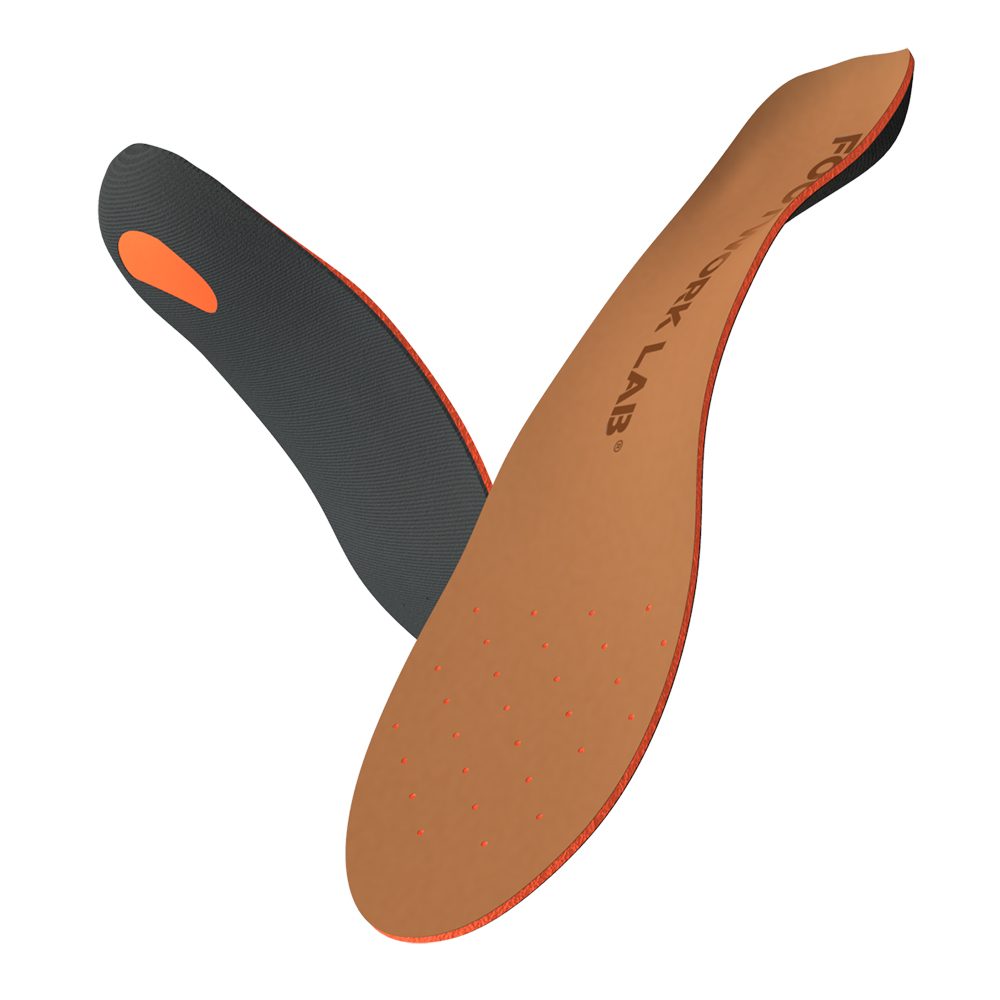
Every pair in the FX series is specified through four build grades, and each grade reads a different part of the record:
- Support grade
- Configured from the midfoot record. Where the midfoot shows sustained load or a long flat phase, the build carries a shaped support plate and arch-contoured structure designed to share the load the midfoot is taking.
- Anti-torsion grade
- Configured from the side-to-side behaviour in the record — the lateral-medial shifts visible in the pressure path and the heel pair. A structure with more torsional control is chosen to hold the foot steadier through the step.
- Cushioning grade
- Configured from where peak load concentrates. The documentation’s own load map puts the heavy regions at the first to third metatarsal heads and both heel regions, so the cushioning layers are placed where that record shows the peaks, not spread evenly.
- Starting-ability grade
- Configured from the push-off record — how load hands off to the big toe and forefoot at the end of contact. It governs how much responsive flex the build keeps under the forefoot.
The grades are not a menu the buyer picks from by taste; they are read off the assessment record captured on our detection systems and passed to production. Standing in our Ruichang plant during a production run, the sequence is visible end to end: an order arrives with its grade profile, the layers are cut and assembled to that profile, and the pair is checked before it ships. The plant runs roughly five hundred to a thousand pairs a day, the minimum order is 200 pairs and can mix styles and sizes, and a sample pair ships within three days — terms that exist because the grade system makes orders repeatable rather than bespoke one-offs.
The grade language also does quiet work inside the buyer’s own team. A clinic that writes “support grade high, cushioning placed at the medial heel and first metatarsal column” into a reorder has removed the two arguments that slow insole programmes down: what was actually specified last time, and whether the new order matches it. Distributors we work with see the same effect at the counter — a grade profile travels between a fitting record and a purchase order without translation, because both sides read the same four fields. That is the practical reason the series is documented through grades at all: not as marketing vocabulary, but as the shortest honest description of what changed between one pair and the next.
What the rehab series builds for, direction by direction
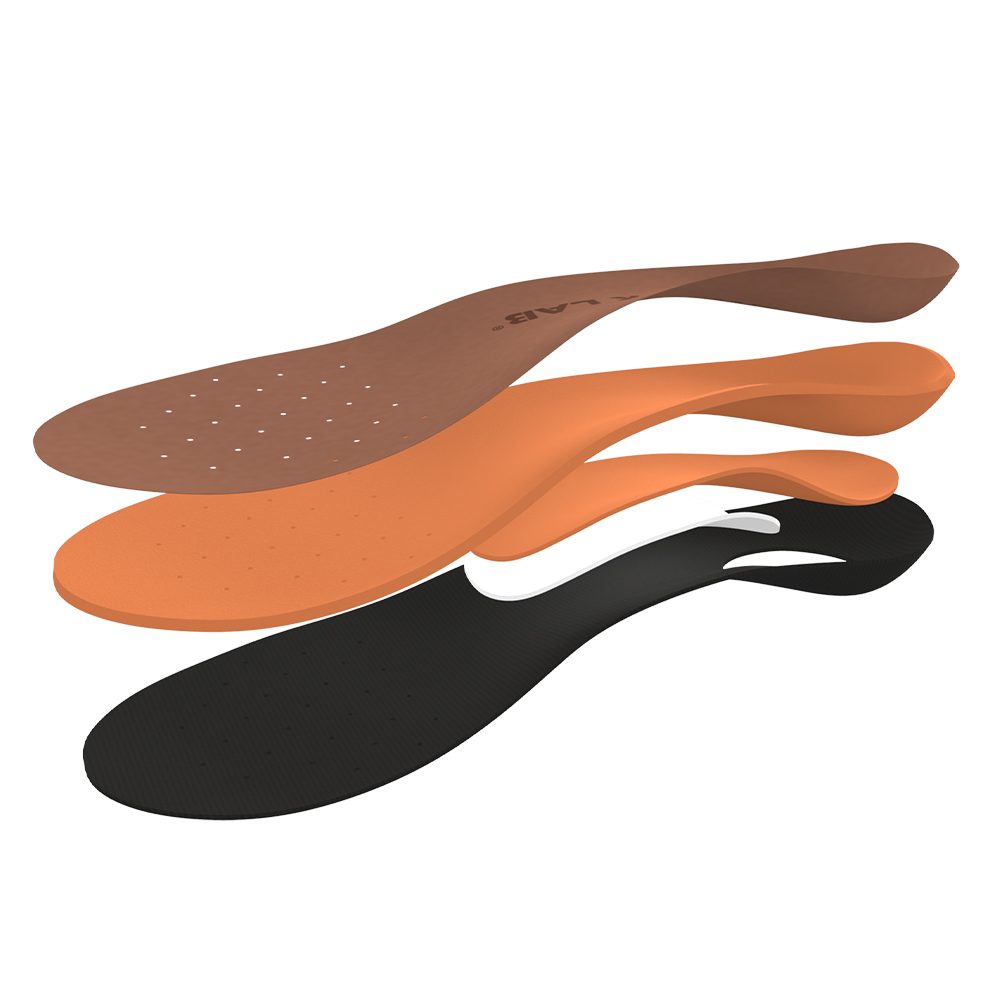
The rehabilitation care range is defined by four directions, each documented with its own structure and intent. For flat foot, the build centres on midfoot support: a construction designed to share the load the midfoot is absorbing during standing and walking and to help the foot hold its position through contact. For pressure relief, the design disperses load away from overloaded regions and adds a wrapped heel cup for stability — a load-distribution brief, stated as such. For hallux valgus, the build balances forefoot pressure and cushions the metatarsal region, reducing the squeeze the first metatarsal head takes under load. For plantar fasciitis, the heel region carries a cut-out treatment that spreads the point pressure the heel otherwise concentrates.
Two documentation notes matter to clinics writing these into a service. First, the builds are designed to work with the shoe: the series fits athletic, casual and outdoor footwear, so the direction is chosen from the record and the shoe decides the limits of what the build can do. Second, the manual gives the product a service life of four to six months in daily wear, and notes that high-intensity sport shortens both that life and the support and cushioning performance. Our after-sales team raises this on support calls before clinics ask: a follow-up re-record at the end of that window is the natural moment to check whether the grade profile still matches the person wearing it — and it keeps the whole programme anchored to records rather than to assumptions.
How the four directions sit inside a service is worth planning before the first order, because they answer different intake questions. A flat-foot direction answers an intake where the midfoot record carries sustained load. A pressure-relief direction answers an intake where load concentrates and the wearer reports discomfort under specific regions — the record shows where, and the build spreads it. A hallux valgus direction answers a forefoot-heavy record where the first metatarsal column takes the squeeze. A plantar fasciitis direction answers a heel-heavy record. A clinic that maps its own intake mix against those four cases before ordering ends up with a shelf that turns over; a clinic that buys one of each and hopes tends to end up with three directions gathering dust and one that sells out. Our marketing-support service after delivery exists partly for this — helping the buyer match the range to the records their room actually produces.
Frequently asked questions
How does a pressure record show overpronation?
Through the combination of a foot axis angle, the contact-phase and flat-phase shares, and the path the centre of pressure travels from heel to push-off. Where load concentrates along the inner column — the medial heel and the first to third metatarsal heads — the path drifts accordingly. These are measurements taken in a session and compared across visits under the same protocol; the record itself does not issue a verdict.
Can an insole from the rehab series correct overpronation?
We do not promise that, and the product documentation does not claim it. The series is specified through four build grades — support, anti-torsion, cushioning and starting ability — configured from the assessment record, and described in terms of support, alignment and load distribution. What the construction is designed to do and what a professional decides for a particular person are kept deliberately separate.
What are the four build grades and where does each come from?
Support grade is configured from the midfoot record; anti-torsion grade from the lateral-medial shifts in the pressure path; cushioning grade from where peak load concentrates (the first to third metatarsal heads and both heel regions); and starting-ability grade from the push-off record. The grades are read off the assessment data rather than chosen from a catalogue.
Which equipment works with the FX rehab series?
The documentation pairs the series with the X5 detection system: BODYFIT AI assessment and senthmetic flexible-fabric sensing capture the data characteristics that specific equipment then uses to customise the build. In practice a clinic captures the record on the assessment system and passes the grade profile into the insole order.
What is the minimum order and how fast can we see a sample?
The minimum order for the insole series is 200 pairs, and mixed styles and sizes are accepted within one order. ODM and OEM cooperation is accepted. A sample pair ships within three days, and the plant runs roughly 500 to 1,000 pairs a day. Full order, warranty and transit terms are on our FAQ page.
How long does a pair last and when should it be re-checked?
The manual gives a service life of four to six months in daily wear and notes that high-intensity sport shortens both the life and the support and cushioning performance. A follow-up assessment record at the end of that window is the practical moment to confirm whether the grade profile still matches the wearer.
What we would do next
If you run a rehabilitation or physiotherapy service and overpronation records are part of your intake, map the flow before ordering anything: where the record is captured, who reads it, and which grade profile you would write from it. Send that sketch through the contact page and we will tell you which detection system and which insole direction fit the flow you already run. The insole categories page sets out the three FX series side by side, and the X5 foot and posture detection system page covers the assessment side of the pairing.
If you already hold assessment records but your insole orders are still specified by label rather than by grade profile, start with one direction — flat foot is the usual first — and trial the record-to-grade handover on a small order. Our FAQ page carries the minimums, sample terms and transit windows in full.
This article is intended for professional and educational reference. It is not medical advice. Assessment records and insole builds describe support, alignment and load distribution; clinical interpretation, treatment decisions and outcomes remain the responsibility of a qualified professional. Certification scope is limited to the documentation we hold: European Union certification and ISO quality system certification.