
Most of the insoles we ship are not bought by runners. They are bought by people who walk: to the bus stop, between meeting rooms, around a warehouse floor for a full shift, up one flight of stairs with shopping bags in both hands. On a pre-sales call this spring, a shoe store owner asked which record she should build her fitting service on — a standing capture, or one taken while the customer actually walks. She had floor space for either, and staff time for only one. The question is worth answering slowly, because everyday walking is the workload a daily insole genuinely carries, and a gait walking record is what turns a standard build from a guess into a considered choice. This article works through her question in order: what walking loads onto a foot through an ordinary day, what a walking pass adds that a standing pass does not, where the standard daily build in our FX range starts from, which decisions the record moves — support grade, cushioning balance, torsion behaviour — which ones it cannot move, and where the replacement conversation belongs in the same fitting session.
The phrase we keep coming back to with retailers is gait walking, and it describes something narrower than exercise. It is the walking a person does without deciding to: the commute, the corridor, the school run, the shifts spent on a shop floor. That is also the workload the daily comfort series in the FX range was shaped for — daily walking, leather shoes, long hours standing — and it is the workload a record should describe before anyone chooses between builds.
Everyday walking is the hardest workload to see from a chair
A fitter can learn a great deal from watching a customer cross the shop floor. What that glance cannot give is the distribution of load through the whole contact, the timing of each region, or the way the two feet compare when neither is being asked to perform. Walking is repetitive by nature, which is exactly why small inefficiencies matter: a foot that rolls through slightly unevenly does it five thousand times before dinner, and the tissue notices long before the person does.
The manual’s own description of daily walking is deliberately unglamorous — short distances in home, community and workplace settings, walking to shop, stairs, the walk to a station. It lists the familiar risks of doing it in the wrong shoes: strain along the plantar fascia, crowding at the big toe, general fatigue, and the extra stress that uneven ground adds to bone. None of that is dramatic. All of it is cumulative, and all of it is the daily build’s problem to soften.
Where the load concentrates during ordinary walking is documented in the design notes for the range: the first three metatarsal heads, and the outer and inner regions of the heel — the zones marked M1 to M3, HL and HM in the plantar map. Those are the areas a daily build has to protect and support, because those are the areas an ordinary day pounds. A build designed around a different workload would put its material somewhere else, and the customer would feel the difference by the second week.
At one exhibition in Hong Kong, a visitor pressed us on exactly this point: why not sell every customer the firmest build available and be done with it? The honest answer is that a firm build answers a walking problem the customer may not have, while the problem they do have — arriving impact, midfoot fatigue, a heel that drifts inside the shoe — sits in a different part of the grade table. The record exists to find out which one is theirs.
What a gait walking pass adds to the standing record
A standing capture answers the question of how load sits when the body is still: the distribution between and across both feet, the contact area, the arch behaviour under weight. It is quick, it is calm, and for some customers it is enough. What it cannot show is sequence — and sequence is what walking is made of. The moment the foot meets the ground, the way load travels forward, the proportion of the step spent in the contact phase against the flat phase, the speed at which the centre of pressure moves from heel to toe: none of those exist in a standing record, because in standing nothing is arriving or leaving.
The walking pass on a pressure system records exactly that sequence. Alongside the phase proportions and the path of the centre of pressure, the report holds the foot axis angle, footprint length and width, peak and average pressure, and the contact area curve as the foot rolls through. On the extended version of our F2 system, the longer walkway lets the person reach a natural pace before the sensors begin, which matters more than it sounds: a record taken at someone’s real walking speed describes their real day; one taken at an awkward shuffle describes the laboratory.
There is also a comparison value that only appears with walking. Two standing records taken months apart can look nearly identical while the walking records differ, because load timing changes before load distribution does. A store that captures the walking pass at fitting and again at the replacement visit is collecting evidence about its own work, not just about the customer’s feet.
In our pre-sales calls we keep hearing one version of the same doubt: my staff can see the walk with their eyes, why does the plate add anything? Our answer is to ask what happens when two staff members disagree. Eyes are excellent at noticing that something is off and unreliable at saying how much, and the record is what turns a disagreement into a decision both of them can accept.
Where the standard daily build starts before any record is taken
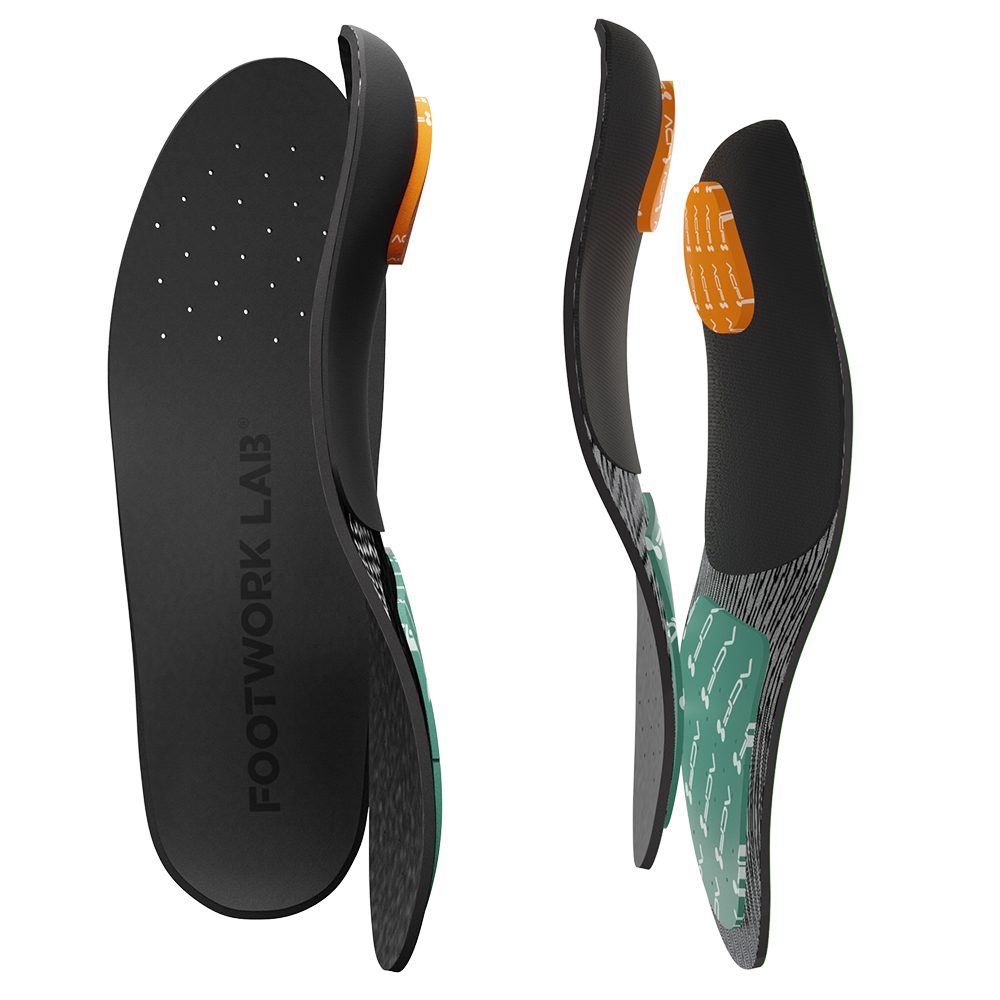
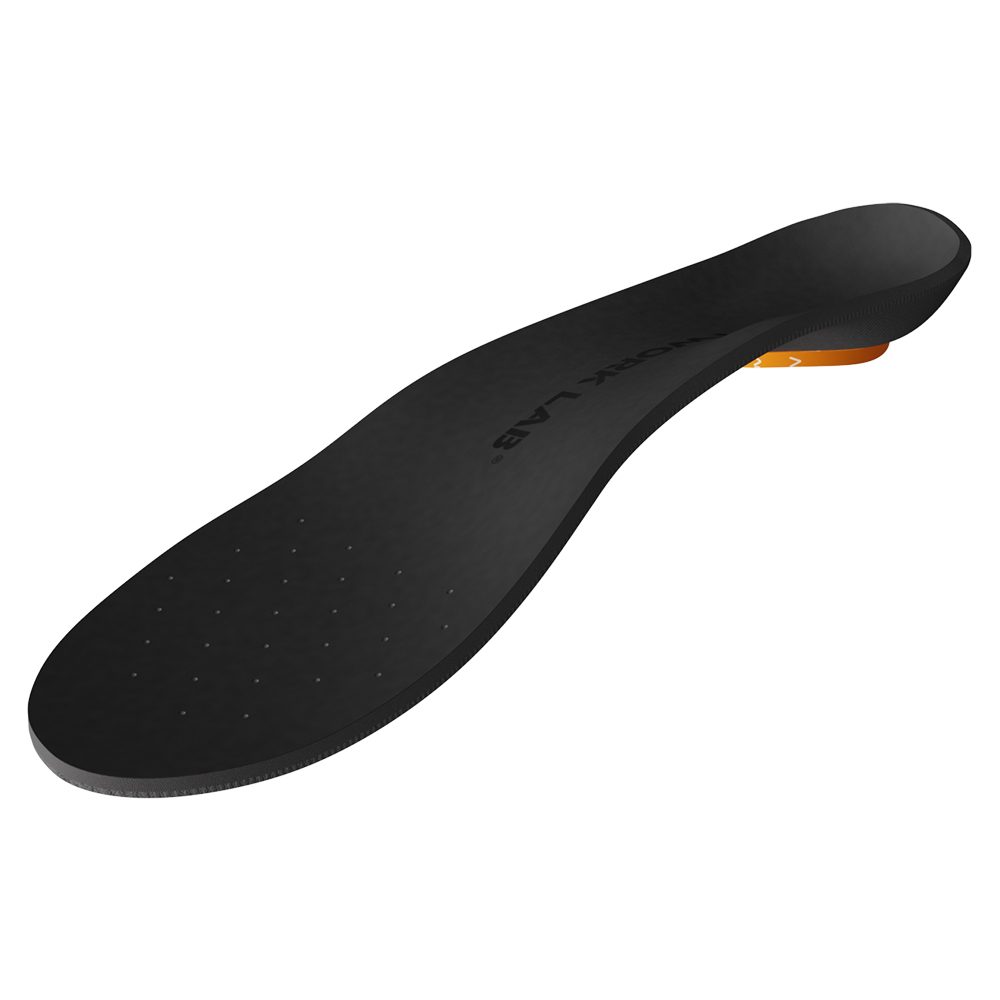
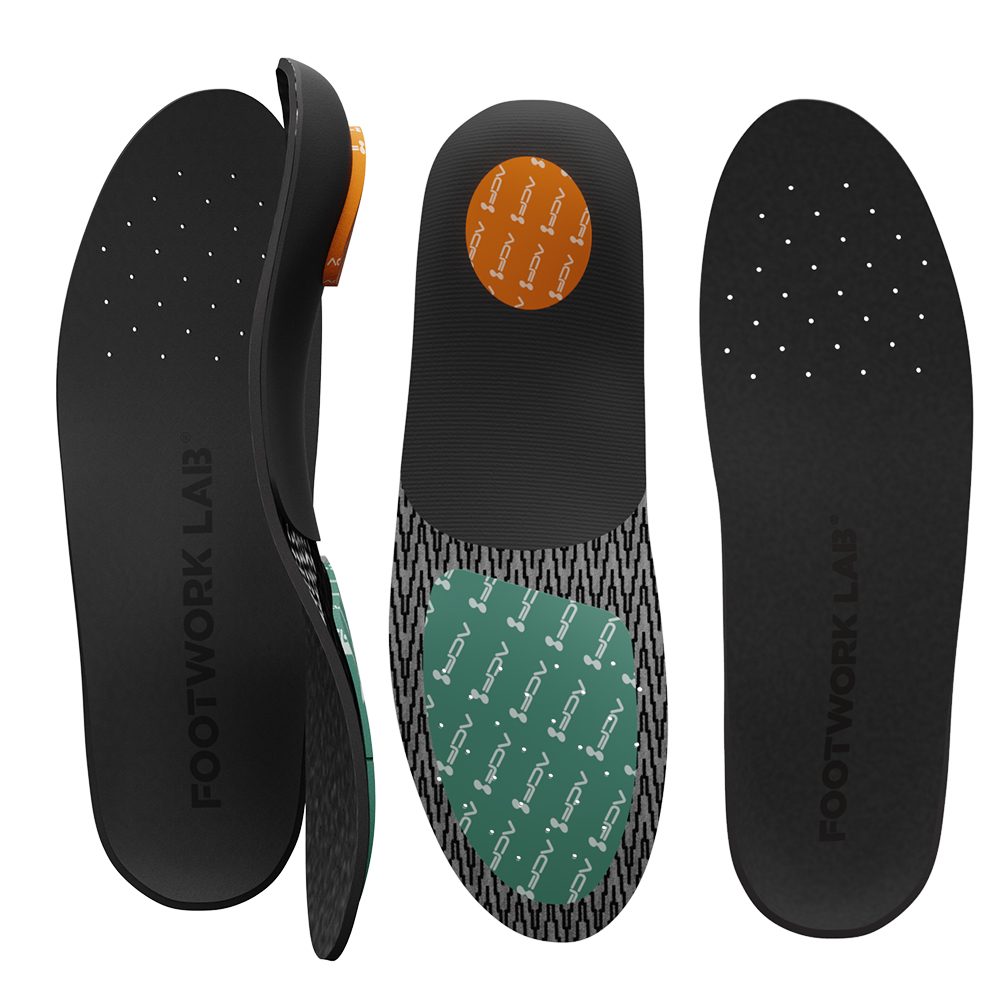
The everyday casual build in the FX range has a fixed structure, and it is worth reading as three jobs stacked together. The top is a mesh cloth: breathable, moisture-wearing against the foot, resistant to the friction of a full day. Beneath it sits an orange Osolite cushioning layer, soft by design, which spreads contact and absorbs part of every arrival. Under everything is the AQ polymer shaping board, which holds the contour the build was given, resists bending and twisting along its length, and keeps the whole assembly from flattening by the end of the month.
That stack is the standard answer to the zones the walking data keeps flagging. Cushioning under the heel regions, support shaped into the midfoot, contact spread across the forefoot where the metatarsal heads take their share. The leather shoe version of the daily build keeps the same logic with a different surface and external cushioning pieces at heel and forefoot, because a leather shoe gives the build less room and a harder ride.
Every build in the range is graded on four separate scales: support, anti-torsion, cushioning and starting ability. The grades are dials, not a ladder — a build can be soft under the heel and firm through the arch at the same time, and daily builds usually are. The standard construction is the factory’s answer to the average walking day. What the record decides is how far any individual customer needs to move away from it, and in which direction.
The decisions the walking record actually moves
Read honestly, a walking record changes three things about a standard build, and the first is the support grade. A foot whose flat phase runs long and whose contact area stays wide through midstance is asking for more contour than the standard board holds; a foot that shows a firm, high arch through the same phase is often better served by less. The record does not prescribe the grade — a professional reads it beside the shoes, the hours and the person — but it moves the conversation from “do you want support?” to “here is what your contact pattern shows; which side of the standard build does it argue for?”
The second is the cushioning balance. Peak and average pressure across the walking pass show where the arrivals land hardest. A customer whose record concentrates load in the heel regions through a long day on hard floors needs the cushioning layer to hold up for a full shift, which often means trusting the shaping board underneath to keep the softer material from bottoming out. A customer whose pressure peaks sit forward under the metatarsal heads needs the spread more than the depth, and the fitter can say that out loud with the record on the screen between them.
The third is torsion behaviour, which customers never ask about directly and always feel. A walk that loads one edge of the foot and twists through the midfoot puts a bending demand on the build that the anti-torsion grade answers. In a flexible trainer this matters less; in a work boot worn across uneven ground it decides whether the build behaves as one piece or folds quietly under the arch by mid-afternoon.
What the record does not move is the basic stack. Materials and construction are the factory’s decision, held consistent so that a grade change means a real change in behaviour rather than a reshuffle of the same parts. We do not publish a thickness for each build, and we would rather the fitter judged the feel on the foot than argued with a number on a sheet.
Replacement is part of the specification, not an afterthought
The care notes that ship with every FX build say the same thing: under daily wear, expect the product to serve for four to six months, and expect high-intensity use to shorten that, taking some of the support and cushioning with it. The first days can also feel unfamiliar, and the guidance is to extend wearing time gradually rather than judge the build on a single morning. None of that is fine print. It is the second half of what the customer is buying.
A walking record makes the replacement conversation concrete instead of calendar-based. When the customer returns, the store can repeat the walking pass under the same routine and set the two records side by side: if the contact pattern has drifted, or the phases have shifted, that is evidence a build has softened and the conversation about a new pair stops being a sales approach and becomes a reading. If the record is unchanged, the honest answer may be that the build still has work in it, even if the calendar says otherwise.
There is a second benefit that stores discover after a season of doing this. A customer who has seen their own walking record twice understands intuitively that the build is matched to a moving target — their weight, their shoes, their job, their season. That understanding is what turns a one-time purchase into a cycle, and the cycle is where the fitting service actually earns its keep.
One store owner who visited our booth in Brazil put it plainly: her customers never argued about the price of the second pair, they argued about whether the first pair was finished. The record does not settle the argument by itself, but it gives both sides something to look at, and it has a way of ending negotiations that opinion alone never does.
What the record cannot decide
There is a boundary to state before any of this goes into a fitting script. A walking record describes load: where it sits, how it arrives, how the phases divide. It does not say why a heel aches in the morning, whether a particular ache is serious, or what any person should do about discomfort that has already been going on for months. Those questions belong to a clinician, and the record belongs to the professional who reads it. We do not diagnose from the reports our systems generate, and we ask partners not to present a build as an answer to a named condition.
Some situations should end the fitting and start a referral, and no record from a pressure plate changes that: symptoms that wake the person at night, visible swelling or colour change, numbness or tingling into the sole, pain that has been worsening week on week rather than settling, a recent injury, or a child’s foot complaint of any kind. A fitting service that refers early keeps its customers; one that builds around a warning sign loses more than a sale.
Inside that boundary, the record’s humility is a feature. It cannot promise what a build will feel like in week nine; it can show whether the pattern the build was chosen against has changed. A customer who understands that distinction rarely comes back disappointed, because they were never sold a promise — they were sold a considered match, and a way to check on it.
The same restraint applies to the grade table. A high support grade is not a better build, it is a different one, and the record is what stops a fitter from selling strength to a customer whose problem was arrival shock all along.
Frequently asked questions
Is a standing record enough for choosing a daily build?
For some customers, yes, and a standing capture is a legitimate starting point. It misses sequence, though: how load travels through the step, how the phases divide, and how fast the centre of pressure moves. If the fitting service is positioning itself on everyday walking, the walking pass is the one that describes the workload the build will actually face.
Which parts of the build does the walking record change first?
Support grade, then the cushioning balance, then torsion behaviour. The record shows the contact pattern and pressure peaks; the professional sets those beside the customer’s shoes and hours and decides how far to move from the standard construction in each direction. The record informs the decision; it does not make it.
How long does a daily comfort build last?
The care notes state four to six months under daily wear, with high-intensity use shortening that and reducing support and cushioning along the way. First wearing days can feel unfamiliar, so wearing time should be extended gradually. A repeat walking record at the review visit shows whether the build still matches the pattern it was chosen against.
Why do two customers with similar records get different builds?
Because the record describes the foot and the shoe describes the space, and the build has to satisfy both. A shallow leather shoe and a deep trainer cannot carry the same stack, so the same contact pattern ends in two different orders. The shoe check comes before the build is finalised, not after.
Does the AQ shaping board make the build feel stiff underfoot?
No, and this is worth saying at the counter. The board sits beneath the Osolite cushioning layer and does its work by holding contour and resisting twist, not by sitting against the foot. What customers describe as stiffness is usually an over-firm support grade, which is a fitting choice, not a property of the construction.
How does a customer get assessed for the daily range in the first place?
The FX range is assessed through the BODYFIT AI assessment with senthmetic flexible-fabric sensing, and it is designed to work alongside the X5 detection system where a fuller foot, alignment and posture record is wanted. The route depends on the store’s setup; what stays constant is that a build is chosen from a record and a shoe check together.
Can a store stock the daily range without a scanner on site?
Yes. Minimum order is two hundred pairs, and styles and sizes can be mixed within that, so a store can hold the daily walking, leather shoe and long-standing builds across a normal size run. Assessment equipment is a separate decision; some partners start with stock and standard builds, then add capture once the fitting conversation has proven itself.
What we would do next
If you run a store or a fitting room, try this on your own floor: capture the walking pass for the next ten customers who buy a standard daily build, file the records, and look at them again at the four-month mark. The pattern you see will tell you more about your own customer base than any brochure we could send. The insole categories page sets out the daily comfort series and the grade table in the factory’s wording, and our article on foot assessment as a session rather than a device covers how the fitting conversation is structured around a record.
For the manufacturing half of the same decision — how a build goes from record to finished pair, and what the order terms look like — the FAQ page carries the current sample, minimum and transit terms, and the contact page reaches the team directly. Bring the shoes your customers actually wear; the answer changes with the shoe more than with anything else.
This article is intended for professional and educational reference. It is not medical advice. Foot assessment equipment produces measurements and images; clinical interpretation and any decision about care remain the responsibility of a qualified professional. Certification scope is limited to the documentation we hold: European Union certification and ISO quality system certification.