
The shop had four metres between the till and the stockroom door, and a customer who wanted to know why her left shoe wore through faster than her right. The owner had measured the space twice — once for the plate, once for the camera stands — and had already decided the answer was no. A proper foot gait analysis needed a corridor, she said, and a corridor was the one thing the lease did not include. What she actually needed was a smaller question answered honestly: how much of a walk does four metres contain, and what can be said about a person from that without overreaching? This article is about the answer. It sets out what a shortened walkway still records, which findings survive a brief pass and which quietly fall away, how a standing record differs from a walking one when the walking is short, and — the part most suppliers skip — the customer who should be sent to a clinic with a longer floor rather than measured here.
The F2-PRO is the extended version of our pressure plate: a longer sensing walkway that captures a complete dynamic cycle rather than a single contact, with the support phase, swing phase and double-support periods separated in the report, plus lower-limb and posture camera records taken in the same session. It exists because contact timing is where most fitting questions actually live, and timing needs a walk rather than a step.
The tape measure decides more than the specification sheet
In a rehabilitation corridor or a sports laboratory, eight metres of clear floor is unremarkable. In a shoe shop it is a fantasy. The straight run between the fitting bench and the mirror is often the only uninterrupted line in the building, and for ten months of the year a display table sits in the middle of it. Buyers who compare plate specifications line by line are usually comparing the wrong column; the number that changes what a shop can do is the distance it can keep clear on a Saturday.
That distance decides whether the record holds a stride or a step. A stride is two steps — one full cycle of the same foot — and a short pass of three or four metres rarely contains more than one and a half of them once the approach and the slowdown are stripped out. The consequence is not a worse picture of the same thing. It is a different picture: pressure distribution at the plate survives, while anything that depends on repetition over distance starts to wobble.
Shops tend to settle into one of three arrangements. The plate sits in the aisle and customers walk towards it, which makes the approach short and the exit awkward. The plate sits at the far end and customers walk away from the bench, which gives a longer approach but moves the session away from the fitting area. Or the plate sits beside the bench and the customer walks a there-and-back pass, turning at a marked line. The third is the one we suggest for narrow rooms: it doubles the usable distance at the cost of a turn, and the turn has to be edited out of the record rather than averaged into it.
One thing we say plainly to retailers, because it saves a year of disappointment: a shop is not a laboratory, and buying a longer plate does not make it one. The equipment records what happens on its surface. Whether the surrounding room, the queue and the operator’s routine can produce a comparable record twice is a property of the shop, not of the hardware.
What the short pass still records honestly
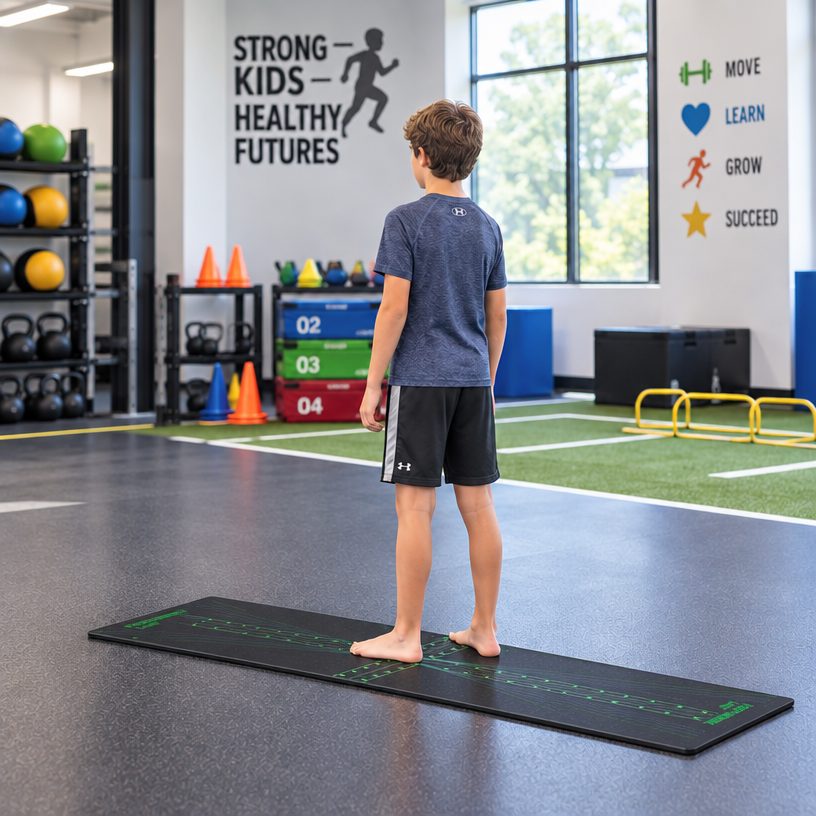
The plate does not need distance; it needs contacts. Every footfall that crosses the sensing surface is a complete event, with a beginning at heel strike and an end at toe-off, and that event is recorded in full regardless of how far the customer walked to reach it. Contact phase as a proportion of the cycle, flat phase, peak and mean pressure under each region, contact area, and the forward path and speed of the centre of pressure all come from the contact itself.
Foot axis angle belongs in the same category. It describes the rotation of the foot relative to the line of walking at the moment of contact, and it is read from the footprint rather than from a series of strides. A single clean contact can carry it. So can the comparison between the two feet, which is where most of the honest content of a short record actually sits: not “this foot is abnormal” but “this foot loaded differently from the other one, in this pass, on this day”.
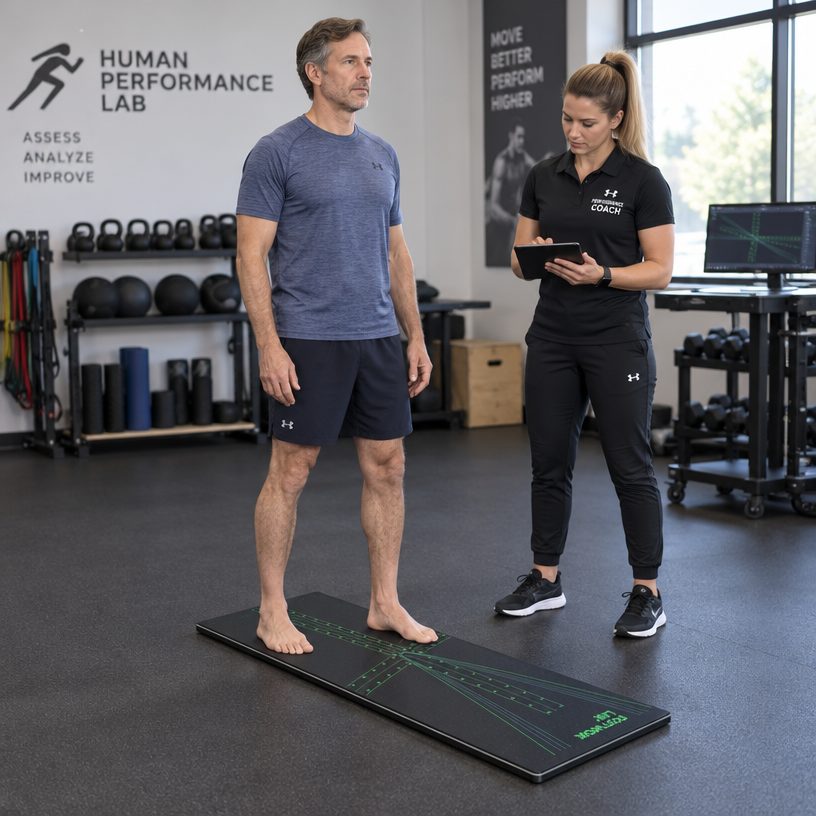
The cameras are less distance-dependent than buyers expect. The lower-limb camera records how the leg aligns above the plate as the foot lands, and the posture camera records the standing stance before or after the walk. Both are moment records. Neither claims to describe a gait cycle, and neither should be presented as if it did.
Everything the report lists is a recorded quantity — a percentage, an angle, an area, a pressure value, a speed of travel. The software orders the findings and the report generation lays them out, but what any of it means for a particular person belongs to the professional reading it. A shop that keeps that sentence visible in its own head runs better sessions than one that treats the printout as an answer.
What the short pass quietly drops
Cadence is the first casualty. Steps per minute needs a counted interval, and a pass that contains one and a half strides gives an interval too short to be stable. Walking speed is the second: the centre of pressure speed across the plate is a genuine measurement, but it describes the speed of that contact, not the speed of the person’s walk. A customer who accelerates into the plate because the operator said “walk normally towards me” produces a number that belongs to the instruction rather than to her.
Steady state is the third and the most important. Almost nobody walks naturally on the first crossing. The first pass is a performance — slightly careful, slightly slow, eyes on the equipment. By the third or fourth crossing the body gives up on being watched and the walk becomes the walk. A four-metre walkway often contains exactly one usable crossing per approach, so the routine has to supply the repetitions that the floor cannot: walk in, turn, walk back, repeat, and record only the last two.
Change over distance disappears entirely. A gait that deteriorates after twenty minutes, or a limp that appears when the customer is tired rather than fresh, is invisible in a pass that lasts four seconds. So is anything about endurance, and so is the difference between the first hour of a shift and the eighth. Those questions are legitimate and common. They are simply not questions a shop floor can answer, and pretending otherwise is how a record gets over-read.
The turn deserves its own paragraph because it is where short-walkway records most often go wrong. At the end of a there-and-back pass the customer pivots, and the pivot loads the plate in a way that no straight walk does: rotation, a wider stance, a lateral push. If the turn lands on the sensing surface and nobody removes it, the average quietly contains something that never happened during walking. Mark the turning point a stride short of the plate, and exclude the first contact after the turn from the recorded set.
Standing still, stepping in place, and the third option
Some shops solve the space problem by not walking at all. The static record is a legitimate session on its own: footprint length and width, contact area, the distribution of load across each sole, and the comparison between left and right while the customer stands still and looks ahead. It answers a narrow question — what the foot does when nothing is asked of it — and for a fitting conversation that question is often enough.
The balance record is the second standing option, and it is the one narrow rooms most often skip. It needs a quiet corner, a still customer and an operator willing to stop talking for thirty seconds, which a busy floor rarely offers. Running it only at slow hours, or only when a customer raises stability, is a defensible policy, provided the shop applies the same policy every time rather than improvising. A trial run for one customer and skipped for the next produces two records that cannot be compared.
Stepping in place is the compromise customers ask about, and it should be described accurately. It is a stepping task, not a gait record: the feet leave and return to roughly the same spot, so there is no forward travel, no stride length and no honest cadence. What it does show is how load transfers from one foot to the other and how long each foot spends loaded. Useful for a balance or loading question. Not a substitute for a walk, and shops that present it as one are borrowing trouble.
The third option is the one we recommend most often, and it costs nothing: record what the room allows and write down what it did not. A file that says “static, plus three recorded contacts at the plate, balance not taken, customer in work boots” is more useful to the next session than a file that implies a full gait cycle was captured. The note is part of the record. It is what makes the second visit comparable to the first.
When the honest answer is a different floor
Some questions arrive with a shape that a shop cannot hold. A runner asking why his knee drifts after forty minutes. A customer whose discomfort appears only on the second hour of a shift. A football club wanting a pre-season comparison across twenty players. Each of these needs repetition over distance, or a controlled speed, or a workload that a retail floor cannot supply, and each of them is a referral rather than a sale.
The referral is easier when it is prepared. A clinic with a treadmill-based system, a sports medicine centre, a university movement laboratory — one or two names, agreed in advance, with a card kept behind the counter. The customer leaves with the record in hand and somewhere to take it, and the shop is remembered for the sentence “this is beyond what I can see here” rather than for a printout that promised more than the floor could deliver.
Two limits of our own belong in this section, because buyers ask. We do not diagnose, and the equipment does not produce diagnoses; it produces measurements and images, and the reading belongs to a qualified professional. We also do not make shape-scanning hardware: a buyer whose plan depends on a surface model of the foot — the kind of file a milling bench would cut from — is shopping in a different category, and no amount of walkway length changes that. Saying so early has cost us orders and saved us more.
There is a commercial argument for the referral, and it is not cynical. A shop that sends three customers a season to a clinic because their questions were clinical builds a reputation that no advertisement buys. Those customers come back for shoes, and they come back with friends, because the shop was the one place that did not pretend.
Floor marks, a written pass, and a retest that means something
The pass has to be defined once and then left alone. Where the customer starts. Which foot leads. How many crossings are recorded and how many are thrown away. Whether shoes come off. How long the customer stands before the static capture. Who counts the crossings and who reads the screen. None of these decisions is difficult; the difficulty is making the same ones next month, when a different person is running the session.
Marks on the floor are the cheapest instrument in the room. Tape that survives mopping, laid at the start line, at the turning point and around the plate and camera stands, turns an intention into a fixture. When the shop rearranges for a seasonal promotion, the marks are what stop the plate drifting half a step to the left — which is enough, over a year, to make two records that should have matched look like two different customers.
Retest conditions matter more in a narrow shop than buyers expect, and for a good reason: the floor is fixed, so almost everything else can be fixed too. The same four metres, the same starting mark, the same barefoot condition, the same operator briefed from the same page. A clinic comparing two sessions has to worry about treadmill speed and camera calibration. A shop comparing two sessions mostly has to worry about whether anyone moved the tape.
That is the compensation for the short walkway, and it is worth stating as the closing argument. A four-metre pass cannot describe a gait cycle the way a laboratory can. It can, however, be repeated exactly, season after season, by staff who follow a page — and a modest measurement repeated exactly is more useful to a fitting decision than an ambitious one taken once.
Frequently asked questions
Is four metres of clear floor enough to record a walk?
Enough for a usable short-pass record, not for a gait cycle. You will capture complete individual contacts with their timing, pressure distribution, foot axis angle and centre of pressure path. You will not capture cadence, stride length or how the walk changes over distance. The record is honest as long as the file says which of those were taken.
Which findings survive a shortened walkway best?
Anything read from a single contact: peak and mean pressure by region, contact area, the percentages of the contact and flat phases, foot axis angle, and the left-right comparison. The camera alignment images also survive, because they describe a moment at the plate rather than a sequence of strides.
Should a small shop bother with the balance record?
Only if it can be run under consistent conditions — a quiet corner, a still customer, no conversation. Run it every time or on a stated rule, never ad hoc. A balance trial taken for one customer and skipped for the next gives you two records that cannot be compared, which is worse than not taking it at all.
Do customers walk barefoot or in shoes?
Barefoot for the pressure record, because the sole and its load pattern are the object being measured. If a shop wants to compare how a shoe changes the pattern, that is a second session with its own label in the file. What matters is that the condition is stated, so a later visit is captured the same way.
Is walking on the spot an acceptable substitute?
No. It is a stepping task: the feet return to roughly the same position, so there is no forward travel, no stride and no honest cadence. It shows load transfer between the feet, which can be useful, but presenting it as a gait record misleads the customer and contaminates your own comparison.
How many passes should a short routine record?
Three recorded contacts after at least two discarded ones is a workable rule for most rooms, with the same foot leading each time. Discard the first contact after a turn. Write the count on the routine page, because the number matters less than it staying the same between visits.
What does the extended plate add in a narrow room?
It separates the support phase, the swing phase and the double-support periods, which a single-contact plate cannot. In a narrow room the gain is real but bounded: the longer sensing surface buys a full cycle per crossing, not a longer walk. The floor still sets the limit, and the routine still decides whether the record compares.
What we would do next
Take a tape measure to the floor before you take a specification sheet to a supplier. Mark the longest clear line a customer could walk without crossing a display, measure it, and write down how many crossings that line allows after the approach and the turn are removed. That number, not the plate’s feature list, tells you what your records will contain.
Then write the pass on one page and have the second operator run it while you watch. If the two of you produce different records from the same customer, the page is not finished. Send it to us through the contact page if a second pair of eyes would help; we have read enough of them to spot the gap quickly. The F2-PRO page lists the record types and the phase parameters in the manual’s own wording.
This article is intended for professional and educational reference. It is not medical advice. Foot assessment equipment produces measurements and images; clinical interpretation and any decision about care remain the responsibility of a qualified professional. Certification scope is limited to the documentation we hold: European Union certification and ISO quality system certification.