
A clinic manager in a rehabilitation hospital opens a spreadsheet with two columns and asks which one the machine fills. The left column is titled equipment: a walking surface, cameras, a screen, a report. The right column is titled programme: how many sessions, what the patient does in each, who watches, what changes if nothing improves. She has been told by one supplier that a single purchase covers both. She suspects it does not, and she is right. The phrase she searched — gait training device — describes the left column almost every time, because a machine is what a search engine can sell. The right column is written by clinicians, changes with the patient, and cannot be shipped in a crate. This article draws the line between them: what a training device actually records, what a record is worth once a programme is built on it, where the F5-LAB sits, and which parts of the work we will not pretend to do.
The search names the bench, not the baseline
Search behaviour explains most of the confusion. A buyer who wants to buy something types the noun for the thing, and the noun that exists in the market is the device. There is no search phrase for a baseline, partly because a baseline is not sold and partly because it only becomes valuable after the second session, which is months after the purchase. So the market fills the results with machines, and the machines are described by their hardware, because hardware photographs well.
Yet the reason a clinic buys any of it is almost never the hardware. It is the second visit: the moment a patient comes back and someone can say what changed. That sentence cannot be produced without a first record taken under conditions the second record can be compared against. A training device without a baseline is a gym; a training device with a baseline is a service that can be reviewed, charged for and defended when the patient asks whether it is working.
The commercial consequence is worth stating plainly, because it decides budgets. If a clinic buys the device and leaves the baseline to whoever happens to be operating it that day, it has bought a very expensive way to make the first appointment more interesting. If it buys the device and writes a protocol for the record — same warm-up, same instruction, same order of passes — it has bought the ability to have a second conversation, which is where a rehabilitation service actually earns its money.
None of that makes the machine unimportant. A record needs a surface to stand or walk on, cameras to see what the surface cannot feel, and software that names the items rather than drawing a picture. The point is only that the phrase in the search bar is the smaller half of the purchase, and a buyer who knows that asks better questions in the first meeting.
There is a budget reason the distinction gets lost. Capital spending and staff time are approved by different people on different cycles, so the device is bought in one meeting and the protocol is assumed to be free because it involves no invoice. In practice the protocol is the expensive part: it is the training, the written routine, the fifteen minutes at the end of a session that nobody bills for. Clinics that budget for the machine and not for that hour are the ones that end up describing their purchase as underused.
What a training device cannot tell you
It cannot tell you what to do next. That is the honest answer, and it is not a limitation of one product but of the category. A device can record that a step is asymmetric, that one foot stays on the ground longer than the other, that the line of pressure wanders outward through a stance. It cannot decide whether that asymmetry matters for this patient, whether it is improving, or whether the right response is a different exercise, a different shoe, an insole or nothing at all.
It also cannot tell you whether the patient is trying. A walking belt encourages a certain kind of walking, and a person who is being watched walks differently from a person crossing a room. That is not a flaw to be engineered away; it is a condition to be acknowledged in the protocol, which is why the warm-up period matters and why the first pass is rarely the one worth keeping.
And it cannot replace the hand. A clinician palpating a foot, watching a heel from behind, asking a patient to stand on one leg, is gathering information no surface under the foot will produce. The equipment adds quantities to that picture: how much, how long, how fast, in which direction. A clinic that treats the report as a substitute for the examination has misunderstood both.
What it can do is make the conversation specific. Instead of “your gait looks a little off”, the review becomes “this value moved, this one did not, and this is the part we have been working on”. Patients respond to that differently, and clinics that can show the difference retain them longer. That is a commercial argument, and it happens to be true.
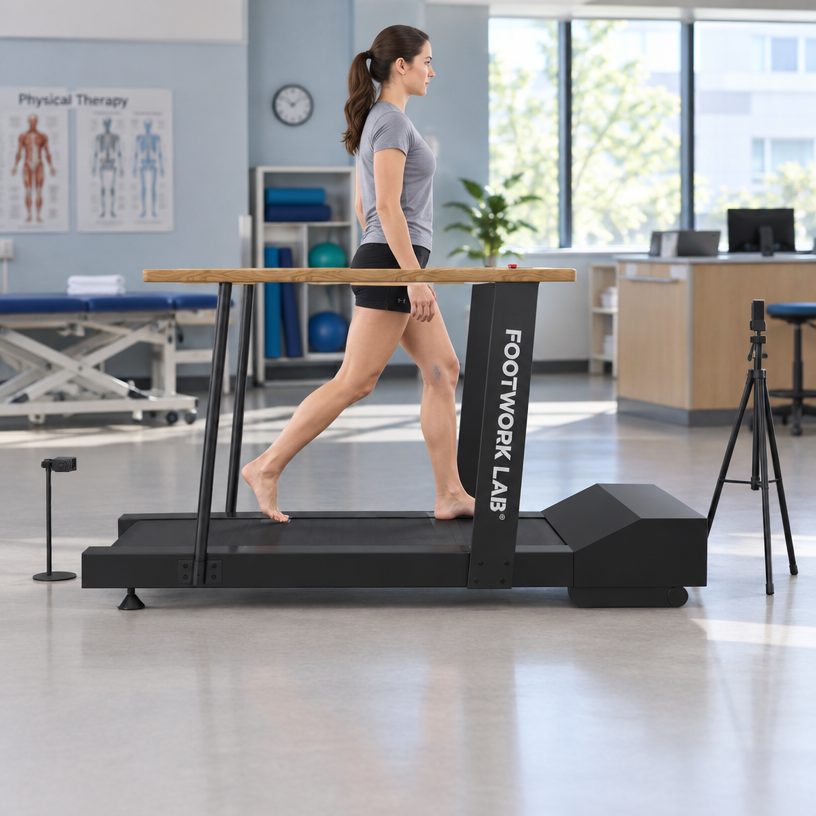
The record a gait session leaves behind
The F5-LAB is a dynamic gait system built around a treadmill-form host, with two cameras on stands and a hub that brings the signals together. A session produces four kinds of output: the gait cycle, the movement posture, the dynamic pressure under both feet, and the paired butterfly lines that show how load travels through each step. Walk and run are separate modes, because a walking record and a running record answer different questions and should not be mixed in one comparison.
The gait cycle is the frame everything else hangs on. Contact, stance, swing, the moment both feet are down — those phases give the pressure values their meaning, because a peak that arrives early in stance and a peak that arrives late describe two different ways of walking. Without the cycle, a pressure graph is a shape; with it, the shape has a place in time.
The cameras cover what the surface cannot. Movement posture is recorded as the body carries itself over the belt: where the trunk sits, how the pelvis moves, what the knees do through the stride. Dynamic pressure covers the sole: where load concentrates, how long it stays, how the two sides compare. The butterfly lines put the two feet on one page in a form a patient can read without training, which is often the difference between a report that gets discussed and one that gets filed.
All of it is recorded value. The F5-LAB does not interpret, rank or advise; it produces numbers, traces and images, and the reading of them belongs to the professional in the room. Our reports carry a line saying the data is for reference, and we mean it as an operational instruction rather than a legal formality.
Where the programme belongs
A training programme is a clinical document. It says how often, how hard, for how long, with what progression and with what exit criterion, and every one of those decisions depends on a person rather than a product. Suppliers who offer a protocol with the machine are usually offering a template: a sensible starting point that a clinic then adapts. There is nothing wrong with a template, provided nobody mistakes it for a prescription.
The division of labour is therefore straightforward. The device records; the clinic programmes; the record is what the programme is checked against. When those three roles blur, two failures follow. A clinic that lets the device set the programme ends up running the same session for every patient because the machine only knows one. A clinic that keeps no record ends up unable to tell whether the programme is working, and patients notice that before the staff do.
This is also where a supplier can be useful without overstepping. We can explain what the record contains, how to run a session so the next one is comparable, and what a report looks like when it is exported. We cannot say which patient should be on which programme, and we decline when asked. A supplier who answers that question is guessing about someone he has never met.
The rehab team’s side of the line includes the parts that never appear in a brochure: who books the follow-up, who explains the record to the patient, what happens when a patient misses three weeks, and how the clinic records a change of programme. Those are operational decisions, and they decide whether the equipment earns its place far more than the specification does.
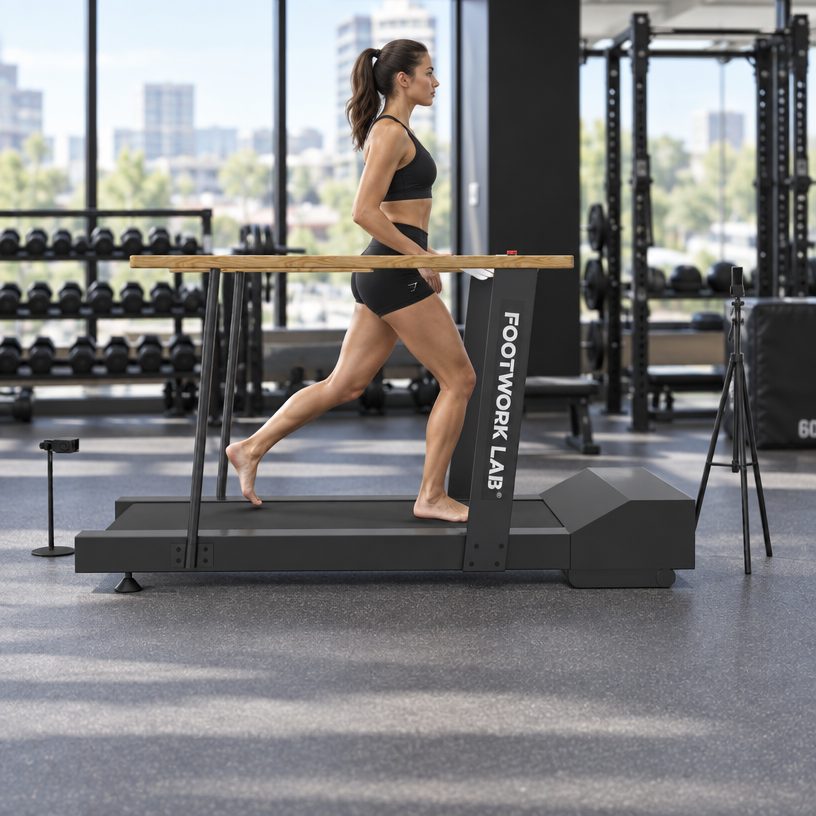
Why a baseline has to survive the retest
A baseline is only a baseline if the conditions around it can be repeated. That means a written routine: how long the warm-up lasts, which mode is used, what the patient is told, which foot is recorded first, and where the machine stands. Change any of those between visits and the difference in the record may be a difference in the room rather than in the patient — and nobody will be able to tell which.
The trap is that routines erode quietly. A new member of staff shortens the warm-up because the clinic is running late. Someone switches to run mode because the patient prefers it. The belt setting drifts. Six months later the clinic has a folder of records that look comparable and are not, and the review meeting becomes an argument about method rather than a discussion about progress.
The fix costs nothing: write the routine on one page, keep it beside the machine, and put the date and the operator on every record. Then a comparison is between two documents that state their own conditions. A clinic that does this can hand a record to a colleague, to a referring doctor or to the patient, and the document explains itself without a phone call.
For a running record the discipline matters more, not less, because running introduces variables a clinic does not control. Which shoes, which surface, how much sleep, how hard the previous day was. The record cannot capture those, so the protocol has to ask about them and note the answers. It is unglamorous work, and it is the difference between a data set and a pile of pictures.
The test of a good routine is whether a colleague can reproduce a session from the page alone. Hand the sheet to someone who has never run the machine and watch what they ask. If the questions are about the warm-up and the instruction, the page is nearly complete. If the questions are about which button starts the capture, the page was written for the person who already knows, which is the same as not writing it at all.
What we will not claim about training
We will not claim that the equipment improves anyone’s gait. It records; the programme and the professional do the rest, and any supplier who collapses those two into a product claim is describing an outcome he cannot control. The honest sentence is narrower and more useful: a session produces a record that makes change visible, which is what a programme needs in order to be adjusted.
We will not describe our system as a diagnostic tool, and we will not put a verdict on a report. Every item — gait cycle phase, movement posture, dynamic pressure, the butterfly traces — is a measurement. Whether a pattern matters, and what should be done about it, is a clinical judgement made by someone with a qualification and a patient in front of them.
We will not publish prices, and we will not promise exclusivity by region. A quotation depends on configuration, destination and the service attached to it; territorial protection is a distribution agreement rather than an order. We also will not sell a machine into a clinic that has no plan for who runs the session, because that machine becomes a covered object in a corner and a bad reference in a small market.
What we will state is structure. One unit is the minimum order, machines accept ODM, every unit is tested at the plant for seven days before dispatch, and the warranty runs twelve months against non-human damage with free parts. Support runs through a dedicated WhatsApp group with engineers reachable directly, remote assistance during a live session, and over-the-air updates where the unit is connected.
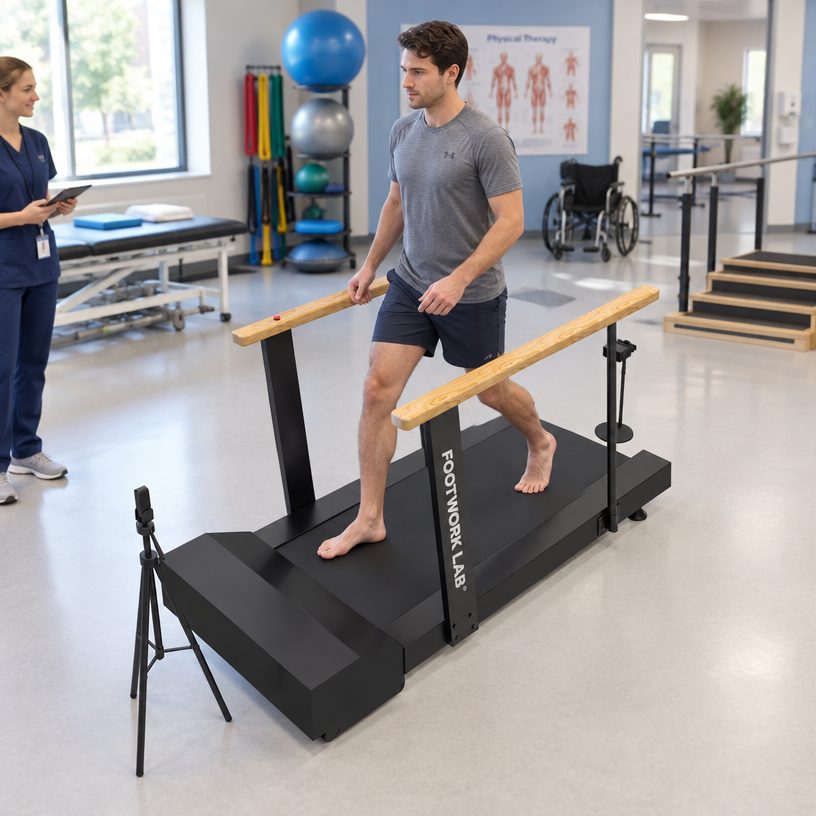
Frequently asked questions
Is a gait training device the same as a gait analysis system?
Not usually. The phrase in a search engine mostly returns training equipment, which is the bench. A record is what makes training reviewable, and the two are bought for different reasons even when one supplier sells both.
What does an F5-LAB session record?
The gait cycle, movement posture, dynamic pressure under both feet, and the paired butterfly traces. Walking and running are separate modes, and a record from one is not compared with a record from the other.
Does the system recommend a training programme?
No. A programme is a clinical document that depends on the patient, the stage of rehabilitation and the judgement of the professional. The system produces the record a programme is checked against.
How do I keep two sessions comparable?
Write the routine down: warm-up length, mode, instruction to the patient, which foot is recorded first, where the machine stands. Put the date and the operator on every record so a comparison states its own conditions.
Can the record be shared with a referring clinician?
Yes. Reports can be exported and printed, which matters in rehabilitation, where the record often travels to a doctor, a coach or an insurer rather than staying in the room where it was made.
What are the order and warranty terms?
One unit is the minimum order, machines accept ODM, each unit is tested at the plant for seven days before dispatch, and the warranty covers twelve months against non-human damage with free parts.
Who reads the report?
A qualified professional. Every value is a recording, and the interpretation of gait phases, posture and pressure belongs to clinical judgement rather than to the equipment or its supplier.
What we would do next
Draw the two columns before the next supplier call: what the equipment records, and what the clinic does with it. If the second column is empty, the purchase is premature, and it is cheaper to hear that now. Send the list through the contact page and we will answer only the first column, because the second is not ours to fill.
The F5-LAB platform page lists the recorded items and the two modes in the equipment’s own terms. What a gait analysis system is made of takes the hardware apart, and gait training protocols on the F5-LAB describes how a clinic typically arranges the session around the record. Foot rehabilitation programmes need a baseline makes the same argument from the clinical side.
This article is intended for professional and educational reference. It is not medical advice. Foot assessment equipment produces measurements and images; clinical interpretation and any decision about care remain the responsibility of a qualified professional. Certification scope is limited to the documentation we hold: European Union certification and ISO quality system certification.