
A buyer at the exhibition stand types one phrase into the enquiry form — orthotic machine foot scanner — and asks for a quotation on the spot. The phrase sounds like a single product, and the enquiry arrives as a single line on a business card. It is not a single product. Read slowly, it names two purchases that happen to live inside one service: a scanner that records what the foot is doing, and a machine — in practice a bench with a heating box and forming pillows — that turns a record or a mould into a finished insole. The two halves are specified differently, demonstrated differently, accepted differently, and in plenty of workshops they are bought from different suppliers months apart. A quotation that quietly covers only one of the two is the most common disappointment we meet in the exhibition hall, and it is avoidable with a checklist. This article takes the phrase apart: what the scanner half has to demonstrate before it is accepted, what the machine half has to demonstrate, what changes when both halves travel inside one portable case, and which order terms belong on the page before any money moves. The equipment in our own photographs is a pressure and posture customisation system that carries both halves in one case — but the checklist works whichever supplier you finally sign with.
One phrase, two purchase orders
The phrase survives in inboxes because buyers assemble it from need rather than from a catalogue. Somebody plans to open a service — a shoe shop that fits, a clinic room that assesses, a studio that builds insoles on site — and the whole plan compresses into the words they can think of: a machine that makes orthotics, a scanner for feet, welded into one string. Search engines accept the string without complaint, listings answer it with whatever the seller manufactures, and the quotation that comes back may describe one half of the purchase, both halves, or something else entirely.
Split at the obvious joint, the phrase divides into a measurement purchase and a production purchase. The scanner half is judged by records: what it captures, how the report reads, whether two sessions taken minutes apart can be set beside each other. The machine half is judged by output: whether the bench forms an insole that matches the mould, whether the tenth pair of the afternoon matches the first, whether edges and contour and bonding come out consistent. A buyer who applies the measurement test to the machine, or the production test to the scanner, has accepted something without examining it.
When the halves are bought separately, a second risk appears at the joint between them. The scanner produces a report; the bench expects parameters — a mould, a set of grades, a contour decision. If the two suppliers have never spoken, the fitter becomes the human interface, transcribing one document into another system by hand. That is workable, and many workshops run exactly that way, but it should be a known arrangement rather than a surprise discovered after delivery. The question worth asking either supplier is simple: does your half read the other half’s output directly, or does somebody retype it?
We build both halves and ship them in one case, and we still ask buyers to accept them separately. Test the records against records and the output against output, at the demonstration stage and again at installation. An acceptance that mixes the two — admiring the formed insole without ever checking the record it came from — is how a workshop ends up with a handsome bench that nobody trusts, because nobody can say what the insole was based on.
What the scanner half has to demonstrate
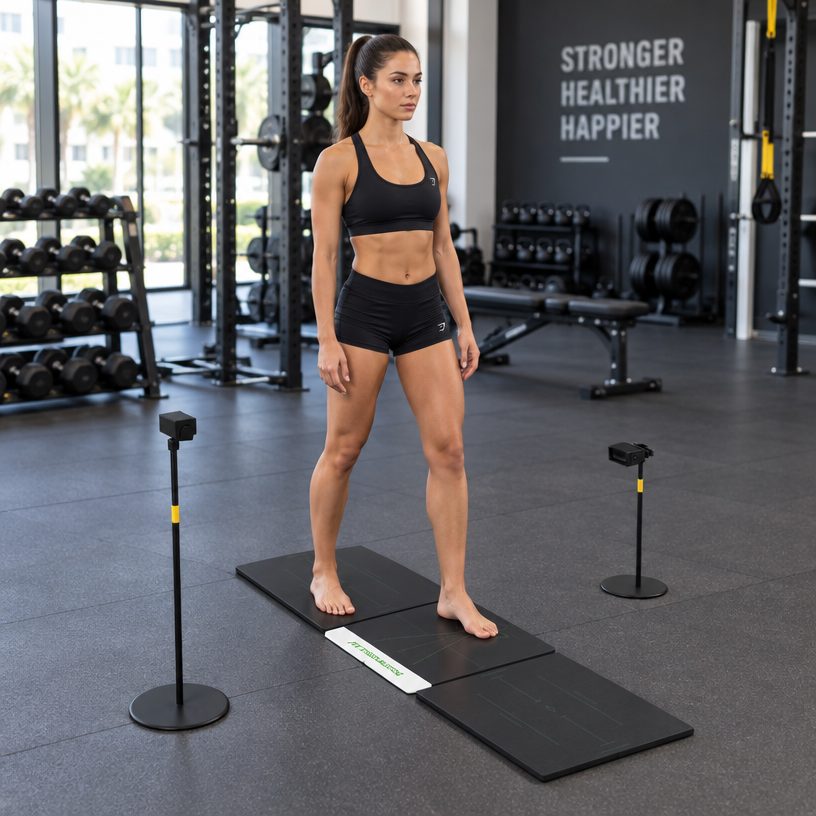
The first demonstration is record variety. A standing pose is not a gait, and a gait is not a balance task, so the scanner half should show all three: a static record taken standing still, a dynamic record taken walking across the sensing surface, and a balance record taken under shifting load. Each answers a different question, and a service that will eventually fit insoles for walkers, runners and standers needs all three rather than one flattering pose. Ask the supplier to switch between the record types in front of you and to show the report of each.
The second demonstration is the report itself, printed or on screen, not described. The items worth finding on it: pressure distribution under the foot, contact area, peak and mean pressure, the travel of the centre of pressure, the proportions of the contact and flat phases, the foot axis angle, foot print length and width, and alignment images of the lower limbs from the cameras. A report that carries the pressure picture beside the alignment picture lets the professional read both in one document — which is the whole point of buying the record and the images together.
The third demonstration is repeatability, and it is the one sellers least enjoy. Have the same person recorded twice, minutes apart, under the same instructions, and put the two reports side by side. They will never be identical — a living foot is not a calibration block — but the shapes should agree, the arch type should agree, the phase proportions should sit in the same range. A scanner that cannot pass this test produces records that cannot support a retest later, and the retest is what turns a one-off sale into a service with follow-up visits.
One boundary belongs in the same conversation, stated plainly. The scanner records; it does not judge. Nothing on the report tells the fitter what to build or the patient what to expect — reading the record and deciding what it means for a named person belongs to the qualified professional who owns the case. Buyers who arrived searching with imaging adjectives should also ask directly what the report contains: what our systems capture is pressure and alignment through a sensing surface and cameras, not a surface model of the foot, and we would rather say that in the first conversation than after the crate is opened.
What the machine half has to demonstrate
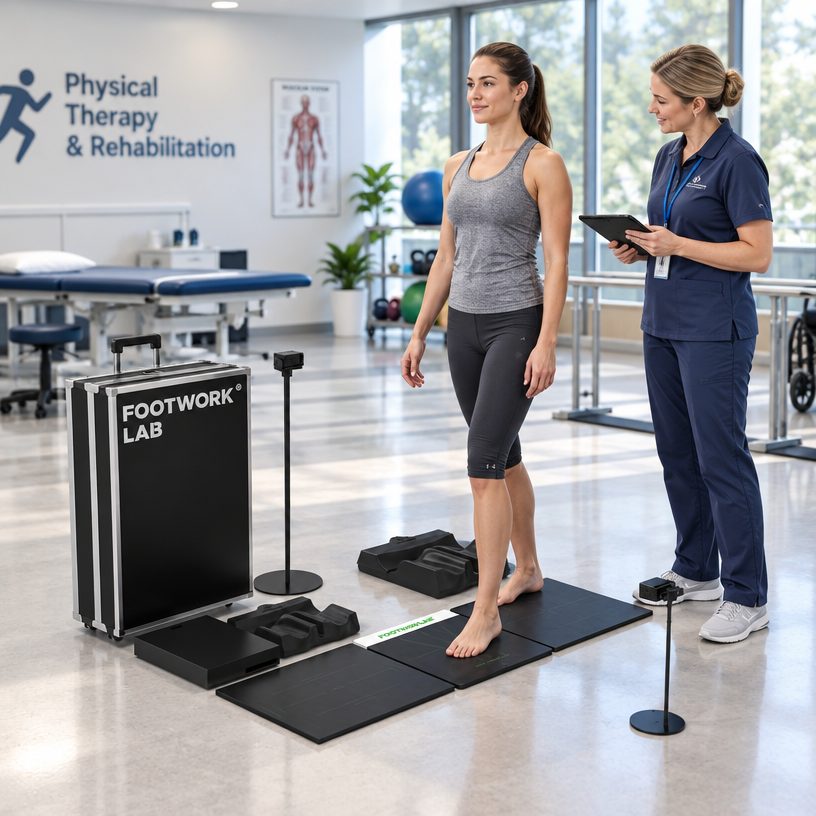
The bench half of the phrase is a small production line compressed into furniture: a heating box that softens the blank, forming pillows in adult and child sizes that press the heated material into contour, and the auxiliary pieces that hold, trim and finish. On our own configuration these sit beside the record station in the same case, but the acceptance questions are the same whether the bench arrives alone or as a set. What softens, what presses, what holds the shape while it cools, and what the fitter still does by hand.
The demonstration that matters is consistency, and it is cheap to demand. Ask the operator to form several pairs from the same parameters in front of you, then compare them: contour at the arch, edge line at the forefoot, the bond between layers, the surface finish. A bench that produces one beautiful pair and a second that drifts is a bench that will fill the workshop with remakes. Behind our own line the same discipline is enforced at plant scale, where the production capacity runs at roughly five hundred to a thousand pairs a day and consistency is checked batch by batch rather than pair by pair.
The second thing to establish is what the machine does not decide. The bench executes parameters; it does not choose them. Which support grade, how much cushioning volume, how deep the arch sits — those are fitting decisions made by the fitter from the record and the shoe check, and the machine is the instrument that carries the decision into material. A seller who demonstrates the bench as if it autonomously produces the right insole for any foot is skipping the step the whole service depends on, and the remakes will eventually land on your counter, not theirs.
The third is consumables and wear. The heating element, the forming pillows, the cutting accessories all age with use, so the honest questions are about supply: how blanks and pillows are reordered, what a worn pillow does to output, how quickly parts arrive. A bench is a relationship with a consumables pipeline as much as it is a machine, and the quotation that ignores the pipeline is the one that looks cheapest in month one and costs the most in month six.
What changes when both halves travel in one case
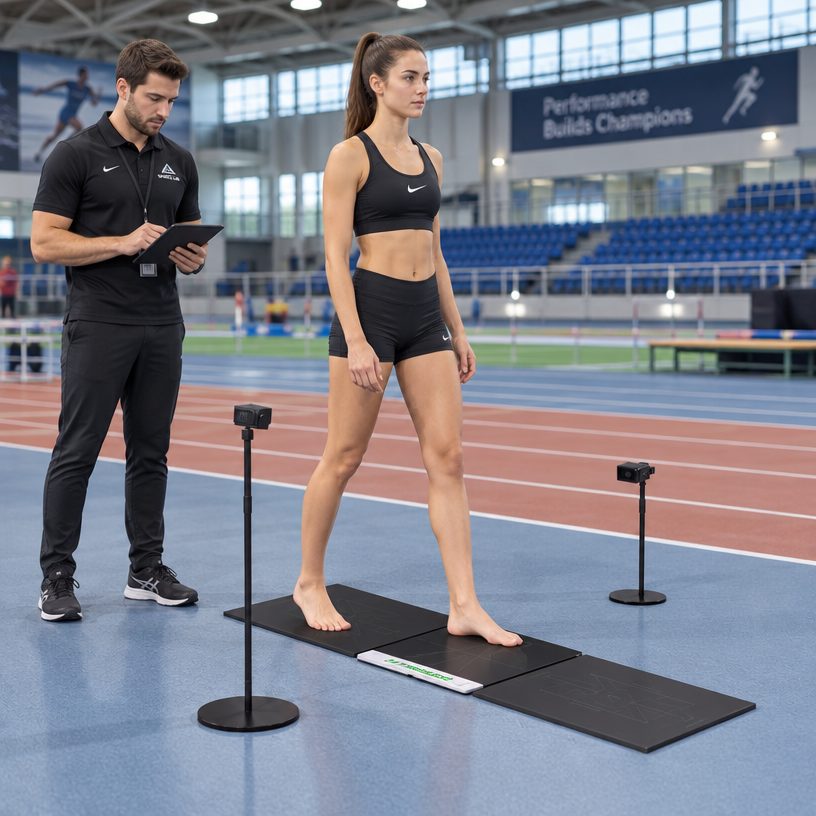
Some services do not sit still. A shoe shop that wants the assessment at the counter, a clinic that screens in a borrowed room, a sports venue that fits during an event weekend — for these the two halves need to travel, and travelling is what our own configuration was designed around. The pressure and posture customisation system packs static, dynamic and balance recording, the lower-limb and whole-body biomechanical line images, and the on-site customisation module — heating box, forming pillows in adult and child sizes, auxiliary pieces — into a portable case that two people can carry and one person can set up.
The honest trade-offs of portable should be said out loud, because a case does not shrink the checklist. The record still needs session discipline: the same instructions, the same floor spot, the same camera marks, or the retest comparison dies exactly as it would in a fixed room. The bench still needs power, ventilation and a clean surface, and the forming result still depends on the fitter’s judgement. What the case removes is the wall — the service goes to the foot instead of waiting for the foot to come to the service — and nothing else about the acceptance changes.
What the combination buys, for the buyers who need it, is the single appointment. Record the standing, walking and balance; let the professional read the report with the customer looking on; form the mould on site; fit into the customer’s actual shoes before they leave. In a fixed-room layout the same flow usually splits across two visits, and the second visit is where no-shows live. For a shop or a venue, one appointment that ends with a fitted pair is not a luxury — it is the difference between a service and a booking.
Even so, the combination is not for everybody, and we say so when the caseload does not need it. A workshop that only ever fits by appointment in one room wastes the portability; a buyer who only wants the record and outsources forming to a plant has no use for the bench half at all. The phrase — orthotic machine foot scanner — describes a service where both halves sit in one room, in one session, under one fitter. If your plan looks like that, the combined case deserves the demonstration; if it does not, buy the half you need and keep the quotation honest.
The questions to put to each half before signing
For the scanner half, four questions carry most of the weight. Which record types does it capture, and can you show me switching between them. May I see a full sample report, printed, not a photograph of a screen. Can you record the same person twice and set the reports side by side. And who installs, who trains, and how long before my staff run sessions without hand-holding. Suppliers who answer these with documents rather than adjectives are the ones who have shipped before.
For the machine half, the questions move to output and supply. What parameters does the fitter set, and what does the bench decide on its own. Can you form several pairs from one setting while I watch, and may I compare them. How are blanks, pillows and accessories reordered, and what is the lead time on wear parts. And what does the bench expect as input — the scanner’s report directly, a mould made by hand, or both — because that answer defines how much retyping your staff will do for years.
The joint questions are the ones buyers forget until the crates arrive. Does the bench read the scanner’s output directly or through the fitter’s hands. When the record and the fitter’s judgement disagree, whose call is it — and the only acceptable answer is the fitter’s, because the record is an input to judgement, never a replacement for it. Who is responsible when the halves misalign: one supplier or two. Buying both halves from one factory simplifies that accountability, which is a fair commercial argument, but only after each half has passed its own test on its own merits.
Then the order terms, which on our side are fixed and published without bargaining theatre. Machines start from one unit and accept ODM; every unit is tested at the plant for seven days before dispatch; the warranty runs twelve months against non-human damage with free parts. After-sales runs through a dedicated WhatsApp group with engineers reachable directly, remote assistance when a session misbehaves, and over-the-air updates where the unit is connected. These terms are the floor of the conversation, not its ceiling — everything above the floor is configuration.
Order terms, insoles and the honesty page
Most services that buy both halves also order insoles, so the insole terms belong on the same page. The minimum order runs at two hundred pairs, mixed across styles and sizes, which is what lets a small shop stock a shelf instead of a warehouse; samples ship within three days, and a sample pair in hand answers questions that no listing photograph can. At the plant the capacity sits at roughly five hundred to a thousand pairs a day, so a restock is a production scheduling question rather than a hope.
Logistics close the practical page, and we quote them in plain words. Express delivery runs six to seven working days, air freight ten to twelve days, and sea freight thirty to thirty-five days depending on the destination — enough spread that the choice of route is a planning decision, not a detail. A shop that wants to open on a date should work backwards from the sea option, because the savings only exist if the calendar can absorb the weeks.
Three things we do not do, stated where buyers can hold us to them. We do not publish prices, because a quotation follows the configuration and the destination and a number pulled from the air helps nobody; we do not promise exclusive territories, because a service built on foot records does not respect a map; and we do not write the clinical judgement — the equipment produces measurements and images, and reading them for a named person belongs to the qualified professional. A buyer who needs the machine to decide what a customer’s foot needs is not shopping for equipment at all, and we would rather say that now than refund later.
The phrase will keep returning two quotations masquerading as one, because the phrase compresses two purchases by design. The buyers who come out ahead are the ones who separate the acceptances: records judged as records, output judged as output, the joint tested in front of them, the terms read as written. That discipline costs an afternoon at the demonstration stage and saves a season of remakes afterwards — which is, in the end, the whole return on reading a search phrase slowly.
Frequently asked questions
Does the phrase orthotic machine foot scanner name one product or two?
Two, joined by one service: a scanner that records the foot, and a bench that forms an insole from a record or mould. They are specified, demonstrated and accepted separately, even when both halves ship in the same case.
What should the scanner half demonstrate before purchase?
All three record types — static, dynamic and balance — a full sample report with pressure items beside alignment images, and two sessions of the same person taken minutes apart and compared side by side for repeatability.
What should the machine half demonstrate?
Consistency above all: several pairs formed from the same parameters, compared for contour, edges and bonding. Also what parameters the fitter sets, what the bench decides alone, and how blanks and wear parts are reordered.
Can one portable case really carry both halves?
Yes. Our pressure and posture customisation system packs static, dynamic and balance recording, lower-limb and whole-body alignment capture, and the on-site customisation module — heating box, forming pillows, accessories — into a portable case. The portability removes the wall, not the acceptance checklist.
Does the equipment decide what insole a customer needs?
No. The scanner records, the bench executes, and the fitting decision belongs to the qualified professional reading the record and checking the shoe. No report tells a fitter what to build for a named person.
What are the minimum order and delivery terms?
Machines start from one unit and accept ODM, with a seven-day plant test before dispatch and a twelve-month warranty against non-human damage with free parts. Insoles start from two hundred pairs, mixed styles and sizes, with samples shipped within three days.
Do you publish prices?
No. A quotation follows the configuration and the destination, so a number quoted in the abstract would mislead. Ask through the contact page with the two halves of your plan described, and the reply carries the terms in full.
What we would do next
Send the phrase back to us with its context — which room, which caseload, who reads the records, who forms the insoles — through the contact page. We will answer which half you actually need first, and say plainly if the combined case is more case than your plan requires. The FMP system page sets out the portable configuration in the equipment’s own terms: the record types, the alignment capture and the on-site customisation module, item by item.
Three articles deepen the halves separately. A foot pressure plate that travels covers what portability changes on the record side, a fit insole machine still needs a fitter makes the case for the human half of the bench, and an orthotic machine earns its place walks through when the machine half justifies itself at all.
This article is intended for professional and educational reference. It is not medical advice. Foot assessment equipment produces measurements and images; clinical interpretation and any decision about care remain the responsibility of a qualified professional. Certification scope is limited to the documentation we hold: European Union certification and ISO quality system certification.